Why Classical Art Looks Perfect: The Greek Beauty Code
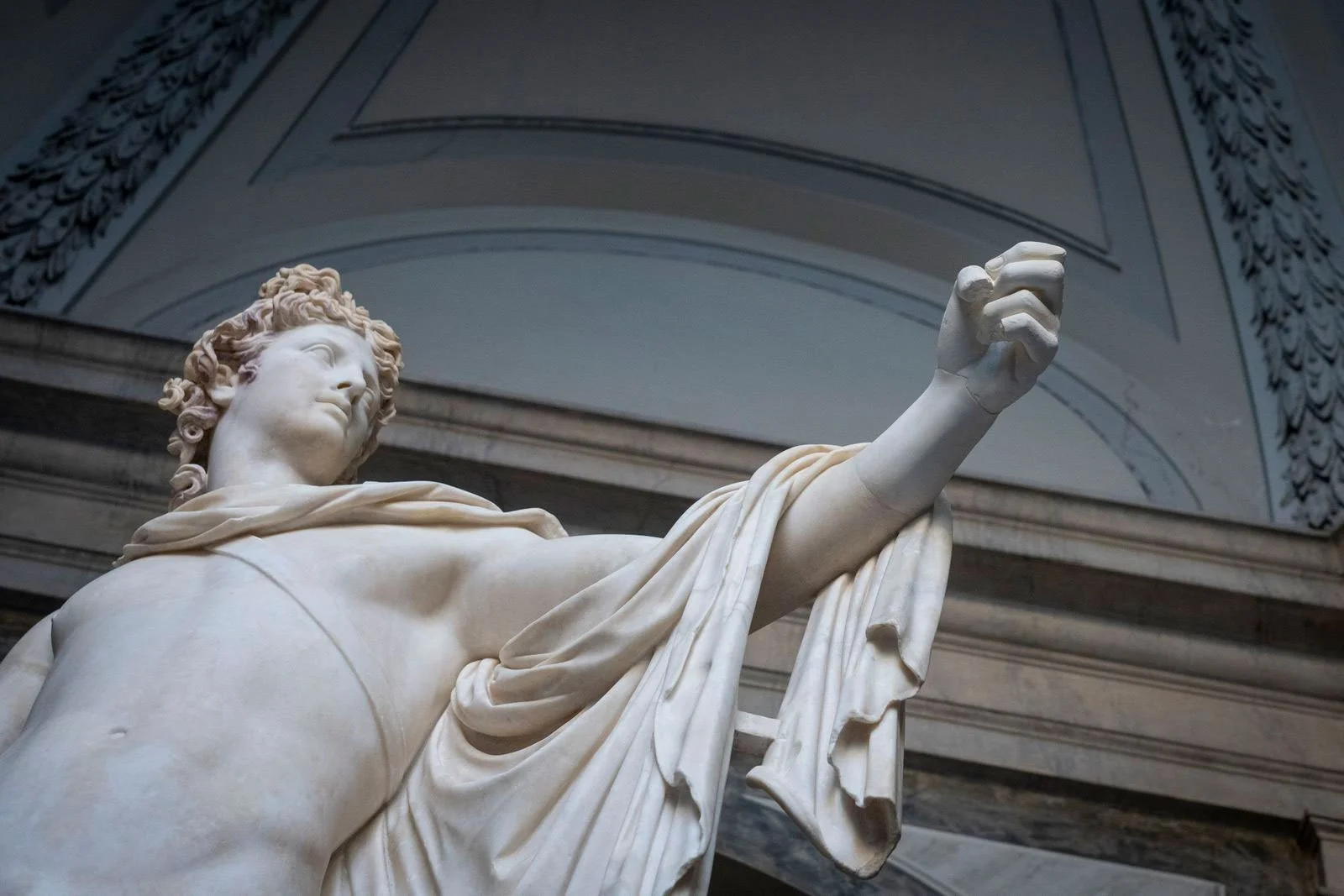
The extended arm and calm, idealized body are classic “Apollo cues” in Greco-Roman sculpture. Even from this angle, you can feel how drapery is used like a visual wind—adding motion to a still pose.
Have you ever looked at a Greek statue and felt something like, “This is… weirdly flawless”? Not in a glossy, Instagram way. More like it has an inner calm. The body makes sense. The pose feels inevitable. Even the silence feels designed.
That feeling is exactly the point. Classical art wasn’t trying to copy reality like a camera. It was trying to improve reality with a set of visual rules: proportion systems, idealized anatomy, controlled movement, and a kind of balance that reads as “perfect” even if we can’t explain why.
In this pillar guide, we’re going to decode that Greek beauty code together. We’ll follow it from the era that shaped it, through the tools that built it, all the way to the legacy that made it feel like the default definition of beauty.
Classical art looks perfect because it aims for clarity, not realism
It looks “true” because it chooses what to keep, and what to edit.
When we say classical sculpture, we often mean marble bodies that feel alive and stable at the same time. But the secret is not that Greek artists suddenly discovered realism. The secret is idealization, making the subject better than everyday life. Greek artists studied real bodies, then refined them into an image of harmony.
You can feel that approach even in small details. A chest is simplified into clean planes so light travels smoothly. A knee is shaped so the leg reads clearly from across a sanctuary. Muscles become a pattern of believable strength, not a messy record of one individual’s body. The goal is a body you can understand instantly.
This is why Classical art can feel strangely modern. It’s designed for the human eye and brain. Our brains love patterns, balance, and coherence. When the parts fit, we relax. When nothing looks accidental, we trust what we’re seeing.
The best way to notice the “edited reality” effect is to keep the bigger timeline in view. Classical art is one point in a long story, and the overview in Ancient Greek art helps us see what changes, and what stays consistent. Once we do that, Classical “perfection” stops feeling like magic. It starts feeling like a visual strategy.
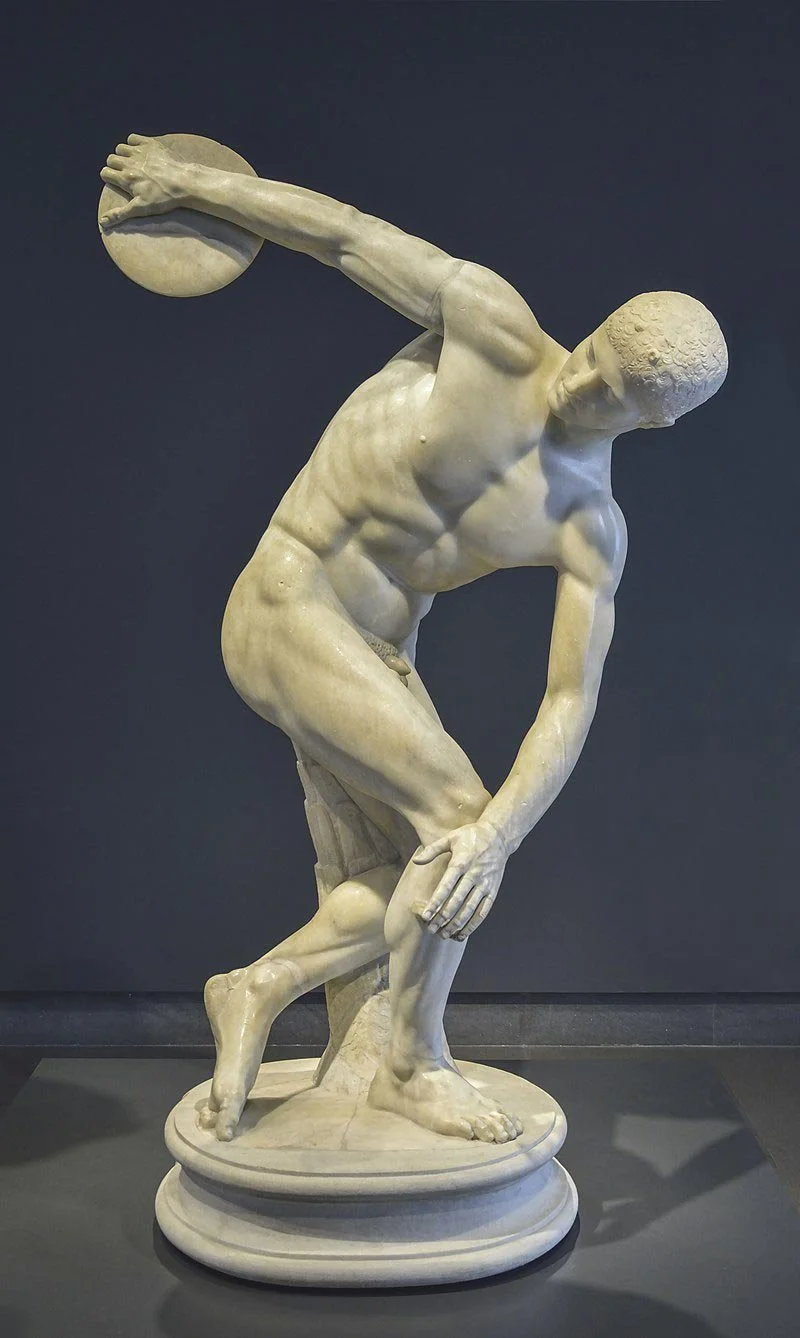
This is the “frozen moment” trick: the body coils like a spring, balancing tension and control right before release. It’s a great reference for spotting Classical Greek interest in athletic movement and proportion.
The Classical Period wasn’t just a date range, it was a new goal
It wasn’t “better art,” it was art with a new job.
The shorthand label the Classical Period can sound like a museum category, but it’s really a shift in intention. In many Greek city-states, art becomes tightly tied to public identity, civic pride, and the image of order. Statues and temples are not private decoration. They’re public statements.
That matters because it changes what a “good” artwork is. If your job is to represent a community’s values, you don’t want chaos. You want stability. You want the figure to feel disciplined, even in motion. That’s one reason Classical faces look calm, and bodies look composed: they’re doing cultural work.
This is also where the polis, a self-governing city-state, becomes a key context. The way Greek communities organized themselves shaped what they built and celebrated. When we talk about “ideal beauty,” we’re also talking about the ideals a community wanted to see in public. The background in Ancient Greek city-states makes that link between politics, identity, and public art feel much more concrete.
And when the city wants to project power and legitimacy, architecture becomes a stage. The meaning layered into monuments like the Parthenon is a perfect example of how art can be both beautiful and strategic. You can feel that logic in Parthenon meaning, where design and message are basically fused.
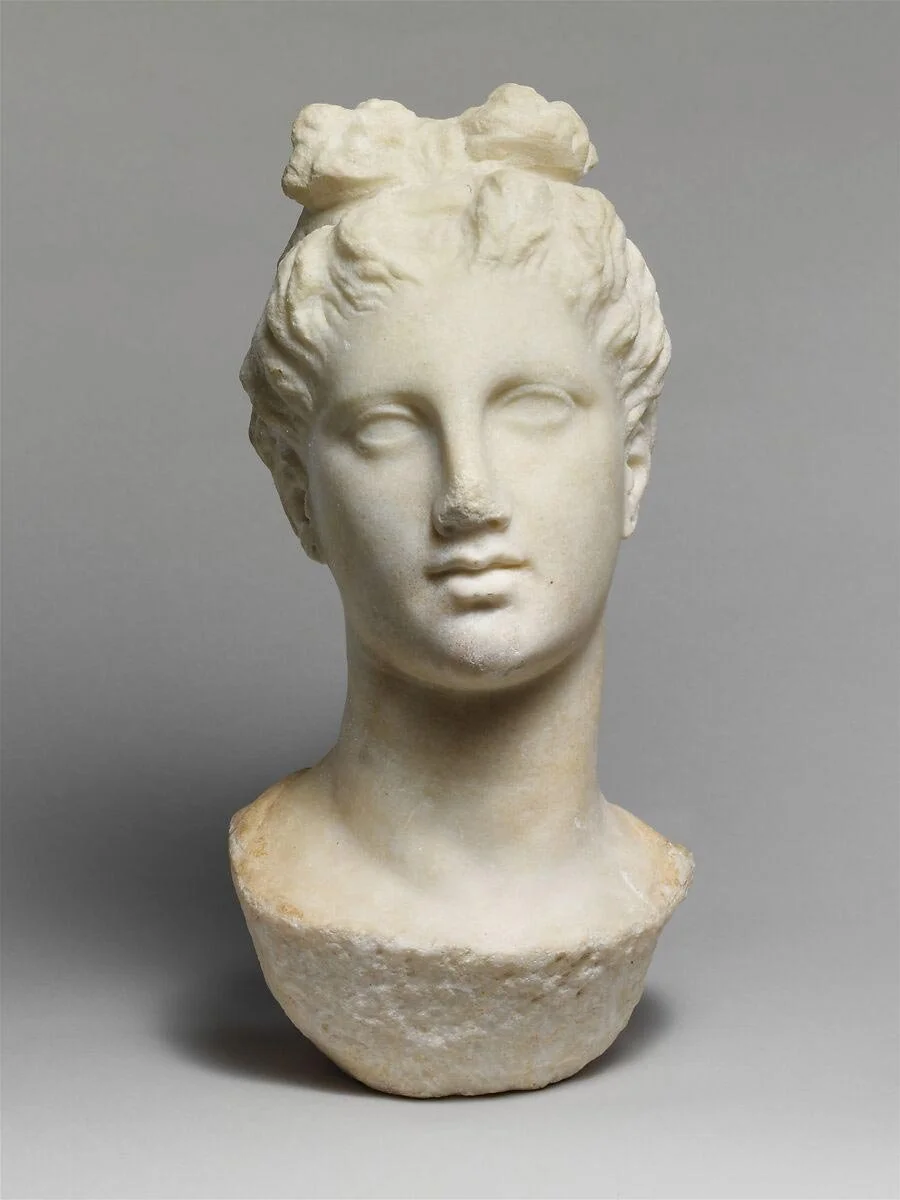
Heads like this teach us to look for small clues—hair styling, idealized features, and the calm expression that often signals “Classical taste.” Even without the full statue, the face can carry the period’s mood.
Proportion is the Greek beauty code’s operating system
It feels harmonious because the parts are designed to agree.
One of the deepest Classical instincts is that beauty can be organized. Greek writers used symmetria, measured harmony between parts. It’s not “everything is equal.” It’s “everything relates.”
That’s why the canon of proportions matters so much. A canon is a guiding rule set. In art, it means the body is built on ratios, relationships, and repeatable balance. Even if we don’t know the exact numbers a sculptor used, we can see the aim: head, torso, limbs, and stance all feel like they belong to one system.
When proportion works, the figure becomes legible from a distance. The viewer’s eye moves smoothly. Nothing pulls attention too aggressively. You don’t get stuck on one odd detail. You get a whole that feels complete.
If you want to picture how radical that was, imagine the Greek body becoming a kind of visual “grammar,” a rule-based language that artists could teach, repeat, and refine. That’s exactly why Polykleitos becomes such a big deal. His influence is easier to understand when you read Polykleitos’ canon alongside the broader concept of proportion, because it shows how “beauty” becomes something you can build, not just something you hope happens.
And once we notice that “rule-based harmony” is a Greek habit, we start seeing it beyond bodies. Pattern systems do the same thing in a different medium. The visual logic behind repetition and rhythm is what makes Geometric art in Greece such a useful prelude to Classical calm.
The contrapposto pose is controlled asymmetry, and that’s why it feels alive
It looks natural because it breaks symmetry without losing balance.
Here’s the moment where Greek statues stop standing like signs and start standing like people: the contrapposto pose. Contrapposto is weight on one leg, with hips and shoulders counter-tilting. In plain terms, it’s a body that has to solve gravity.
That tiny shift changes everything. One leg bears weight, the other relaxes. The pelvis angles. The spine responds. The shoulders adjust. Even the head feels free to turn. Suddenly the statue suggests time. Not just “this is a body,” but “this is a body doing something,” even if it’s only pausing.
What makes this more powerful is the comparison point. Earlier Archaic figures often feel front-facing and patterned, with a kind of formal stillness. That’s not “bad art.” It’s a different goal. The guide from Archaic smiles to Classical calm lets us watch that shift happen without turning it into a simplistic progress story.
If you want a concrete “before” image, the standing male type in Archaic Greek sculpture is the baseline, and the more specific lens of a kouros statue helps us see how rigid symmetry used to carry meaning. Even a deeply human piece like the Anavysos Kouros still presents the body in a formal, front-oriented way. Contrapposto is not just a new pose. It’s a new relationship between art and lived movement.
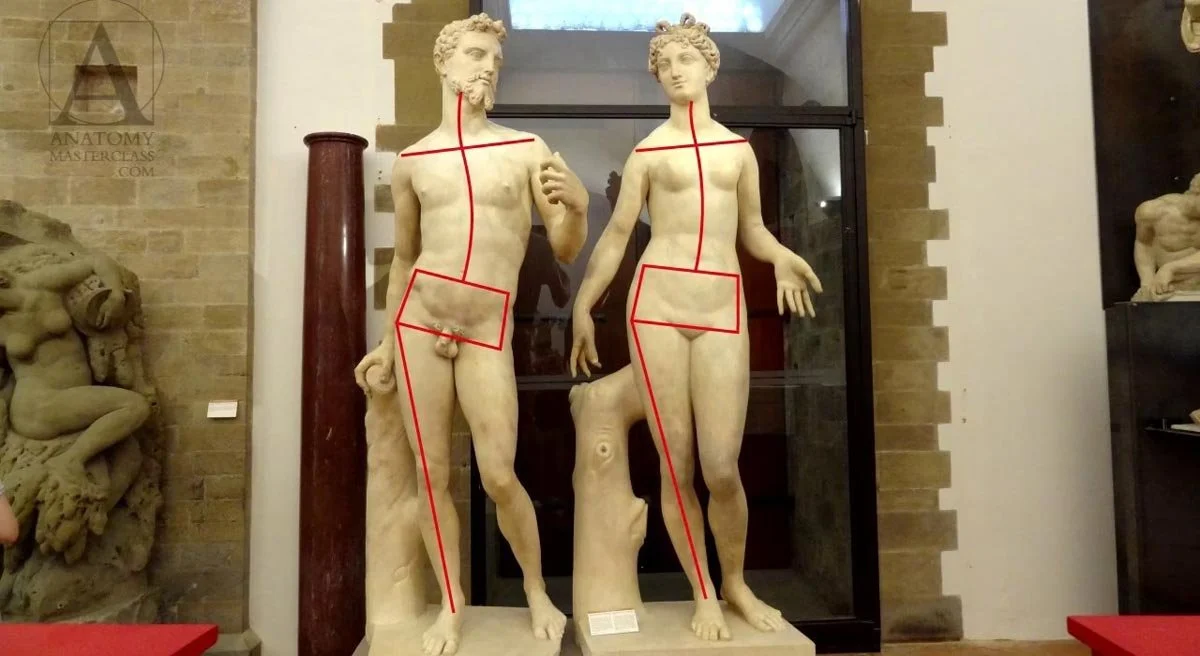
Contrapposto is basically “weight shift made visible”: one leg bears the weight, the hips tilt, and the shoulders subtly counter-tilt. Once you see those two angles, you’ll start spotting contrapposto everywhere.
The “perfect” body is edited anatomy, not a medical diagram
It feels believable because artists simplified what mattered most.
Classical bodies aren’t detailed in the way a biology textbook is detailed. They’re detailed in the way a great drawing is detailed: emphasizing what makes the whole read clearly. That’s why a Classical Greek statue can look both real and unreal at once. The anatomy is convincing, but it’s also tuned.
One reason Polykleitos becomes a key figure is that his approach turns the ideal body into a replicable model. That’s why Polykleitos Doryphoros matters beyond being a famous statue. It’s not just a beautiful athlete. It’s a demonstration of rules: proportion, balanced tension, and a stance that implies motion without turning chaotic.
Classical sculptors also shaped bodies for light. Marble is basically a surface for light and shadow. So artists refined planes and transitions to make the body readable in shifting conditions, outdoors and indoors. A muscle group might be smoothed so it catches light cleanly. A hip might be subtly adjusted so the weight shift reads from below. This is another reason Classical art feels “inevitable.” It’s not only what the body is. It’s how the body behaves visually.
And anatomy is never isolated from context. A body is often paired with drapery, objects, or architectural settings that frame it. The most famous architectural frame is the Parthenon, where bodies become part of a larger visual story. The overview in How to read Parthenon sculptures as one visual story is a great reminder that Classical perfection is frequently collaborative: sculpture, architecture, and civic message working as one system.
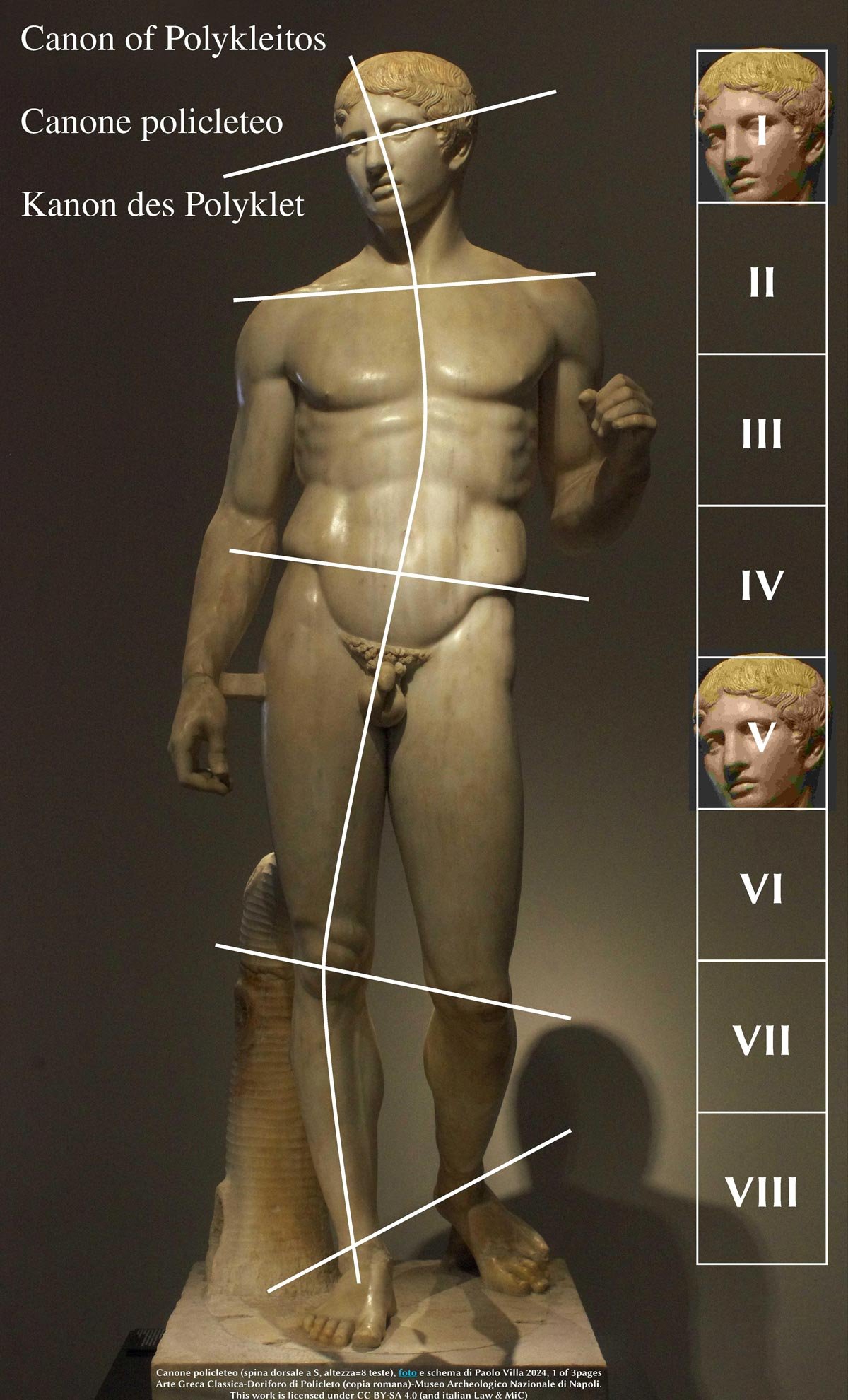
Polykleitos’ “canon” is less a magic formula and more a way of thinking: the body becomes a system of relationships you can measure and compare. Diagrams like this show how sculptors built naturalism from structure, not just observation.
Classical faces look calm because calm was the message
The expression isn’t blank, it’s a kind of moral posture.
A lot of us meet Classical art and think, “Why does everyone look so composed?” It’s easy to assume the artists couldn’t do emotion. But restraint is a choice, and it matches a culture that valued moderation and self-control.
Classical calm often reads as timeless. A dramatic expression locks a figure into one moment. A controlled face can represent an ideal across time: the disciplined citizen, the stable leader, the serene deity. That’s why Classical faces can feel less personal than later art. They’re not always portraits. They’re visual arguments.
This is where the Archaic comparison helps again. The famous Archaic smile can feel odd to modern eyes, because it shows up in serious contexts too. The explanation in the archaic smile makes that “why are they smiling?” moment feel much less random. The smile is part of a visual convention, not a literal emotion.
Then the Classical era shifts toward composure. The smile fades. The face becomes quieter. That quietness is a feature, not a bug. It lets the body and pose do the expressive work, while the face holds the tone steady.
Even when Classical art depicts gods, the calm face helps communicate authority and distance. If you want to see how artists built recognizable divine identities without relying on big emotions, the symbol language in Greek god statues shows how expression is only one tool among many.
Greek architecture uses the same beauty code, just scaled up
A temple feels perfect for the same reason a statue does.
If Classical sculpture is the beauty code in the human body, Greek architecture is the beauty code in space. The building is designed to feel stable, rhythmic, and “right,” even when it’s enormous.
A Greek temple is not primarily a congregational space. It’s a house for the god’s image, designed to be seen, approached, and circled. That’s why the exterior matters so much. The full walkthrough in Greek temples makes it easier to understand why the outside is the main visual event.
What makes a temple feel harmonious is repetition and proportion:
columns create rhythm
spacing creates visual breath
horizontal lines anchor the structure
the overall shape feels coherent from a distance
This is also where Greek “rule systems” become explicit: column orders. If you’ve ever mixed them up, types of columns is the simplest map. And the specific logic of the sturdier, more restrained look is clearest in the Doric column, while Ionic columns show how elegance and detail can still stay disciplined.
Then we get the most iconic case study: the Parthenon. A lot of its “perfection” is about optics, not raw geometry. The subtle corrections explained in optical illusions of the Parthenon are basically the architectural version of sculpting for light. And if you’re the kind of person who likes concrete numbers, dimensions of the Parthenon gives you the measurable side of the effect. Even the human story of design choices becomes clearer when we remember the architects, which is why Iktinos and Kallikrates belongs in the same conversation.
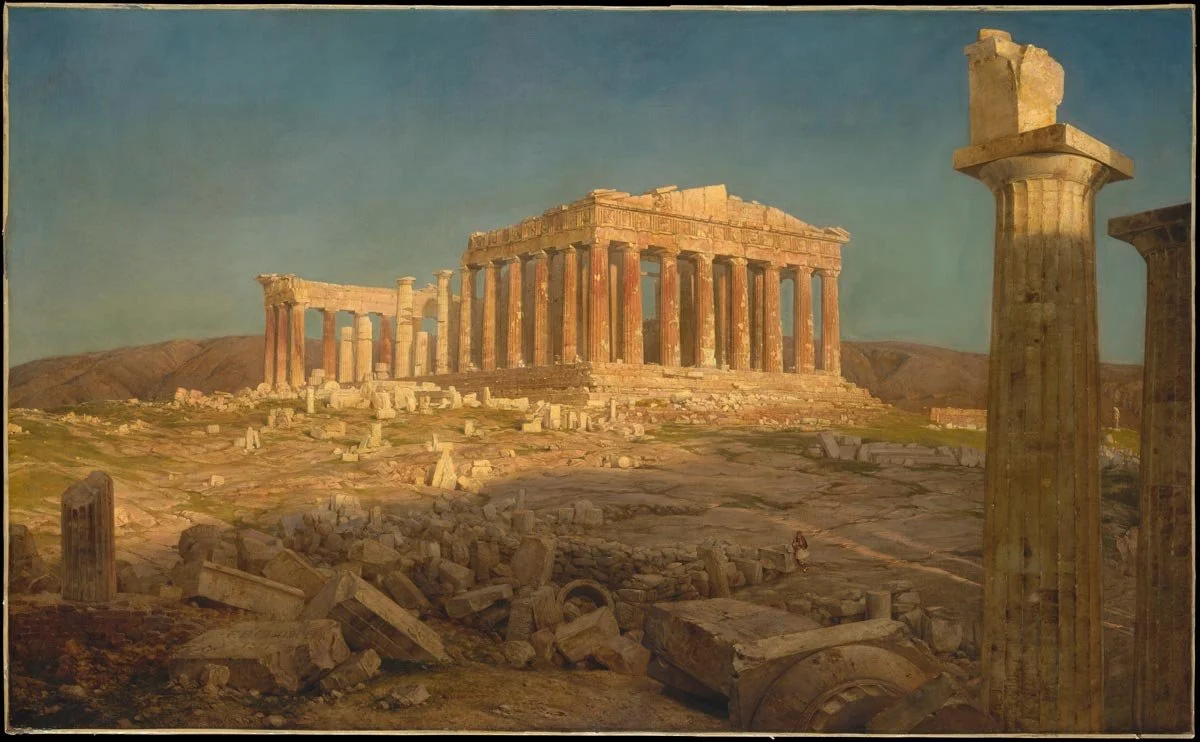
Romantic-era views of ruins don’t just document—they feel the past. The Parthenon becomes a mood: architecture as atmosphere, time, and longing, not only stone and geometry.
Classical “white marble perfection” is a modern illusion
The ancient world was colored, textured, and visually louder than we imagine.
Many of us first meet Classical art in museums: white marble, clean walls, controlled lighting. That presentation makes Classical art feel pure and minimal. But ancient experience was not minimal.
Greek sculpture and architecture often included polychromy, applied color on surfaces. In plain terms, many “white” statues were once painted. Color changes what the body feels like. It adds contrast, directs attention, and can make details pop in ways bare stone does not.
We can see that world most clearly when surviving evidence makes color hard to ignore. A perfect example is Peplos Kore, where identity, clothing, and pigment evidence pull us away from the “pure marble” fantasy. And the Parthenon context matters too, because sculpture on temples wasn’t meant to be stared at from two feet away. It was meant to read from below, at a distance, in bright daylight. The processional storytelling of the frieze is a good reminder of that viewing condition, and Parthenon frieze helps us imagine how meaning and movement were staged.
This is where the Greek beauty code gets even more interesting. It wasn’t a sterile idea of perfection. It was a practical idea of legibility. How do you make forms readable in sun, shadow, motion, and ritual? How do you make bodies and buildings feel stable in a crowded world?
Once we admit that Classical art was experienced as part of a living environment, the “perfect” feeling starts to look less like a miracle and more like a smart design response.
The Greek beauty code keeps returning because it became a cultural reference
It feels universal today because later cultures treated it like a standard.
One more layer to the “why does this look perfect?” question is historical. Greek Classical art didn’t stay in Greece. Roman collectors copied it. Renaissance artists studied it. Neoclassical architects revived it. Museums reinforced it. Over time, “Classical” became more than a period style. It became a cultural benchmark.
That’s why we still see Classical bodies as the default “ideal” in so many places. It’s partly visual, because the harmony genuinely works on our brains. But it’s also learned. We’ve been trained to see this code as authoritative.
This is where it helps to keep two thoughts in your hand at once. Classical art is an extraordinary achievement in clarity and craft. It’s also a tradition that can narrow what we think counts as beauty, strength, or dignity. The more we understand the code, the more freedom we have. We can admire it without being trapped inside it.
Even myths about “secret rules” tend to gather around Classical monuments because we want the perfection to have one single key. The reality is usually more human and more interesting. The debate in Parthenon golden ratio is a good example of how modern people sometimes project a tidy formula onto something that was built through skill, iteration, and visual judgment.
And if you ever catch yourself mixing up the Parthenon with the whole Acropolis, you’re not alone. The clarity in Parthenon vs Acropolis is actually part of the same learning journey: naming the parts so we can see what we’re looking at.
Mini-FAQ
What is classical art? Classical art is Greek art built around balance, harmony, and idealized clarity.
What is contrapposto? Contrapposto is a weight shift that makes standing feel natural.
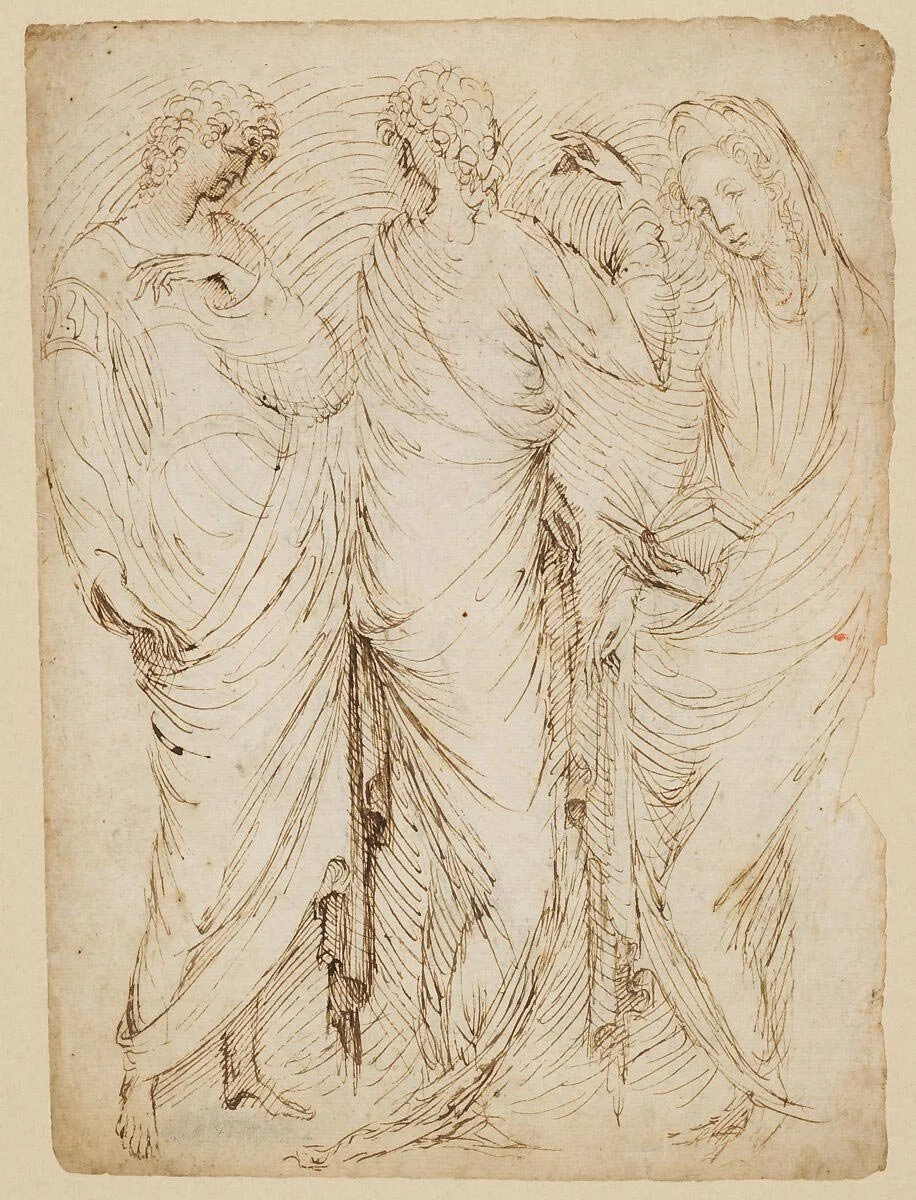
Renaissance artists practiced drapery like musicians practice scales—again and again—because folds reveal how bodies move underneath cloth. The quick looping lines here are less “finish” and more “thinking on paper.”
Conclusion
Classical art looks perfect because it’s built like a system. Proportion ties the parts together. Contrapposto makes stillness breathe. Anatomy is edited for legibility. Faces hold emotion steady. Temples scale the same logic into rhythm and optical correction. Even our modern “white marble” image is part of how Classical art was later framed and repeated.
The best part is that this perfection is learnable. We don’t have to stand in front of a Greek statue and just feel intimidated. We can read it. We can name what’s happening. And once we can name it, Classical art stops being a cold standard and becomes what it really is: a set of human choices about how beauty should feel.
Sources and Further Reading
The Metropolitan Museum of Art — “The Art of Classical Greece (ca. 480–323 B.C.)” (2008).
UNESCO World Heritage Centre — “Acropolis, Athens” (n.d.).
Stewart, Andrew — “The canon of Polykleitos: a question of evidence” (1978).
Boys-Stones, George — “Polyclitus among the Philosophers: Canons of Classical Beauty” (2009).
Sengoku-Haga, Kyoko, et al. — “Polykleitos and His Followers at Work: How the Doryphoros Was Used” (2017).
Verri, Giovanni, et al. — “The goddess’ new clothes: the carving and polychromy of the Parthenon Sculptures” (2023).

You may also like