Parthenon Frieze: How to Read the Procession Scene
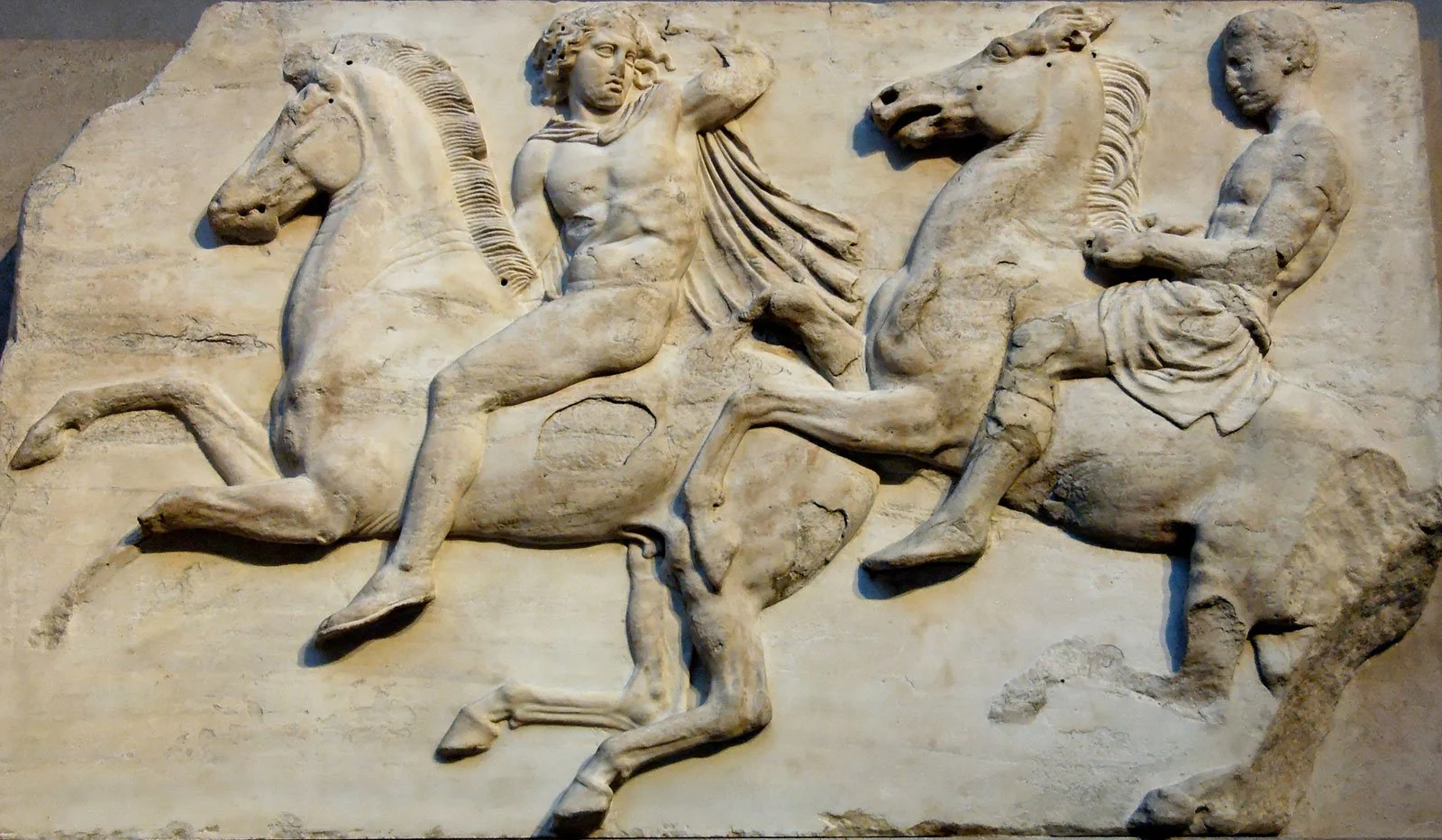
The west frieze is best known for its riders, one of the clearest signs of movement in the Parthenon procession.
The Parthenon frieze is one of those artworks that feels obvious until you try to describe it. It looks like “a crowd,” carved in marble, marching calmly around a temple. Then you realize the crowd includes gods, elite youths, musicians, animals, and a very strange quiet moment at the center that doesn’t look like a parade at all.
So this is our reading guide. We’ll treat the frieze like a designed sequence, not a decorative border. We’ll name what we’re seeing, where to start, and why the scene mattered inside the Classical context of Athens.
The frieze is a continuous image band placed where you had to work to see it
A frieze is a continuous sculpted band running along a building.
The Parthenon’s is an Ionic-style frieze carved in low relief and originally ran around the upper part of the inner building, inside the outer colonnade. In other words, it’s not at a comfortable eye level, and it isn’t on the most obvious “front” like a modern billboard. Viewers would have caught it in fragments, in shifting light, while moving.
That placement matters because it changes what the frieze can do.
If you can only see parts at once, the frieze doesn’t need to be read like a comic strip panel-by-panel. It can work more like rhythm: repeated forms, repeated movement, repeated calm, building one big impression of order. It is a carved atmosphere.
And it also means the frieze isn’t trying to compete with the Parthenon’s more dramatic exterior zones. The metopes shout mythic violence from the outside. The frieze stays controlled, almost civic in tone. That contrast is exactly what we mean by frieze vs metopes.
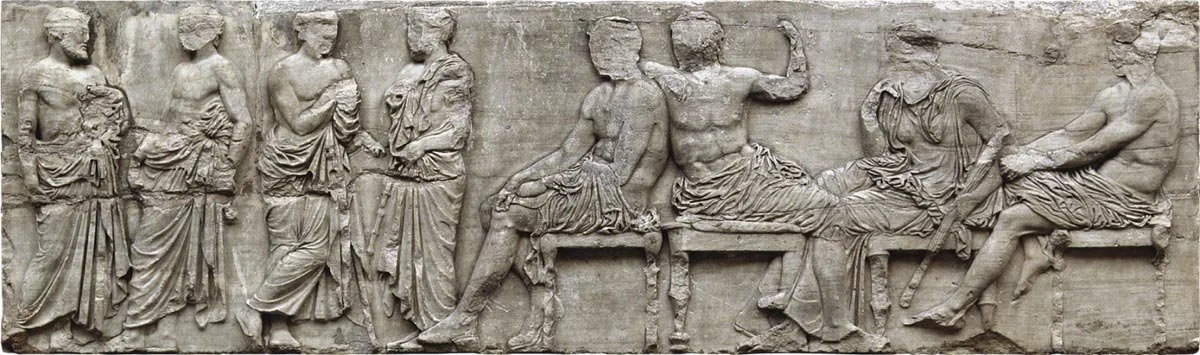
The Parthenon frieze combines processional figures with gods, linking civic ritual and divine presence.
Most scholars read it as the Panathenaic procession, but it’s not a documentary photo
The common interpretation is that the frieze depicts the Panathenaic procession, the major festival for Athena.
Definition: The Panathenaic procession is a citywide ritual parade honoring Athena.
The Greater Panathenaia was a huge civic-religious event in Athens. It involved participants across social roles, offerings, and a climax tied to the presentation of a sacred cloth (peplos) for Athena. The frieze seems to show a procession moving toward a central ritual moment.
Still, it’s worth holding one important qualifier: even if the subject is the Panathenaia, the frieze is not a literal “you are here” snapshot. It’s art. It edits. It idealizes. It compresses. Some expected features of real processions are not obviously present, and that’s one reason alternate readings exist.
The safest way to say it is: the frieze is believed to represent the Panathenaic procession, but it presents it as a perfected civic image, not a messy record of one day.
This matters because it links directly to the message behind the scene. A temple does not decorate itself by accident. The Parthenon chooses to place “Athens in procession” on the building that most loudly represents Athens.
Read the frieze like two streams that meet at the east center
If you want a practical method, use the building’s logic.
The frieze starts on the west side and splits into two moving currents, one running along the north, one along the south, both heading toward the east side. The east is the “arrival” zone.
A simplified way to track it:
West side: the procession gathers and begins, with a strong emphasis on horsemen.
North and south sides: the movement builds, mixing riders, chariots, elders, musicians, and groups associated with offerings, including animals for sacrifice.
East side: the energy slows. Gods appear seated. The procession reaches a central ritual moment.
That east-center scene is the one everyone talks about because it looks almost domestic compared to the rest: folded cloth, figures standing close, a pause rather than a rush. Many readings connect it to the presentation or handling of the peplos.
One way to keep it beginner-friendly is to read the frieze in three registers:
Motion (riders, chariots, forward rhythm)
Order (grouped participants, repeated roles, controlled pacing)
Arrival (gods, central ritual, the “meaning” moment)
If you want the full “where does this sit on the building” overview, the frieze only makes complete sense inside Parthenon sculptures overview, because the frieze is one voice in a larger sculptural argument.
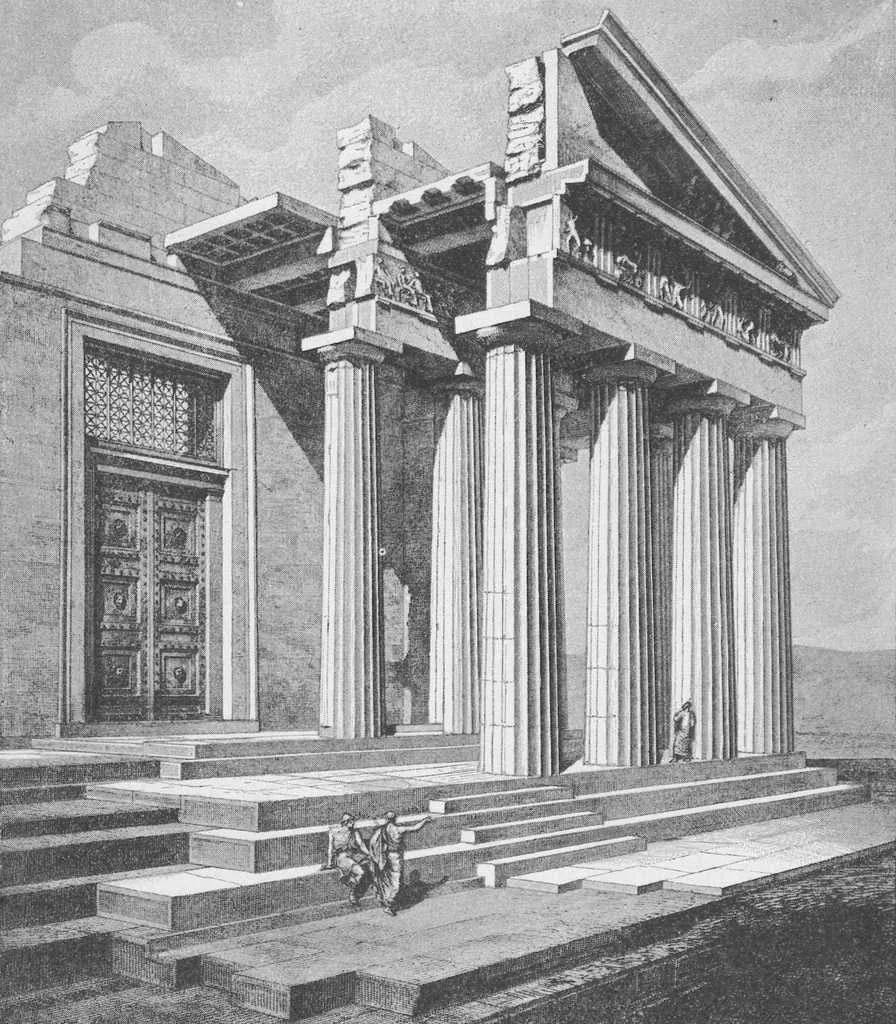
This reconstruction helps show where the Parthenon frieze actually ran: high on the outer wall of the cella, inside the colonnade.
The frieze’s bold move is making civic life look worthy of a temple
Here’s the deeper claim, and it’s why the Parthenon frieze is so unusual.
Greek temple sculpture usually leans hard on myth: gods, monsters, origins, cosmic conflict. The Parthenon does that too. But the frieze introduces something else: the city itself.
It elevates a civic ritual into an image band that runs around the temple of Athena. That implies a tight relationship between deity and polis. In plain terms: Athens’ public identity is presented as sacred, organized, and legitimate.
If that sounds political, it is. Not in a modern party sense, but in a “how a city imagines itself” sense. The frieze doesn’t just show people walking. It shows a society that believes its order deserves divine attention.
And this is where Greek visual storytelling habits matter. Greeks were used to reading images as narratives and as values, whether on architecture or on objects like how Greeks told stories in images. The frieze uses the same basic literacy: repeated types, recognizable roles, staged climax.
So when we ask “how do I read it,” the real answer is: read it as Athens designing an image of itself at its best.

Conclusion
To read the Parthenon frieze well, we don’t need every name and every missing fragment. We need the structure: a continuous band that begins on the west, flows along north and south, and culminates on the east with gods and a central ritual moment. Most interpretations connect it to the Panathenaic procession, but even then, it’s an edited, idealized version built to communicate order, devotion, and civic identity.
And once we see that, the frieze stops being “a long parade.” It becomes one of the Parthenon’s sharpest messages: Athens belongs in sacred space because Athens is worthy of being seen.
FAQ
What does the Parthenon frieze show?
It is widely believed to show the Panathenaic procession, presented as an ideal civic ritual.
Where is the Parthenon frieze located on the building?
It ran around the upper part of the inner structure, inside the outer colonnade.
How do you read the sequence?
Start on the west, follow north and south as two streams, then end on the east center.
Why are gods shown sitting on the east side?
Because the east is the “arrival” zone, framing the climax as a divine-facing ritual moment.
Sources and Further Reading
Acropolis Museum —“The frieze” (n.d.)
Acropolis Museum —“The Parthenon frieze” (n.d.)
British Museum —“The Parthenon Sculptures” (n.d.)
British Museum —“Marble relief (Block V) from the East frieze of the Parthenon” (n.d.)
Robin Osborne —“The viewing and obscuring of the Parthenon frieze” (1987)
Smarthistory —“Parthenon frieze” (n.d.)
Oxford Research Encyclopedia of Classics —“Arrephoria” (2015)
You may also like