Greek Patterns: Meanders, Waves and Palmettes in a Nutshell
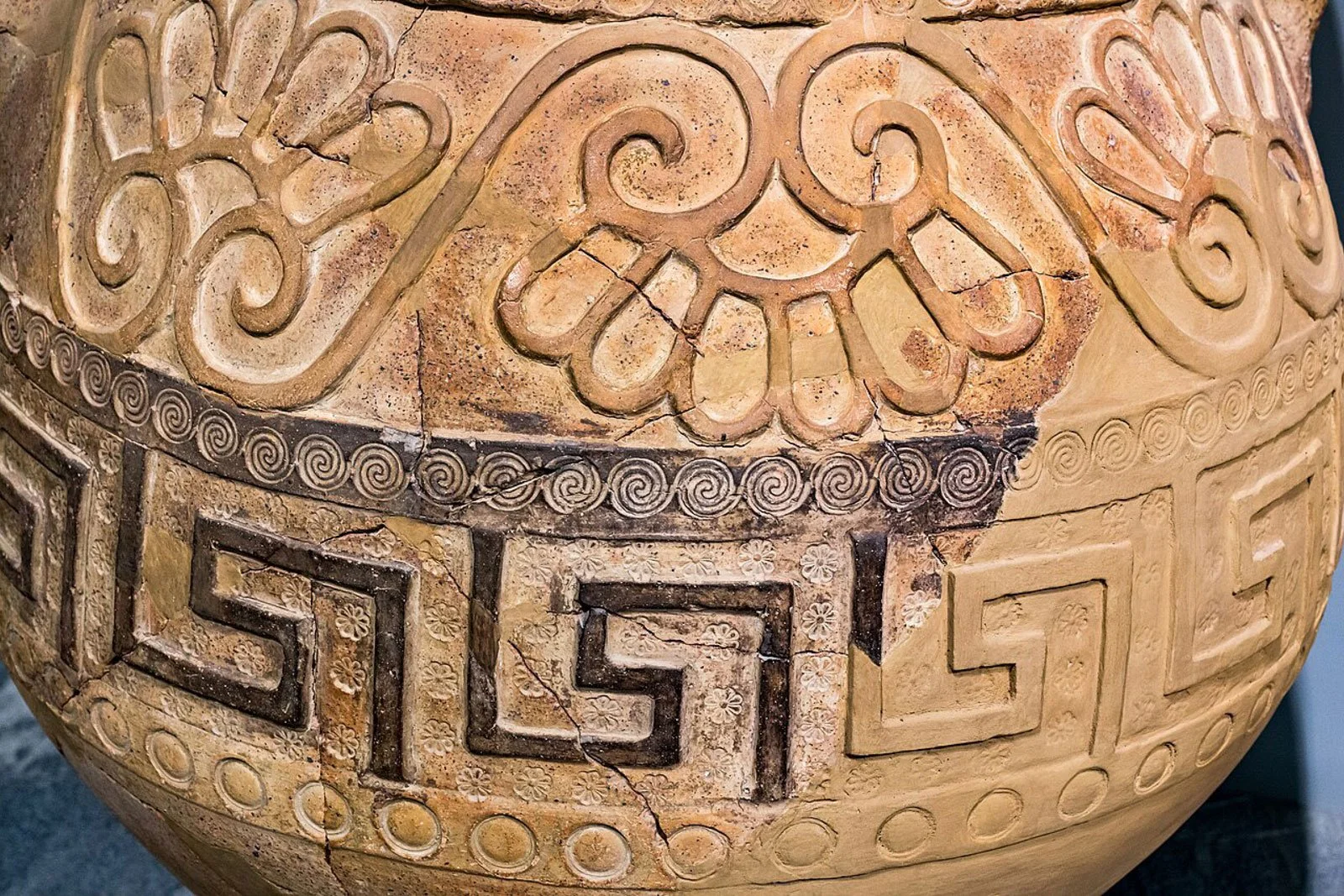
Geometric patterns, spirals and floral bands wrap this jar, turning simple storage into a bold monument of clay, surface rhythm and movement.
If you start paying attention to the borders on Greek vases and temples, something funny happens. The background stops being “decoration” and turns into little rhythms that repeat everywhere. Meanders, wave bands, palmettes. Once you can name them, museum rooms and textbook pages suddenly look much more readable.
In this glossary guide, we walk through the main Greek patterns you will meet again and again. We keep it practical. What does each one look like? Where do you usually find it? And how can these small details help you understand bigger things about Greek design and taste?

Greek patterns turn borders into tiny visual rhythms
Greek artists did not leave large empty edges if they could help it. They used patterns to frame scenes, mark transitions and guide the eye around a surface. Once you see that, borders stop being “filler” and start feeling like visual punctuation.
On greek pottery, patterns often sit in bands. One band might carry a meander, another a run of waves, another a chain of palmettes or lotus flowers. These repeat around the body of the vase like a drum beat under the main scene. On greek architecture and especially around a greek temple, similar motifs show up in carved friezes, mouldings and painted cornices, where they help separate one architectural zone from another.
The key thing is that Greek patterns are modular. They are built from a small unit, repeated with almost obsessive regularity. That makes them quick to apply in paint or carving. It also gives them a calm, ordered feel. Even when a myth scene is chaotic, the borders keep everything in a steady frame.
Definition: Greek patterns are repeated decorative motifs that frame, separate and rhythmically fill surfaces in ancient Greek art.
If you think in terms of “beat” and “frame”, it becomes much easier to remember what you are looking at and why it is there.
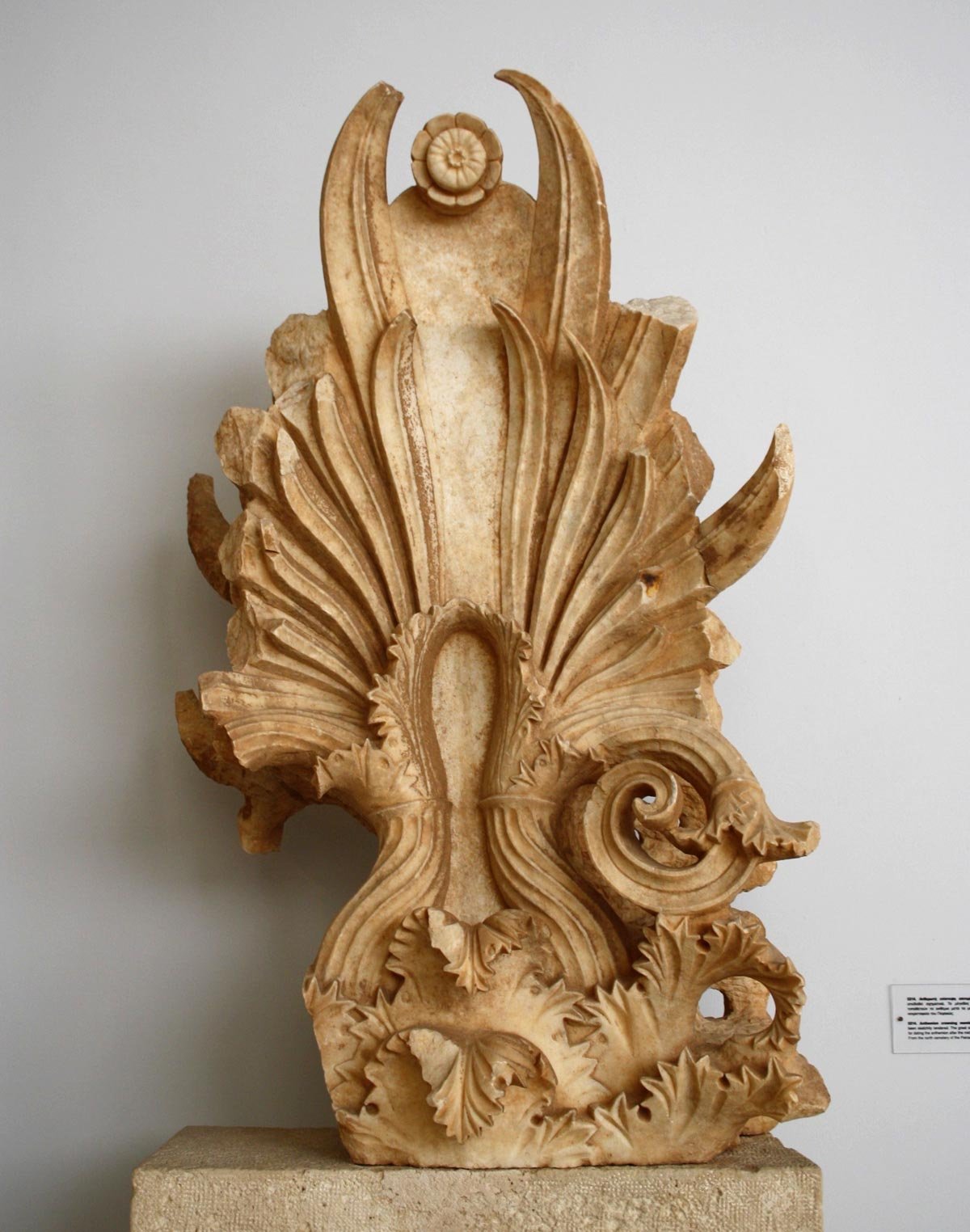
This exuberant anthemion crowns a grave stele, its swirling leaves and palmette turning private mourning into monumental ornament.
Meet the main Greek patterns: meander, waves and palmettes
The meander, also called the Greek key pattern, is probably the celebrity here. It is a continuous line that turns at right angles again and again, making a band of interlocking right-angled spirals. On vases, it often runs just above or below the main painted scene. On buildings, it can appear as a band on mouldings or around metopes. If you want to go deeper into this single motif, you can jump to the dedicated guide to the greek key pattern.
Wave patterns are another favourite. A simple version looks like a row of small, regular curves, as if you drew a series of tiny semicircles touching each other. Sometimes you get a “running wave”, where the line lifts and drops in a smoother rhythm. These bands often appear near the base or rim of greek vases, or along architectural elements that are close to the “sea” of space below, like a step or lower cornice. It makes sense that a maritime culture would enjoy turning water into a repeatable motif.
The palmette is a stylised fan of leaves that spreads out from a central point. In Greek art it is often paired with a lotus flower in chains, or repeated as a frieze, especially in architectural decoration and high-quality pottery. On vases, you might see palmettes flanking the handles, almost like plant “brackets” holding the main scene in place. On buildings, palmettes often grow along simas and akroteria, softening sharp outlines with a controlled burst of vegetal life.
All of these patterns live inside a larger visual system. They support the storytelling scenes on greek pottery, they echo the geometric logic of ancient greek art, and in some cases they pick up older Aegean habits you might already have seen in our discussion of minoan bull leaping.
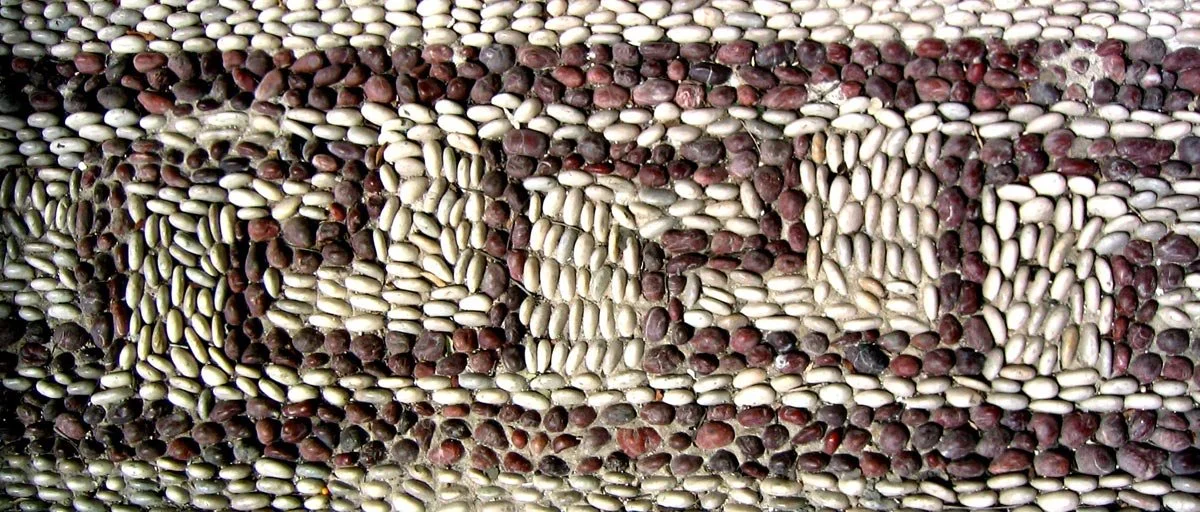
This Rhodes pebble mosaic turns the Greek key into texture, each small stone catching light so the meander seems to ripple softly.
Why Greek patterns still feel so modern
It is no accident that you can find Greek meanders and palmettes on hotel carpets, logos and fashion today. These motifs are simple enough to reuse and strong enough to carry meaning.
The meander works well in modern design because it is basically a grid-based line. It reads as both decorative and technical, almost like an early vector graphic. The same goes for many other greek patterns: they balance geometry and nature, repetition and small variations, in a way that still feels fresh.
For us, as learners of art and architecture, patterns also act as entry points. Recognising a meander on a cornice nudges you to ask what kind of building you are looking at. Spotting palmettes and waves on a vase can help you link it to a period, a workshop or at least a general Greek taste for ordered ornament. When you start to see borders as decisions, not background noise, Greek art stops being remote and starts to feel designed in a very contemporary sense.
Conclusion
If Greek statues and temples tell the main stories, then Greek patterns are the soundtrack running underneath. Meanders, waves and palmettes might look like small details at first, but they are doing serious work: framing images, pacing surfaces, hinting at water, plants, eternity and order.
Next time you scroll past a “Greek-inspired” graphic or stand in front of a case of vases, try this small exercise with me. Ignore the figures for a moment and just follow the borders with your eyes. Count the turns of a meander, the rise and fall of a wave band, the spread of palmettes. You will start to feel how much care went into filling even the smallest strip of space.
And once these patterns click, they become a bridge to everything else in this Greek cluster: from greek pottery and greek vases to full-blown greek architecture. They also prepare your eye for later decorative traditions that reuse and remix the same motifs.
Sources and Further Reading
The Metropolitan Museum of Art — “Art of the Hellenistic Age and the Hellenistic Tradition” (2004)
The Metropolitan Museum of Art — “Greek Art in the Archaic Period” (2003)
The Metropolitan Museum of Art — “Greek Art” (Educator Resource) (2000)
Zahra, F. — “Development and Evolution of Palmette Ornament” (Landscape Architecture and Art, 2022)
You may also like