Contrapposto Definition: The Pose That Made Stone Move
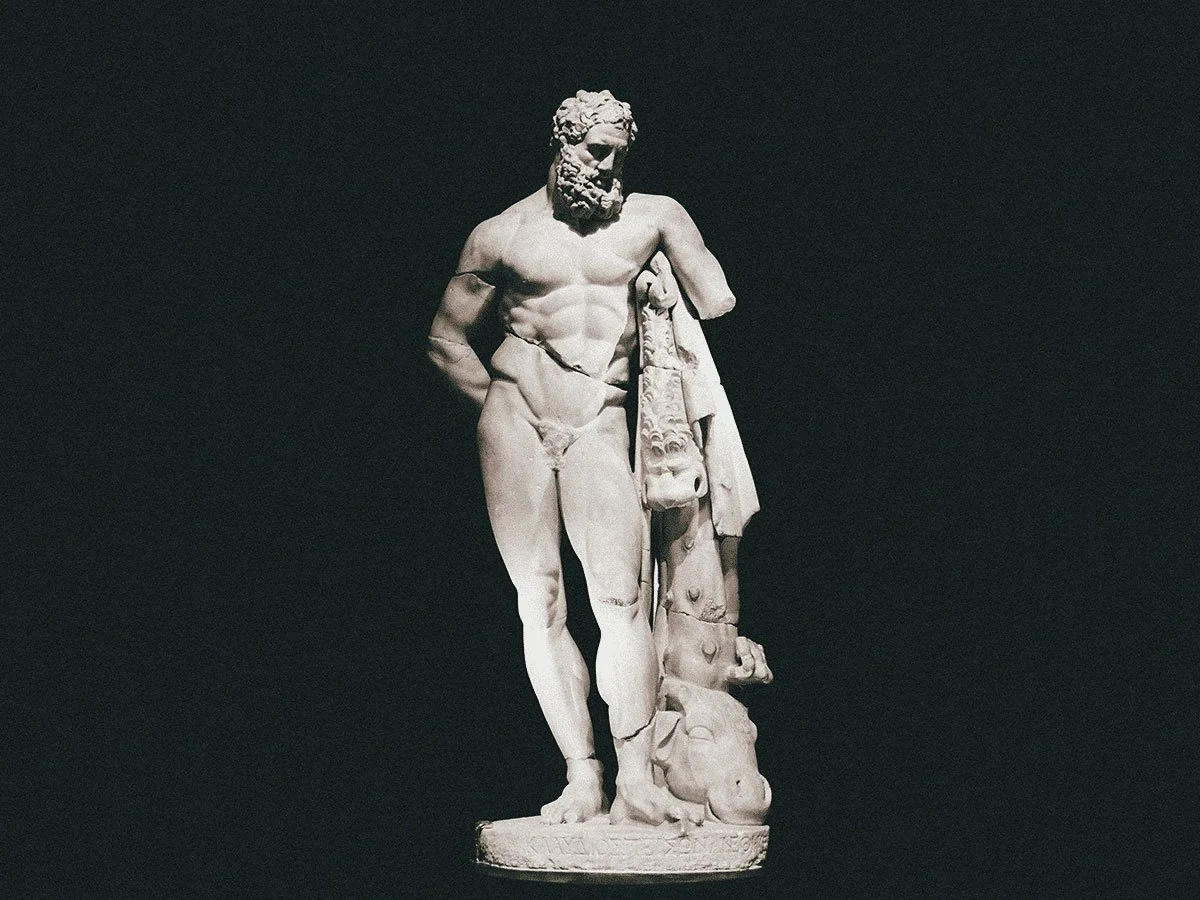
Contrapposto isn’t just a tilt—it’s a whole-body negotiation between stability and movement. Use this as a quick check: find the weight-bearing leg first, then follow the chain reaction up through hips, ribs, and shoulders.
You know that moment in a museum when a statue feels oddly… present? Like it’s not posing for us, it’s simply standing there, breathing quietly, taking up space. A lot of that effect comes down to one deceptively simple idea: contrapposto, weight on one leg, body counter-tilts.
In this guide we’ll pin down a clear contrapposto definition, then we’ll unpack why it works so well visually. We’ll also look at how Greek sculptors turned a “casual stance” into a whole new language of balance, calm, and life, the foundation for so much of Classical sculpture and even our modern idea of a “natural” body.
Contrapposto is a weight shift that reorganizes the whole body
Definition: Contrapposto is weight on one leg, body subtly counterbalances.
That’s it, but the key word is counterbalances. Contrapposto is not just “a bent knee.” It’s a chain reaction. If most of your weight sits on one leg, your pelvis tilts. If your pelvis tilts, your spine adjusts. If your spine adjusts, your ribcage responds. Your shoulders don’t stay level. Your head rarely stays perfectly centered. The body becomes balanced but asymmetrical, which is exactly how real people stand when they’re not performing for a camera.
This is why contrapposto felt like such a breakthrough in Greek sculpture. Earlier standing figures often read as “built for front view,” stable, symmetrical, and a bit unreal. If you want that comparison in one place, before contrapposto: Archaic bodies gives us the baseline: bodies that are powerful, iconic, and still a little rigid.
Contrapposto doesn’t destroy stability. It upgrades it. The statue can still feel calm, even monumental, but now that calm looks earned. It looks like gravity is real in this world, and the figure knows how to live inside it.
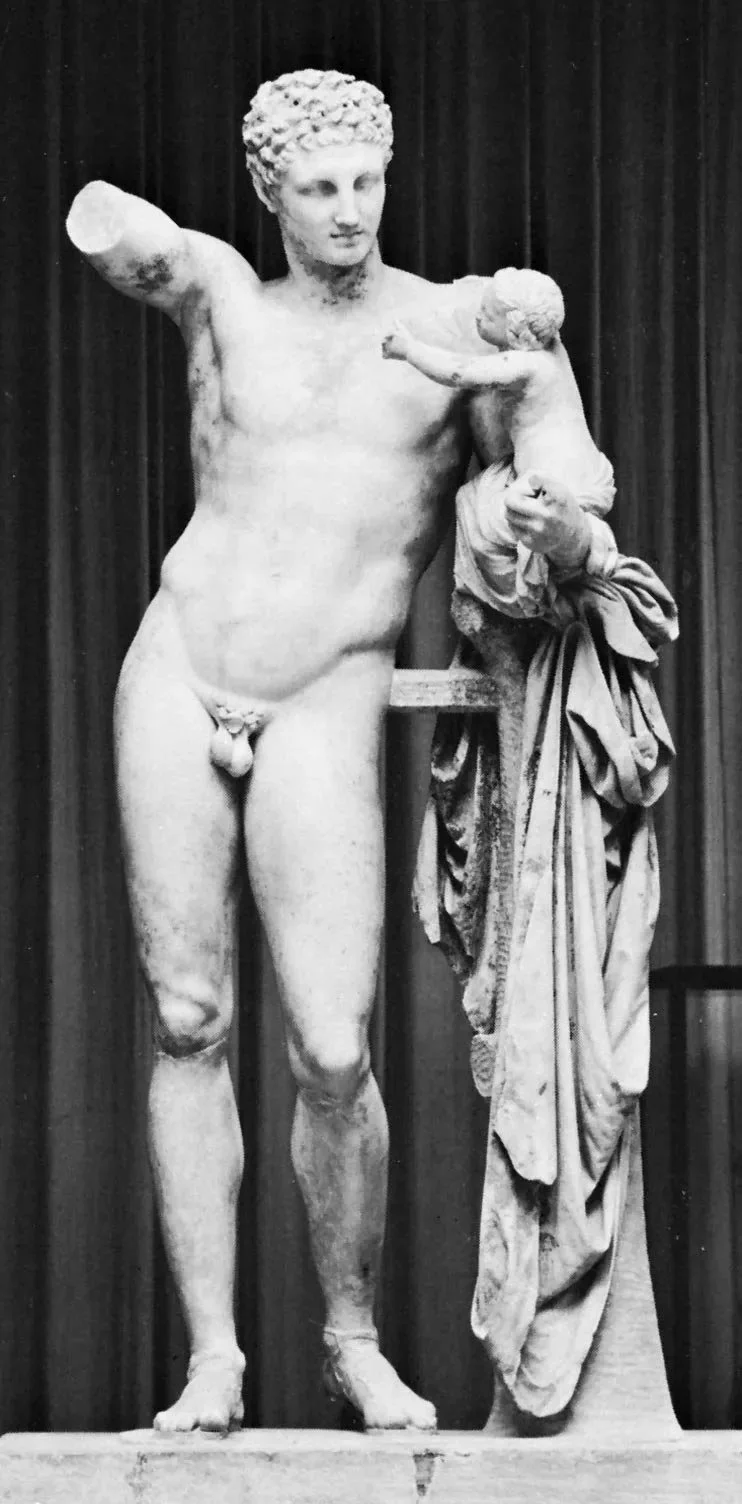
This composition is a masterclass in balance: Hermes’ relaxed stance anchors the scene while the child adds a small burst of energy. It’s a great reminder that “classical calm” can still tell a story.
This pose feels alive because it implies time
Why does contrapposto make stone feel like it could move?
Because it suggests a moment between moments.
A symmetrical stance says, “I am an image.” Contrapposto says, “I just shifted,” or “I’m about to shift again.” The figure isn’t frozen mid-action, it’s paused mid-life. That’s a subtle difference, but it changes everything about how we read the body.
Think about how you stand while waiting. You settle into one hip. You relax one knee. One shoulder drops a touch. You might not even notice you’re doing it. Contrapposto captures that exact kind of unannounced realism, then turns it into art.
This is where the Classical taste for controlled naturalism shows up. Greek sculptors were not chasing messy, documentary realism. They were chasing a convincing body that still reads as ideal. Contrapposto becomes the perfect tool because it blends two things that seem like opposites:
Relaxation, the body looks unforced.
Structure, the body still looks designed.
If you’ve read Greek statue basics, you already know the bigger pattern: classical style tends to feel effortless, but it’s almost never accidental. Contrapposto is one of those “effortless” effects that is actually a highly engineered illusion.
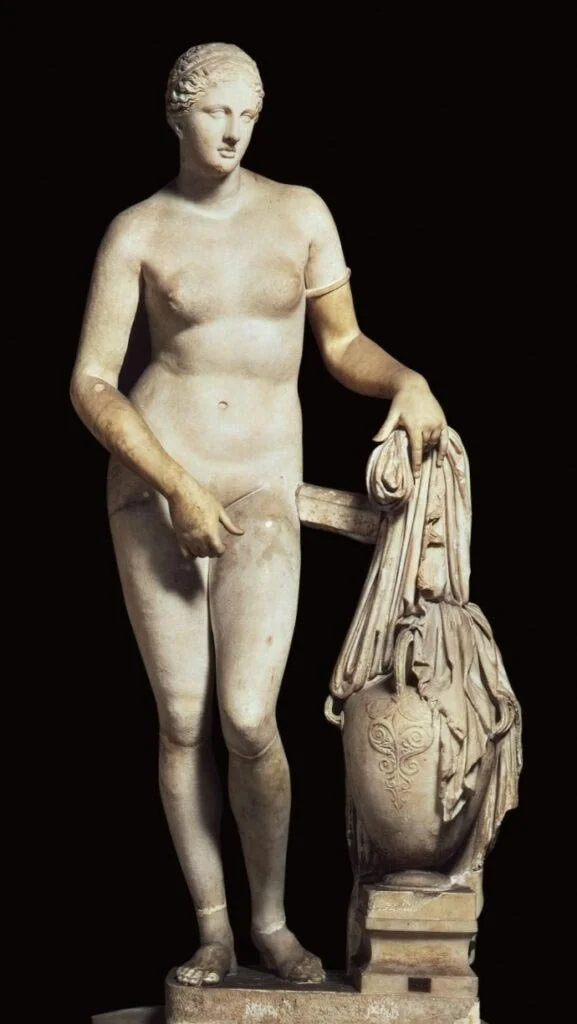
Aphrodite of Knidos is famous because the pose is both bold and carefully “managed”: the body is fully shown, but the gesture frames it as a moment of privacy. That tension is exactly what made it unforgettable.
Polykleitos turns contrapposto into a system, not a vibe
It’s one thing to discover a natural stance. It’s another thing to make it repeatable.
That’s where Polykleitos comes in, because he didn’t treat contrapposto like a clever trick. He treated it like part of a rule-set. When we talk about Polykleitos’ rules, we’re talking about a way of building an “ideal” body through proportion and balance, so the figure feels unified from head to toe.
And the clearest, most famous case study is Doryphoros as contrapposto. Even if you never memorize the name, you’ve probably seen the type: an athletic young man, weight settled, one leg relaxed, shoulders and hips subtly offset, a body that feels like it’s obeying gravity and geometry at the same time.
Here’s what’s quietly radical about that. Contrapposto is not only a leg idea. It creates a diagonal logic across the body, sometimes described as a “cross-balance,” where the active leg pairs with a relaxed arm, and the relaxed leg pairs with the active arm. It’s a whole-body composition. It makes the figure read as integrated, not assembled.
So when people say contrapposto “made stone move,” they don’t mean it literally animates the statue. They mean it gives the body a believable internal organization, the kind we subconsciously read as life.
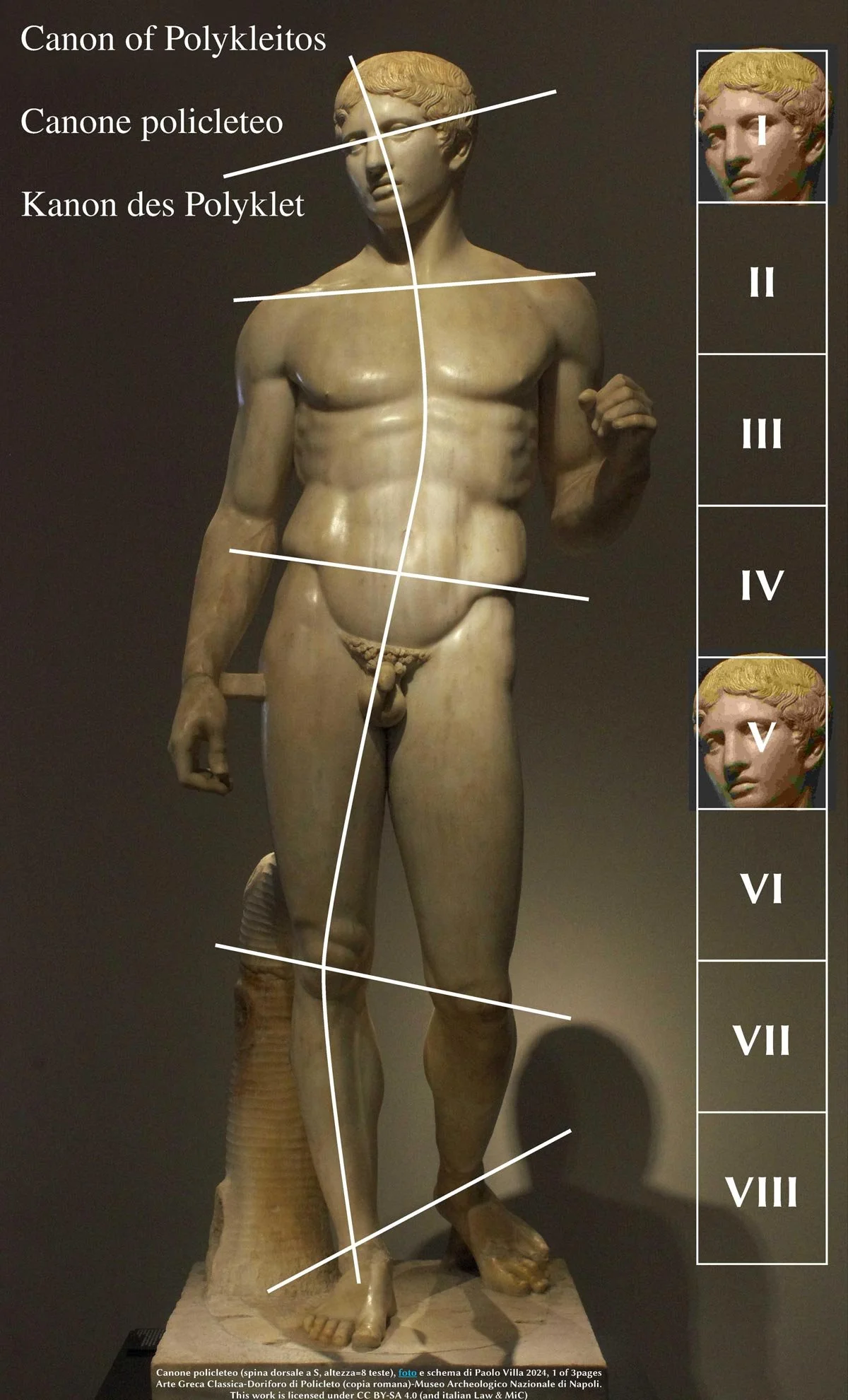
Polykleitos’ “canon” is basically a design mindset: the body as a system of ratios you can test and repeat. Diagrams like this show how Greek naturalism often starts with structure, then becomes lifelike.
You can spot contrapposto in seconds if you know the six checkpoints
Let’s make this practical. If you’re trying to identify contrapposto in the wild, don’t start with the word. Start with the body.
A quick in-museum scan, built around what we cover in Greek statue basics:
One leg works, one leg rests. The weight-bearing leg looks straighter and more engaged.
Hips tilt. One hip sits higher, not both level.
Spine responds. You often see a gentle curve rather than a straight “pillar.”
Shoulders counter-tilt. They usually don’t mirror the hips.
Ribcage shifts. The torso can look slightly compressed on one side, stretched on the other.
The head is not locked. It may turn or sit slightly off-axis, even subtly.
Notice what we’re doing: we’re looking for cause and effect. If the knee bends but the hips and torso do nothing, that’s often not true contrapposto, it’s just a pose variation. Contrapposto is convincing when the whole body participates.
And this is also why contrapposto is a historical marker. Once sculptors can solve this chain reaction consistently, you’re usually in the realm of Classical experimentation and refinement, a step away from before contrapposto: Archaic bodies.
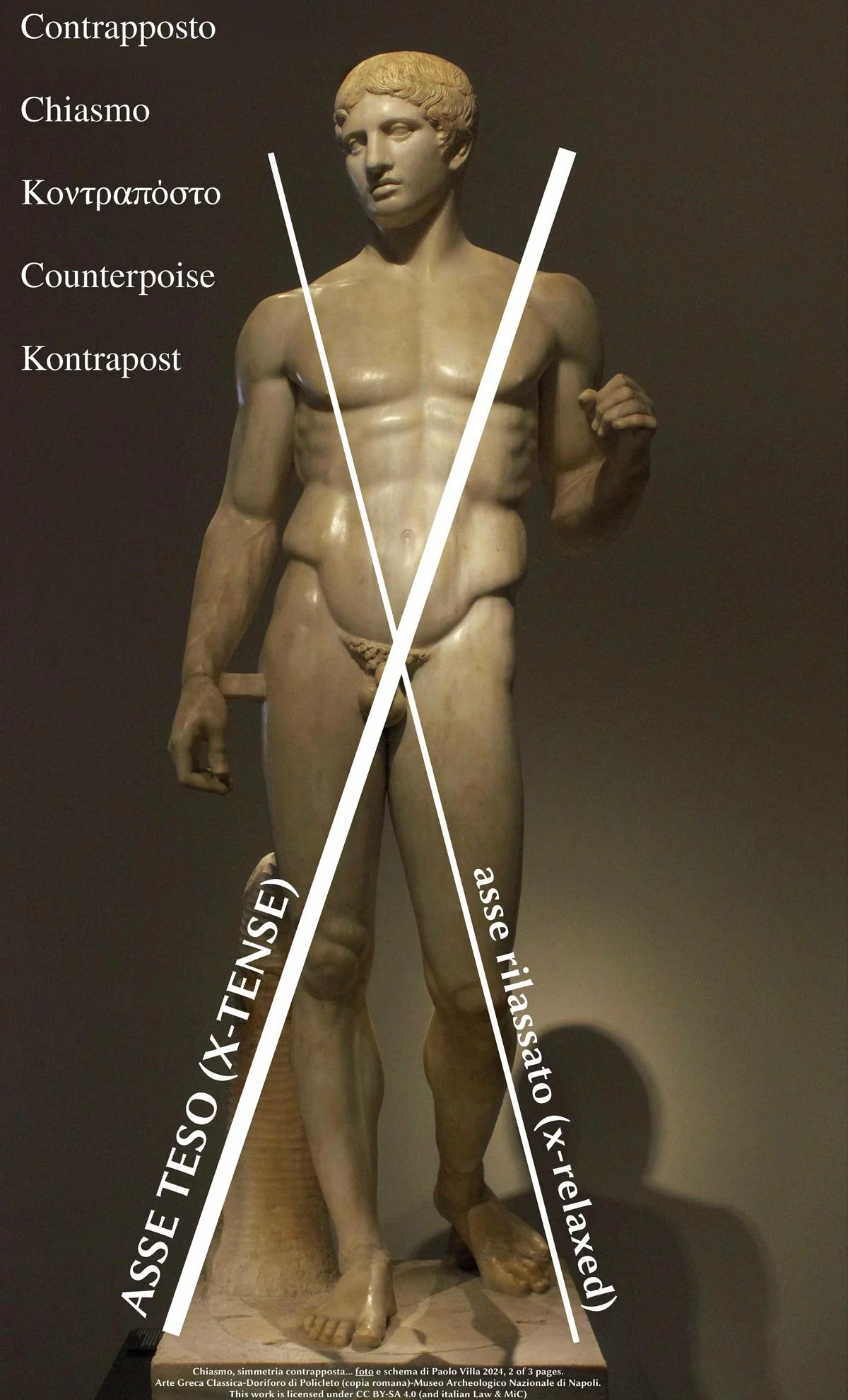
The “X” is a simple trick that makes contrapposto click: relaxed arm pairs with the weight-bearing leg, and the other diagonal responds. Once you see that cross-balance, the pose stops feeling random and starts feeling engineered.
Contrapposto is not only realism, it’s a statement about the “ideal” human
Here’s the deeper layer that makes contrapposto more than anatomy homework.
A contrapposto figure often feels self-possessed. Balanced. Calm. In control. Even when the subject is an athlete or a hero, the body doesn’t look chaotic. It looks like it knows itself.
That mood matters in Classical Greek art because “ideal beauty” is rarely just about looks. It’s also about values: harmony, measure, rational structure, the idea that the human being can be understood and shaped into a coherent model. Contrapposto fits perfectly into that worldview because it makes a body look natural and ordered.
Polykleitos helps us see that clearly. With Polykleitos’ rules, contrapposto becomes part of a broader project: the body as a system of proportions and balances, not a random snapshot.
So yes, contrapposto makes stone feel alive. But it also makes life feel readable. It translates human movement into something that looks inevitable, like the body is following a beautiful law.
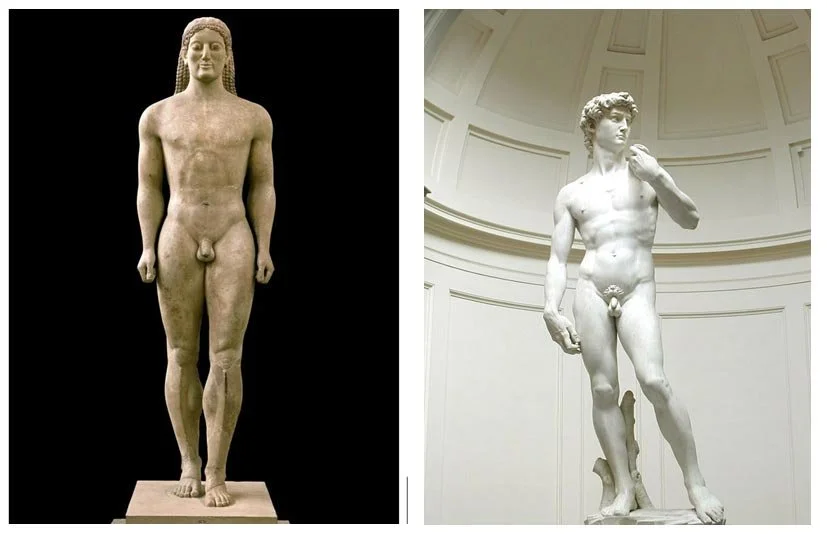
This comparison is the “before and after” of body logic: the Archaic stance reads frontally and evenly, while David’s weight shift creates a natural chain reaction through the torso. It’s not just pose—it’s a whole new way of imagining life inside stone.
Conclusion
Contrapposto can sound like one of those art-history words that exists mainly to intimidate beginners. It isn’t. It’s one of the most friendly concepts in the whole museum, because it starts with something we all understand: how it feels to stand.
Once we see contrapposto as a chain reaction, the pose stops being “a bent leg” and becomes a full-body logic of balance, counter-balance, and calm. And once we notice how deliberately sculptors like Polykleitos shaped that logic, we also start to understand why Classical sculpture feels so convincing. It doesn’t copy life. It edits life into a model that still feels human.
FAQ
What is contrapposto in simple terms?
Contrapposto is a standing pose where weight rests on one leg and the body counterbalances with a subtle tilt.
Why did contrapposto matter in Greek sculpture?
It made figures look balanced and lifelike by showing how the whole body responds to weight.
Is contrapposto only about the legs?
No, it affects hips, spine, shoulders, and often the head, because the body has to rebalance.
What’s a famous example of contrapposto?
Polykleitos’ Doryphoros is a classic example of contrapposto used as a structured ideal.
Sources and Further Reading
The J. Paul Getty Museum — “What Is Contrapposto?” (2023)
The Metropolitan Museum of Art — “The Art of Classical Greece (ca. 480–323 B.C.)” (2008)
National Galleries of Scotland — “Contrapposto” (n.d.)
Smarthistory — “Contrapposto explained” (n.d.)
Andrew Stewart — “The Canon of Polykleitos: A Question of Evidence” (1978), The Journal of Hellenic Studies
Kyoko Sengoku-Haga et al. — “Polykleitos and His Followers at Work: How the Doryphoros Was Used” (2017), Getty Publications

You may also like