What Was the Purpose of the Colosseum? Spectacle, Power and Crowd Control
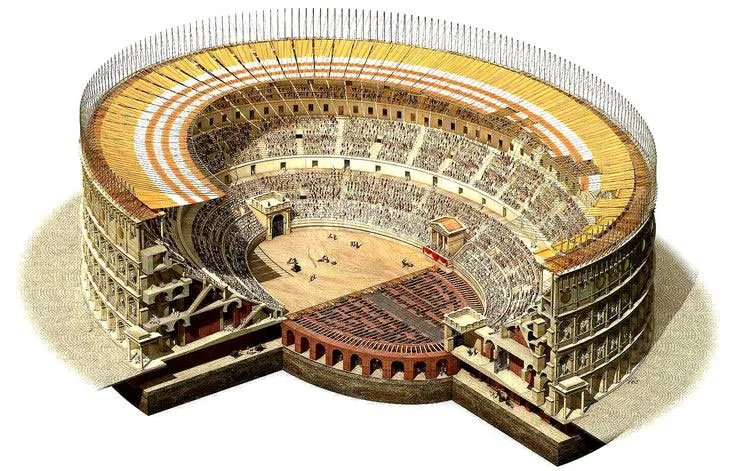
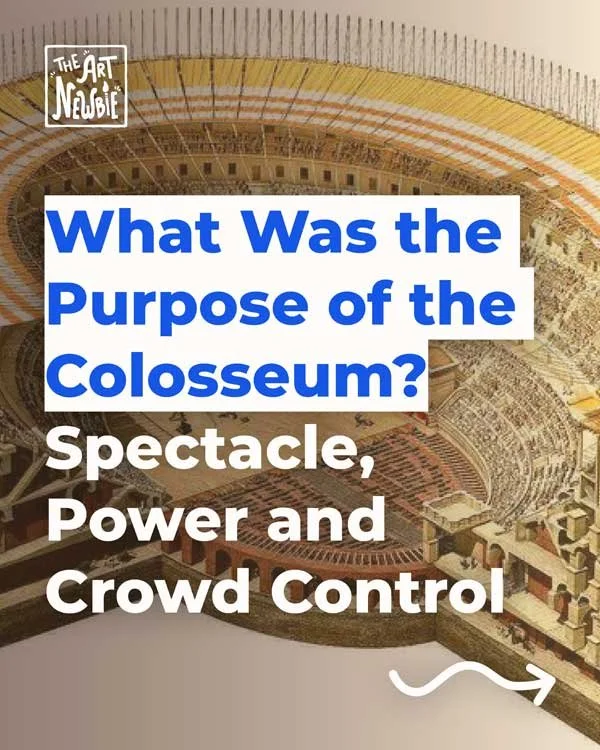
This reconstruction works well because it shows the Colosseum as a machine for spectacle, hierarchy, and crowd control.
The Colosseum was built to do more than host shows. Its purpose was to stage public spectacle, display imperial power, and manage mass crowds inside a highly organized building. That is the clearest answer. Gladiatorial combats, animal hunts, executions, and staged performances were the visible events, but the architecture around them was doing just as much work. It sorted people by rank, controlled movement, and turned entertainment into a public lesson about Roman order.
This is why the Colosseum matters so much. It was not just a place where things happened. It was a machine for visibility. The emperor could be seen. The crowd could see itself. Social hierarchy became physical. And the building itself demonstrated that Rome could build at a scale that made power feel concrete.
That is also why the question of purpose opens into something bigger than entertainment. To understand the Colosseum properly, you have to see it as architecture, politics, and spectacle working together.
At its core, the Colosseum existed to gather a huge public, direct its attention toward a central arena, and stage Roman power through controlled mass experience.
What was the Colosseum built for?
The Colosseum was built as a public amphitheatre for large-scale spectacles. These included gladiatorial games, wild-animal hunts, executions, and other staged entertainments designed for thousands of spectators. In that basic sense, it was a venue for mass viewing.
But that description is only the first layer. The building was also meant to function as a public gift. It belonged to the Flavian emperors, and its construction turned a politically charged part of the city into a place of collective gathering. If you want the historical frame for that more precisely, when was the Colosseum built is the key starting point.
This public function mattered because Rome was not just offering amusement. It was offering an architecture in which spectacle, generosity, and authority could appear together. The emperor sponsored the event, the people filled the seats, and the building made the connection visible.
So the main purpose of the Roman Colosseum was never only “to entertain.” It was to entertain in a way that reinforced civic and imperial order.
Why did spectacle matter so much?
Spectacle mattered because it was one of the main ways Roman public life became visible at scale. A spectacle gathered the city into one place and focused attention on a shared event. That made it powerful.
In the Colosseum, this power was intensified by architecture. The building surrounded the arena, concentrated the gaze, and created a single field of spectatorship. Everyone was there to watch, but they were also being arranged, classified, and displayed as part of the event itself.
This is why the Colosseum makes the logic of the Roman amphitheatre so clear. The amphitheatre type is not just a container for combat. It is a structure built specifically for mass spectatorship. The arena is central, but the crowd is just as important. The building exists because the spectacle needs an audience, and the audience needs to be organized.
That is one reason the Colosseum was so effective. It turned spectacle into an urban and political instrument, not just a pastime.
How did it show imperial power?
The Colosseum showed imperial power in at least three ways.
First, it was a monumental public work. Its sheer size demonstrated the capacity of the Roman state to command labor, materials, and technical skill. A building like this did not simply shelter events. It advertised what imperial authority could build.
Second, it was closely tied to the image of the Flavian dynasty. The amphitheatre rose on land that had been associated with Nero’s private palace complex. Turning that zone into a public entertainment building sent a clear message: what had been associated with imperial excess was being refashioned as public benefit. The building therefore carried political meaning even before the games began.
Third, the emperor’s role in sponsoring spectacles gave the building a constant political charge. The arena might display fighters, animals, or staged violence, but it also displayed the emperor as the one who made the event possible. Spectacle became a form of imperial presence.
This is one reason the Colosseum was so important to Rome. It made power feel public, visible, and staged rather than distant and abstract.
Why was crowd control essential?
The Colosseum was built for tens of thousands of people. That means crowd control was not a secondary technical issue. It was one of the building’s core purposes.
Spectators had to enter, find their place, watch the event, and leave again without total confusion. Roman builders solved this through an elaborate system of entrances, corridors, stairs, and ring-shaped circulation paths. The structure was designed so movement could be divided and directed with unusual efficiency.
This is one reason the Colosseum still feels surprisingly modern. It behaves less like a simple ancient ruin and more like a carefully planned public machine. The architecture is not only impressive from the outside. It is intelligent from the inside.
That interior logic becomes much clearer in Roman Colosseum inside. Once you look beyond the facade, you begin to see that the building’s purpose was not only to hold a crowd, but to manage a crowd.
How did it organize social hierarchy?
The Colosseum did not treat the audience as one undifferentiated mass. Seating was arranged according to rank and social status. In other words, the building did not just host Roman society. It physically mapped Roman society into stone.
The best seats were closest to the arena and reserved for the emperor, senators, and other high-status figures. Higher zones were assigned to lower ranks. This arrangement made hierarchy visible. Where you sat reflected who you were in Roman public life.
That matters because the purpose of the Colosseum was not only to show combat or performance. It was also to show order. The building turned a potentially chaotic crowd into a legible civic body. Everyone could see the arena, but everyone could also see that access, proximity, and prestige were not equal.
So the Colosseum was a place of collective gathering, but not of social flattening. It brought many people together while still preserving sharp distinctions between them.
Why did the arena matter?
The arena was the emotional center of the whole building. It was where the spectacles took place, where danger was concentrated, and where the crowd’s attention was focused.
That centrality is why the building works so well. Everything radiates around the arena. Seating curves around it. Entrances and passages lead toward it. Sound, movement, and visual focus all gather there. The arena turns the building into a single unified instrument of attention.
This is also why the arena floor deserves attention on its own. The surface spectators saw was only the top layer of a more complicated system, which becomes clearer through Colosseum arena floor. What looked like a simple performance ground was actually part of a more elaborate event-making structure.
So the purpose of the Colosseum was not merely to contain spectacles. It was to create the perfect conditions under which an arena could dominate collective attention.
What was hidden below it?
A major part of the Colosseum’s purpose depended on what spectators did not fully see.
Below the arena, later phases created the underground service network now called the hypogeum Colosseum. This space housed cages, corridors, lifts, storage areas, and machinery that supported the spectacles above. It made the arena more theatrical, more controlled, and more logistically complex.
This hidden layer matters because it shows that the Colosseum was not just a bowl of seats around an empty center. It was a building with visible and invisible levels, each serving the larger purpose of spectacle.
That division between what is seen and what is concealed is one of the most interesting things about the monument. Above, the crowd experienced the event as public drama. Below, the architecture managed the technical work that made that drama possible.
How was it different from other venues?
The Colosseum was not the only place in Rome for mass entertainment, but it had a very specific purpose.
A circus, such as the Circus Maximus, was built mainly for races and had a long linear form. A theatre faced a stage and worked differently again. The Colosseum, by contrast, was an amphitheatre: compact, surrounding, and centered on one arena.
That distinction matters because the Colosseum’s purpose was bound to its shape. It was designed for events that required viewers to gather all around a central action zone. This made it ideal for combat, animal hunts, and other highly concentrated spectacles.
Its location mattered too. Standing in the monumental heart of Rome, not far from the Roman Forum, the building belonged to a wider public landscape of imperial Rome. It was not a peripheral venue. It was part of the city’s political and symbolic core.
Why is the Colosseum important to Rome?
The Colosseum is important to Rome because it condenses several Roman priorities into one building: spectacle, engineering, hierarchy, and imperial presence.
It also remains one of the clearest answers to the question of why architecture matters politically. The Colosseum did not persuade through argument. It persuaded through scale, repetition, order, and visibility. It let Rome present itself as organized, powerful, and capable of staging public life on a massive scale.
That is why the building still dominates the modern imagination. It is not only one of the best-known monuments of ancient Rome. It is also one of the best explanations of how Roman public architecture worked.
Conclusion
The purpose of the Colosseum was never just to host shows. It was built for spectacle, but also for power, crowd management, and hierarchical display. Its architecture gathered thousands of people, sorted them by rank, focused them on a central arena, and turned public entertainment into a visible performance of Roman order.
That is why the Colosseum is so important to Rome. It was not just a place where the empire entertained itself. It was one of the main ways the empire made itself seen.
FAQ
What was the main purpose of the Colosseum?
The main purpose of the Colosseum was to host large public spectacles such as gladiatorial games and animal hunts, while also displaying imperial power and organizing huge crowds.
Why is the Colosseum important to Rome?
It is important because it combines Roman engineering, mass entertainment, political messaging, and social hierarchy in one highly legible monument.
Was the Colosseum only for entertainment?
No. It was also a political building in the broad sense, because it staged imperial generosity, public order, and social ranking.
How did the Colosseum control crowds?
It used a complex system of entrances, corridors, stairs, and seating zones that allowed very large audiences to move through the building efficiently.
Why were seats arranged by rank?
Seating reflected Roman social hierarchy. The building made status physically visible by placing different groups in different zones.
What happened under the Colosseum?
Below the arena was the hypogeum, an underground network of cages, passages, and machinery that helped manage the spectacles above.
Sources and Further Reading
You may also like