Anavysos Kouros: A Fallen Warrior Between Life and Stone
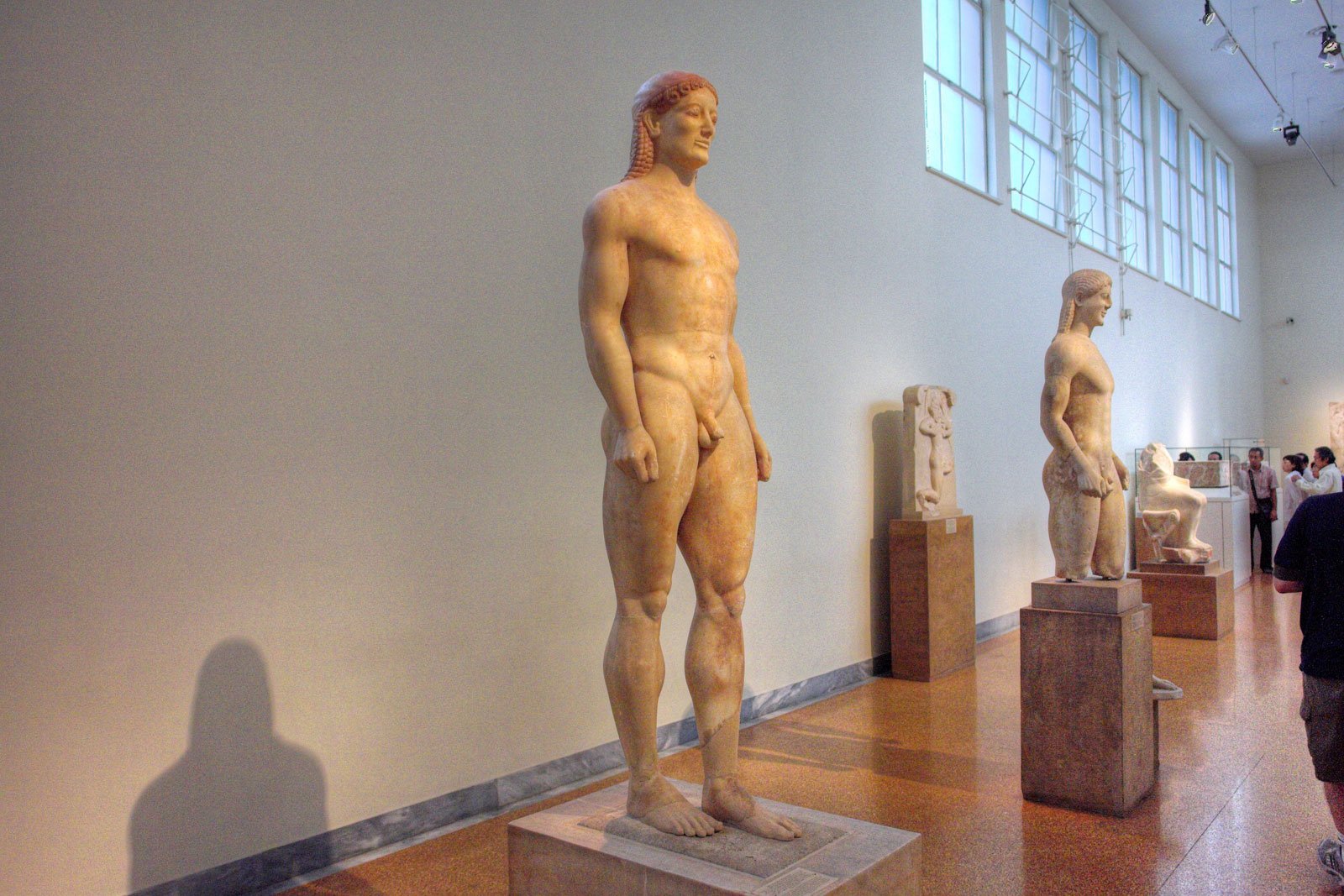
In the archaic kouros, stiff pose and idealised muscles turn a grave marker into a model of youth, balanced between Egyptian rules and Greek ideas.
If you walked into the National Archaeological Museum in Athens without any labels, the Anavysos Kouros might first read as just “another naked marble guy.” Then you get closer. The muscles feel fuller, the stance more grounded, the face strangely calm and alive. And once you read the base — an epitaph for a young man killed in battle — the statue suddenly becomes a body caught halfway between life and stone.
In this guide, we stay with this one figure and let it open up the whole world of archaic Greek sculpture, from idealised youth to the very real grief of a family marking a grave.

A kouros that turns a generic type into a real loss
The Anavysos Kouros stands just under two meters tall, carved in marble around 530 BCE and found in a cemetery at Anavyssos in Attica. He’s a kouros, the Greek word for “youth,” which art historians use for a specific statue type: a standing, naked young man, frontal, with one leg forward and arms straight at his sides. Kouros statues show up everywhere in archaic Greek sculpture, from sanctuaries to cemeteries, as offerings to gods or as grave markers.
Seen from a distance, this kouros fits the template perfectly. He faces us frontally, left leg stepping forward, fists clenched, gaze straight ahead. But if we slow down and trace the surface, the form starts to feel much more individual. The thighs swell naturally, the knees are rounded rather than carved as simple disks, and the chest rises and falls in a believable rhythm instead of a flat grid. Compared to earlier, more blocky kouroi, this body has weight.
And yet, it’s not a portrait in our modern sense. He doesn’t look like “Kroisos” in a literal way. He looks like what an ideal young man should be: strong, symmetrical, eternally in his prime. That tension — between a real dead person and an idealised, reusable body type — is one of the most powerful things about this sculpture, and something we keep bumping into across ancient Greek sculpture and ancient Greek art more broadly.
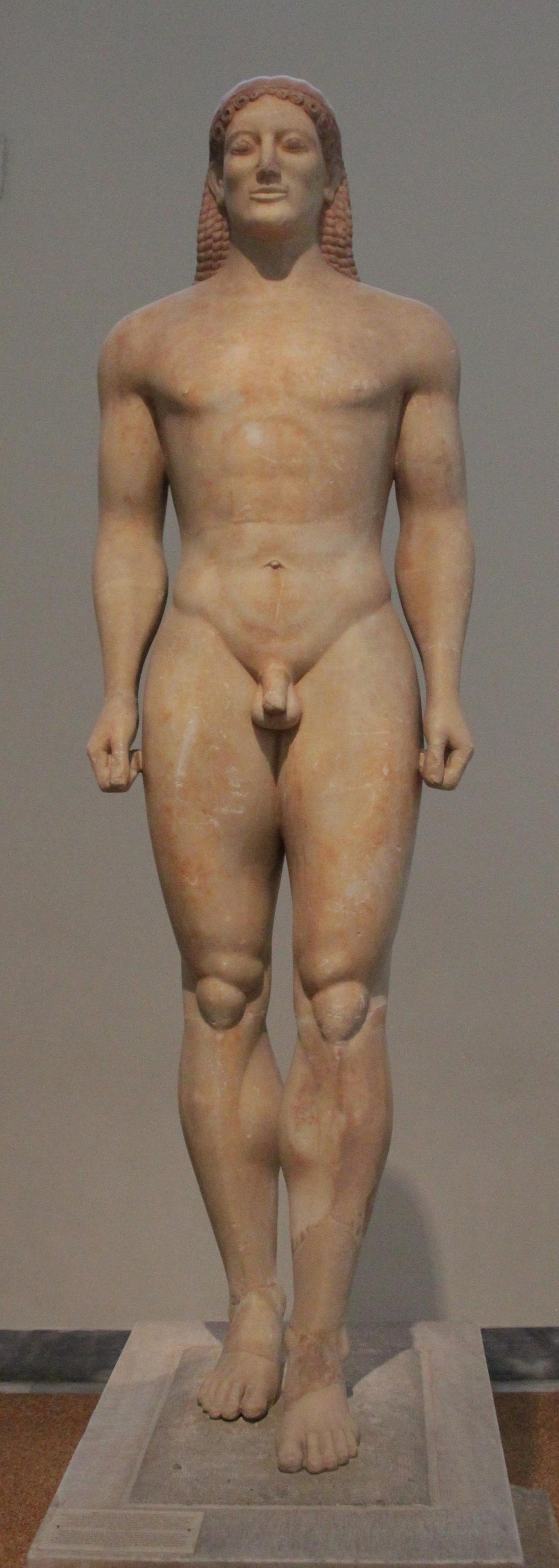
Front view of the Anavysos Kouros, a grave statue turning a real fallen warrior into an ideal, timeless young male body.
Style: from rigid formula to almost-breathing body
Art historians love the Anavysos Kouros because he sits right at a turning point. You can almost see Greek sculpture learning to breathe.
Look first at the legs. Earlier kouroi tend to stand like planks, with the forward leg just sliced ahead. Here, the weight is more convincingly shared. The calves bulge, the ankles narrow, and the muscles of the thighs feel like they wrap around the bone. The transition from chest to abdomen is smoother, the ribs implied rather than drawn as sharp lines. All this keeps the statue firmly in the archaic period but nudges it toward the more relaxed bodies of the early Classical age that you may have seen in Greek god statues.
The head and face still keep older conventions. The hair falls in neat, beaded rows over the shoulders, braided and patterned rather than loose. The eyes are almond-shaped and wide. Most famous is the archaic smile, that faint upward curve at the corners of the mouth. It doesn’t mean he’s “happy” in a modern sense; it’s more a sculptural way to show that the face is alive, with muscles engaged, not inert. If you’ve already read about the archaic smile elsewhere, this is one of the clearest examples.
We also have to mentally add back things that time erased. Traces of pigment on many kouroi suggest they were once painted: hair in darker tones, lips and perhaps nipples picked out with colour, maybe detailing on the eyes. In that original state, the Anavysos Kouros would have looked less like a pure white “classical” statue and more like a vividly present, almost warm body standing in the cemetery.
Mini-FAQ
What is the Anavysos Kouros?
A late archaic marble statue of a standing nude youth, used as a grave marker for a fallen warrior named Kroisos.
Why is it important?
Because it shows how Greek sculptors moved from rigid formulas toward more natural, lifelike bodies while still keeping an idealised, symbolic type.
Inscription, grave and the ideal of dying “in front”
What really anchors this statue in a specific life is not the face; it’s the inscription on the base. Translated, it reads something like: “Stop and show pity at the marker of Kroisos, dead, whom raging Ares destroyed as he fought in the front ranks.”
This one short text tells us a lot. First, the kouros represents Kroisos, a young man who died in battle. Second, it tells any passerby how to behave: pause, feel pity, acknowledge both the loss and the bravery. Third, it underlines a key value in ancient Greek religion and society: dying heroically “in the front ranks” is both tragic and honourable.
So the Anavysos Kouros is doing several jobs at once. As a grave marker, it plugs this one death into a public space, where the community moves around it and remembers. As an image, it uses the familiar, non-portrait type of the kouros to say, “Kroisos was everything a young citizen should be.” And as an object of art, it shows off the most up-to-date skills of a sculptor working at the end of the archaic period.
If you place this statue mentally inside a wider map of ancient Greek city-states, it becomes part of a network of monuments that made values visible. Cemeteries, sanctuaries and city streets were full of figures like this, each one both personal and generic, each one a stone argument about what mattered most in the polis.
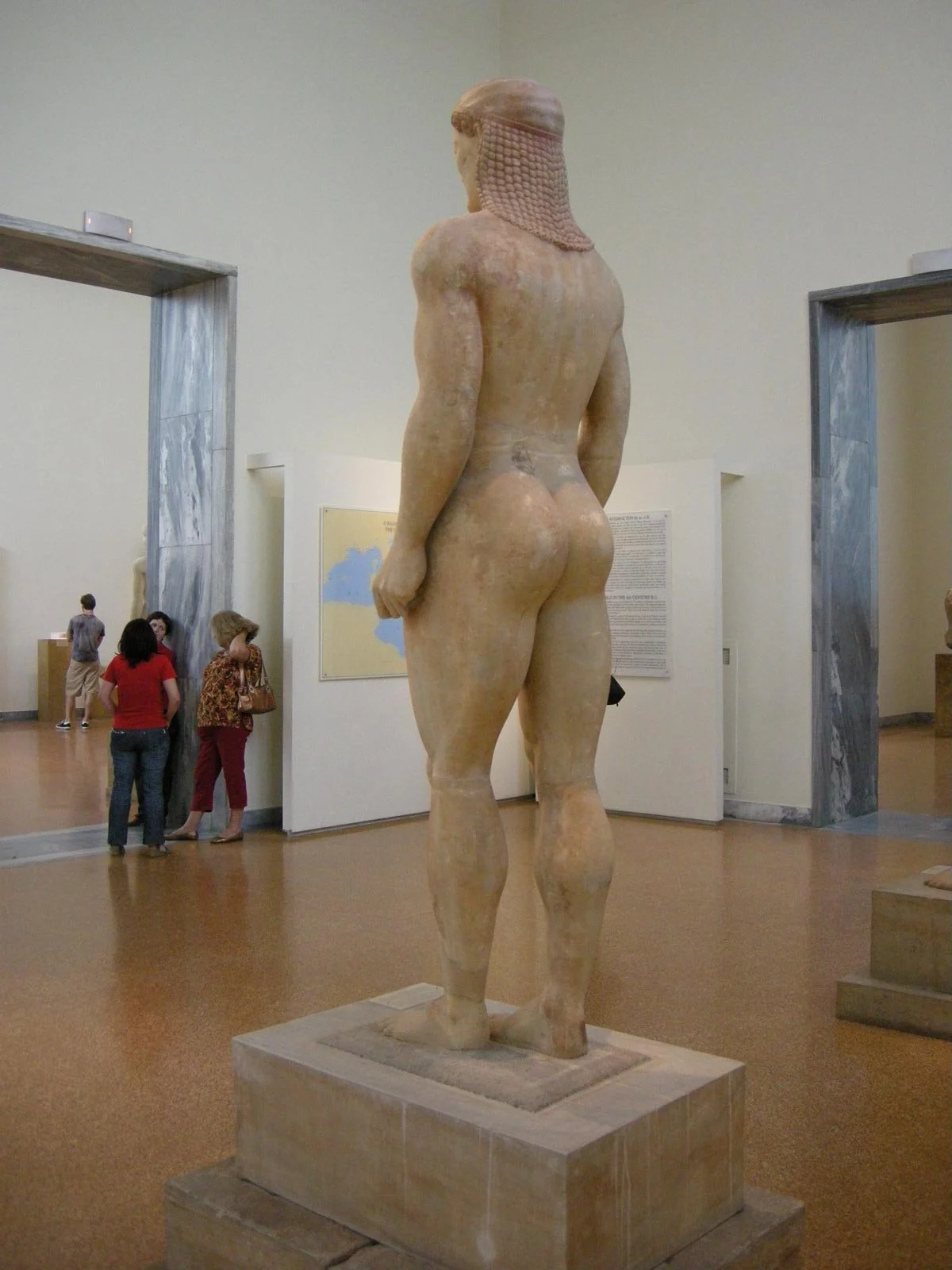
Seen from behind, the Anavysos Kouros reveals how archaic sculptors modelled anatomy, hair and stance with strict symmetry and volume.
Between life and stone: what this kouros still teaches us
Standing in front of the Anavysos Kouros today, we meet him as a clean museum object. The rough edges of his discovery story — dug up illegally, cut in pieces for sale, later reclaimed — stay in the label or the catalogue, not in the marble itself. But even in this distilled form, the statue keeps that strange balance between living body and stone marker.
He no longer carries bright paint, incense or offerings; he now lives in a white-walled gallery alongside other highlights of ancient Greek sculpture. Yet the combination of pose, modelling and inscription still pulls us into the archaic Greek conversation about youth, beauty, bravery and death. The statue lets us practise what Greek viewers once did almost automatically: reading bodies and images as condensed arguments about how to live and how to be remembered.
For our wider journey through archaic Greek sculpture and ancient Greek art, the Anavysos Kouros works like a checkpoint. Earlier kouroi show the formula in its stricter, more geometric form; later Classical statues unfold that promise into full contrapposto and natural movement. This figure sits exactly in between, which is why textbooks love him — and why he’s worth revisiting slowly, each time with slightly different questions.
Conclusion
The Anavysos Kouros is more than a famous example in a timeline; it’s a case study in how a culture uses one body type to hold together ideals, grief and artistic experiment. Once we learn to see how his stance, smile and inscription all work together, other kouroi and grave monuments around Greece start to look less anonymous and more like variations on a shared visual language.
If you keep this statue in mind while exploring other topics — from general overviews of ancient Greek art to close-ups on kouros statues or specific themes in Greek god statues — you get a handy mental benchmark for what “late archaic” really means in stone. And the next time you walk past a heroic figure on a plinth, ancient or modern, you might hear a faint echo of that old epitaph: stop, look, and think about the life behind the image.
You may also like