Polykleitos Doryphoros: Why This Statue Changed Art Forever
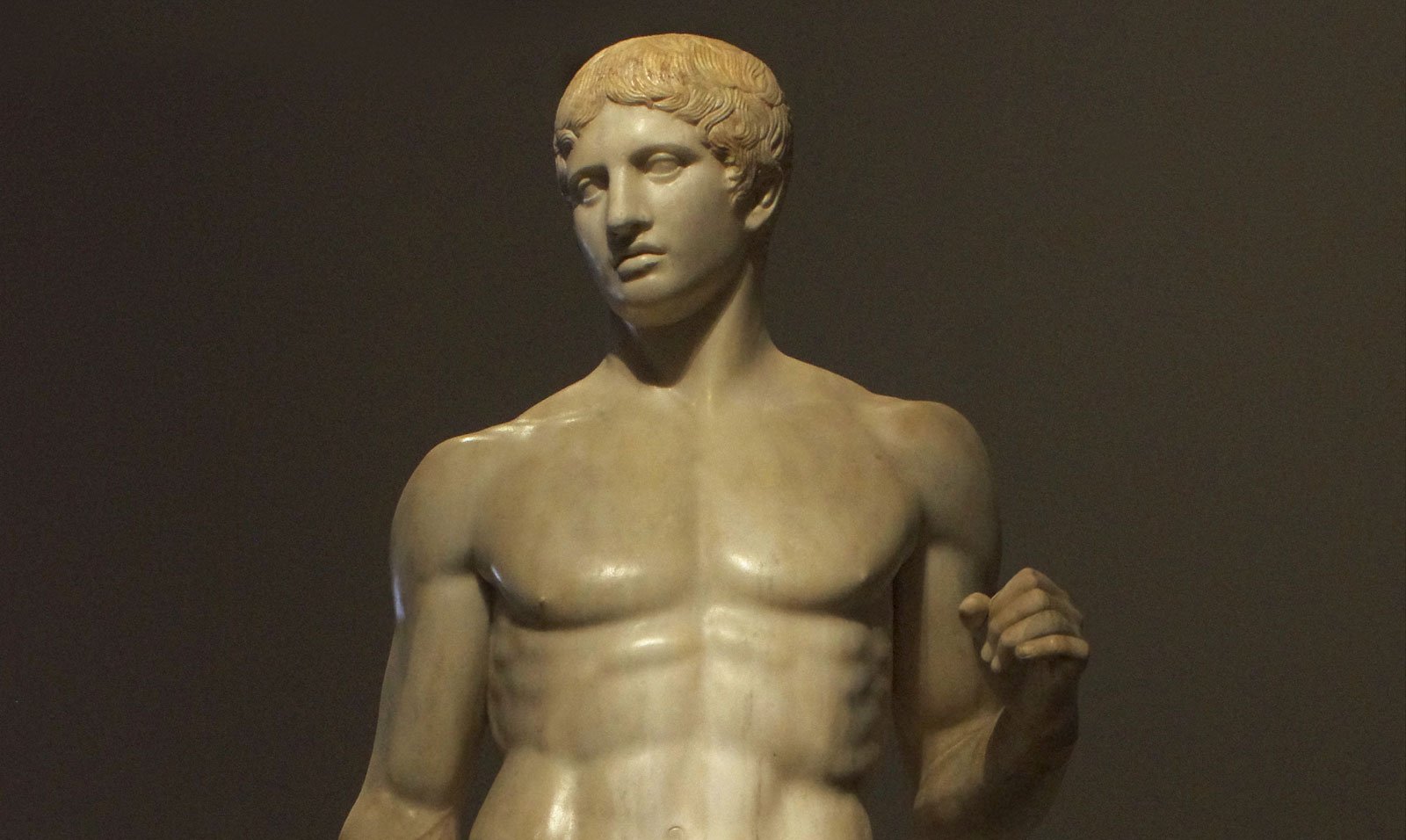
This is the Doryphoros (“Spear Bearer”), the statue that became a cheat-sheet for Classical “ideal” proportions. Notice how calm the face stays, even as the body feels perfectly tuned and alert.
The Doryphoros is one of those statues that looks “normal” until you realize it invented the normal.
A calm young man stands with a spear. He isn’t performing. He isn’t posing dramatically. He’s just… there. Balanced, human, and somehow more “right” than real life. That quiet feeling is exactly why the Doryphoros mattered. It turned the Greek body into a repeatable design system, not just a one-off masterpiece.
In this guide we’ll unpack what the Doryphoros is, why it’s linked to Polykleitos’ theory, and how it became the model for Classical proportion and balance for centuries.
The Doryphoros changed art because it made “ideal” look natural
It did that by treating the body like a system, not a symbol.
First, the basics: Doryphoros means “spear-bearer” in Greek. It was originally a bronze statue made in the mid-5th century BCE by Polykleitos, and what we usually see today are Roman marble copies.
That detail matters. The statue you’ve seen in books is likely not the original. The original bronze is lost, and marble copies come with their own quirks: supports added for stone weight, surface differences, and occasional repairs or restorations. Still, the core invention survives: a body that looks alive without looking dramatic.
To feel why this was new, it helps to keep a “before” in mind. Compare the Doryphoros to the Archaic ‘before’ body type. Archaic kouroi can be powerful and beautiful, but they often read as front-facing icons. The Doryphoros reads like a person caught in a real moment, with weight, breath, and inner balance.
This is also the easiest way to understand why later cultures cared so much. The Doryphoros isn’t just “a nice statue.” It’s a solution to a design problem: how do you build a body that feels real, but still feels ideal?
If you want a simple framework for reading it in a museum, how to read a Greek statue is the exact mindset the Doryphoros rewards: start with stance, then structure, then surface.
Myth vs Fact
Myth: The Doryphoros is “the” marble original.
Fact: The original was likely bronze; marble versions are later copies.
The Canon behind it is why the Doryphoros feels “inevitable”
It’s not just a body, it’s a theory you can see.
Polykleitos wasn’t only a sculptor. He was also a theorist. Ancient writers tell us he wrote a treatise called the Canon (canon = rule-set for proportion). That text is lost, but the idea survived: beauty can be built through measured relationships between parts.
That’s why the Doryphoros is often described as the physical demonstration of the Canon behind it.
Here’s the key concept in plain words: Classical ideal bodies weren’t “found.” They were designed. The body becomes a network of relationships: finger to finger, hand to forearm, forearm to upper arm, and so on. Ancient authors even describe this kind of commensurability, a sense that every part “belongs” to every other part.
This is also why “ideal proportions” don’t mean one magic number. They mean coherence. When Polykleitos’ system works, you don’t think “math.” You think “this body makes sense.”
That bigger concept is exactly what we mean by the ideal proportions tradition: a proportional plan that keeps the figure unified, calm, and believable.
One important qualifier: scholars debate how precisely we can reconstruct Polykleitos’ exact numerical scheme from copies. Copies vary. Materials change outcomes. Measurement points matter. So it’s safest to say this: the Canon’s logic is clear even if the exact formula remains contested.
And that’s enough to explain why the Doryphoros changed art. It turned the ideal body from taste into method.
Contrapposto is the Doryphoros’ “movement engine”
It makes the figure feel alive without breaking the calm.
If the Canon is the rulebook, contrapposto is the pose that makes the rules feel human. Contrapposto means weight shifts onto one leg and the body counterbalances. It’s a chain reaction: hips tilt, spine responds, shoulders adjust, head aligns. The whole figure becomes a system under gravity.
This is why the Doryphoros feels like a person instead of a diagram. The stance suggests time. Not dramatic time, just everyday time. The figure looks as if he has paused mid-step, settled, and could continue.
Polykleitos also makes that balance feel structured. A common way of describing it is chiastic balance (chiastic = crosswise counterbalance). In simple terms: tension on one side is answered by relaxation on the other. The body is asymmetric, but it still feels stable.
If you want to train your eye on this quickly, scan the Doryphoros in this order:
where the weight sits (the “working” leg)
how the hips respond
how the shoulders counter-tilt
how the relaxed arm and leg echo each other
That sequence is the statue’s heartbeat. Once you see it, you start noticing how much Classical art depends on the same strategy: make the body feel alive through structure, not through facial drama.
And this is one reason the Doryphoros became a model for teaching. It’s legible. You can point to it and say, “This is what balance looks like.”
It changed Western art because it became a portable standard
Its influence spread through copies, education, and imitation.
The Doryphoros didn’t change art because everyone saw the one original. It changed art because the type travelled.
Roman culture collected and copied Greek statues obsessively. That copying is one reason we can still study Polykleitos at all. The Doryphoros becomes a kind of curriculum object: a body that represents “Classical rightness.”
Then, centuries later, artists and academies return to Greek sculpture as a foundation for training. The Doryphoros fits that purpose perfectly because it’s not just “pretty.” It’s teachable. It shows:
proportion as a system
contrapposto as controlled life
idealization as design, not fantasy
Even when later artists don’t copy it directly, they absorb its logic. The Doryphoros becomes part of the background software of Western figure-making: how to stand, how to balance, how to make calm feel powerful.
This is also where the comparison to the Archaic world stays useful. If Archaic kouroi helped establish the “human figure as monument,” the Doryphoros establishes the “human figure as living system.” That’s one of the biggest shifts in the story from Archaic to Classical.
So the Doryphoros changed art forever not because it’s the only masterpiece, but because it became a standard that other artists could argue with, learn from, and build on.

Conclusion
The Doryphoros is famous because it makes the impossible look casual. It’s a theory of the body that doesn’t feel like theory. It’s proportion you can sense without measuring. It’s contrapposto that feels like a human pause, not a pose.
And once we learn to read it that way, the Doryphoros stops being “a famous nude.” It becomes a key for decoding Classical sculpture itself: not realism, but engineered harmony.
FAQ
What is Polykleitos’ Doryphoros?
A “spear-bearer” statue that became a model of Classical proportion and balance.
Was the Doryphoros originally marble?
Probably not. The original was likely bronze; many surviving versions are Roman marble copies.
Why is the Doryphoros linked to the Canon?
Because it’s widely treated as the visual demonstration of Polykleitos’ proportional rule-set.
What does contrapposto do in the Doryphoros?
It shifts weight and triggers a full-body counterbalance that makes the figure feel alive.
Why did it influence later Western art so strongly?
Because it became a repeatable standard through copies and teaching traditions.
Sources and Further Reading
Smarthistory — “Polykleitos, Doryphoros (Spear-Bearer)” (n.d.).
The Metropolitan Museum of Art — “The Art of Classical Greece (ca. 480–323 B.C.)” (2008).
Cambridge University Press (Andrew Stewart) — “The Canon of Polykleitos: A Question of Evidence” (1978).
Getty Publications — “Polykleitos and His Followers at Work” (2017).
Lexicon Philosophicum (CNR) — “Il Canone di Policleto” (2018).
Museum of Classical Archaeology, University of Cambridge — “Doryphoros (cast record)” (n.d.).
Cornell University Library (Cornell Cast Collection) — “Doryphoros (Roman Copy), fragments” (2008 image; original ca. 440 BCE).
You may also like