How to Read Parthenon Sculptures as One Visual Program
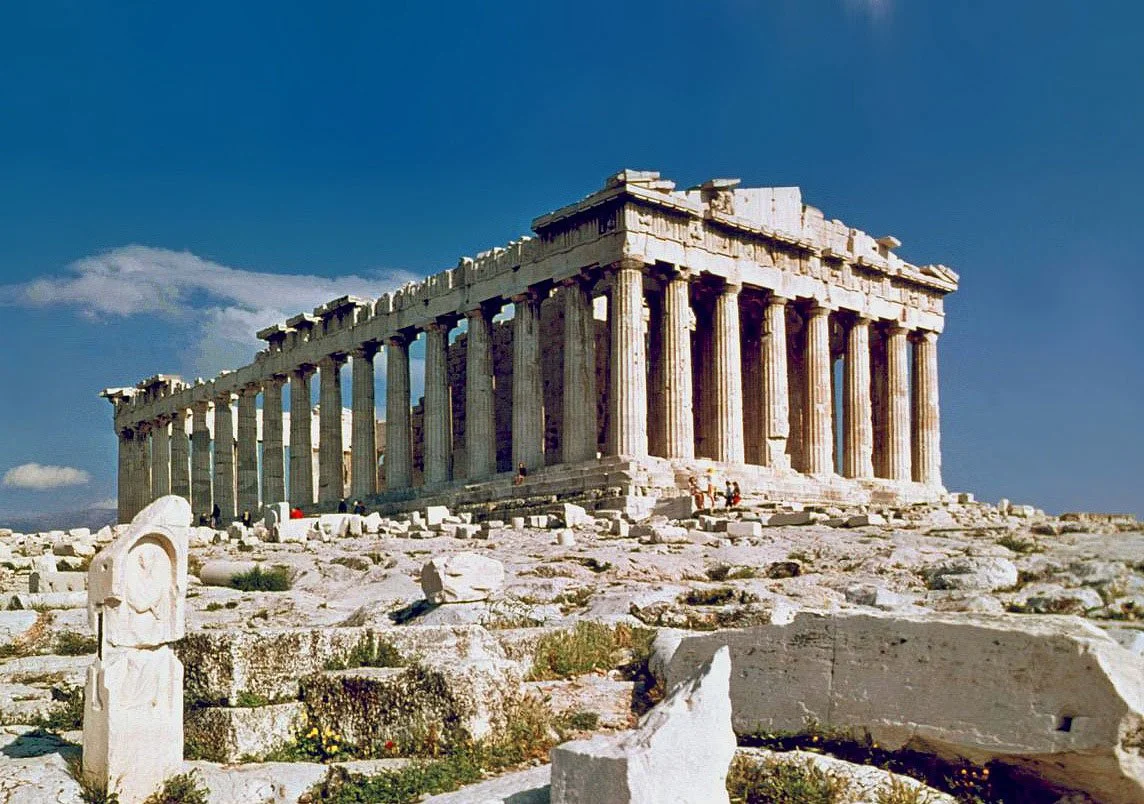
The Parthenon reads as simple from far away—but up close it’s packed with precision: column rhythm, refined proportions, and a layout built for processions and viewing. Ruins like this are where architecture becomes both building and memory.
The first time you really look at the Parthenon’s sculpture, it can feel like a scattered playlist: battles here, gods there, a long crowd scene running around the building, and then… a giant statue we don’t even have anymore. So it’s tempting to treat the pieces as separate “masterworks.”
But the Parthenon sculptures were never meant to be visited like a gallery. They were designed to be read together in place, on one specific building, by people who already knew the myths, the festivals, and the political mood of Athens. Once we start reading them as one connected message, everything gets clearer and honestly, a lot more intense.
Definition: A visual program is a planned set of images that work together to communicate one idea.
The Parthenon’s sculptures are one argument, not separate “decorations”
If we treat the Parthenon sculptures like a random greatest-hits compilation, we miss what they’re doing. They’re closer to a carefully edited speech. Each part says something different, but they all push in the same direction.
Here’s the simplest way to hold it in our heads: the temple “speaks” on multiple levels at once.
Up high, the pediments (triangular gable sculptures) tell big origin myths.
On the outer ring, the metopes (square relief panels) show violent mythic conflicts.
Closer in, the frieze (a continuous sculpted band) shows a civic procession that feels almost real.
Inside, the missing anchor was Athena Parthenos (the temple’s cult statue of Athena).
That stack matters. It’s a visual hierarchy: from cosmic myth, to raw conflict, to the city’s own ritual life, to the goddess herself. And because this is a temple, everything is ultimately framed as an offering. If you want the quick architectural grounding for why temples work this way, it helps to start with how Greek temples were built, because sculpture on a Greek temple isn’t “extra.” It’s part of the building’s job.
Also, the Parthenon isn’t standing alone. It’s part of a larger sacred landscape, and that context changes how the imagery reads. If you’ve ever heard people say “Acropolis” when they mean “Parthenon,” this is where the correction matters: Parthenon vs Acropolis.
So yes, we can admire individual scenes. But the real power comes when we read them as a single system, guiding the viewer from mythic time down into Athenian time.
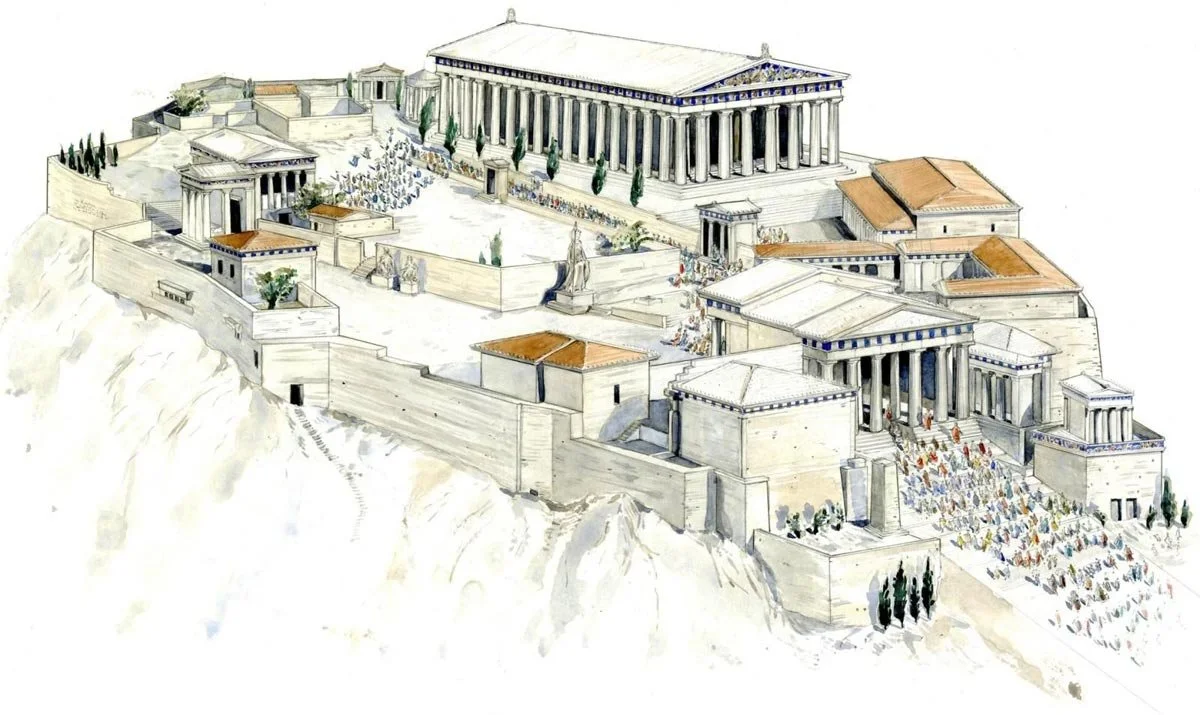
Reconstructions help us remember the Acropolis wasn’t a “lonely temple on a hill”—it was a busy sacred landscape. Seeing the whole complex together makes the Parthenon feel like one powerful piece inside a larger choreography.
The building itself tells you how to read the sculpture
Want a slightly nerdy but very useful trick? Before we “read” images, we read placement.
The Parthenon is primarily a Doric temple (Doric = sturdy, simple column style), but it makes choices that are unusually ambitious. Those choices shape the sculpture’s meaning. Even the decision to combine Doric structure with an Ionic-style frieze (Ionic = more ornate, scroll-like capitals) is a signal that Athens is playing with categories, not just following rules.
This is where basic column language becomes surprisingly practical. If you’ve ever mixed up Doric and Ionic, types of Greek columns helps you spot what the building is “saying” before any figure appears.
Now imagine your body on site. You approach the temple from below, you circle it, you look up, the sun shifts. Many of the sculptures are placed where they’re hard to see clearly, which sounds like bad design… until you realize the program isn’t built for close reading of every detail. It’s built for impact.
At some angles, you register silhouette and rhythm more than faces. At others, you catch a highlight on a horse’s chest or a goddess’s knee and your brain fills in the rest. The Parthenon is engineered for perception, not for a static “front view.” (We’ll come back to that when we talk about viewing paths and optical tricks in the Parthenon.)
Even measurements matter, because scale is part of the emotional effect. When you look at key measurements, you understand why the sculpture has to be bold in outline. The building eats detail for breakfast.
So the first big move is this: don’t start by zooming in. Start by asking, “Where is this image, who was meant to see it, and from how far?”
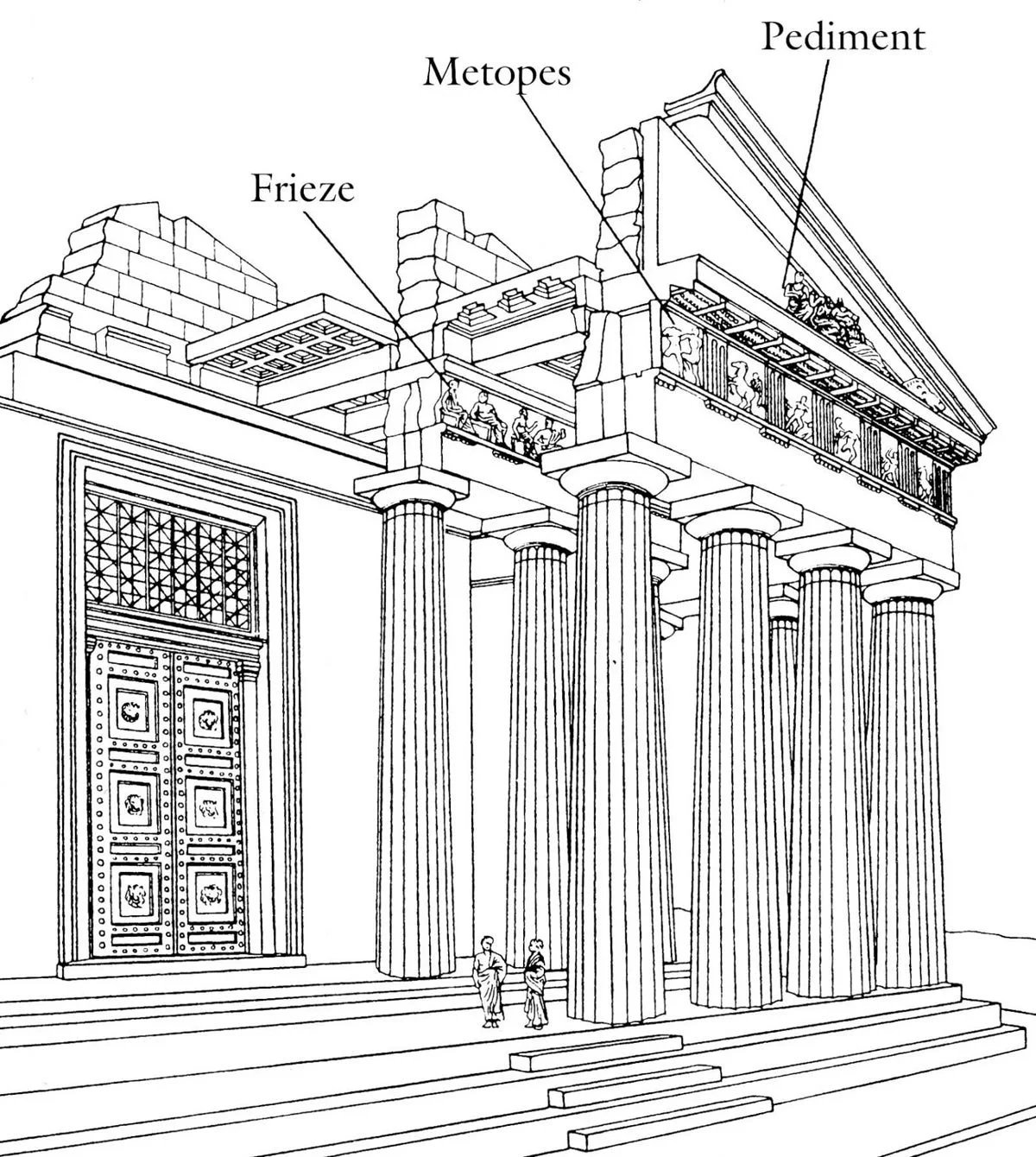
If you ever mix up where the sculptures go, this is the cheat sheet: pediment is the triangle, metopes are the “picture panels,” and the frieze runs like a continuous band. Once the map clicks, the Parthenon’s decoration becomes easier to read.
The Parthenon pediments frame Athens as chosen by the gods
The Parthenon pediments sit at the ends of the building like two mythic headlines. A pediment (triangular gable sculpture) is prime real estate: it’s high, visible, and it marks the “face” of the temple.
What do you put there, if your goal is a unified message? You put the myths that justify Athens’s identity.
Traditionally, the east pediment is associated with Athena’s birth (Athena emerging, fully armed, from Zeus’s head). The west pediment is linked to the contest between Athena and Poseidon for Athens (a myth explaining why Athena becomes the city’s patron). Even if details of reconstruction are debated, the core point is stable: these are not random myths. They’re Athens-origin myths.
And notice the emotional structure. These scenes aren’t just stories. They’re arguments in the form of stories:
Athens belongs to Athena.
Athena belongs to the Olympian order.
Therefore, Athens belongs inside cosmic legitimacy.
This is where Athena’s iconography becomes more than a fun spotting game. Her symbols (owl, olive, helmet, aegis) are identity markers, not decorations. If you want to recognize her quickly across media, how to spot Athena and Athena’s symbols make the pediment logic easier to “read” at a glance.
So the pediments don’t just tell myths. They set the tone: Athens is not merely powerful. It is authorized.
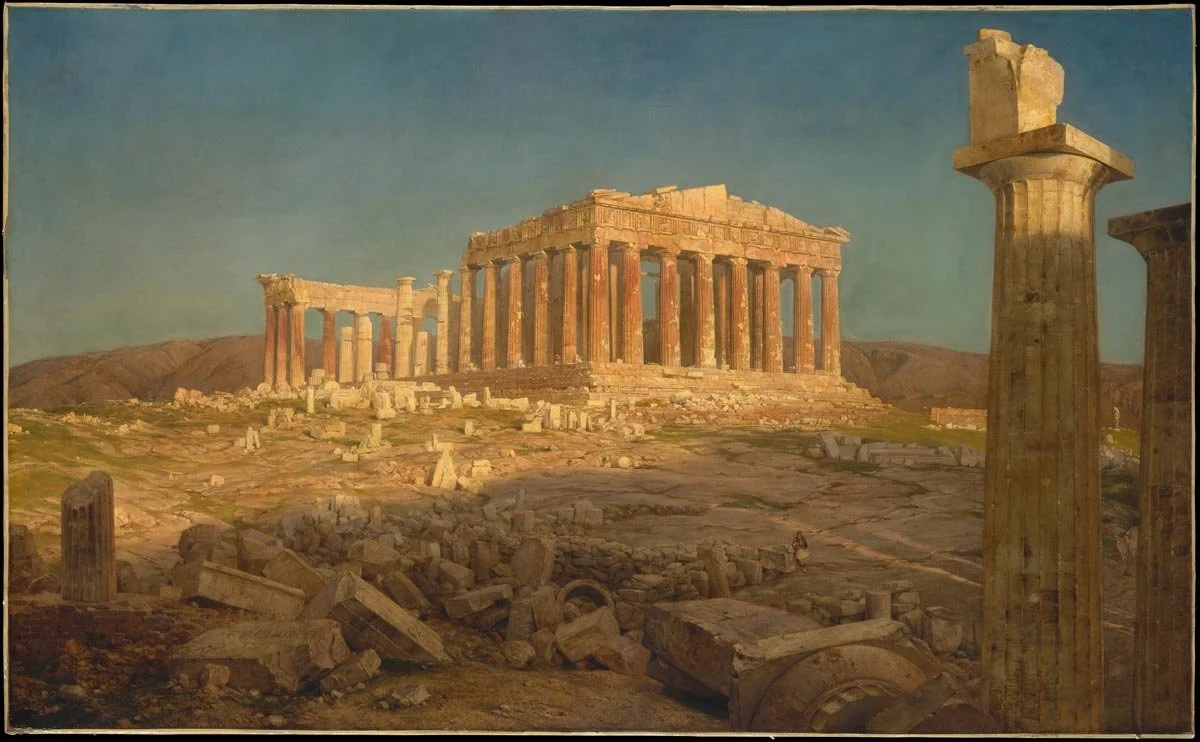
Romantic-era views of ruins don’t just document—they feel the past. The Parthenon becomes a mood: architecture as atmosphere, time, and longing, not only stone and geometry.
Parthenon metopes put chaos on the outside, so the inside feels like order
The Parthenon metopes are the punchiest sculptures on the exterior because they’re built for contrast. A metope is a single square panel, usually with one intense scene, framed by architecture. That format is perfect for conflict.
On the Parthenon, the metopes are famous for showing mythic battles that Greeks associated with the triumph of order over disorder. The common grouping goes like this:
Centauromachy (Lapiths vs Centaurs)
Amazonomachy (Greeks vs Amazons)
Gigantomachy (Olympian gods vs Giants)
Trojan War scenes
If those names feel like alphabet soup, the pattern is simple: civilized order is threatened, then restored. And the important thing is where these scenes sit: on the outer skin of the building, facing the world.
That placement turns the temple into a kind of moral boundary. Outside is the realm of danger, appetite, invasion, excess. Inside is the realm of the goddess and the city’s right relationship with her.
This is also why “violence” here doesn’t read as gore for entertainment. It reads as a political and ethical claim: Athens can face chaos and remain Athens.
When you read Parthenon metopes as part of the program, they start to feel less like myth-illustrations and more like a warning label on the city’s identity. Greatness is fragile. Order must be maintained.
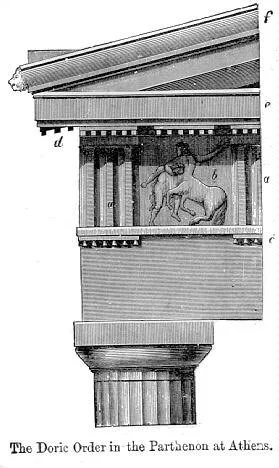
This kind of cutaway is great for learning the Doric “stack”: columns, then the frieze with triglyphs/metopes, then the roof edge above. It’s the moment where structure and storytelling literally meet.
The Parthenon frieze turns a real festival into something almost mythic
Now we step inward to the most emotionally strange part: the Parthenon frieze.
A frieze is a long continuous band, which means it behaves like time. It unfolds. It moves. It invites you to follow it. And unlike the metopes, it isn’t dominated by monsters. It’s dominated by people: riders, elders, musicians, animals for sacrifice, girls carrying offerings.
Most interpretations connect it to the Panathenaic procession (a major civic-religious festival for Athena), but what matters for us is what that choice does in the program.
The frieze makes Athens itself look like it belongs on a temple. Not just its gods. Not just its legendary heroes. Its citizens. Its rituals. Its public identity.
That is a wild move.
It suggests that the city’s communal life can be presented as worthy of divine attention. It also blurs a line we usually keep sharp: mythic time versus everyday time. On the Parthenon, the city’s own ritual looks elevated, rehearsed, almost timeless.
If you want a guided walk through how the procession scenes connect (and how to read the rhythm of the figures), the Parthenon frieze is the close-up companion piece to this big-picture article.
And because procession is a religious act, it also helps to know what Greek religion was in daily practice: offerings, festivals, reciprocal relationships with gods. That’s where ancient Greek religion becomes more than background. It’s the frieze’s operating system.
Athena Parthenos is the missing center, and we should read the sculpture with that absence in mind
Here’s the part that always makes me pause: the Parthenon’s most important image was not on the outside at all.
Inside stood Athena Parthenos, a colossal cult statue (cult statue = the main sacred image of a god in a temple), made of gold and ivory over a core. We don’t have it. We have descriptions, copies, echoes. But in the original experience, it was the gravitational center.
So when we read the exterior sculpture, we should read it as pointing inward.
The pediments tell you who Athena is in myth.
The metopes tell you what Athena’s order resists.
The frieze tells you how the city aligns itself with her through ritual.
All roads lead to the goddess.
This is one reason the Parthenon’s program feels coherent even when individual scenes are debated. It’s structured like a funnel: the further you move into the sacred zone, the more the imagery moves from cosmic struggle to civic participation to divine presence.
If you want to sit with what we can (and can’t) confidently say about that lost statue, Athena Parthenos is where we can slow down and separate evidence from reconstruction.
And this is also where meaning stops being one-note. A cult statue isn’t only “art.” It’s an object of relationship. It’s a focal point for offerings. It’s where the city performs devotion.
So yes, the Parthenon sculptures can be read politically. But inside the logic of a Greek temple, they’re also deeply religious. Athena isn’t a metaphor first. She’s the recipient.
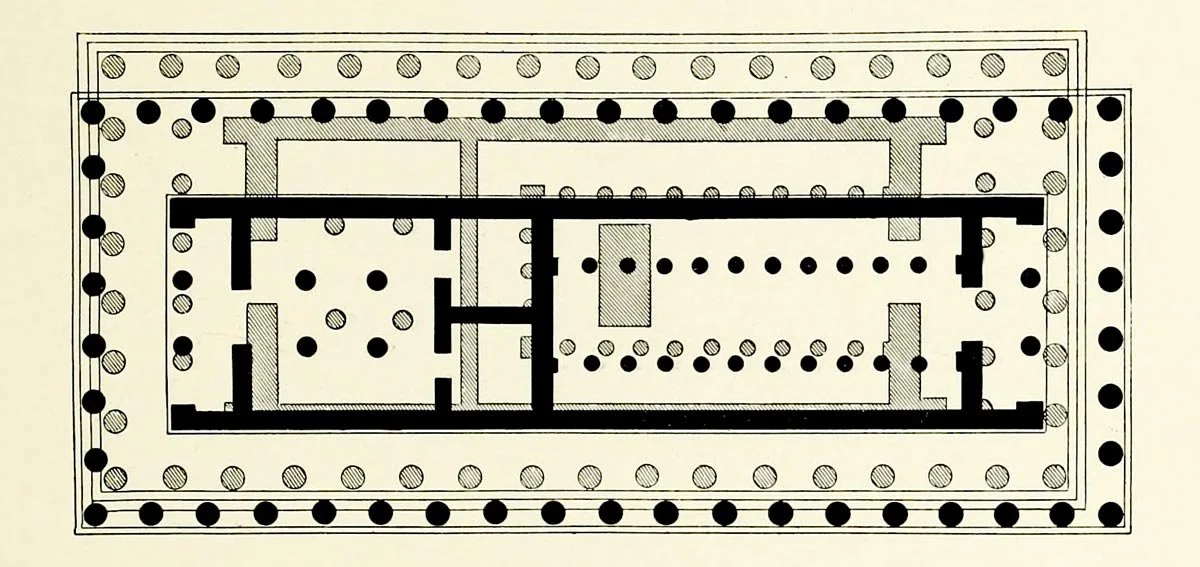
Floor plans show what photos can’t: how the temple is organized as a sequence of spaces and boundaries. Here the peristyle (outer colonnade) frames the inner rooms like a architectural “buffer” between city, ritual, and statue.
The program is designed for movement, distance, and imperfect seeing
Let’s be honest: we tend to imagine ancient viewing as crisp and museum-like. But the Parthenon is not built for that.
A lot of the sculpture was hard to see clearly from the ground. Some of it is high. Some of it is tucked in. Some of it is better read as shape than detail. That difficulty isn’t a failure. It’s part of the strategy.
When you circle a temple, you don’t receive a single “image.” You receive a sequence. You catch fragments. Your mind stitches them into coherence. That stitching is exactly how a program works: it doesn’t require you to read every figure’s face. It requires you to absorb a world.
This is where the Parthenon’s famous refinements matter, because they show how much the builders cared about human perception. The same culture that adjusted columns to correct visual distortion also understood that sculpture is read by bodies in space. If you’ve ever fallen into the rabbit hole of curvature and subtle corrections, optical tricks in the Parthenon is the perfect companion.
And if you’ve heard modern claims about perfect mathematical secrets, it’s worth holding those lightly. The Parthenon is sophisticated, but internet certainty can be… enthusiastic. proportion myths helps keep our admiration evidence-forward.
So when we say “visual program,” we don’t mean a static poster. We mean a designed experience: approach, circle, look up, look again, and leave with the feeling that Athens is both human and mythic at once.
Myth vs Fact
Myth: The Parthenon sculptures were meant for close-up viewing like a museum display.
Fact: Much of the program works through distance, movement, and partial views.
“What does the Parthenon mean?” depends on how many layers we’re willing to hold
At this point, it’s fair to ask the question people always ask: is the Parthenon “about” religion, politics, or art?
Yes.
The Parthenon’s sculptural program is coherent precisely because it allows multiple truths to sit on top of each other:
Religious layer: the temple honors Athena through myth and ritual.
Civic layer: the city presents itself as worthy, ordered, devout.
Political layer: Athens frames its power as legitimate and divinely aligned.
That last layer can feel uncomfortable, especially if we want art to be pure. But the Parthenon is built in a specific historical atmosphere, and its imagery is one way Athens narrates itself to Athenians and to visitors. It is a statement in marble.
This is where it helps to anchor the building in time. If you want the straight timeline context, timeline of the Parthenon keeps the big picture clear. And if you want to connect the message to the humans who actually planned the structure, architects and design choices makes the “program” feel less abstract and more like a real project with real decision-makers.
If you want the fullest version of this question, with the layers laid out carefully, this is exactly what what the Parthenon ‘means’ is for.
Because maybe the best way to say it is this: the Parthenon doesn’t give you one meaning. It trains you to think in stacked meanings, like the sculpture itself.
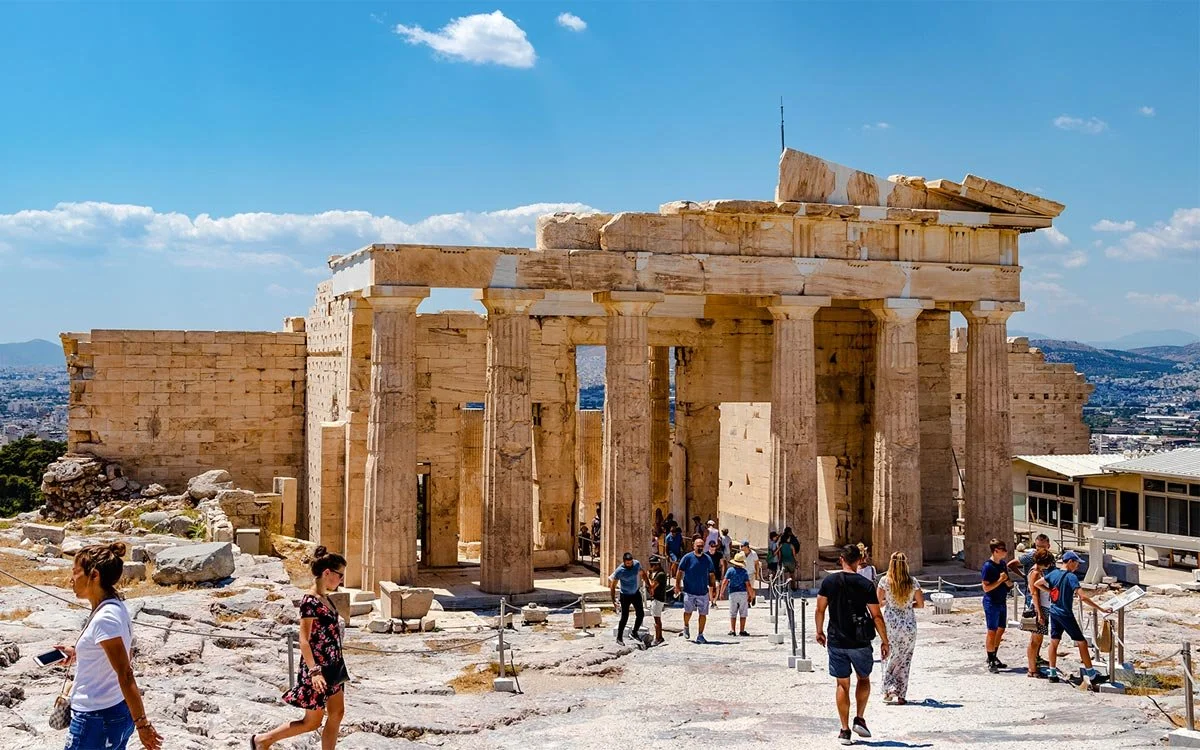
Approaching the Acropolis is part of the design: the gateway funnels your movement, controls your sightlines, and builds anticipation. Even today, the visitor path helps us feel how ancient architecture staged experience.
Conclusion
When we read the Parthenon sculptures as one visual program, the building stops being a pretty ruin with famous fragments. It becomes a designed experience that moves us from mythic origins, through conflict and civic ritual, into the presence of Athena. And once we notice that structure, we start seeing a bigger truth about Greek art: it’s rarely “just decoration.” It’s a way of organizing values in public space, with astonishing discipline.
That’s also why studying the Parthenon is such a good gateway into the wider world of Greek art and architecture. It trains our eyes to ask better questions: who is the intended viewer, what is the setting doing, and what story is the whole environment trying to tell?
FAQ — How to Read Parthenon Sculptures as One Visual Program
What are “Parthenon sculptures”?
They’re the temple’s sculptural system: the pediments (ends), metopes (outer panels), frieze (continuous band), plus the lost central cult statue of Athena.
What does it mean that they’re “one visual program”?
It means the images were planned to work together as one message, not as isolated artworks.
What’s the difference between frieze, metopes, and pediments?
A frieze is a continuous band, metopes are square relief panels, and pediments are triangular sculpture groups at the temple’s ends.
What is the Parthenon frieze showing?
It likely represents the Panathenaic procession, a major civic-religious festival for Athena, presented as a timeless civic ritual.
Why are the metopes so violent compared to the frieze?
Because they show mythic conflicts that frame “order vs chaos,” setting the temple’s outer boundary as a place where disorder is defeated.
Who was Athena Parthenos?
Athena Parthenos was the colossal cult statue inside the Parthenon, the missing centerpiece that the entire exterior program ultimately points toward.
Sources and Further Reading
Acropolis Museum — “The Parthenon Gallery” (n.d.)
Acropolis Museum — “The Parthenon frieze” (n.d.)
British Museum — “An introduction to the Parthenon and its sculptures” (2018)
Robin Osborne (The Journal of Hellenic Studies) — “The Viewing and Obscuring of the Parthenon Frieze” (1987)
Richard Stillwell (Hesperia) — “The Panathenaic Frieze: Optical Relations” (1969)
Ellie Mackin Roberts (The Classical Quarterly) — “(Re)appraising the Parthenon Frieze: ‘Divinespace’ and ‘Mortalspace’” (2025)
Giovanni Verri et al. (Antiquity) — “The goddess’ new clothes: the carving and polychromy of the Parthenon Sculptures” (2023)

You may also like