Ionic Columns: How They Differ from Doric and Corinthian
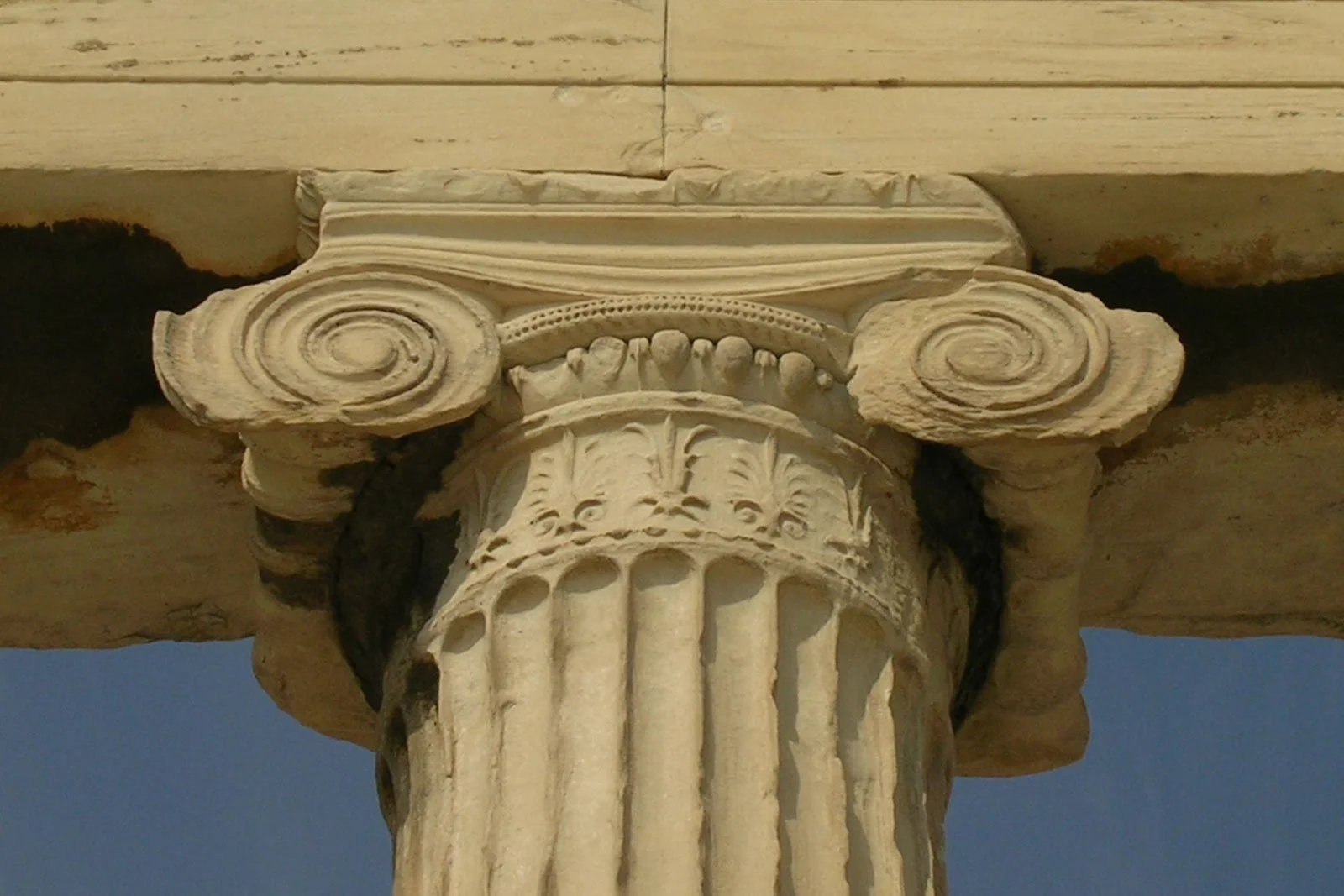
An Ionic capital up close, its scrolls and ornament explain why this order felt lighter and more elegant than the solid Doric column.
At some point, “Ionic” just becomes a word we recite in the Doric–Ionic–Corinthian trio without really seeing it. Then you notice a column with a neat base and little spiral ears at the top, and you realise: this isn’t just “a column”, it’s a completely different attitude to weight, proportion and decoration.
In this guide, we slow down and give Ionic columns a close-up. We will start with the basic features (base, shaft, capital), then compare them calmly with Doric and Corinthian, and finally see where the Ionic order shows up on real buildings. If you want the wider picture, you can keep our overview of types of columns and the broader map of Greek architecture open in other tabs while we zoom in here.
Definition. Ionic columns are slender, fluted supports with bases and scroll-like capitals (volutes), used in one of the main classical architectural orders.

Ionic columns have a clear “signature”: base, slender shaft, scroll capital
The easiest way to approach Ionic columns is to treat them as a visual signature. If you remember three things – base, slim shaft, scroll capital – you already have a strong starting point.
First, the base. Unlike Doric columns, which traditionally stand straight on the stylobate (the top step of the temple platform), Ionic columns almost always sit on a moulded base that lifts them gently off the ground. This base is usually made from stacked rings and curves, giving a soft transition between floor and shaft. Ancient treatises and modern summaries both underline this base as a key difference from Doric.
Second, the shaft. Ionic shafts are more slender and tall than Doric ones, with more and deeper flutes. Those vertical grooves catch light and shadow more delicately, making the column feel less chunky and more refined. Writers often describe Ionic proportions as “graceful” or even “feminine” compared to the sturdier Doric.
Third, the capital. This is where most people recognise Ionic at a glance. The capital has two large spiral scrolls, called volutes, curling out to either side. Often, there is also a band of carved ornament (like egg-and-dart) just below, tying the scrolls back to the shaft. Reference works from Britannica to Oxford and specialist glossaries all agree: the volute capital is the most distinctive Ionic feature.
Above the columns, the entablature (the horizontal “beam” zone) often carries a continuous frieze – a long band of sculpture – instead of the broken triglyph-and-metope rhythm we see in Doric. Guides like Smarthistory and the Met point to this unbroken frieze as another major Ionic signal, especially on temples such as the Temple of Athena Nike.
Once you put these clues together – base, slimmer fluted shaft, scrolls, continuous frieze – Ionic stops being vague and starts feeling like a concrete “look” you can pick out from a distance.
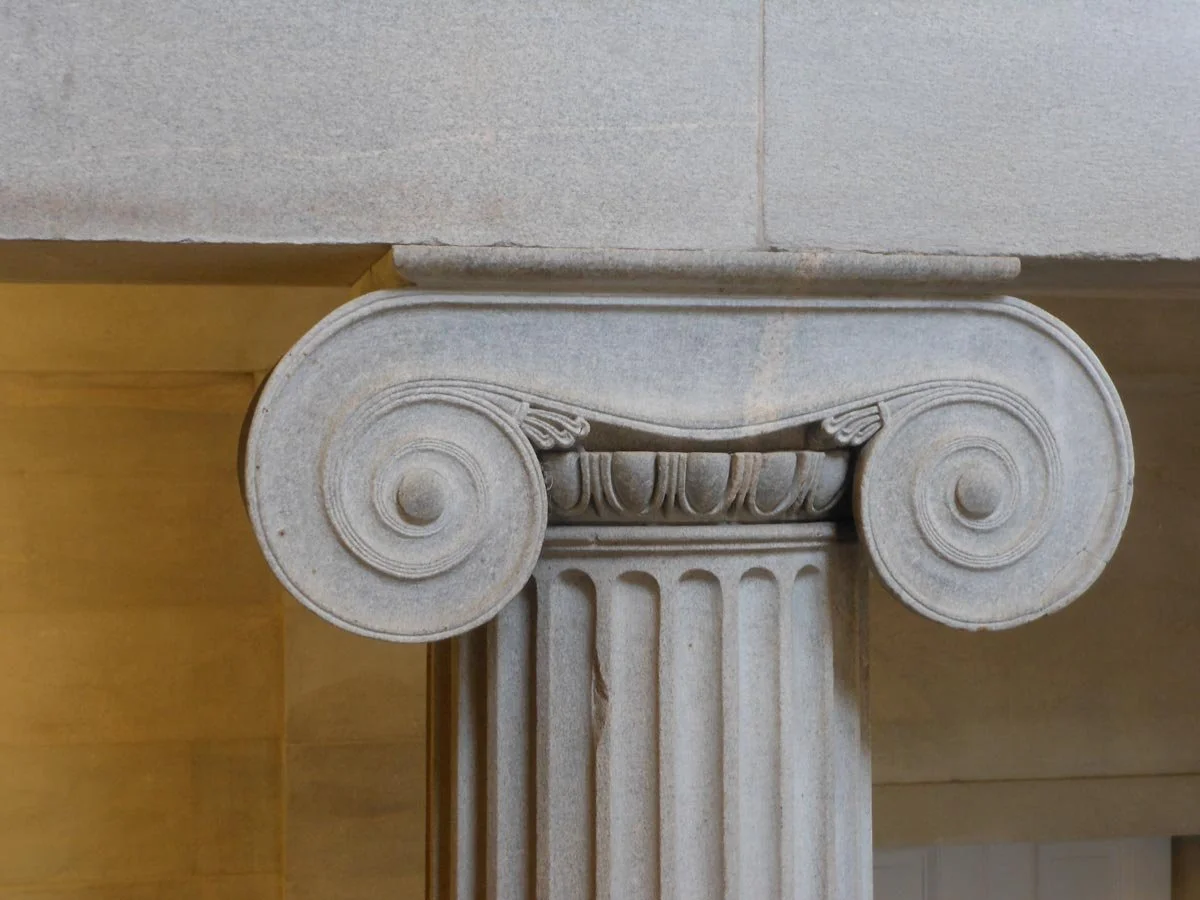
An Ionic capital seen up close: the spiral volutes, egg-and-dart moulding and shallow flutes show the order’s quiet refinement.
Ionic vs Doric vs Corinthian: three orders, three moods
So how does the Ionic order actually sit between Doric and Corinthian? Thinking in terms of contrasts helps the differences stick.
Compared to Doric, Ionic is lighter and more articulated. Doric columns have no base, thicker shafts, simpler capitals and that very graphic triglyph/metope frieze. Everything about Doric stresses strength, clarity and a kind of structural bluntness. Ionic, by contrast, adds a base, refines the shaft, and dresses the capital in scrolls. The frieze turns into a continuous strip, which is ideal for long narrative sculpture. Where Doric is blocky and muscular, Ionic feels more drawn-out and elegant. This difference is why many architectural histories talk about the two as complementary “voices” in the Greek toolkit.
Compared to Corinthian, Ionic is calmer and less busy. Corinthian columns share the same basic base-and-shaft setup, but their capitals explode into tiers of carved acanthus leaves, with small scrolls tucked into the foliage. In technical terms, Corinthian is more ornate and appears later, becoming a favourite of Hellenistic and Roman designers who want maximum decorative impact. The Ionic capital, with its two main volutes and limited leaf decoration, is much more restrained. Summaries of the classical orders routinely describe Corinthian as the most elaborate of the three, with Ionic as the middle ground between Doric simplicity and Corinthian exuberance.
In everyday reading, you can think of it this way:
Doric – no base, thick, plain capital, broken frieze rhythm.
Ionic – base, slender, scroll capital, continuous frieze.
Corinthian – base, slender, leafy capital, often very ornate overall.
For a more complete side-by-side, our beginner’s guide to types of columns walks through all three orders together, but in this article we keep returning to one core idea: Ionic represents a choice to give a building finer proportions and a more decorative, but still controlled, profile.
Mini-FAQ
Q: What is the main difference between Ionic and Doric columns?
A: Ionic columns have bases and volute (scroll) capitals, while Doric columns have no bases and simple cushion-like capitals.
Where the Ionic order appears in Greek temples and structures
Ionic is not just a style; it is also tied to certain regions and building types. Knowing where it tends to appear helps you read maps and ruins together.
Historically, many scholars locate the origins of the Ionic order in Ionia, the band of Greek cities along the western coast of modern Turkey and nearby islands. The Met’s essays on Archaic Greek art and architecture point out that by the early sixth century BCE, two main orders are firmly in play: the Doric of mainland Greece and western colonies, and the Ionic of eastern Greek cities and islands. Early Ionic temples and fragments appear in places like Ephesus and Priene, where the more delicate style seems to fit coastal, trading cities that are plugged into wider eastern Mediterranean influences.
As time goes on, the Ionic order travels. In Classical Athens, it plays key roles on the Acropolis. The Temple of Athena Nike is a clean textbook example: a small, elegant Ionic temple with a continuous sculpted frieze around the cella. The Erechtheion mixes Ionic columns on its porches and the famous Caryatid figures on the south side, wrapping a complicated sacred history in a very refined architectural skin. Guides from Smarthistory and Oxford’s architectural dictionaries love using these buildings as case studies for the order in its mature form.
Beyond temples, Ionic also shows up in stoas, interiors and hybrid complexes, often alongside Doric. A building might have a Doric outer colonnade and Ionic columns inside, or use Ionic for upper storeys to lighten the visual weight. This flexibility means that, in practice, the order is less rigid than textbook diagrams suggest. Our broader look at ancient Greek structures shows how column choices tie into function: a stoa framing the agora, a temple terrace, or a sanctuary court all “speak” differently depending on whether they use Doric or Ionic rhythms.
If you zoom all the way out, Ionic becomes part of the long story that runs from early megaron-type halls to fully developed Greek temples. It is one answer to a recurring question in Greek design: how do we hold up stone roofs while making the support system itself beautiful, legible and expressive?
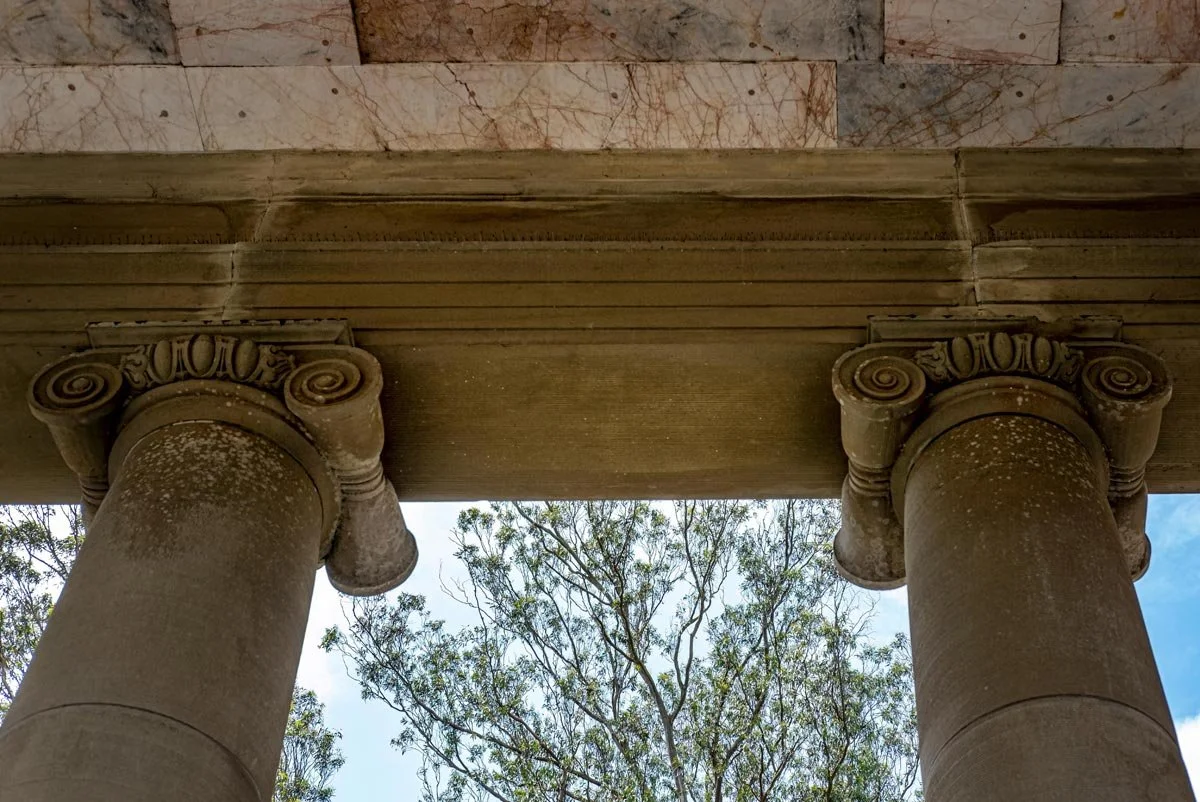
Looking up at a neoclassical portico, with painted coffers and colourful Ionic capitals recalling how ancient temples once blazed with colour.
How to spot Ionic columns today (and not just in ruins)
The nice thing about the Ionic order is that it travelled far beyond ancient Greece. Once you know what to look for, you will start seeing Ionic columns on museums, libraries, universities and even town halls built in neoclassical styles.
When you stand in front of any columned façade, try a quick three-step scan:
Check the base. Is there a clear moulded base under each column? If not, you can probably rule out Ionic.
Look at the capital. Do you see two big scrolls (volutes) curling out sideways? If yes, you almost certainly have Ionic.
Glance at the frieze. Above the columns, is there one long continuous band, or a rhythm of blocks and gaps? A continuous frieze supports your Ionic diagnosis; triglyphs and metopes nudge you towards Doric.
Pairing this with a bit of context from ancient Greek art can be fun. Architects from the eighteenth and nineteenth centuries often revived specific orders to send specific messages. Doric might signal seriousness and strength, Ionic a learned elegance, Corinthian a more aristocratic flamboyance. So, when you spot Ionic on a modern courthouse or library, you are seeing a conscious quote from Greek architecture, not just a random decorative choice.
The more you practice this kind of looking, the more the order system stops feeling abstract. Instead, it becomes a living part of how you read cities, both ancient and modern.
Conclusion
Ionic columns can look intimidating at first: another label to memorise on top of Doric and Corinthian. But once we slowed down, a very clear image emerged: columns on bases, slim fluted shafts, scroll capitals and often a continuous frieze. We have seen how that package sits neatly between Doric solidity and Corinthian lushness, and how its history runs from eastern Greek cities to the Acropolis and far beyond.
For me, the most useful change is that Ionic now feels like a choice rather than a fact. When an architect in the fifth century BCE or the nineteenth century CE picks the Ionic order, they are choosing a certain balance of strength and elegance, of decoration and restraint. If you connect this article with our broader guide to types of columns, plus the bigger picture of Greek architecture and ancient Greek art, you will start to see those choices everywhere.
Next time you visit a site or walk past a neoclassical building, pick one column and read it from base to capital. Ask: “Is this Ionic? If yes, why here?” That tiny exercise is exactly the kind of slow, attentive looking that turns architectural orders from vocabulary lists into tools for understanding how people shape space over time.
You may also like