What Is a Kouros Statue? Quick Guide to Archaic Greek Youths
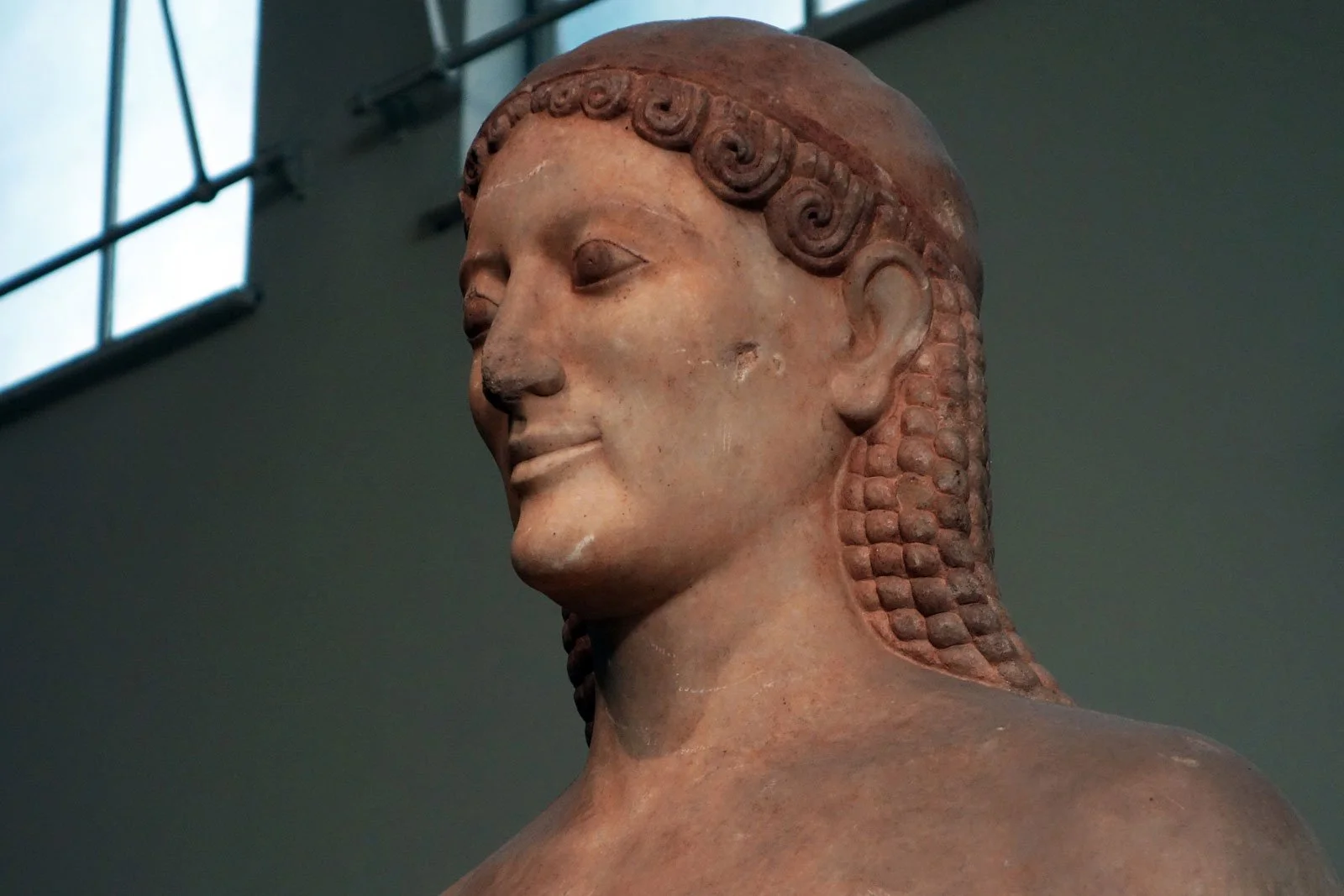
The archaic smile on this kouros head feels distant yet oddly friendly, a sculptural trick that turns anonymous stone youth into someone we can greet.
You know that tall, rigid Greek guy in museums? One foot forward, arms glued to his sides, calm half–smile on his face? That’s a kouros. Once you see one properly, you start spotting them everywhere in books, slides and gallery rooms, and they stop being “generic statue of a naked man” and become a very specific idea: what an ideal young male looked like in archaic Greece.
Here we’ll keep it short and clear: what a kouros statue is, how to recognise it, and why the Greeks spent so much stone and effort on this one standing pose.

What is a kouros statue, in plain language?
A kouros (plural kouroi) is an archaic Greek statue of a standing nude youth, usually life-size or bigger, made in stone and set up as a dedication or grave marker.
Think of them as the “template” figure of archaic Greek sculpture:
The figure stands frontally, facing us.
The left leg is advanced, right leg back, but weight is still evenly shared.
Arms hang straight down, fists clenched, often with thumbs forward.
The body is nude, idealised and young, with stylised muscles.
The head shows the famous “archaic smile” and patterned hair.
Definition
A kouros statue is a freestanding stone figure of a nude young man, standing frontally with one leg forward, made in archaic Greece.
Kouroi appear in the late 7th and 6th centuries BCE, exactly the period you meet in overviews of ancient Greek sculpture and ancient Greek art. They show Greeks experimenting with large-scale stone bodies, learning how to carve anatomy, and testing how a single pose can carry many meanings at once.
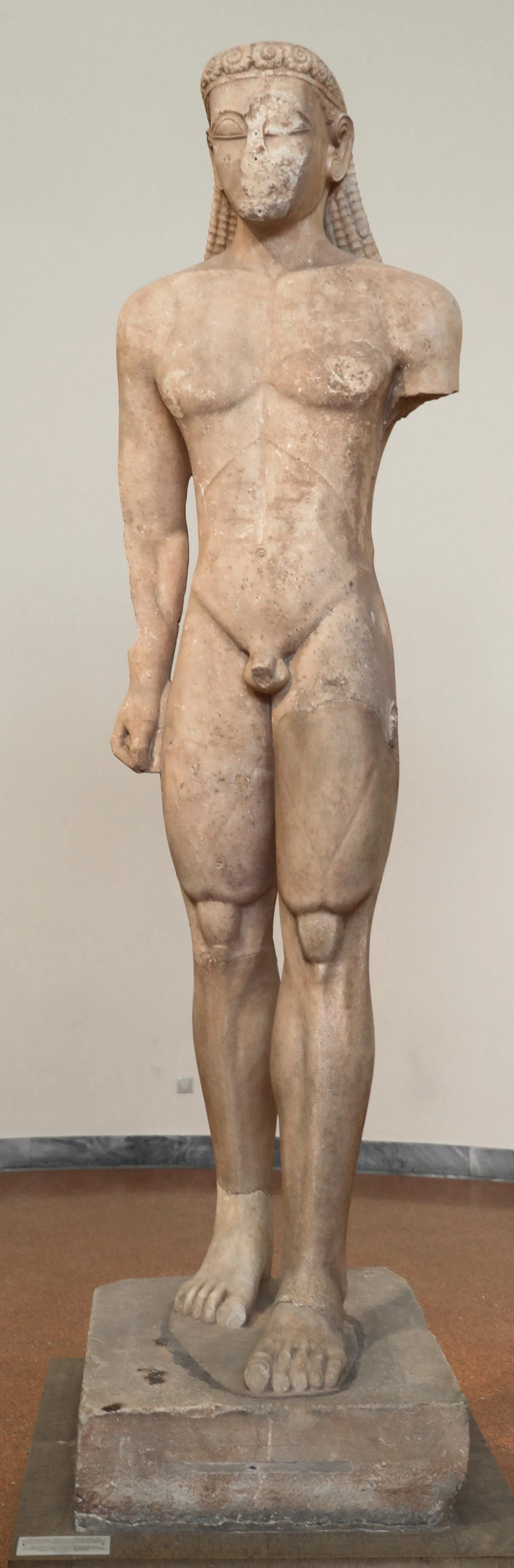
This early kouros from Sounion shows the formula: stiff stance, patterned hair, and a body halfway between Egyptian block and living boy.
How to recognise a kouros: pose and style
When you’re standing in front of a statue and wondering “kouros or not?”, a quick checklist helps.
Pose
The kouros stance is very specific: one leg forward, but still stiff overall. Unlike later classical contrapposto, the hips do not tilt and the shoulders remain level. It feels like the figure is about to move but hasn’t quite worked out how.Body type
Kouroi are young, athletic and idealised. Muscles are mapped out with clear lines: pectorals as simple rectangles, the “archaic V” from chest to hips, knees and shins drawn almost like diagram shapes. Proportions gradually become more natural over time, which is why comparing early figures to the later Anavysos Kouros is so instructive.Head and face
Look for the archaic smile: lips slightly upturned, not because the youth is happy but as a conventional way to give life to the stone. Hair is often arranged in tight, patterned locks or braids, falling symmetrically over the shoulders or down the back.Support and setting
Many kouroi stand on simple bases, sometimes with inscriptions if they mark a grave. Others were dedicated in sanctuaries. This is where they meet themes you see again in Greek god statues and ancient Greek religion: the idealised body acts as a link between humans, heroes and gods.
Once you’ve trained your eye on a few examples, the kouros stance becomes as recognisable as a logo: even broken torsos or legs start to read as “part of a kouros” because of these repeated choices.
What kouroi meant in archaic Greece
So why did archaic Greeks keep returning to this one standing youth?
First, the kouros is a shorthand for ideal youth: strength, beauty, readiness for war or athletic competition. As grave markers, kouroi often stand for someone who died young, especially in battle, without being literal portraits. The Anavysos Kouros famously commemorates a fallen warrior, using the perfect body to honour a specific person.
Second, in sanctuary contexts, kouroi can function as offerings to the gods, symbolising devotion or asking for favour. Here they sit alongside other dedication types you might meet when studying early temple sites or even architecture like the megaron in earlier Aegean cultures.
Third, kouroi are learning tools in stone. Through them, sculptors move from more rigid, geometric schemes towards bodies that feel almost alive. If you line up several, you can literally watch Greek artists figuring out how to turn frontal blocks into convincing anatomy and space. That’s why kouroi keep appearing in any course or book that traces the road from archaic stiffness to classical naturalism.
Conclusion
A kouros statue is more than a stiff, nude boy from a distant past. It’s a compact formula that combines ideal youth, social values and artistic experimentation in one standing pose. Once you know the basic recipe – frontal stance, one leg forward, archaic smile, stylised yet athletic body – you start seeing kouroi not as generic examples, but as milestones in a story about how Greeks imagined and carved the human figure.
As you keep exploring archaic Greek sculpture, notice how individual kouroi tweak the formula: a deeper chest here, a more natural step there, a more introspective face somewhere else. Each variation tells you something about what artists, patrons and communities were trying to say with these young stone bodies.
You may also like