Roman Temple Architecture: From Podium to Portico
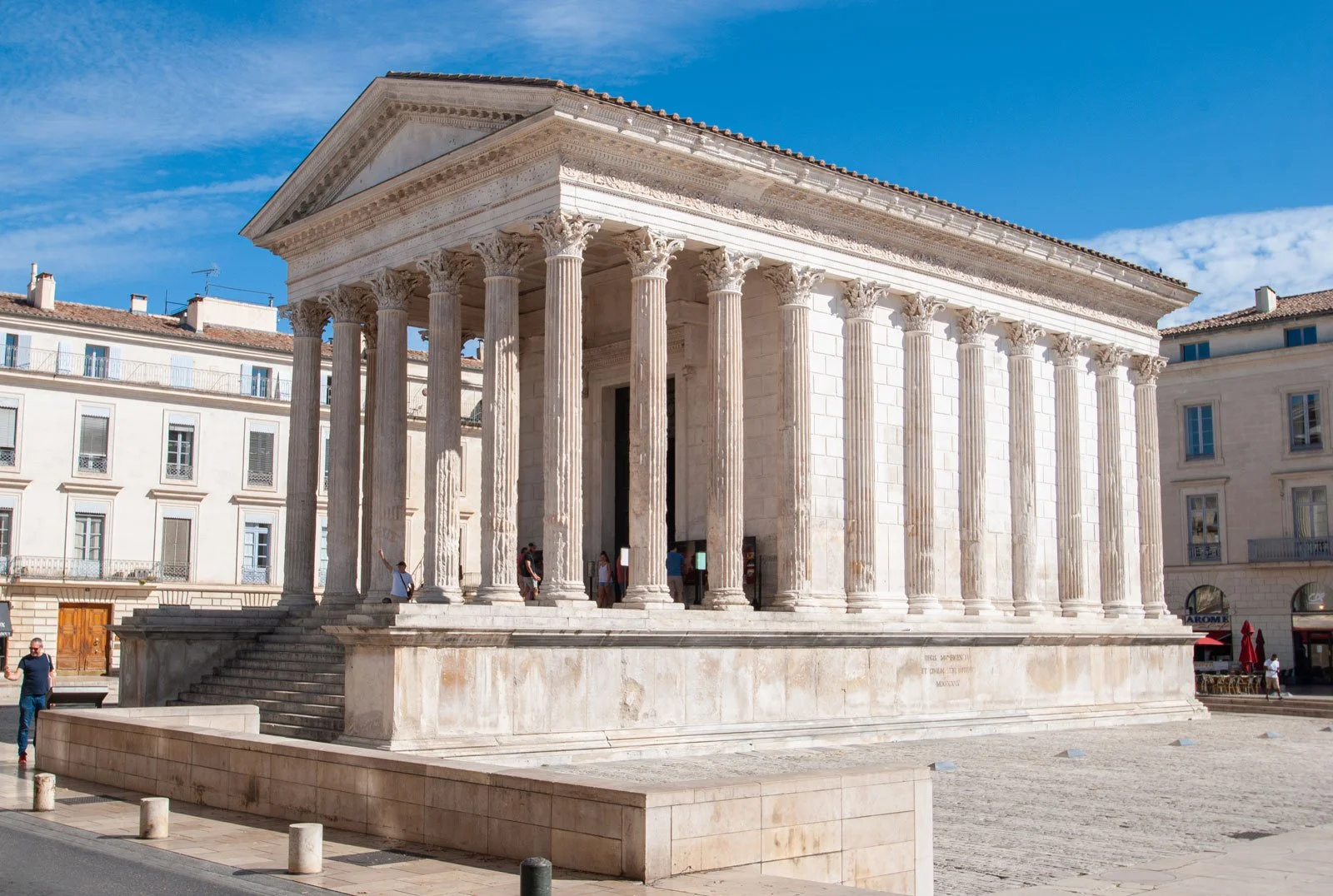
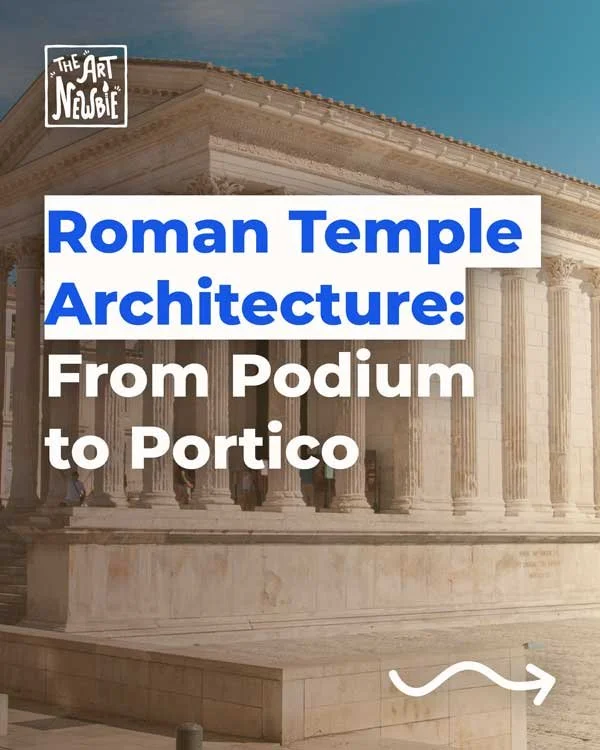
The Maison Carrée makes Roman temple architecture easy to read because the building is frontal, elevated, and built for approach.
A Roman temple looks familiar at first, especially if you already know something about Greek architecture. There are columns, a porch, a cella, and often a triangular pediment above the entrance. But Roman temple architecture is not just a copy of Greek models. The Romans borrowed from earlier traditions, especially Greek and Etruscan ones, then reorganized the temple into something more frontal, elevated, and urban.
That shift matters. A Greek temple often feels like an object you can move around and view from all sides. A Roman temple more often feels like a building designed for approach. You climb toward it. You face it. You meet it from the front. The high podium, the deep portico, and the single main stair all help produce that experience.
This is why Roman temple architecture is so useful to study. It shows Rome doing something it often did very well: taking inherited forms and giving them a new practical and spatial logic.
Quick answer
Roman temples were usually raised on a high podium, approached from the front, and organized around a deep porch and a cella behind it. They borrowed Greek columns and ornament, but they reshaped the temple into a more frontal and urban type.
What is a Roman temple?
A Roman temple is a sacred building dedicated to one or more gods in the Roman religious world. In basic terms, it includes a cella, meaning the inner sacred chamber, and usually a porch with columns at the front. But that definition only gives the parts. The more interesting question is how those parts were arranged.
Roman temples were usually designed to create a clear frontal experience. Instead of treating all sides of the building equally, they emphasized the entrance side. This is one of the main differences between Roman temple architecture and many Greek precedents.
That does not mean all Roman temples looked identical. There were rectangular temples, circular temples, imperial cult temples, and local variants across the empire. Some were small and tightly integrated into city fabric. Others were grand monuments in forums or sanctuaries. The Pantheon complicates the picture even further because it joins a temple front to an enormous rotunda. If you want to follow that exceptional case more closely, see when was the Pantheon built.
Still, for a beginner, one broad description works very well: the Roman temple is a sacred building that takes older Mediterranean temple language and reorganizes it around podium, portico, and frontal approach.
Why did Roman temples feel frontal?
Roman temples felt frontal because they were usually designed to control how you arrive.
A high podium lifts the building above ground level. A single stair or stairway at the front directs movement to one main entrance axis. A deep porch emphasizes the facade rather than the flanks. All of this makes the temple less like a freestanding sculptural object and more like a building that stages approach.
This is one of the clearest distinctions from the Greek temple. In many Greek temples, the external colonnade wraps around the whole building, and the structure can be appreciated from multiple sides. The building is often conceived as a balanced object in the landscape. Roman temples, by contrast, often privilege one main face.
That frontal quality does not come from nowhere. It has strong roots in Italic and Etruscan traditions. If you look at Etruscan architecture, you can already see the importance of high podiums, deep porches, and strongly directed entry. Roman temple architecture develops out of that background while also absorbing Greek forms and ornament.
This is why Roman temples can feel both familiar and different. They may use Greek-looking columns, but the spatial message is not exactly Greek. The temple is not only something to look at. It is something to mount and face.
What did podium and portico do?
The podium and the portico are two of the most important parts of the Roman temple type.
The podium is the raised platform on which the temple stands. It does several things at once. Practically, it lifts the sacred building above the street level around it. Visually, it gives the temple more authority. Spatially, it helps concentrate access at the front. A Roman temple on a high podium is never casual. It asks to be approached deliberately.
The portico, or front porch with columns, does something slightly different. It creates a transitional zone between city and sacred interior. You are no longer simply outside, but you are not yet in the cella either. That threshold matters. Roman temples often use a deep portico to make the entrance sequence feel more pronounced.
Together, podium and portico turn the temple front into the building’s strongest statement. This is one reason the title “from podium to portico” is such a useful way to think about Roman temples. Those two elements summarize the temple’s spatial logic.
They also help explain why Roman temple architecture fits so well into the larger world of Roman architecture. Roman builders were deeply interested in approach, threshold, urban presence, and controlled movement. The temple type reflects that.
How much came from Greece?
A great deal came from Greece, especially the language of columns and entablature. Roman temples borrowed the established classical orders and much of the ornamental vocabulary associated with Greek architecture. That is why Roman temples can look immediately classical to us.
The Romans used Doric, Ionic, and Corinthian orders, and they later developed or standardized specifically Roman variants such as the Tuscan and Composite. If you want to follow that vocabulary more closely, it helps to look at types of columns, the Doric column, and Ionic columns. Roman temples inherit that language, but they do not always use it with the same structural logic the Greeks preferred.
This is an important distinction. In many Roman temples, the columns on the front are free-standing, but the columns along the sides may be engaged, meaning attached to the wall rather than standing free. This creates what is often called a pseudoperipteral arrangement: it looks as though the temple has a surrounding colonnade, but much of that colonnade is merged into the wall.
That solution is very Roman. It preserves the visual prestige of Greek colonnades while strengthening the building’s frontal emphasis and wall-based structure. It also shows why the Romans were so interested in adapting forms rather than copying them exactly.
So yes, Greek influence is essential. But Roman temple architecture is not Greek architecture transplanted unchanged. To understand the older model more clearly, it helps to compare it with Greek architecture as a whole.
What came from Etruscan tradition?
If Greece gave Rome much of its formal vocabulary, Etruscan and Italic traditions gave it much of its spatial attitude.
The Etruscan temple is especially important here. It typically emphasized a deep porch, a high podium, and a strong frontality. Those features created a sacred architecture designed less for all-around viewing and more for directed entry and urban display. Roman temples inherit a great deal from that logic.
This is why Roman temple architecture often feels like a synthesis. From Greek architecture it takes columns, orders, entablatures, and much of the monumental language of stone temples. From Etruscan architecture it takes the elevated base, the frontal staircase, and the emphasis on the temple front as the main face.
That synthesis becomes very clear in the Temple of Portunus in Rome. It uses Ionic columns and a pseudoperipteral plan that reflects Greek influence, but it also stands on a high podium and strongly directs the viewer’s approach from the front. In other words, it looks Roman precisely because it holds both traditions together.
So when we ask where Roman temple architecture comes from, the answer is not “from Greece alone.” It comes from a Mediterranean mix that Rome reorganized into its own sacred type.
Which Roman temples show it best?
A few examples make the Roman temple type much easier to grasp.
The Temple of Portunus is one of the clearest early examples. It shows the classic Roman combination of high podium, frontal emphasis, and Greek-derived columnar language. It is especially useful because the building is compact and legible. You can read its logic almost at a glance.
The Maison Carrée at Nîmes is another key example, and one of the best preserved Roman temples anywhere. It pushes the Roman type toward extraordinary refinement. Its high podium, deep portico, frontal axis, and engaged side columns make the Roman temple formula especially clear. If you want one monument that almost seems to define the type, this is often the one.
Then there is the Pantheon, which both belongs to and stretches beyond the tradition. Its front porch still presents itself as a Roman temple facade, but behind that facade is a domed rotunda that transforms the very idea of sacred space. That is why the Pantheon should be treated as both a Roman temple and a radical rethinking of what a temple could become.
These examples together show something important: Roman temple architecture is consistent enough to recognize, but flexible enough to evolve.
Why did Roman columns matter differently?
Columns matter in Roman temples, but not always in the same way they matter in Greek ones.
In Greek architecture, columns are often deeply tied to the building’s structural expression. They are not just decorative. They visibly carry the entablature and define the temple as a post-and-lintel system. Roman temples inherit that language, but they often use it more flexibly.
A Roman temple may use free-standing columns on the facade to create prestige and depth, while relying more heavily on walls behind and around them. It may also use engaged columns along the sides, preserving the appearance of a colonnade without giving those columns the same structural role. This changes the balance between wall and column.
That is why Roman pillars matter in their own right. Roman architecture keeps the classical column, but often places it inside a broader wall-based and spatially more complex architecture.
This does not make Roman columns less important. It makes them differently important. They continue to carry symbolic and visual authority, but they often work within a building that is less purely columnar than a Greek temple.
Why were Roman temples so urban?
Roman temples were often deeply integrated into city life. They were not only isolated sacred structures placed in a landscape. Many stood in forums, near marketplaces, at key civic nodes, or in relation to processional routes.
This urban setting reinforced their frontal logic. A temple raised on a podium and facing a public square does not need equal treatment on all sides in the same way that a freestanding sanctuary building might. Its role is to command the space in front of it.
That urban condition is one reason Roman temple architecture feels so tied to public life. A temple was religious, of course, but it was also political, ceremonial, and civic. It contributed to the organization of the city and to the visual language of Roman power.
This again helps explain why Roman temples differ from many Greek precedents. They belong to a more densely built and administratively organized world, where architecture is often designed in relation to streets, forums, and concentrated urban approach.
Why does Roman temple architecture matter?
Roman temple architecture matters because it shows Rome’s broader architectural method very clearly. The Romans did not start from zero. They borrowed, adapted, merged, and redirected. Then they made the result feel coherent enough that we now recognize it as distinctly Roman.
The Roman temple is one of the best examples of that process. It takes Greek columns and orders, Etruscan frontality and podium logic, and Roman urban priorities, then fuses them into a sacred building type that feels at once inherited and new.
It also matters because it changes how we think about classical architecture. “Classical” is not one fixed thing. It contains real differences between Greek and Roman ways of shaping space. Roman temples make that visible immediately.
Once you learn to notice podium, portico, frontal stair, deep porch, and engaged side columns, Roman temple architecture becomes much easier to read.

Conclusion
Roman temples were not simply Greek temples in Roman clothing. They borrowed heavily from Greek architecture, but they reorganized those borrowed forms into a more frontal, elevated, and urban sacred type. The high podium, deep portico, and emphasis on approach are the clearest signs of that shift.
That is what makes Roman temple architecture so interesting. It shows Rome doing what it often did best: turning inheritance into a new spatial logic.
FAQ
What is the main difference between a Greek and Roman temple?
A Roman temple is usually more frontal, with a high podium and main stair at the front, while a Greek temple is often conceived more equally on all sides.
What is the podium of a Roman temple?
The podium is the raised platform under the temple. It lifts the building above the ground and helps focus approach on the entrance side.
What is a portico in Roman temple architecture?
The portico is the columned front porch of the temple. In Roman temples it is often deep, making the entrance sequence more pronounced.
Did Roman temples copy Greek columns?
Yes, Roman temples borrowed Greek column orders such as Doric, Ionic, and Corinthian, but often used them in more flexible and wall-based ways.
What does pseudoperipteral mean?
It means a temple appears to have a surrounding colonnade, but many of the side and rear columns are actually engaged, attached to the wall.
Is the Pantheon a Roman temple?
Yes, though it is an unusual one. Its porch follows the Roman temple tradition, but its domed interior radically expands what a temple could be.
Sources and Further Reading
You may also like