Roman Bridges: Why the Arch Made Them Strong
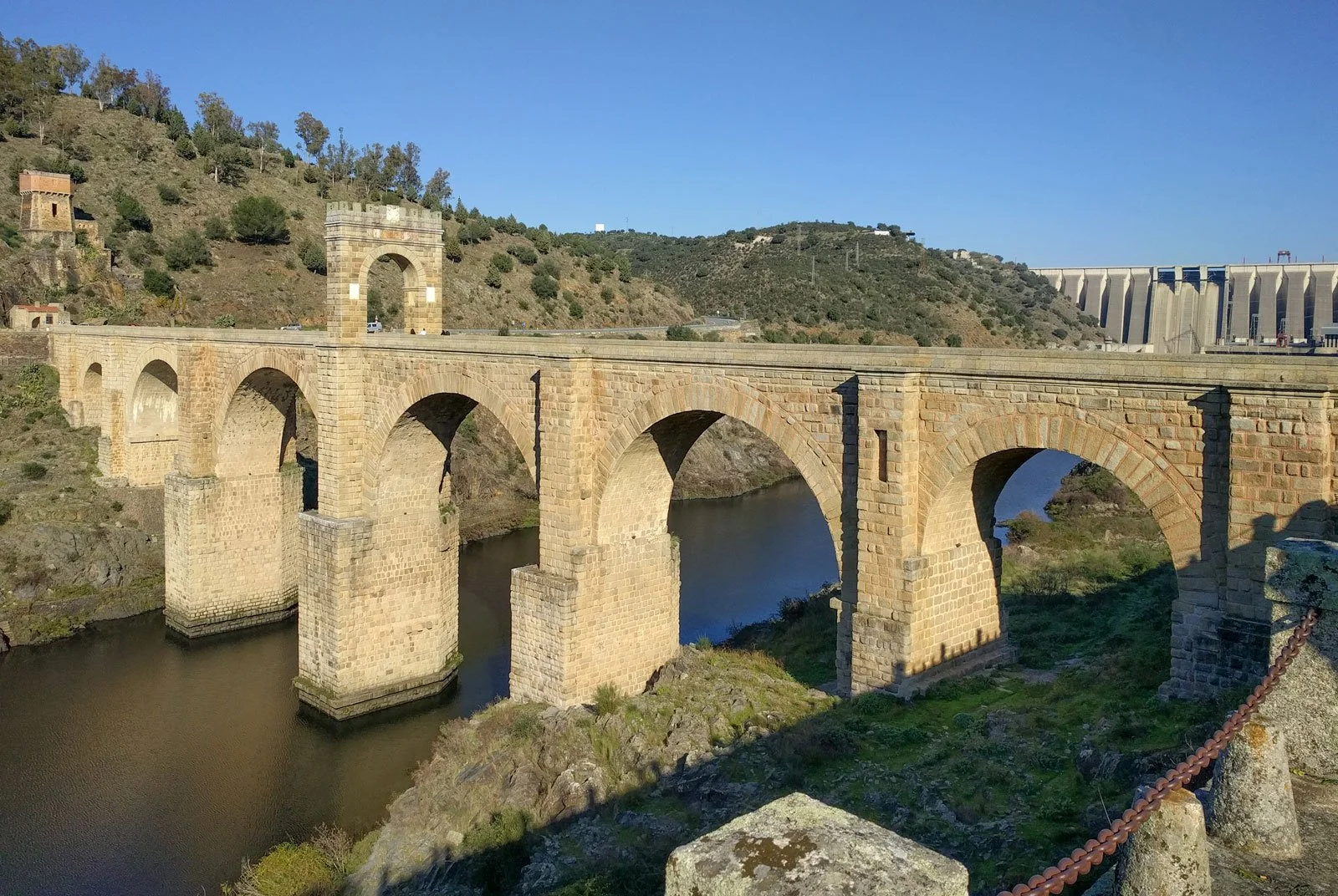
The Bridge of Alcántara is a clear example of how Roman bridges used the arch to carry weight safely across water.
Roman bridges are one of the clearest examples of Roman practicality becoming architecture. A river crossing sounds simple enough. You need to get people, animals, carts, and armies from one bank to the other. But once water enters the picture, the problem becomes much harder. The ground may be soft, the current may strike the supports, floods may carry debris, and a straight stone beam can only span so far before it fails. This is where the Roman arch mattered so much.
The arch made Roman bridges strong because it changed how weight moved. Instead of forcing a flat beam to resist bending, Roman builders used a curved form that redirected load into compression, meaning squeezing force, and sent it into the supports at each side. That one structural idea had huge consequences. It allowed longer spans, more durable crossings, and bridge designs that could be repeated across the Roman world.
At the same time, the arch was never the whole story by itself. A Roman bridge worked because arches, piers, foundations, masonry, and river conditions were all thought together. That is what makes Roman bridges so interesting. They are not just beautiful old crossings. They are lessons in how structure, site, and infrastructure work together.
Quick answer
Roman bridges were strong because arches redirected weight into compression and pushed it into thick supports instead of relying on fragile straight beams. Careful foundations, solid piers, and river-aware details helped make those crossings last.
What made Roman bridges different?
Roman bridges were different because they were built as part of a much larger infrastructural system. They were not isolated monuments dropped into the landscape. They belonged to roads, military routes, urban access points, and long-distance territorial control.
That larger system matters. A bridge is most useful when it connects something important. In the Roman world, that often meant a major route in the Roman roads network. Once a durable crossing existed, traffic became more reliable, travel routes became more stable, and the surrounding region could be tied more tightly into the empire.
Roman bridges were also different because the Romans built them with remarkable consistency. They did not invent the bridge, of course, and they did not invent the arch either. But they made arch-based bridge building systematic. They used masonry, concrete, and careful siting to produce crossings that were not only functional in the moment, but durable over time.
This is why Roman bridges sit so close to ancient Roman engineering. Their strength was not decorative. It came from structural understanding. The Romans knew that a river crossing had to deal with both load from above and pressure from moving water below. Their bridges are impressive because they answer both problems at once.
How did the arch make them strong?
The arch made Roman bridges strong by changing the structure from a bending problem into a compression problem. A flat beam spanning between two supports tends to sag in the middle. Stone is not especially good at resisting that kind of tension. But stone performs much better when it is compressed.
That is why the Roman arch was such a powerful solution. In an arch, each wedge-shaped unit presses against the next. The load above is redirected along the curve and then down into the supports. Instead of a weak middle trying to hold itself up, the whole form collaborates.
This also helps explain why Roman bridges could span farther than simple stone beams. The arch did not remove the need for strong supports, but it made larger openings more practical. That was essential once rivers became wide or currents made too many supports undesirable.
The keystone, the central stone at the crown of the arch, is part of that story too. It helps complete the arch ring, but the strength comes from the whole system rather than from one magic block. If you want to zoom in on that point, the logic becomes clearer in keystone arch.
So when people ask why the Roman arch mattered so much in bridge building, the answer is simple: it used the strengths of masonry rather than fighting against them.
Why were the piers so important?
A Roman bridge is never only its arches. The piers, meaning the vertical supports between spans, are just as important. In fact, once several arches are used in a row, the piers become critical.
Each arch pushes not only downward but also outward. That means the pier has to receive force from both sides while also standing in moving water. It must be strong enough to carry the structural load and stable enough to resist erosion, impact, and flood pressure.
This is why Roman bridge piers were often thick and carefully built. In some cases they stood on rock, which gave excellent support. In other cases, where the riverbed was softer, Roman builders needed more complicated foundation work. That challenge was one of the hardest parts of bridge construction.
The form of the pier mattered too. Many Roman bridges used pointed or diamond-shaped cutwaters on the upstream side. A cutwater is the pointed nose of a pier that helps divide the current and reduce the force of flowing water against the structure. This is a practical detail, but it tells you a lot about Roman intelligence. The bridge was designed not only for static weight, but for a changing river environment.
A good Roman bridge, then, is not just a set of elegant arches. It is a carefully balanced relation between spans and supports.
How did Romans build in water?
Building a bridge over water meant solving the foundation problem first. If the supports were weak, the arches above could not save the structure.
Where possible, Roman builders founded piers on solid ground or rock. But rivers do not always make that easy. In difficult conditions, the Romans used cofferdams, which were temporary enclosures made by driving piles into the riverbed and sealing the space so that work could continue in a relatively controlled area. Once the enclosure was in place, the foundation could be prepared and masonry or concrete added.
This is where Roman concrete enters the story, even though the most visible parts of surviving bridges are often stone. Roman builders used pozzolanic concrete, meaning concrete made with volcanic ash that could perform especially well in damp conditions, to help solve underwater and foundation problems. That practical use of concrete was one reason Roman bridge building became so advanced.
The finished bridge might then be faced in stone and built with carefully cut masonry above, but the unseen technical work below was often just as important. Roman bridges are a good reminder that infrastructure is full of hidden intelligence. What survives above the waterline depends on decisions made below it.
Where did bridges fit Roman infrastructure?
Roman bridges mattered because they fixed crossing points inside a much larger network. A road without a reliable bridge can be interrupted by weather, season, or river conditions. A road with a durable bridge becomes a stable route.
That is why Roman bridges are closely tied to the logic of Roman roads. Roads organized movement across land. Bridges ensured that rivers did not break that organization. Together, they turned geography into a more governable system.
There is also an interesting relation to Roman aqueducts. Aqueduct bridges and road bridges are not the same thing, but they share structural logic. Both often use repeated arches to cross uneven terrain or water. Both show how Roman builders applied the arch across very different infrastructural needs.
That connection becomes especially visible in monuments such as the Pont du Gard and the Segovia Aqueduct. Those are aqueduct structures rather than road bridges in origin, but they reveal how Roman builders could turn arch repetition into strong, durable, and legible infrastructure. The same underlying confidence appears in river crossings built for traffic.
Which Roman bridges show this best?
Several famous examples make the Roman bridge easier to picture.
Pons Fabricius in Rome, built in 62 BCE, is one of the best preserved Roman bridges and still in use. It shows how a relatively compact arch bridge could endure across centuries of urban life. Ponte Sant’Angelo, completed under Hadrian around 135 CE, shows Roman bridge building at a more monumental urban scale, linking the city to the emperor’s mausoleum.
Outside Rome, the bridge at Alcántara in Spain is one of the greatest surviving Roman masonry bridges. Built in the early 2nd century CE, it demonstrates how Roman arches could cross a major river with calm structural authority. Its survival is one reason Roman bridges are still studied with such respect.
Then there is Trajan’s Bridge over the Danube, famous not because it survives intact, but because it pushed Roman ambition to an extraordinary level. It used timber arches mounted on masonry piers and achieved spans that remained exceptional for more than a thousand years. It is a useful reminder that Roman bridge building was not limited to one fixed material formula. The core achievement was broader: the ability to combine structural logic, foundation skill, and large-scale planning.
Together, these examples show that “describe an ancient Roman bridge” can mean several things. It might mean a compact urban crossing, a massive provincial monument, or a strategic military span. What links them is not one appearance, but one engineering mindset.
Why do Roman bridges still matter?
Roman bridges still matter because they show that Roman architecture was not only about temples, baths, and public facades. It was also about infrastructure strong enough to organize territory.
They matter for structural history too. The Roman arch bridge is one of the clearest demonstrations of how a simple form can change building possibilities. Once the arch was understood and repeated confidently, stone and masonry could do much more than people often assume.
And they matter visually. Roman bridges are often beautiful not because they were designed as pure monuments, but because structural clarity has its own elegance. A sequence of arches, a carefully shaped pier, a well-judged crossing point, all of that creates an architecture of necessity that can still feel deeply satisfying.
For beginners, Roman bridges are especially useful because they bring many ideas together at once: arch action, keystones, compression, piers, foundations, roads, and landscape. They make Roman engineering readable.

Conclusion
Roman bridges were strong because the arch let masonry work in the way it works best: through compression. That structural idea allowed longer spans, durable crossings, and a bridge form that could be repeated across the Roman world.
But the real strength of Roman bridges came from the complete system around the arch. Piers, foundations, cutwaters, site selection, and integration with roads all mattered. That is why Roman bridges were not just clever shapes over water. They were carefully engineered crossings that helped hold the Roman world together.
FAQ
Why were Roman bridges so strong?
Roman bridges were strong because arches redirected weight into compression, while thick piers and solid foundations supported the spans and resisted river pressure.
What is a Roman arch bridge?
A Roman arch bridge is a bridge that uses one or more masonry arches to span water or ground, allowing the load to be carried into the supports rather than across a flat beam.
Did all Roman bridges use stone arches?
No. Many famous surviving examples do, but Roman bridge building could also combine masonry piers with timber superstructures, as in Trajan’s Bridge.
What is the role of the keystone in a bridge arch?
The keystone is the central wedge-shaped stone at the top of the arch. It helps complete the arch, but the full strength comes from all the stones and supports working together.
Why did Roman bridge piers have pointed ends?
Those pointed ends are called cutwaters. They helped reduce the force of flowing water against the pier and improved the bridge’s behavior in the river.
Are any Roman bridges still in use?
Yes. Some Roman bridges, such as Pons Fabricius in Rome, are still in use today, though often with repairs and later alterations.
Sources and Further Reading
You may also like