Polykleitos’ Canon: The Rulebook Behind Classical Statues
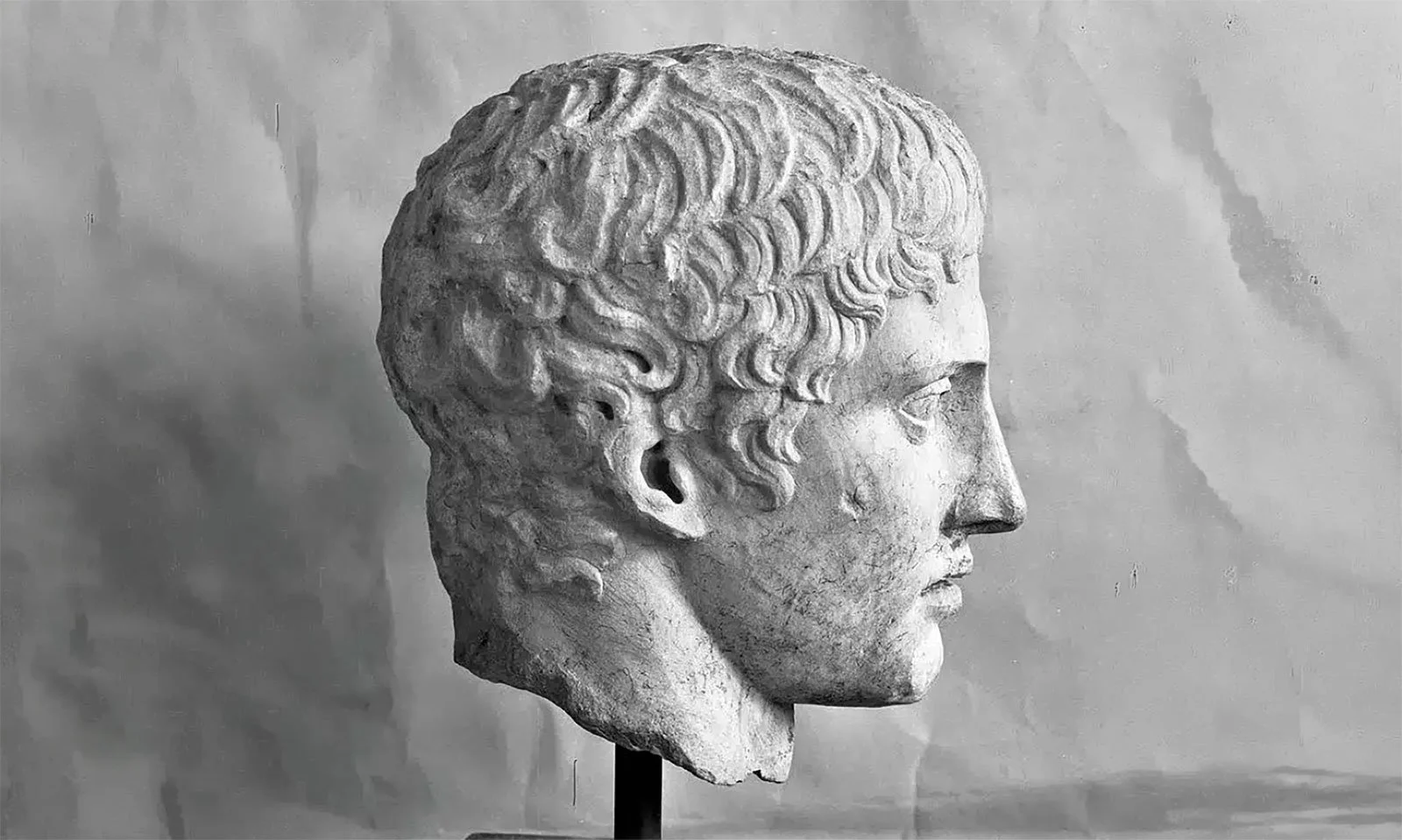
Profiles are great for spotting style choices: forehead slope, nose bridge, lip shape, and how hair is “organized” into neat locks. Even with a fragment, you can feel the period’s obsession with controlled, balanced beauty.
If you’ve ever looked at a classical Greek statue and thought, “Why does this feel so right?”, you’re not imagining it. Some of that calm, balanced “rightness” is deliberate design, not accident. And one of the biggest names behind that design mindset is Polykleitos (active in the 5th century BCE), a sculptor who treated the human body like a system you could tune.
We usually talk about him through a single word: Canon (a rule-set for ideal proportions). But the Canon is not just “math in marble.” It’s a way of making a body look stable, believable, and quietly alive, even when it’s standing still.
Polykleitos thought beauty was a structure, not a vibe
Here’s the core idea: Polykleitos didn’t want a statue that merely copied what a body looks like in real life. He wanted a statue that explained what a body should look like when everything is in harmony.
That’s what “canon” means here: a measuring standard for ideal form. In ancient Greek terms you’ll also see symmetria (parts that match in measured relation). It’s not “symmetry” like a mirror image. It’s closer to “everything fits together.”
So what would a sculptor do with that?
He would design the body as a network of proportional relationships:
finger to finger
fingers to palm
palm to wrist
wrist to forearm
forearm to upper arm
…and so on, until the whole figure reads as one coherent machine.
Even if we don’t know Polykleitos’ exact numbers, we do know the direction of travel: the body becomes a controlled composition. And that control is why classical statues can feel more “perfect” than real people. They’re not neutral recordings of nature. They’re edited nature.
This is also why Polykleitos matters beyond one artist. Once you treat the body as something you can systematize, you create a teachable method. You can hand it to students. You can repeat it. You can refine it.
And suddenly, “style” becomes a toolkit.
If you want the wider concept, the canon of proportions is the umbrella idea. Polykleitos is the moment it becomes legendary.
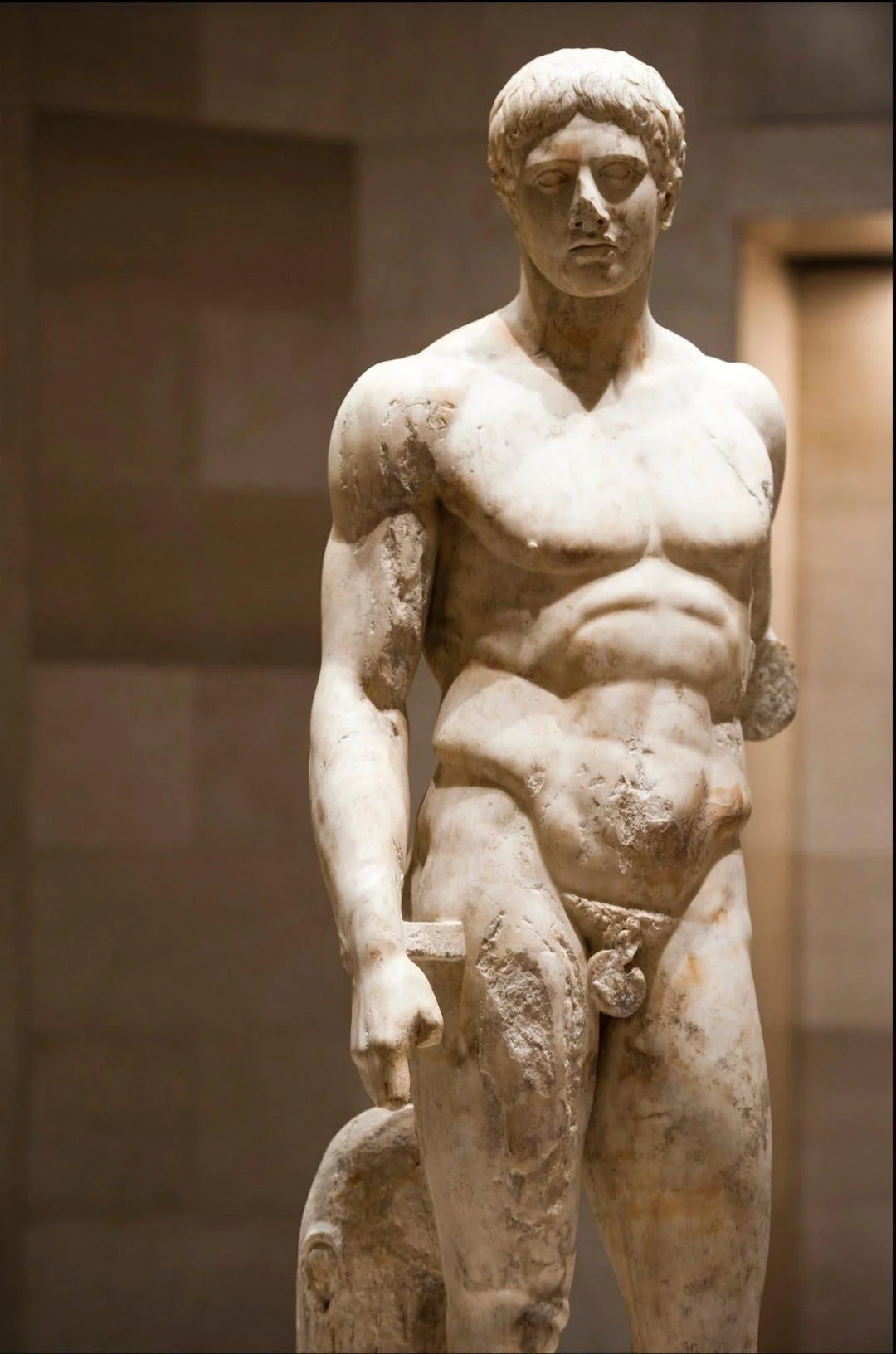
This is the moment Greek sculpture starts to look alive: the weight settles into one leg, the torso subtly shifts, and the head tilts as if mid-thought. That tiny shift is the seed of what later becomes full-blown contrapposto.
The Canon is lost, but its logic survives in bodies we can still “read”
Small twist: Polykleitos’ Canon, the text itself, does not survive intact. We don’t have a clean ancient PDF of “Chapter 1: shoulders.”
What we have is evidence in three forms.
First, ancient writers (later authors quoting earlier ideas). They describe how Polykleitos linked beauty to measured relationships between parts.
Second, statues associated with his method, especially Polykleitos’ Doryphoros. The Doryphoros (Spear-Bearer) became the poster child for this approach, partly because later viewers felt it embodied the “rule” so well that it functioned like a demonstration model.
Third, Roman copies. Many famous “Greek” statues we see today are Roman-era marble versions of earlier Greek bronzes. That’s incredibly useful, and also tricky. Copies vary. Materials change what’s structurally possible. Restorations creep in. So any attempt to reverse-engineer a single perfect formula from surviving marbles has to be careful.
That tension is worth sitting with: the Canon is both real and slippery. Real as an idea that shaped how artists worked. Slippery because we can’t reduce it to one tidy ratio and call it solved.
Myth vs Fact
Myth: Polykleitos’ Canon was one fixed “perfect-body equation” we can reconstruct exactly.
Fact: The text is fragmentary, and copies vary, so we can describe the logic more confidently than the exact numbers.
And honestly, that’s fine. Because the Canon’s power isn’t that it gives us a calculator. It’s that it gives us a way to see what classical sculptors were aiming for: controlled balance that still feels human.
The Canon works because it cooperates with contrapposto, not because it replaces it
If the Canon is the rulebook, what does it look like in practice? It looks like a body that distributes weight intelligently.
That’s where contrapposto comes in: weight on one leg, hips and shoulders counter-tilt. In ten words or less, contrapposto is the contrarian pose where the body rests instead of poses.
Here’s what happens when the Canon mindset meets contrapposto:
A rigid frontal stance (think earlier kouroi) can be measured, sure, but it tends to read like a diagram. Once weight shifts onto one leg, the figure becomes a living problem to solve. Now you have tension and release. One side carries load. The other side relaxes. The pelvis tilts. The ribcage responds. The spine subtly curves. The head can turn without feeling like it’s pasted on.
This is why classical sculpture can feel “alive” even when the expression is calm. The animation is structural.
When you look at a Polykleitan-style body, try this quick scan:
find the loaded leg (the one doing the work)
notice the hip tilt above it
watch the shoulders counter-balance
see how the torso “locks” into stability rather than wobbling
If it feels like the body could actually stand there without toppling, you’re seeing the Canon’s goal in action. Not stiff perfection, but credible equilibrium.
And once you see it here, you start noticing it across the broader shift from Archaic to Classical. The big change is not just “more realistic muscles.” It’s a new confidence that the body can be engineered into calm.
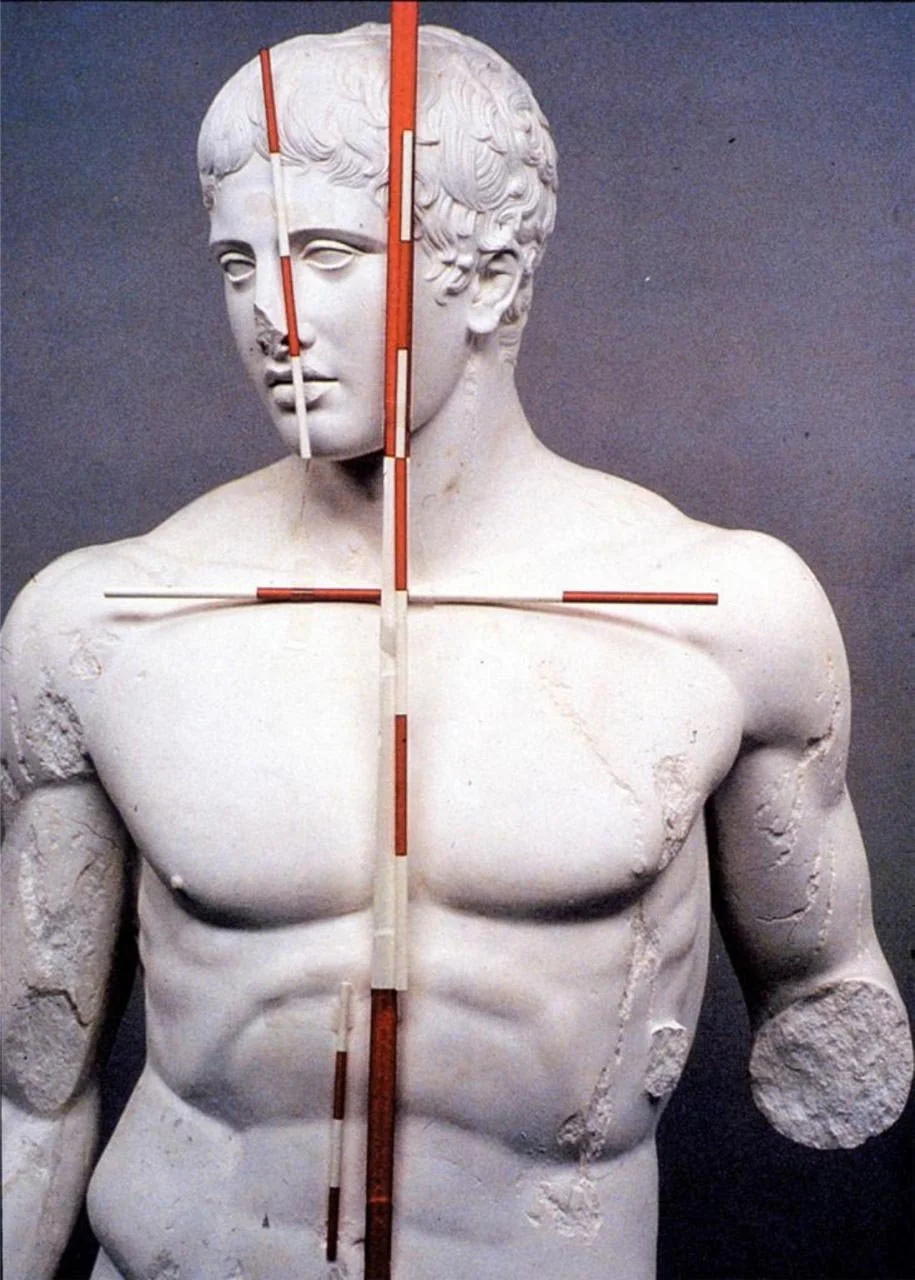
Overlays like this make the “math” of Classical sculpture visible—center lines, balance points, and proportional checkpoints. It’s a reminder that these bodies were designed, not merely observed.
Polykleitos wasn’t chasing realism, he was shaping an ideal citizen-body
One of the easiest mistakes we make with classical art is assuming its goal is realism. That’s a modern instinct. Classical Greek sculptors were often after something different: a body that signals order, self-control, and excellence.
That sounds abstract, so let’s anchor it in something concrete.
The ideal male statue type, especially in athletic contexts, is often:
mature but not old
strong but not bulky
energetic but not chaotic
balanced, even when it’s mid-action
That “just-right” zone is cultural. It mirrors values the city wanted to admire: discipline, measure, and rational control. In that sense, the Canon isn’t only about aesthetics. It’s also about ideology. The body becomes a visual argument for what “good form” looks like.
And this helps explain why the Canon had such a long afterlife. Renaissance artists, academies, and later Western art education loved the idea that beauty could be taught as a system. Even when the specific ratios changed, the dream stayed: that art can be built on method, not mystery.
So when we talk about Polykleitos, we’re not just talking about one sculptor with a neat theory. We’re talking about a pivot point where sculpture becomes:
a practice of observation, yes
but also a practice of design
and, quietly, a practice of persuasion
Once you notice that, classical statues stop being “perfect bodies.” They become perfected arguments.

Conclusion
Polykleitos’ Canon is famous partly because it tempts us with certainty: the idea that beauty can be measured, repeated, and mastered. But what makes it truly interesting is more human than that. It’s the way a “rulebook” can still leave room for life.
When we read a classical statue through Polykleitos, we’re really watching an artist solve a problem: how to make an ideal body feel stable, calm, and convincingly present. The numbers matter. The pose matters. But the magic is the moment they merge and the stone stops feeling like stone.
FAQ
What is Polykleitos’ Canon?
Polykleitos’ Canon is a lost ancient treatise outlining measured proportion rules for an ideal male body.
Is the Canon the same thing as contrapposto?
No, contrapposto is a weight-shift pose, while the Canon is a proportion-and-balance system that can support poses like contrapposto.
Did Polykleitos invent “perfect proportions”?
He didn’t invent proportion, but he made it famous as a rigorous, teachable method tied to a model statue.
Is the Doryphoros definitely the “Canon statue”?
Many scholars connect it to the Canon, but the evidence is indirect, so it’s best treated as a strong, widely used interpretation.
Sources and Further Reading
Cambridge University Press — “The canon of Polykleitos: a question of evidence” (1978)
The Metropolitan Museum of Art — “The Art of Classical Greece (ca. 480–323 B.C.)” (2008)
J. Paul Getty Trust — “Polykleitos and His Followers at Work” (2017)
American Journal of Archaeology — “October 1975 (79.4): The Canon of Polykleitos (pp. 307–321)”.
The British Museum — “Collection object: figure (1824,0446.16)” .
Museum of Classical Archaeology, Cambridge — “Doryphoros (cast record)”.
You may also like