Ancient Greek Art: A Guide from Geometric to Hellenistic Style
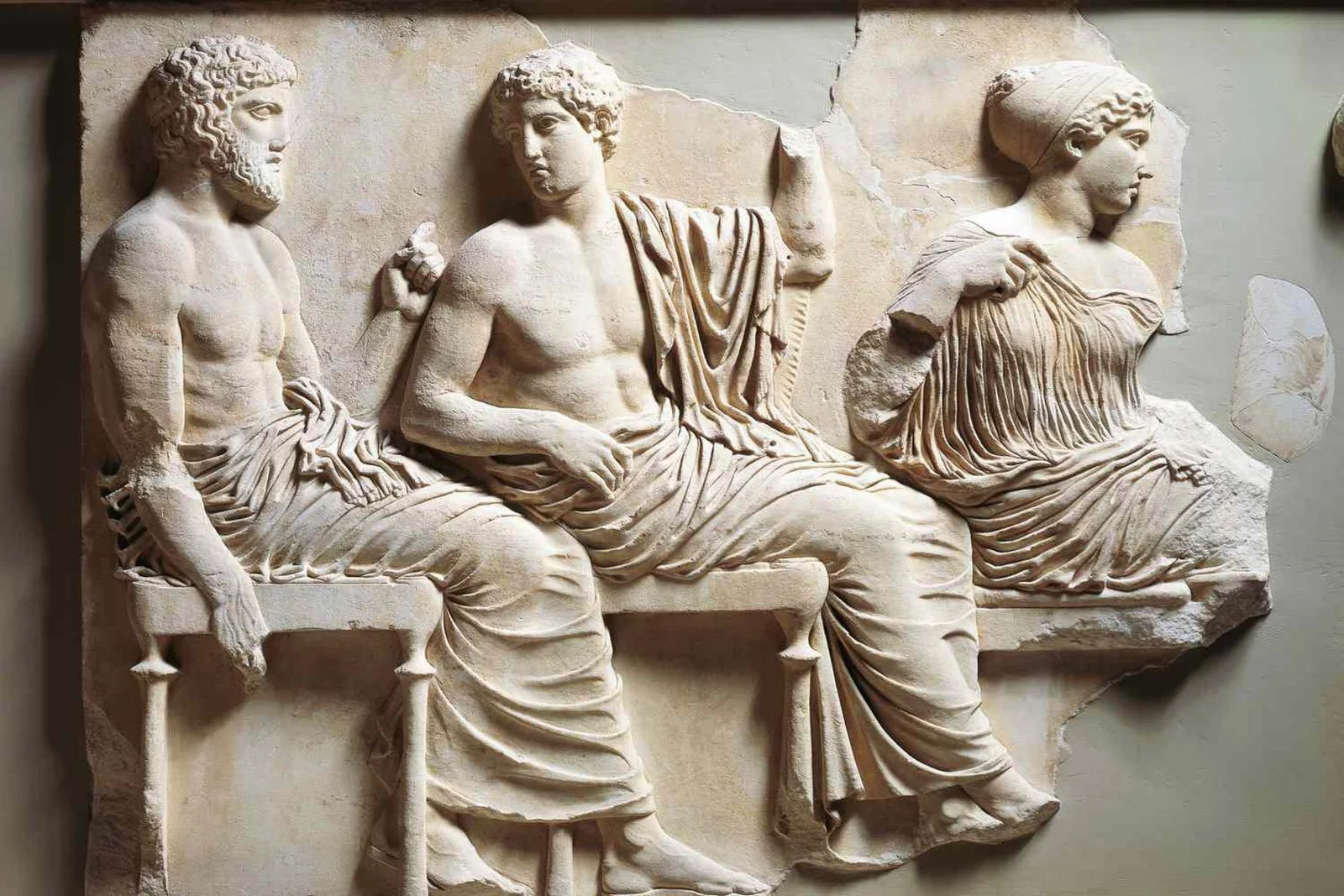
This Attic grave stele turns a family scene into a quiet monument to memory, with calm poses and finely carved drapery.
If you have ever tried to “learn Greek art” in one sitting, it probably felt like a blur. Suddenly you are jumping from patterned vases to stiff marble youths, then to the Parthenon, then to wild dramatic statues collapsing in heaps of muscle. Names pile up, dates blur, and all the “-ic” labels (Geometric, Archaic, Classical, Hellenistic) start to sound the same.
In this guide we slow that blur down. We walk through the main Greek art periods in order and focus on what actually changes from one to the next: how bodies are drawn, how space is organized, and what kinds of stories artists tell. By the end, you should be able to place most Greek works you meet somewhere on the timeline without panicking. If you want deeper dives on the way, you can always open our more focused pieces on geometric art in Greece, the Archaic period in Greek art, or our overview of ancient Greek sculpture in separate tabs.
Ancient Greek art is the visual culture produced by Greek-speaking communities from roughly 900 to 30 BCE, including pottery, sculpture, painting and architecture.

Ancient Greek Art Is a Timeline, Not a Single Style
When people say “Greek art”, they often picture one thing: a white marble statue with calm expression and perfect muscles. That image is real, but it covers only a slice of the full story. Ancient Greek art unfolds over several centuries and goes through distinct Greek art styles that respond to political changes, new materials and outside influences.
Art historians usually divide the timeline into four big periods: Geometric, Archaic, Classical and Hellenistic. The dates shift slightly depending on the book, but a simple framework looks like this:
Mini-FAQ. What are the main periods of ancient Greek art?
Geometric (c. 900–700 BCE), Archaic (c. 700–480 BCE), Classical (c. 480–323 BCE) and Hellenistic (c. 323–30 BCE), with some overlap and regional variation.
In the Geometric period, artists cover pottery with bands of zigzags, meanders and small stick-like figures. Art is mostly small-scale, but it already shows a love of order and rhythm. In our explainer on geometric art we follow those patterns and tiny horses in more detail.
The Archaic period keeps that sense of structure but stretches it into full human bodies and stone temples. This is when the first life-size marble figures appear, along with early stone versions of the megaron (a rectangular hall) turning into temples. Our guide to the Archaic period in Greek art takes that bridge slowly, from schemes to full figures.
The Classical period is probably the one you know best: balanced statues, clear anatomy, and buildings like the Parthenon. Then the Hellenistic period pushes everything further, playing more openly with emotion, drama and movement, and spreading Greek styles across a wider Mediterranean world.
Thinking in periods is not about memorising dates for their own sake. It is about having a calm mental map so that when you see a vase, a statue or a fragment of painting, you can ask: where are we on this road, and what problem was the artist trying to solve at this point in the journey?
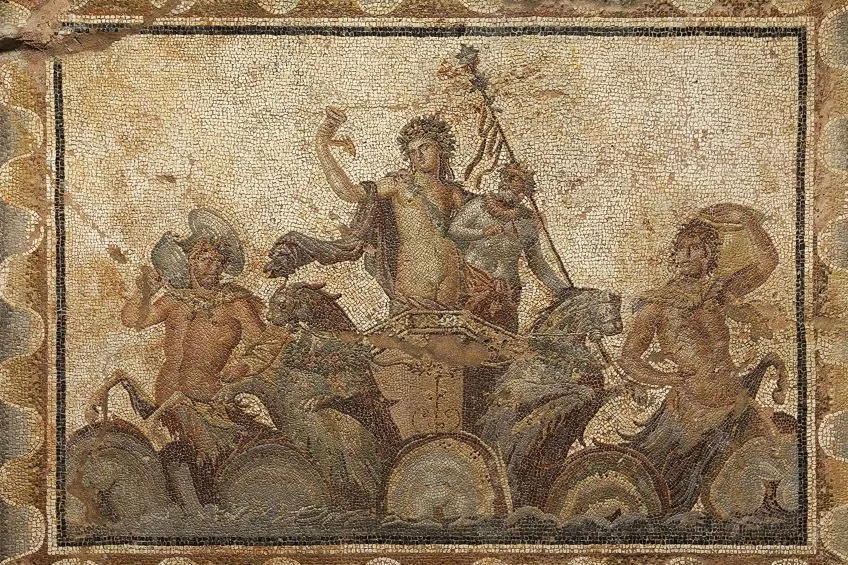
Lively Roman floor mosaic of Neptune’s sea chariot, packed with foaming horses, warriors, and shimmering tesserae.
From Patterns to Bodies: Geometric and Archaic Beginnings
The story of ancient Greek art starts small, on clay. In the Geometric period, potters in places like Athens and Corinth use vases as their main canvas. They organize the surface into horizontal bands and fill those bands with repeated patterns: meanders, triangles, checkerboards, concentric circles. Human and animal figures, when they appear, are reduced to a few straight lines and simple shapes. Yet already, as we saw in our guide to geometric art in Greece, painters sometimes stage funerals or processions using these tiny silhouettes. The first Greek stories are told in miniature, marching around the body of the pot.
As we move into the Archaic period, around the seventh and sixth centuries BCE, the same love of order meets new ambitions. On pottery, patterns start to frame more complex scenes. Techniques like black-figure painting, which we explore more fully in our article on Greek pottery and vase painting, allow artists to paint mythological episodes with named heroes and gods. The pot becomes a narrative surface, not just a decorative one.
In three dimensions, the change is even more striking. Sculptors begin carving life-size stone figures: kouroi (nude male youths) and korai (clothed young women). These standing figures are front-facing, symmetrical and often placed in sanctuaries or over graves. At first they are quite rigid, but over time the anatomy becomes rounder, the faces more individualized, and the poses slightly more relaxed. In our focused guide to archaic Greek sculpture we watch that evolution from blocky to almost alive.
Architecture follows a similar path. Early shrines based on the megaron layout turn into stone temples with columns all around, which we walk through step by step in our explainer on the Greek temple. The same geometric instinct that once organised bands on a vase now organises columns, steps and pediments into a coherent whole.
So, in these first two periods, we are watching Greek artists practice on small surfaces and then scale up. The key move is always the same: take a clear geometric scheme and gently fill it with more life, more volume and more narrative.
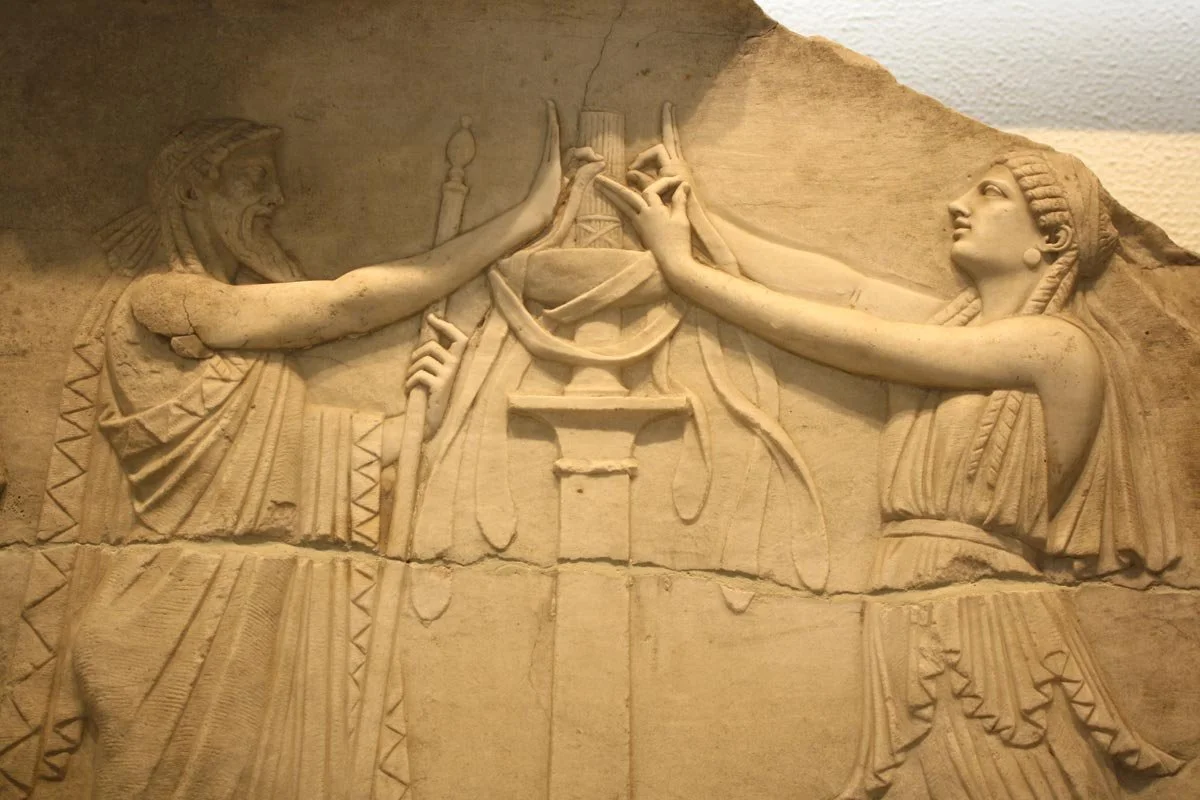
Two archaic figures lean toward a central altar, their hands meeting above the cult object in a frozen act of worship.
Classical Balance: Ideal Bodies, Clear Space and Quiet Power
When people talk about “Greek perfection”, they usually mean the Classical period, roughly 480–323 BCE. This is the time after the Persian Wars, when cities like Athens invest heavily in temples, sculptures and public buildings, and when artists refine earlier experiments into a very confident visual language.
Sculpture is the easiest place to see the shift. Figures no longer stand frontally with equal weight on both feet. Instead, they adopt contrapposto, a pose where most of the weight rests on one leg while the other relaxes. The hips tilt, the shoulders counter-tilt, and the spine curves gently. The result is a body that feels both stable and ready to move. Sculptors study anatomy more closely, using muscles and drapery to guide the eye in smooth S-curves rather than strict verticals. Our overview of ancient Greek sculpture traces that change from early stiffness to this measured naturalism and beyond.
Architecture echoes the same balance. Classical temples fine-tune the Doric and Ionic orders developed in the Archaic period. Columns become more slender, proportions more regular, and subtle corrections are introduced to counter optical illusions. On the Acropolis of Athens, for example, the Parthenon adjusts column spacing and stylobate curvature so that, from a distance, everything looks straight and harmonious. In our broader guide to Greek architecture we unpack how those choices work on the ground.
Painting in this era is mostly known through copies and through the evidence of vases, but the goals are similar: clear compositions, believable bodies and carefully controlled emotion. Later wall paintings and panel copies, which we discuss in our article on ancient Greek paintings, show artists using light, shade and perspective to suggest depth and volume. On ceramics, the red-figure technique allows painters to draw interior details of bodies and clothing with a fine brush, pushing narrative scenes to new levels of complexity. Our explainer on Greek paintings and colour looks at how this side of Greek art develops even if many originals are lost.
What ties all these Classical works together is a commitment to measure. Proportions are calculated, gestures are controlled, and emotional states are often calm rather than extreme. That does not mean the art is cold. It means that drama is usually expressed through composition and rhythm, not through exaggerated faces or chaotic layouts. This visual ideal will later be copied and adapted by the Romans, the Renaissance and countless neoclassical revivals.

Winged goddess races across a red-figure plate, her chariot of white horses framed by swirling vine patterns and floral details.
Hellenistic Drama: Emotion, Experiment and a Wider World
After the death of Alexander the Great in 323 BCE, Greek culture spreads across a huge territory, from Egypt to modern-day Afghanistan. Art in this Hellenistic period reflects that wider, more diverse world. The basic Classical toolkit is still there, but artists feel freer to push it in new directions.
In sculpture, Hellenistic works often lean into emotion and movement. Famous pieces like the Laocoön group or the Nike of Samothrace show bodies twisting, straining and interacting with strong wind or pain. Muscles are highly defined, drapery whips around limbs, and faces register fear, effort or ecstasy more openly than before. At the same time, quieter works appear: realistic portraits of old age, children playing, or people from different social backgrounds. Greek art is no longer focused only on ideal young athletes and gods; it turns its attention to a broader range of human experience. Our overview of ancient Greek sculpture follows this expansion into the Hellenistic era as well.
Painting and mosaic also flourish. Although original panel paintings rarely survive, Hellenistic artists are credited with advances in shading, perspective and illusion that later Roman wall painters adapt and preserve. Mosaics in houses and public buildings show myth scenes, landscapes and everyday life, using tiny tesserae to create almost painterly effects. If you remember how early Greek pottery used bands and silhouettes, Hellenistic surfaces feel like the opposite: freer, deeper, and more spatially complex.
Architecturally, cities across the Hellenistic kingdoms adopt and adapt Greek forms. The familiar column orders are still used, but now they frame new building types: monumental altars, vast stoas, elaborate palaces. Public spaces cater to spectacles, royal processions and philosophical schools. Greek art and architecture become tools for expressing imperial power as well as local identity.
What keeps this period connected to earlier Greek art is a shared visual language of the body and space. Even when compositions are crowded and emotions are high, underlying proportions and anatomical knowledge come straight from Classical training. Hellenistic artists are not throwing the rulebook away; they are bending it, stretching it and testing how far it can go while still feeling “Greek”.
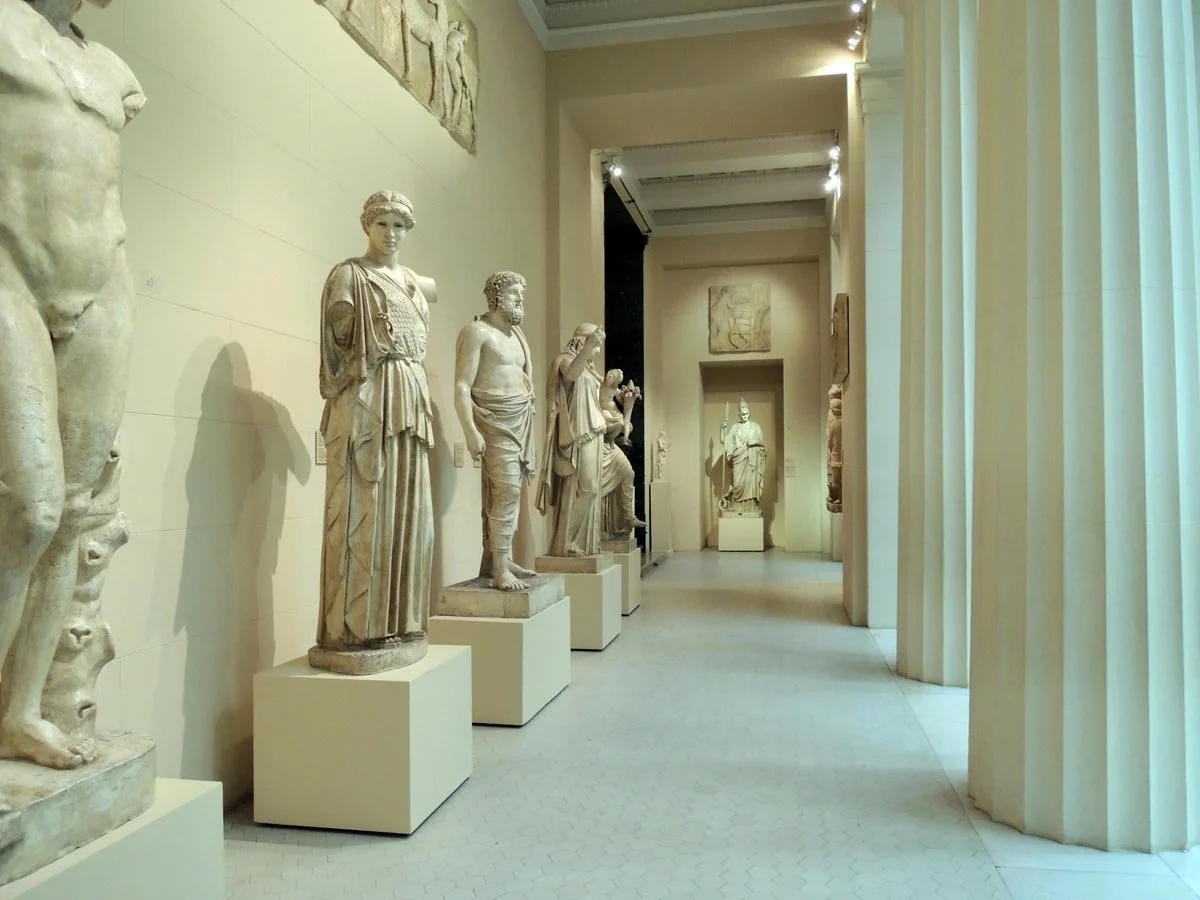
Long hall of plaster casts at the Pushkin Museum, classical gods and heroes lined up like a stone chorus along the walls.
Conclusion
Ancient Greek art is easier to handle once we see it as a conversation over time rather than a single frozen ideal. The Geometric period sets up the grammar: lines, patterns and simple figures on pottery. The Archaic period uses that grammar to build full bodies and stone temples, still a bit stiff but increasingly confident. The Classical period refines everything into balanced, clear forms that many later cultures treat as a gold standard. The Hellenistic period then opens the windows, letting in more emotion, more variety and a wider world.
If you hold this timeline in your head, each object becomes easier to place. A vase covered in zigzags and tiny horses likely belongs near the beginning. A frontal youth with an enigmatic smile sits somewhere in the Archaic bridge. A calm contrapposto figure in ideal proportions signals Classical aims. A swirling, expressive statue or complex mosaic likely speaks with a Hellenistic accent. For more detailed maps, you can always branch out into our guides to geometric art, the Archaic period, or specific media like Greek pottery and ancient Greek paintings.
Next time you walk through a gallery of Greek works, try reading the room by period rather than by material. Notice how patterns, bodies and spaces change as you move from one corner to another. In doing that, you are quietly tracing not just an art history, but a history of how one culture thought about humans, gods and the world around them over several centuries.
Sources and Further Reading
The Metropolitan Museum of Art — “Geometric Art in Ancient Greece” (2004)
The Metropolitan Museum of Art — “The Art of Classical Greece (ca. 480–323 B.C.)” (2008)
The Metropolitan Museum of Art — “Art of the Hellenistic Age and the Hellenistic Tradition” (2007)
Art Institute of Chicago — “Ancient Greek Art” collection overview
Open Textbook Library — Ruth Ezra et al., “Guide to Ancient Greek Art” (2019)
You may also like