Peplos Kore: Color and Identity on the Athenian Acropolis
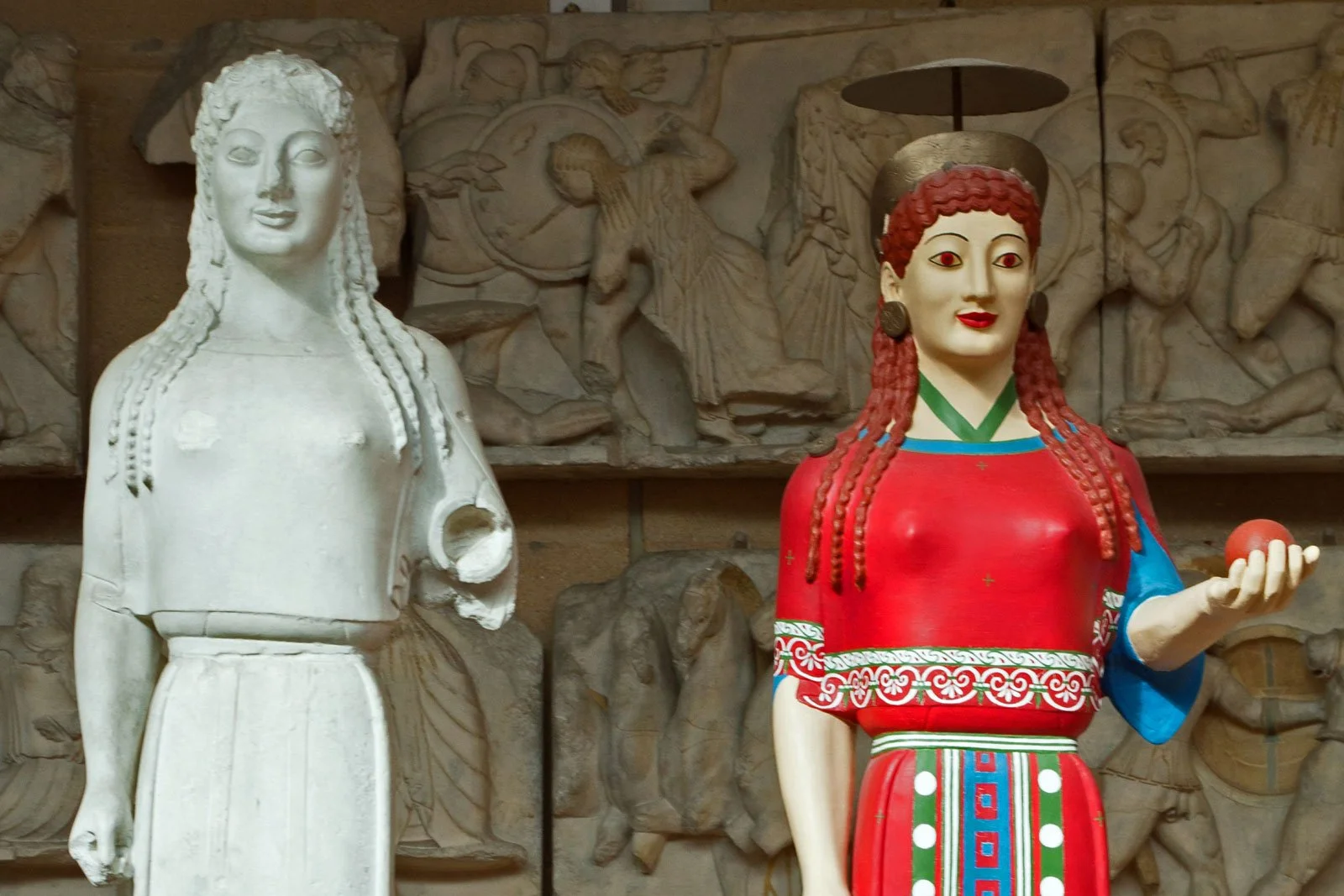
A plain kore beside its coloured reconstruction shows how Greek sanctuaries once glowed with pattern and pigment, not the bare white marble we expect.
If you picture ancient Greek sculpture, you probably see smooth white marble, calm and mute. Then you meet Peplos Kore. She is small, upright, and at first glance quite still. But the closer you get, the more she turns into a puzzle: tiny paint traces, drilled holes for jewellery, an unusual outfit, and a face that seems to know more than it tells.
In this guide we use Peplos Kore as a compact laboratory. We look at what she is, what she wore, how colour changes everything, and why scholars still argue about who she might have been. Along the way, she becomes a bridge between archaic Greek sculpture, ancient Greek fashion and the ritual life of ancient Greek religion on the Acropolis.

A kore on the Acropolis: what the Peplos Kore actually is
Peplos Kore is a marble statue of a young woman, about 1.18 m high, carved around 530 BCE and found on the Athenian Acropolis in 1886. She belongs to the type art historians call a kore (plural korai), meaning a standing maiden figure, usually clothed, frontal, and used as a votive offering or sometimes as a grave marker. In style and date she sits squarely in the late archaic period.
The nickname “Peplos Kore” comes from the garment she seemed to be wearing. A peplos is a simple woolen over-garment for women in archaic Greece, usually a large rectangular cloth, folded and belted so it falls in heavy, straight folds. Early on, scholars thought this kore was a textbook example of that dress, so the name stuck. Later research has complicated that story, but we will come back to that.
Seen from the front, she holds her left arm down and forward, bent at the elbow, with the forearm now missing. Her right arm is close to the body. Four small holes in her head show where a metal crown or wreath once sat; additional holes at the ears likely held metal earrings. Like the Anavysos Kouros, she stands in a fixed pose and looks straight ahead, but her expression is more subtle and her clothing does a lot more storytelling than his bare body does.
As part of the wider family of Acropolis korai, Peplos Kore helps us track how ancient Greek sculpture developed just before the Persian destruction of 480 BCE, when many of these statues were buried in the so-called “Perserschutt” (Persian debris) and accidentally preserved for us.
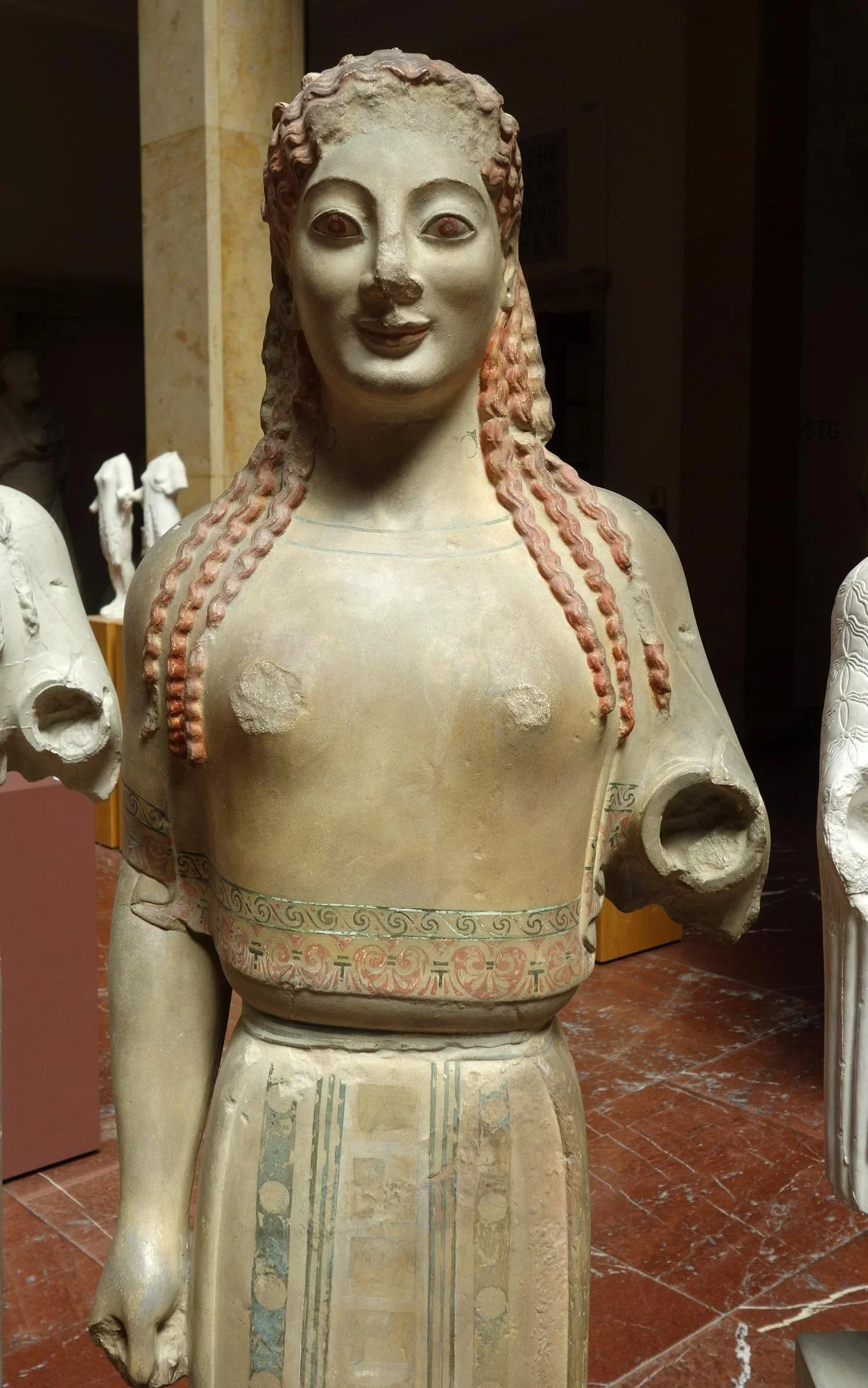
Emile Gilliéron’s painted cast of Acropolis Kore 679 reconstructs the statue’s costume, jewellery and makeup in saturated archaic colours.
Dress and colour: from “plain peplos” to patterned goddess candidate
At first glance in the museum, Peplos Kore can look almost plain: a simple block of marble with a smooth garment and only faint traces of pigment. But detailed study has turned her into one of the star witnesses for colour in ancient Greek paintings and sculpture.
Microscopic and spectrographic analyses on Acropolis korai show that what we now see as bare stone was once covered in layered paint: reds, blues, greens, and maybe touches of gold. In related korai, the Acropolis Museum has mapped out blue and white chitons, red belts, and elaborate painted borders with rosettes and meanders. For Peplos Kore in particular, researchers have identified incised guidelines and pigment traces that suggest her garment was heavily patterned, not a plain wool dress.
This is where the “peplos” label starts to wobble. The folds and underlayers look more like a long chiton (light linen tunic) worn under a shorter, decorated over-garment. Some reconstructions see that outer piece not as an everyday peplos but as a special, stiff, patterned garment that might echo divine or cult dress. The famous polychromy experiments led by Robert Cook in Cambridge in the 1970s, and later by Vinzenz Brinkmann and others in the “Gods in Color” exhibitions, painted casts of Peplos Kore in intense reds, greens and blues, complete with borders and motifs. These reconstructions are deliberately provocative, but they are rooted in real pigment evidence.
Once you imagine her in full colour, it becomes much easier to connect her to ancient Greek fashion. The garment is no longer abstract drapery; it is a very specific outfit, layered and accessorised with metal jewellery and possibly a crown. Instead of a “timeless classical maiden”, you start seeing a richly dressed figure glowing in the sanctuary light on the Acropolis, surrounded by other painted korai and bronze offerings.
Mini-FAQ
What is the Peplos Kore?
A late archaic marble statue of a richly dressed young woman, found on the Athenian Acropolis and now in the Acropolis Museum.
Why is her colour important?
Because paint traces and reconstructions show that Greek sculpture was vividly polychrome, and they help us read her identity and role more accurately.
Maiden, worshipper, or goddess: who is she supposed to be?
This brings us to the big question: who is Peplos Kore meant to represent. Is she an anonymous maiden offering thanks, or a specific goddess standing in her own sanctuary.
Many korai on the Acropolis are read as votive figures – stand-ins for their human dedicators, presented to the goddess Athena as permanent offerings. Their names may have been written on bases now lost, but the figures themselves remain generic: ideal young women, beautifully dressed, holding gifts. Peplos Kore fits some of this pattern, but several details have led scholars to suspect she might be more than a simple worshipper.
First, the outfit again. It seems more rigid and archaic than what contemporary Athenian women actually wore, which has led some to suggest she copies an older type of cult statue, maybe a wooden image of a goddess dressed in a particular way. Second, the missing left forearm probably held attributes: reconstructions propose a bow and arrows, or other objects that would fit a divine identity, often linked to Artemis. Third, the holes for a crown and earrings push her further into a high-status or divine category.
None of this is conclusive. We do not have an inscription that simply says “I am Artemis” or “I am the offering of X.” What we do have is a statue that sits right on the edge between human and divine representation. That edge is where ancient Greek religion often works, especially on the Acropolis: votive figures act as permanent, idealised presences in a sacred space, reinforcing the identity of the goddess and the community at the same time.
If you look at Peplos Kore alongside other korai, and alongside themes like Athena’s symbols, she becomes a kind of visual question: how much can we tell about a figure’s function just from clothing, pose and setting. That question is one of the reasons she keeps appearing in every discussion of ancient Greek sculpture and Greek paintings on sculpture.
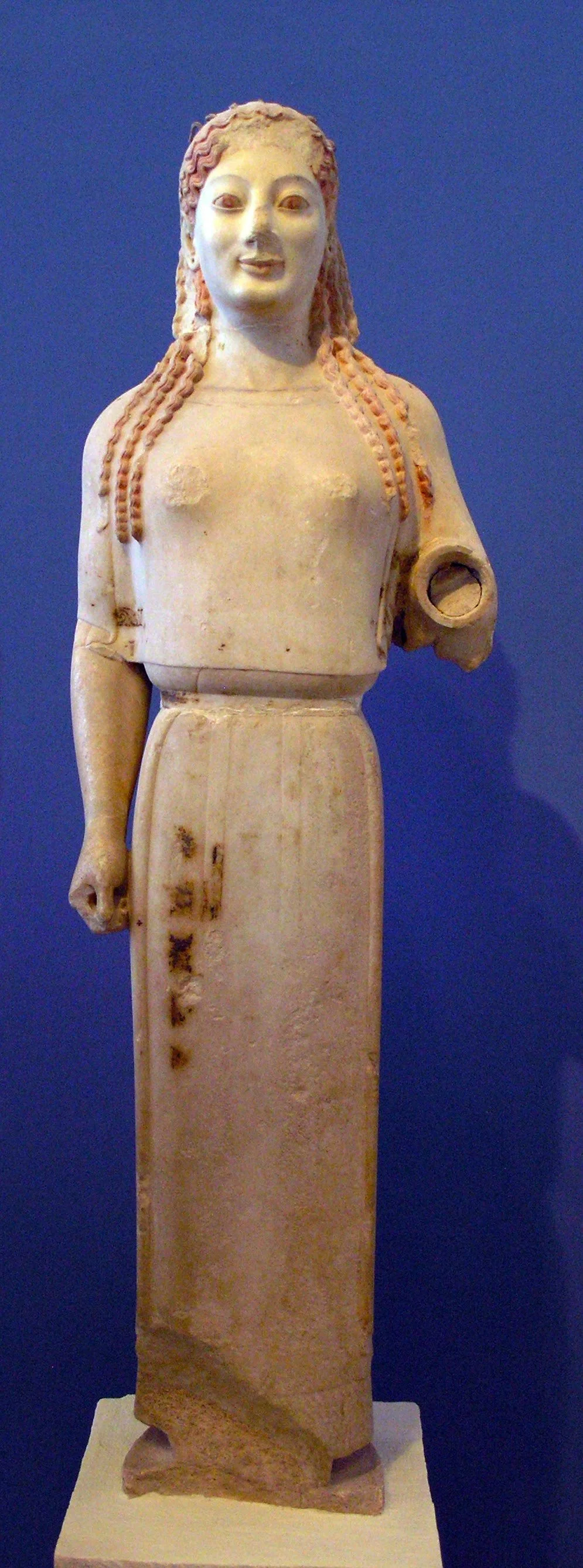
Archaic kore from the Athenian Acropolis, her rigid pose and archaic smile balanced by delicate carving and subtle remains of paint.
Conclusion
Peplos Kore is a compact case study in how much information a single statue can hold. We watched her shift from a pale “classical” figure to a brightly patterned, metal-crowned presence, standing in the dense ritual landscape of the Acropolis. We saw how dress, colour and accessories pull her into the orbit of ancient Greek fashion, while her pose and setting plug her into the long story of archaic Greek sculpture and Acropolis votive practice.
For our broader journey through ancient Greek art, Peplos Kore is a reminder to resist the white-marble myth and to treat colour, clothing and context as core evidence, not decoration. Next time you see her, or another kore, try to imagine the full environment: painted surfaces, metal jewellery catching the sun, and worshippers moving between offerings in a living sanctuary. The statue is not just an isolated artwork; it is a frozen moment in a much bigger ritual and visual system.
You may also like