Ancient Greek City-States: How the Polis Shaped Art
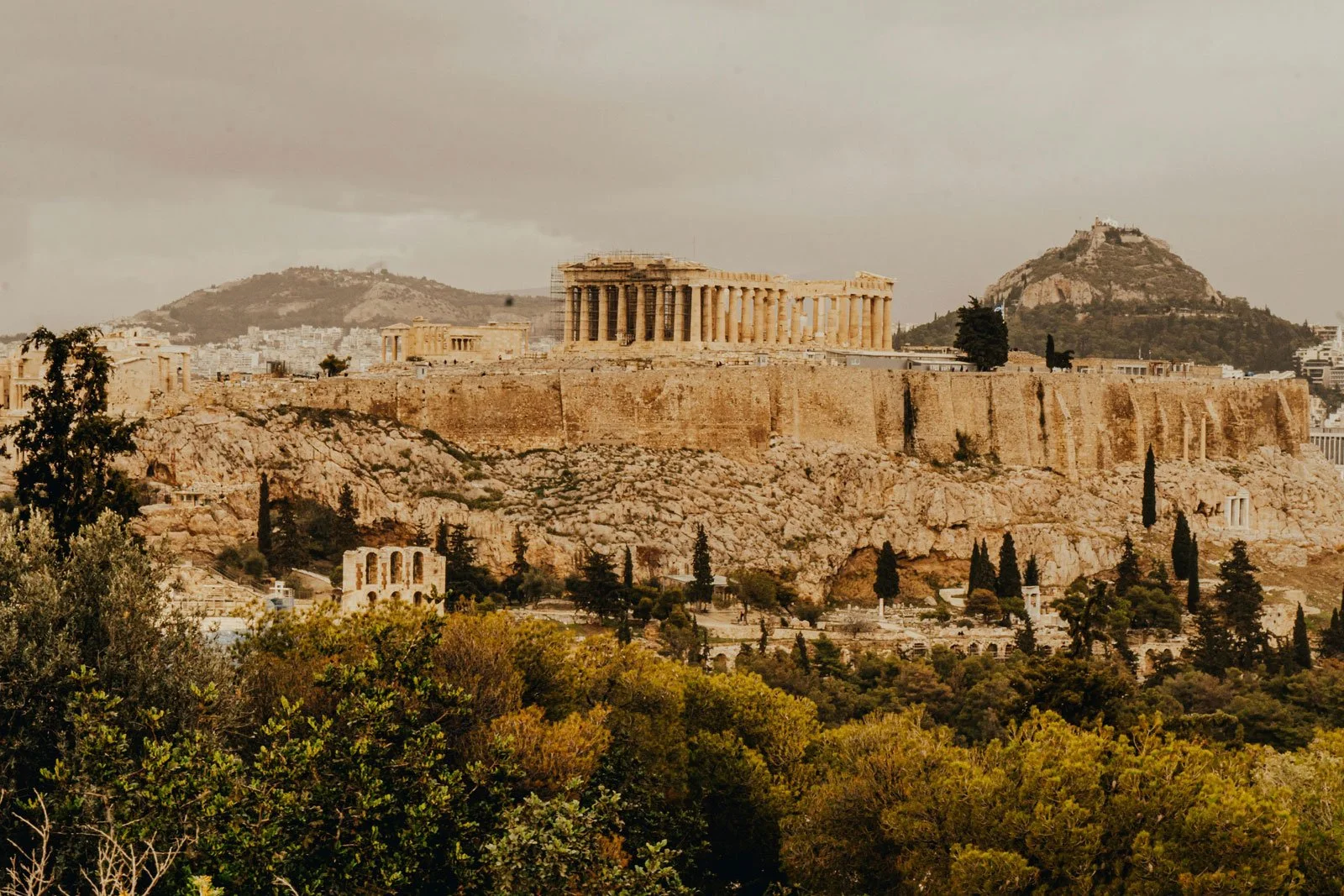
Seen from afar, the Acropolis makes clear how the Athenians turned a rocky hill into a sacred terrace of temples.
Ancient Greek art is usually introduced through big names and big statues: Parthenon, Phidias, “Classical perfection.” But if we zoom out a little, we notice something quieter and more structural. Behind every temple, every painted vase, every marble god, there is a polis – a city-state – deciding what deserves to be built, shown and celebrated.
In this guide, we treat the ancient Greek city-state almost like a living organism. We look at how its territory, laws, festivals and rivalries created the conditions for temples, theatres and statues to exist in the first place. Instead of memorising dates, we follow how politics, religion and space weave together and slowly shape what we now call “Greek art.”

What is a polis, really, and why does it matter for art?
When historians say “polis,” they don’t just mean “ancient city.” They mean a self-governing community with its own territory, laws, and shared spaces, where people saw themselves as citizens, not just inhabitants. This is important for art, because in Greece, major artworks are almost never private luxuries. They are public decisions made by a polis and displayed in spaces that belong to everyone.
A polis usually had three main layers: an urban centre with walls, an elevated acropolis with temples and sanctuaries, and a territory of farms and villages around it. Athens, Corinth, Sparta, Thebes – all of them worked with this basic structure, even if they used it differently. The key point is that the polis is both a place and a political body. When the community votes to dedicate a temple or commission a statue, it’s not a king’s whim. It’s the city speaking in stone.
Definition. Ancient Greek city-states, or poleis, were independent communities with their own laws, territory and shared public spaces.
Now connect that to art. In a monarchy, big monuments tend to glorify a single ruler. In a polis, big artworks usually celebrate gods, shared victories, civic values. The same space that hosts political assemblies can be edged by stoa colonnades, lined with dedications and reliefs. The same acropolis that shows off a city’s main temples also acts as its visual logo from far away.
If you’ve read our overview of ancient Greek art, you’ve already seen the big timeline from geometric to Hellenistic style. The polis is the framework behind that timeline. As poleis consolidate in the Archaic period, they start investing in long-lasting stone buildings and large-scale sculpture. As they compete, ally and fight, they keep using art to mark victories, assert identities and negotiate status with other cities and with the gods. Once you see this, “Greek art” stops being a floating aesthetic category and becomes something rooted in very specific city-states.
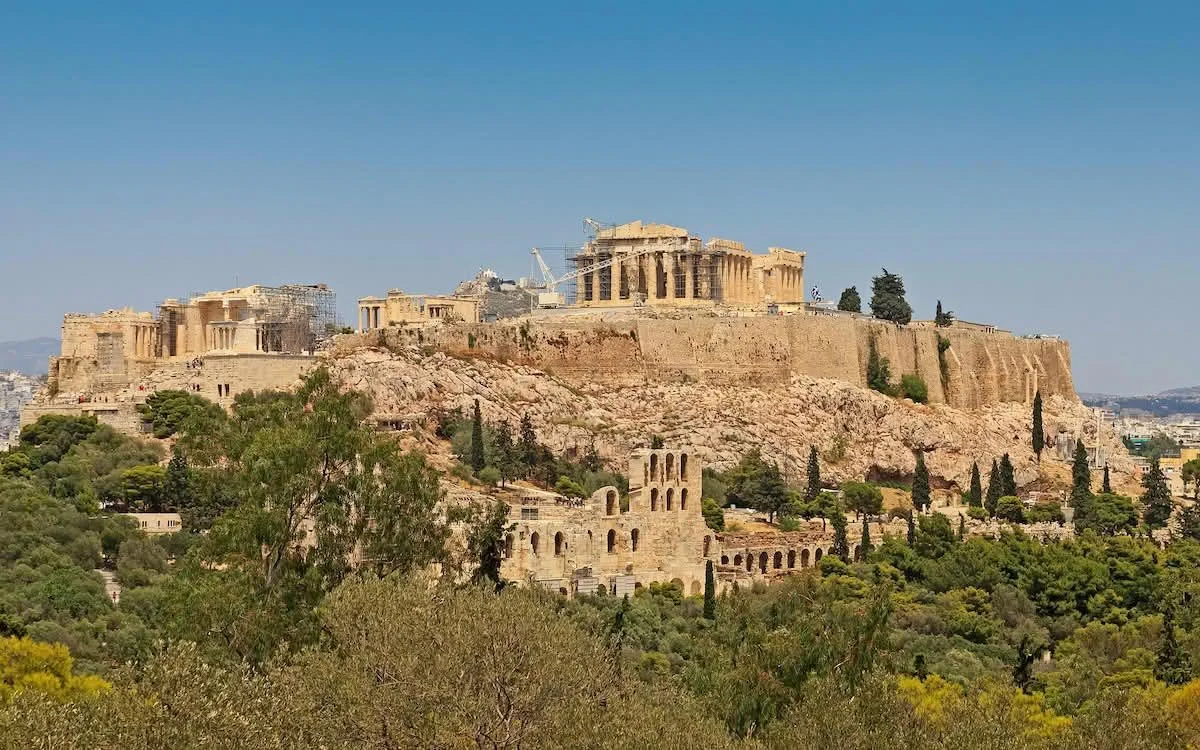
The Acropolis rises over modern Athens, Parthenon and temples clustered on the rock while the city spreads below.
Public buildings turn the polis into a visible “brand”
If you had walked into a polis in, say, the 6th or 5th century BCE, you would not have needed a map to understand what mattered there. The architecture already did a lot of the talking. Temples on the acropolis and at city edges, stoas and shrines around the agora, theatres on the slopes – together they form a kind of built diagram of priorities.
Greek temples are a good starting point. A temple is not a church people gather inside but a house for a god’s image, around which rituals and processions take place. The decision to build a large stone temple with sculpted pediments and columns is always a serious political and financial choice. Our deep dive on the Greek temple walks through plans and parts, but at the level of the polis, each temple also says: “This city honours this deity, on this hill, in this style.” The Parthenon in Athens, the Heraion at Samos, the temples at Paestum – all of them are architectural signatures.
It’s not just temples, though. Think of ancient Greek structures more broadly: theatres, stadiums, council houses, defensive walls. In our guide to ancient Greek structures we treat them as a checklist of what a polis needs to function – to hold assemblies, stage festivals, host games, protect its borders. A theatre carved into a hillside facing the sea, like at Syracuse, does three things at once: it provides a place for drama competitions, frames a spectacular view that visitors will remember, and silently claims that this city can afford such an ambitious public project.
Even things that look purely practical, like city walls, have artistic and symbolic weight. Massive fortification systems, whether in classical Athens or later Hellenistic poleis, use carefully cut masonry, towers, gates and inscriptions that make the boundary visible and legible. The wall is not just a barrier. It’s a statement that says: there is a “we” inside here, and art – reliefs over gates, victory trophies, dedications near key entrances – helps define who that “we” is.
All of this sits inside the larger conversation on Greek architecture. Orders like Doric and Ionic, columned facades, proportional systems – they aren’t only stylistic choices. They are shared visual languages that different city-states use to position themselves within the Greek world, sometimes conservatively, sometimes experimentally.
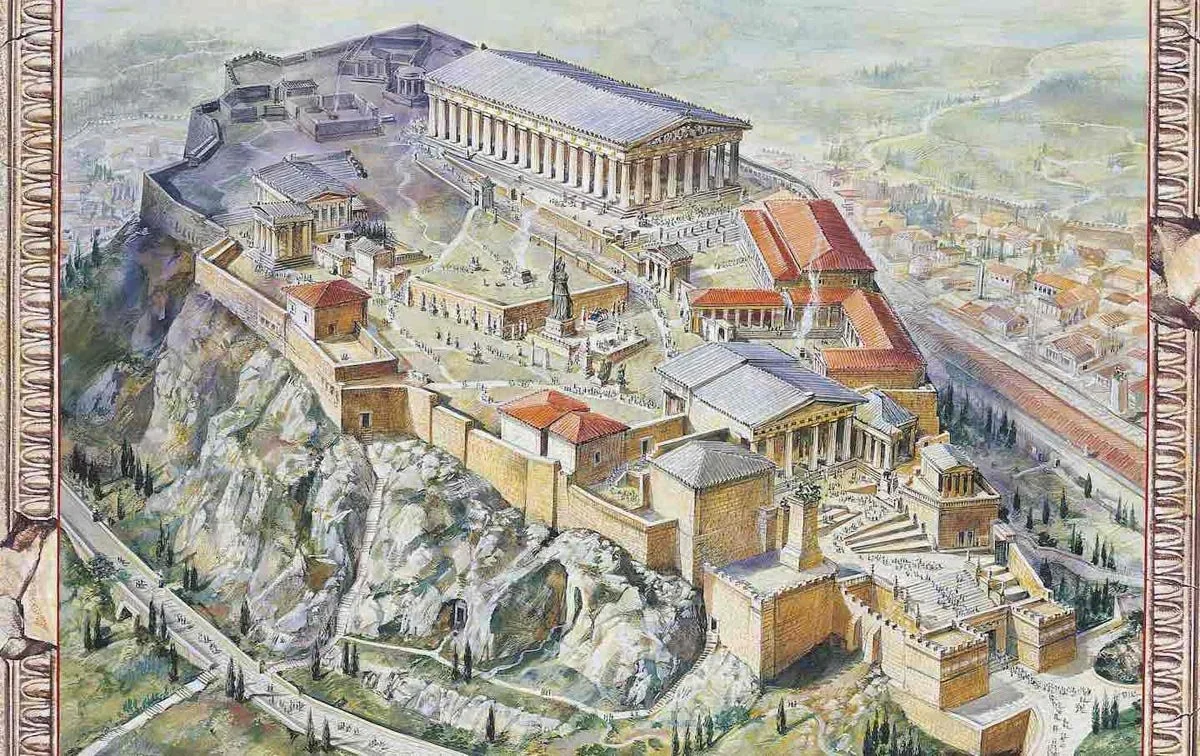
Historical reconstruction of the Periclean Acropolis, imagining temples, stoas and cult statues in their original setting.
Festivals, rivalries and daily life: how the polis fuels artistic innovation
If public buildings give the polis its skeleton, festivals and everyday routines give it a heartbeat. Greek city-states were full of recurring events – religious festivals, athletic games, processions, sacrifices – that needed visual support: altars, votive statues, painted vases, prize amphorae, commemorative monuments. These rhythms are where a lot of artistic experimentation actually happened.
Take religious festivals first. In many poleis, a big yearly or multi-yearly festival for a patron deity involved processions through the city, sacrifices at altars, maybe performances in the theatre. To prepare, the polis might commission new cult statues, repaint or restore older ones, add reliefs to an altar, or dedicate a series of offerings. Artists get repeated chances to rework familiar themes – gods, heroes, local myths – and adapt them to new political contexts. Our article on Greek god statues shows how divine images are never just “decorative”; they are tools through which the polis talks to the gods and to itself.
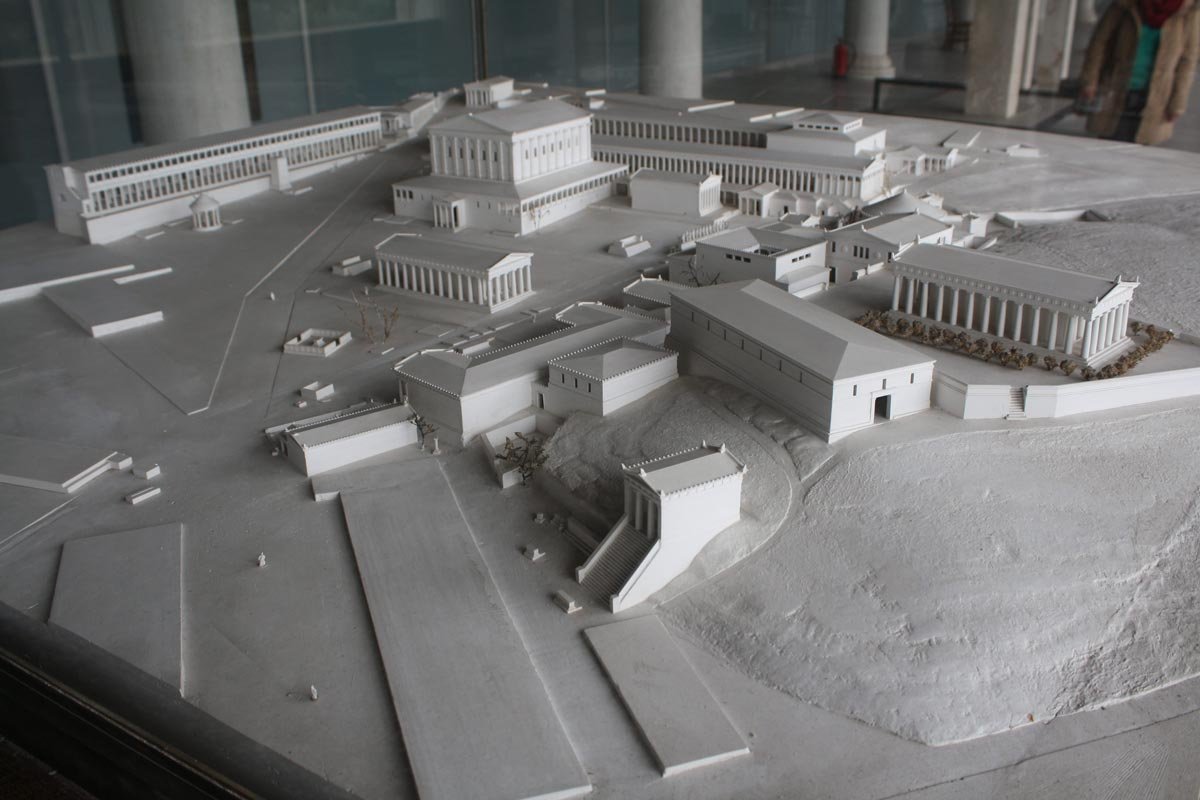
Museum model of the Athenian Agora, turning scattered ruins into a readable cityscape of stoas, shrines and civic buildings.
Now add rivalry into the mix. Poleis compete constantly: for trade, territory, prestige at panhellenic sanctuaries like Delphi and Olympia. One city dedicates a sculpted treasury; another responds with an even grander one. A victory in war or in athletic games might be celebrated with a monumental statue group, a new stoa, or a sequence of painted panels. In this context, art becomes a public scoreboard of successes and alliances. When you look at a row of bronze or marble statues in a sanctuary, you’re reading a very dense conversation between city-states.
What about life behind the big monuments? Inside the city, people live in Greek houses built around courtyards, with modest street facades and interiors that still host a lot of small-scale art: painted pottery, terracotta figurines, decorated furniture. Our future piece on ancient Greek houses explores how domestic space works, but even here the influence of the polis is strong. Laws regulate who can own land, how inheritance works, and sometimes how luxury can be displayed. That means the style and distribution of objects in the home are indirectly shaped by civic rules.
Zooming back out, a map of ancient Greek cities is almost a map of artistic micro-climates. Athens invests heavily in marble sculpture and monumental building programmes. Corinth becomes famous for certain pottery styles and trade networks. Island poleis like Naxos or Paros use their local stone to create distinctive sculptural traditions. If you open a map of ancient Greek city-states, you’re not just looking at geography; you’re looking at nodes in a network where different kinds of art are tested, perfected and exported.
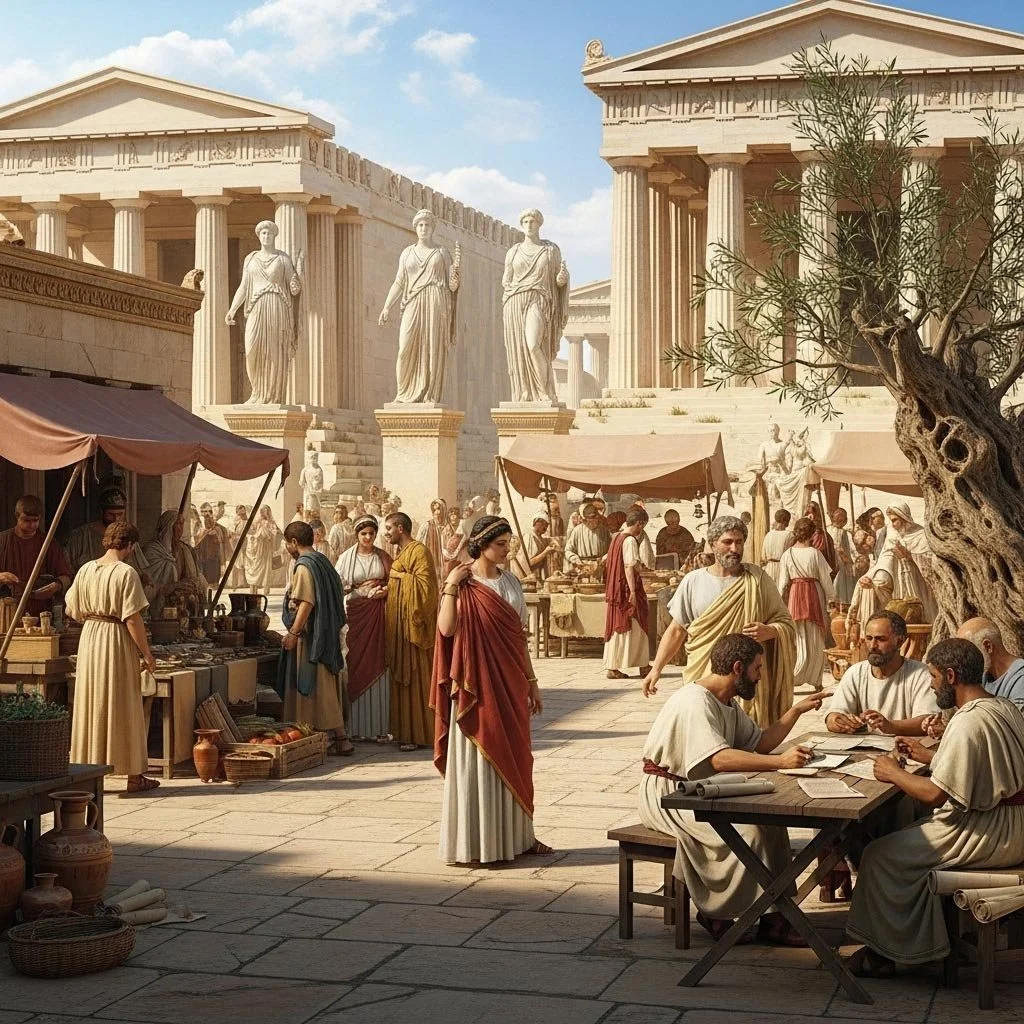
Imagine walking through the Athenian agora, temples towering above as traders, philosophers and citizens share space in the sun.
Conclusion
When we first meet Greek art in textbooks, it can feel like a straight line of styles – geometric, archaic, classical, Hellenistic – floating above real life. Spending time with ancient Greek city-states pulls that line back down to earth. Temples stop being generic ruins and become specific decisions made by specific communities. Theatres are no longer just pretty semicircles but places where a polis stages its myths and debates itself through tragedy and comedy. Even a simple painted vase starts to look different once we remember that it circulates inside a legal, religious and social framework created by a city-state.
For me, the most helpful shift is this: instead of asking “What is Greek art?” in the abstract, we can ask “What did art do for this particular polis, at this particular moment?” Sometimes the answer is diplomatic – a flashy dedication at a shared sanctuary. Sometimes it’s deeply local – a small shrine on a city wall that only makes sense to its citizens. Either way, the works we admire in museums today were once embedded in dense city ecologies of laws, rituals and rivalries.
If you want to keep building this bigger picture, you can follow the thread through our guides to ancient Greek art, Greek architecture and ancient Greek structures. Piece by piece, the polis will stop being just a word from a history exam and start feeling like a very human experiment in living together surrounded by images, buildings and stories.
Sources and Further Reading
You may also like