What Defines the Classical Period? Art Rules Explained
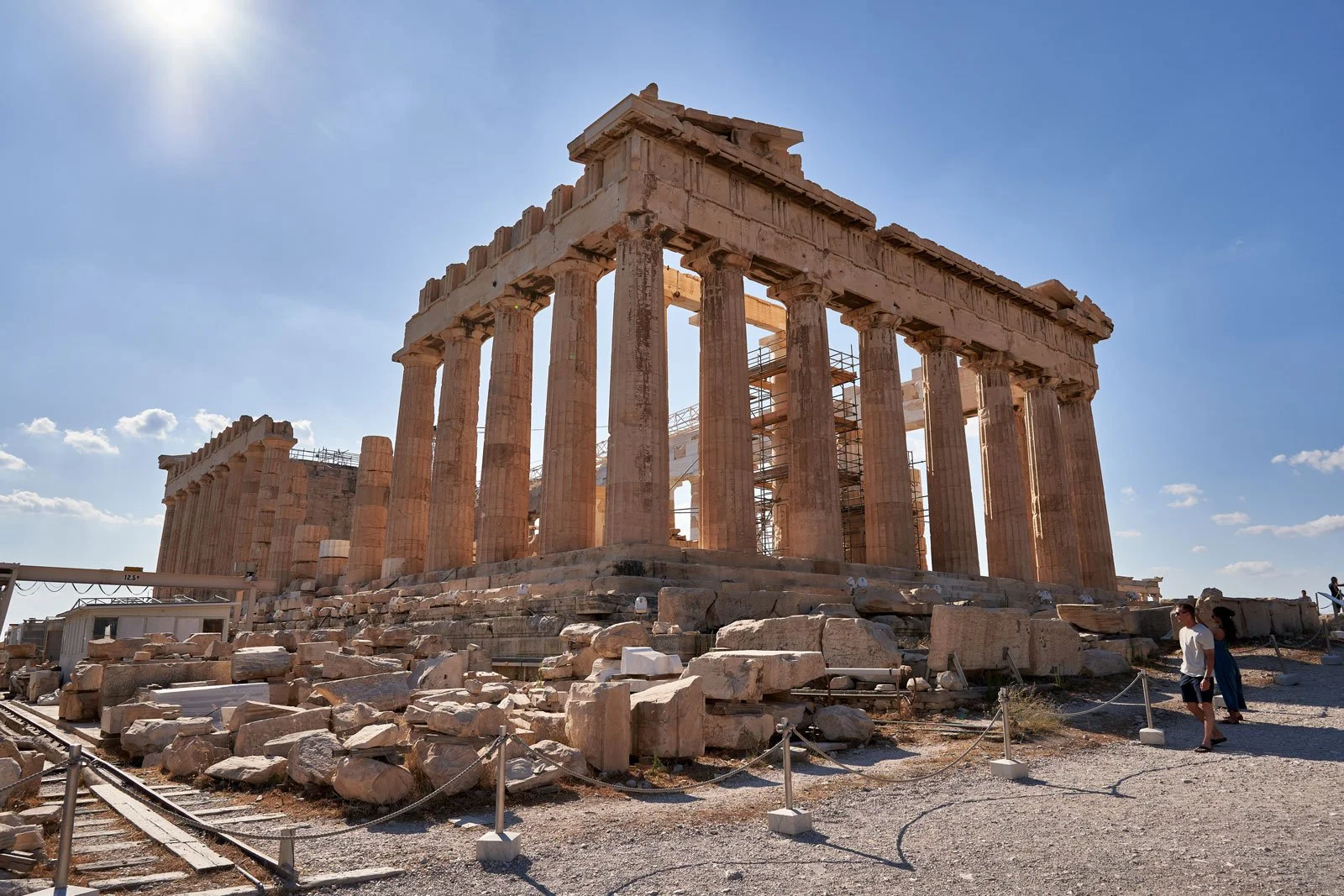
The Parthenon isn’t just “ancient”—it’s also a living restoration site. Photos like this help us see how conservation, scaffolding, and missing blocks shape what we think the building is today.
There’s a moment in Greek art when everything seems to click into place. Faces calm down. Bodies start to breathe. Drapery stops looking like a pattern and starts acting like fabric. And suddenly we, modern viewers, begin saying things like: “Wow. That’s… perfect.”
But here’s the secret: the Classical period wasn’t a magical upgrade where artists suddenly “learned realism.” It was a choice. A shared set of values about what art should do, what a human body should look like, and what a city should project into the world.
In this guide, we’ll pin down what “Classical” means in Greek art: when it roughly happens, what visual rules define it, and why those rules were never just about beauty. They were about power, identity, and a very specific kind of confidence.
The Classical period is a date range, but it’s also a mindset
Most art historians use “Classical period” for roughly 480–323 BCE, a stretch that begins after the Persian Wars and ends around the death of Alexander the Great. That’s the tidy timeline. The more interesting part is what changes inside the art.
Classical Greek artists start chasing a particular combination: clarity, balance, and believable life. Not messy life. Not accidental life. Life that feels composed.
So when we say “Classical,” we’re usually talking about a new visual attitude:
The human body becomes the main measuring tool (not just a subject).
Forms look stable even when they move.
Emotions quiet down, but presence intensifies.
Beauty becomes something you can build with rules.
This is why it helps to keep two ideas in our head at once. The Classical period is historical time, yes. But it’s also a visual agreement artists and patrons buy into. That agreement sits right in the middle of the larger Greek timeline, between the Archaic Period before Classical and what comes next in the bigger Greek timeline.
And within the Classical period itself, people often split it further (as a best-guess map, not a law): early “Severe” experiments, high Classical confidence, late Classical elegance. Those labels matter less than the direction of travel: toward controlled realism and ideal form at the same time.
Definition: The Classical period in Greek art is roughly 480–323 BCE, marked by balance, ideal form, and controlled realism.
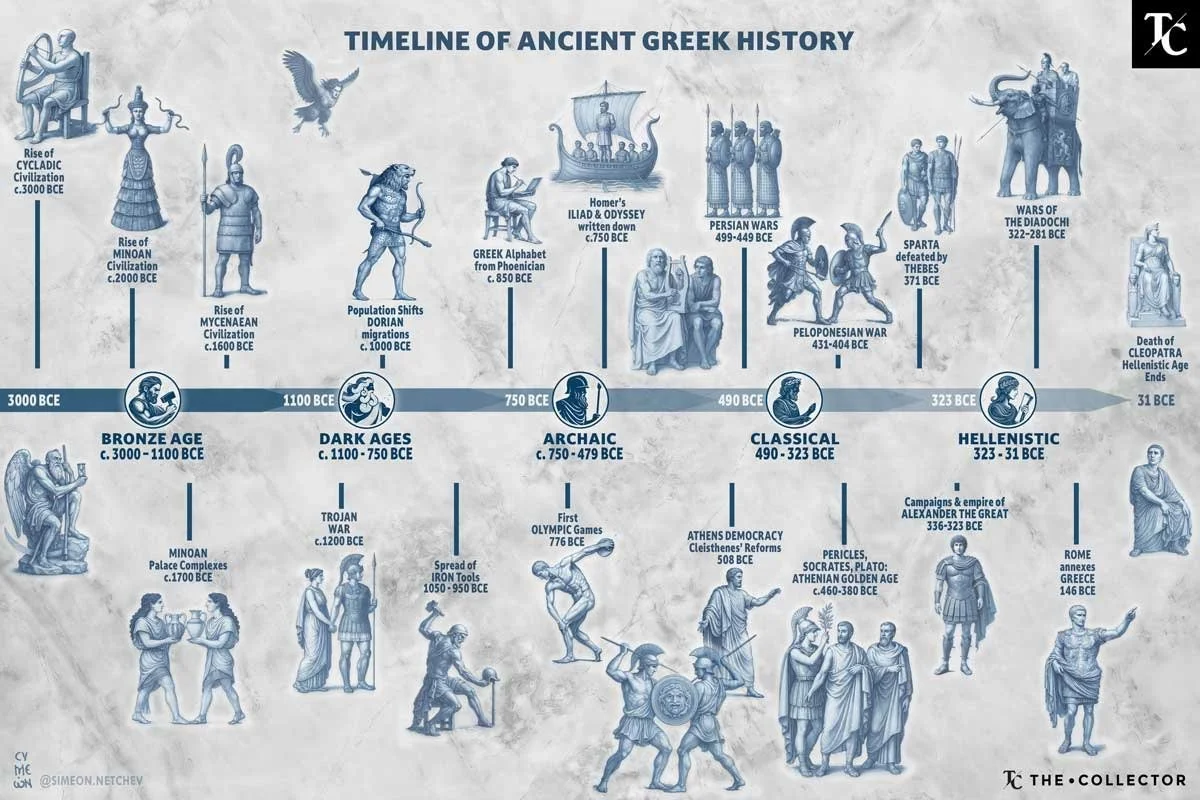
A timeline is a simple tool, but it changes everything: it helps us place artworks in a living sequence of wars, reforms, and cultural shifts.
Classical doesn’t mean “realistic”; it means “made to feel right”
If we walk into a museum and see a Greek statue that looks “real,” our instinct is to praise the accuracy. But Classical artists weren’t trying to copy nature like a camera. They were trying to edit nature into something more legible and more convincing.
Think of it like this: Classical art wants the viewer to feel, “Yes. That’s how a body should work.” Even when no real body looks quite that clean.
This is the core of what “Classical” looks like: not raw realism, but harmonized realism. The hips, ribcage, shoulders, and knees all relate to each other like they’re following an internal logic. The whole figure reads as one system, not a stack of parts.
A lot of that comes down to proportion thinking. The Greeks had words for it. One you’ll see in scholarship is symmetria, meaning parts measured in relation. Not symmetry like mirror-image sameness, but a sense that everything fits together by ratio.
And here’s where the “rules” become emotional, not just technical. When art is composed this way, it makes the viewer feel:
calm rather than overwhelmed,
trust rather than confusion,
admiration rather than unease.
That emotional effect is part of why later cultures kept returning to Greek Classicism as a model. It’s not only beautiful. It’s convincing.
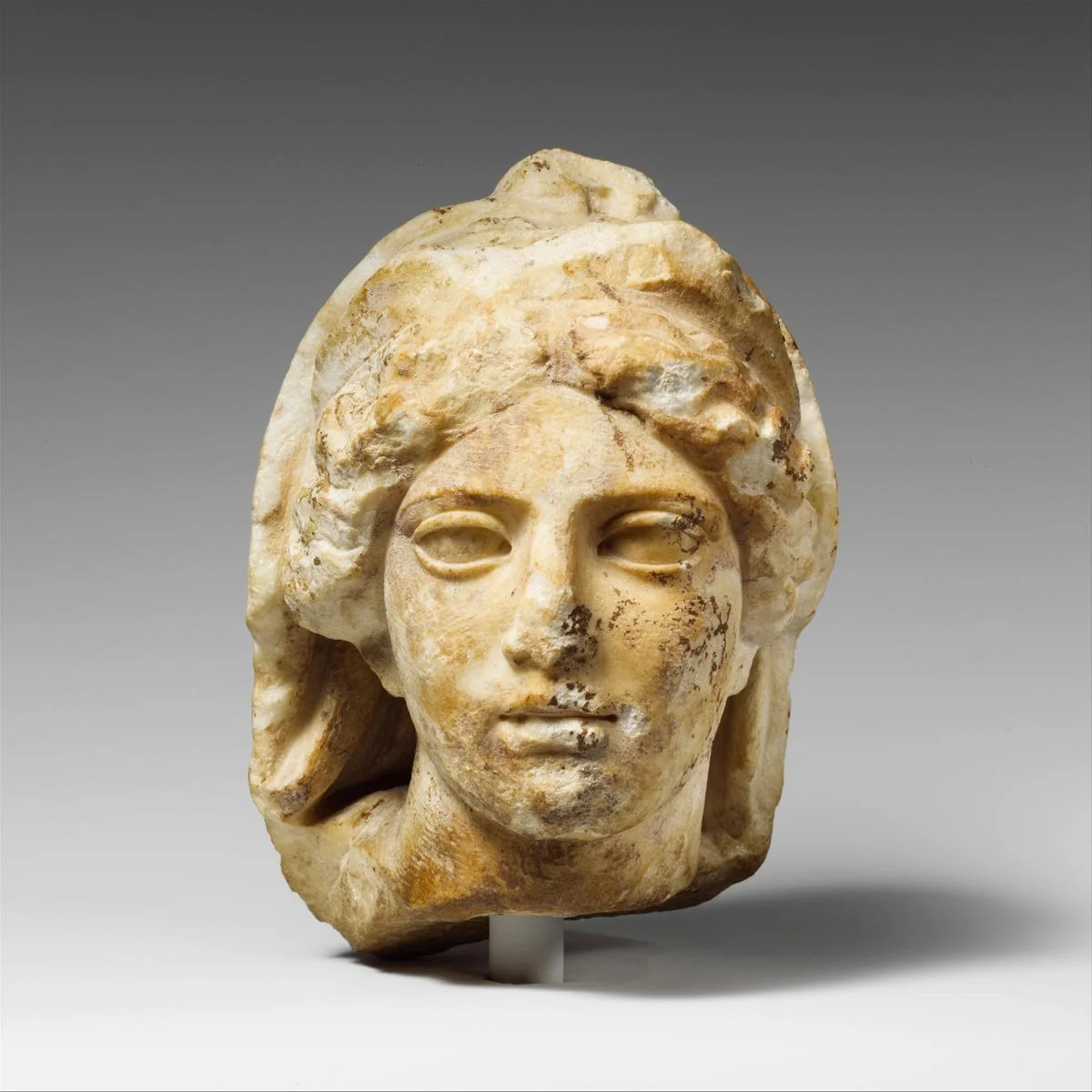
Even when the statue is incomplete, hair, facial structure, and surface finish can still whisper the original style. This is the kind of close-looking that turns “old stone” into evidence.
The body becomes the blueprint: proportion and the contrapposto shift
One of the fastest ways to spot Classical thinking is the stance. The Archaic kouros stands frontally, weight evenly distributed, like a declaration. Classical figures start shifting weight, and suddenly the body behaves like a living structure.
That shift is called contrapposto, meaning weight on one leg, body counterbalances. When the pelvis tilts, the spine responds, the shoulders adjust, and the whole figure becomes a chain of cause-and-effect. If you want the full visual breakdown, the contrapposto pose is one of those concepts that feels small until you notice it everywhere.
But contrapposto is only half the trick. The other half is proportion, the idea that the body can be tuned like an instrument. Greek sculptors talk (and later writers report) about “canons,” meaning rulebooks of proportion. Not because art must be robotic, but because a system lets you repeat “rightness” across different bodies, different materials, different scales. That’s the logic behind the canon of proportions, and it’s why Classical statues often feel related even when they’re not copies.
Put contrapposto and proportion together, and you get the Classical “alive” effect:
The pose suggests a moment, not a pose-for-eternity.
The anatomy looks organized under the skin.
The figure feels stable, but not frozen.
This is also why Classical sculpture is such a leap from earlier traditions. If you trace the arc from Archaic smiles to Classical calm, you can almost watch artists learning how to turn a body into a believable structure.
The “Golden Age” is part of the Classical period, not the whole thing
People often use “Classical” and “Golden Age” as if they’re the same label. They’re not.
The Classical period is the broader artistic era. The Golden Age of Greece usually points to a specific peak, often centered on mid-5th-century Athens, when wealth, politics, and cultural production intensify at the same time.
So here’s a helpful way to keep it straight:
Classical period = the long arc of rules and style.
Golden Age = one high-intensity chapter inside that arc, especially in Athens.
This matters because the Classical period includes different moods. Early Classical art can feel stricter, even tense. Late Classical art can feel softer, more intimate, sometimes more psychologically “human.” If we flatten all of that into “Golden Age perfection,” we miss the fact that Classicism evolves.
And it’s also worth saying out loud: this “perfection” is never neutral. Classical ideals were supported by patrons, cities, and institutions. Art didn’t float above history. It carried history on its shoulders.
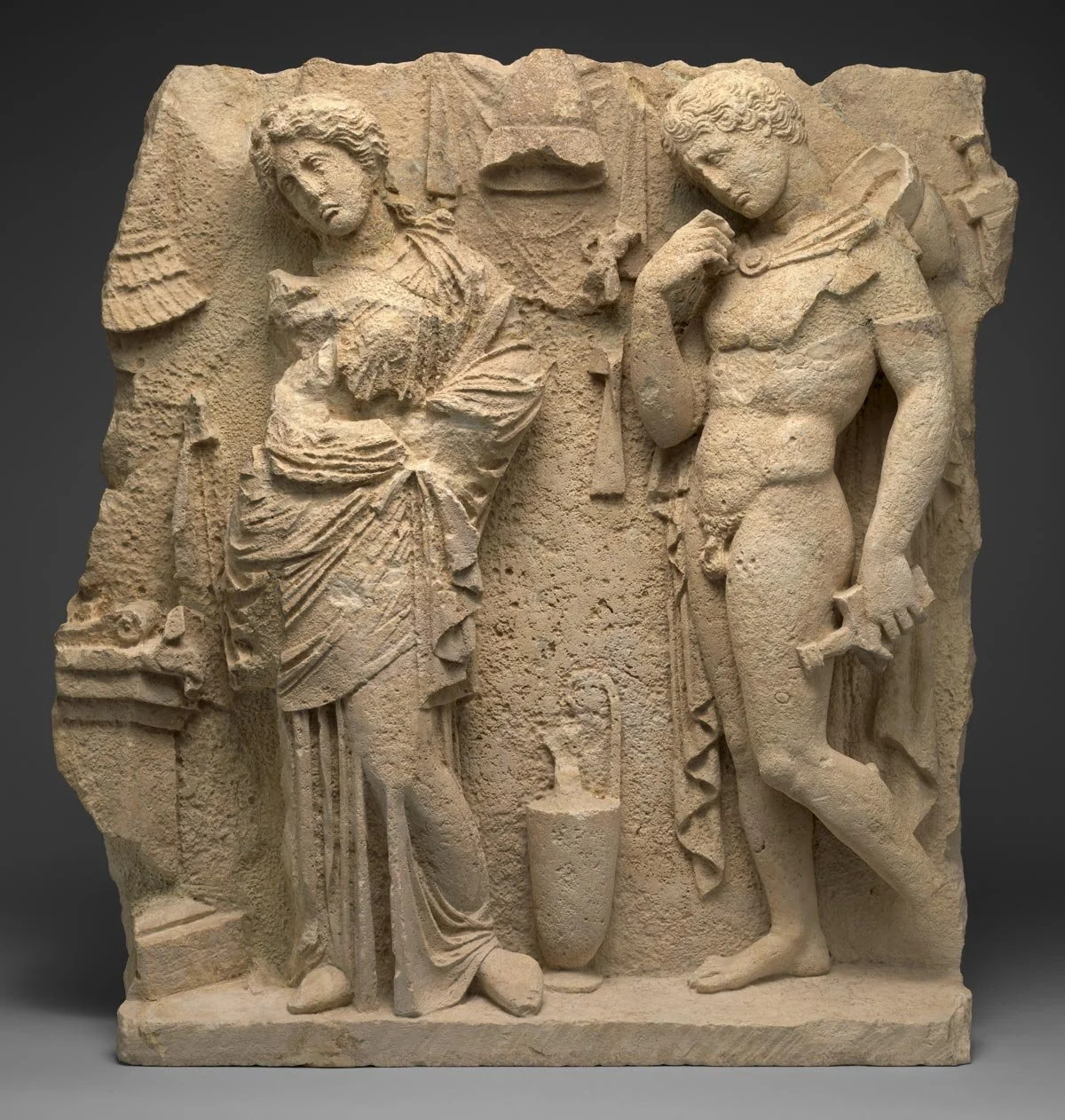
Reliefs like this feel almost like a snapshot—figures, gestures, and symbolic objects compressed into one shallow plane. Notice how the sculptor uses drapery folds and stance to create personality without deep space.
The Parthenon matters because it turns style into a civic message
If Classical rules had a flagship, it would be the Parthenon. Not because it’s the only masterpiece, but because it’s where style, religion, and politics lock together.
To start, it helps to be clear about the site: the Parthenon is one building, while the Acropolis is the larger sacred hill complex. That confusion is common, which is why Parthenon vs Acropolis is basically a survival guide for beginner readers.
Now, what makes the Parthenon so “Classical” isn’t just the marble or the craftsmanship. It’s the fact that everything feels systemic. Architecture and sculpture work like one designed argument. Even the timeline reinforces that sense of intention: when the Greek Parthenon was built is not just a date question, it’s a clue to the political moment that funded it.
And then there’s meaning. The Parthenon doesn’t simply honor Athena. It communicates Athens’ identity, confidence, and claims about leadership. That’s the deeper layer of why the Parthenon matters.
This is where the Classical period becomes easiest to “read.” The style is doing emotional work:
order becomes a public virtue,
ideal form becomes a civic brand,
controlled beauty becomes authority you can see.
If you want to go even deeper on how the temple’s sculptures operate as a connected narrative system, Parthenon sculptures is where the “one program” idea really clicks.
Conclusion
The Classical period isn’t defined by one statue or one temple. It’s defined by a shared decision: to build art that feels composed, not accidental. That’s why the era keeps pulling us back. We recognize the calm. We trust the balance. We feel the body as a system, not a symbol.
And once you start seeing those rules, you can’t unsee them. The Classical period stops being “that famous Greek era” and becomes a set of choices you can spot, question, and appreciate on your own terms.
FAQ
When did the Classical period in Greek art begin and end?
It’s usually dated about 480–323 BCE, from post–Persian Wars to Alexander’s death.
Is the “Golden Age of Greece” the same as the Classical period?
No; it’s typically a peak inside the Classical period, often focused on mid-5th-century Athens.
What’s the clearest visual sign something is “Classical”?
A believable body logic, especially the contrapposto weight shift and balanced proportions.
How is Classical art different from Archaic art?
Archaic art often feels frontal and patterned, while Classical art aims for controlled realism and unified balance.
Why is the Parthenon so central to the Classical period?
Because it turns Classical style into a full civic statement, combining architecture, sculpture, and ideology.
Sources and Further Reading
The Metropolitan Museum of Art — “The Art of Classical Greece (ca. 480–323 B.C.)” (2008)
Cambridge University Press — “Art: Archaic to Classical” in The Cambridge Ancient History (1992; online 2008),
UNESCO World Heritage Centre — “Acropolis, Athens” (n.d.)
Acropolis Museum — “The Parthenon Gallery” (n.d.)
Acropolis Museum — “Sculptural decoration” (n.d.)
The Metropolitan Museum of Art — “Greek Art in the Archaic Period” (n.d.)
American School of Classical Studies at Athens — Stevens, “The Setting of the Periclean Parthenon” (1940)

You may also like