Geometric Art in Greece: Lines, Patterns and Tiny Horses
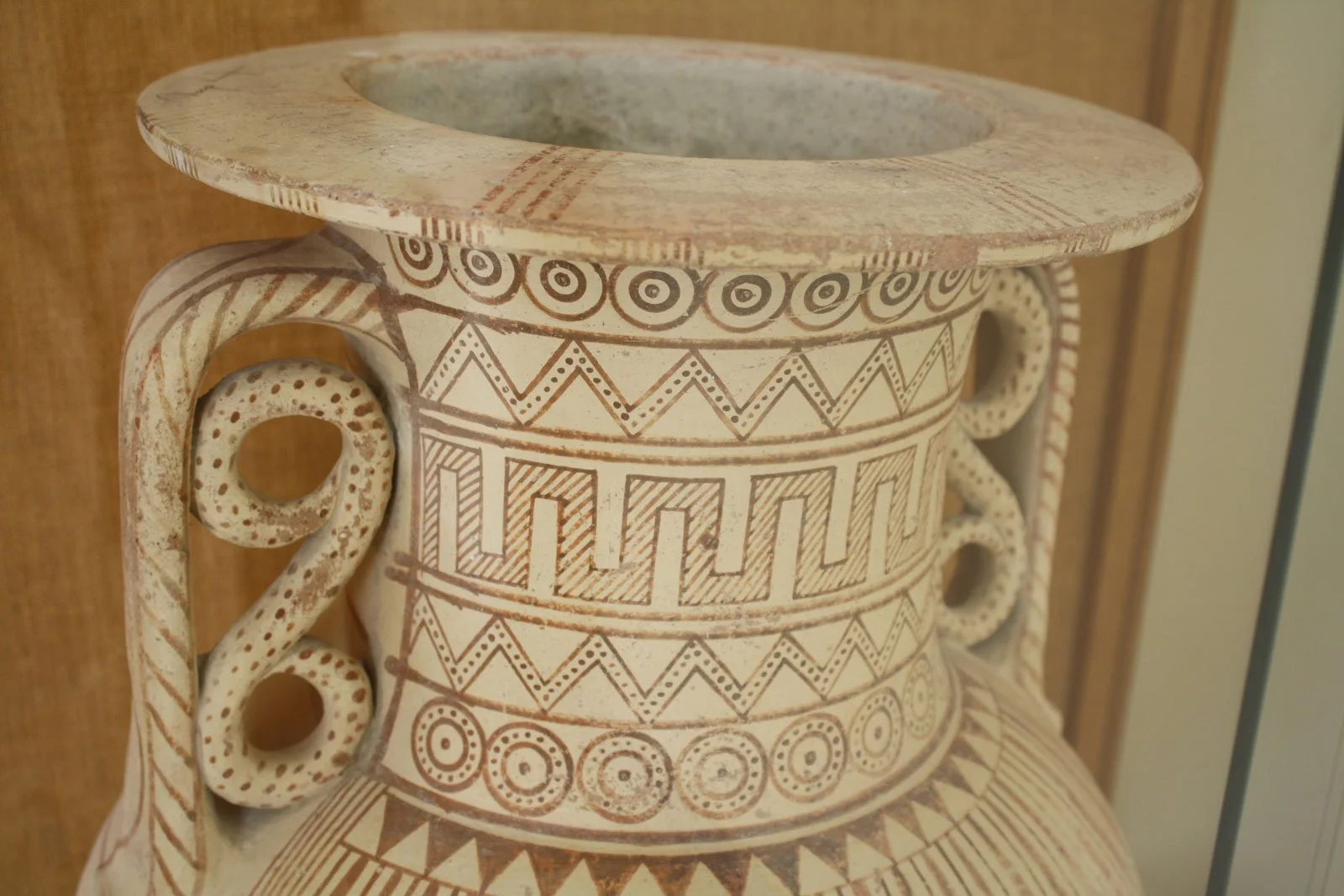
This Geometric krater turns simple lines and shapes into dense patternwork that once wrapped around an entire funerary vase.
Imagine picking up a tall Greek vase and seeing almost no people on it. Instead you get bands of zigzags, checkerboards, triangles, circles and, every so often, a row of tiny horses trotting neatly around the shoulder. No gods, no big myth scenes, just patterns and little silhouettes. It feels almost modern. But for early Greek artists, this was the perfect visual language for a world rebuilding itself after the so-called Dark Age.
In this article we use one simple question as our guide: what is geometric art in Greece really doing, beyond just decorating pots? We will place it in time, look closely at its favorite patterns and horses, and see how those designs slowly turn into the first Greek visual stories. If you want a bigger frame while you read, you can keep our overview of ancient Greek art as a whole open in another tab, or our guide to the main types of Greek pottery and vases.

What Is Geometric Art in Early Greece?
Geometric art in Greece is the visual style that fills the centuries roughly between 900 and 700 BCE. That is the time when Greek communities slowly recover from the collapse of the Mycenaean palaces and start to form the cities that will later build temples and statues. The main canvas for this style is pottery, which is why geometric art and geometric pottery designs are usually discussed together.
Geometric art in Greece is an early style, around 900–700 BCE, where pottery and small objects are covered with repeated linear patterns and simplified figures.
The name “geometric” comes straight from the look. Surfaces are organized into registers, horizontal bands that wrap around the vessel. Inside those bands we find meanders, triangles, squares, concentric circles and cross-hatching, all drawn with compass and straightedge tools. The effect is almost like a textile pattern translated into paint and clay.
Most of these vases are functional objects. They are used to mix wine, store oil, carry water or mark graves. Yet the level of care is striking. A single krater (large mixing bowl for wine) can carry hundreds of carefully painted motifs, each one placed according to a clear system. When we place several examples side by side, we can see that workshops in different cities develop their own preferences: some favour dense, almost obsessive coverage, others leave more breathing space between bands.
Chronologically, scholars often talk about Early, Middle and Late Geometric phases. Early pieces focus almost entirely on abstract pattern. By the Late Geometric period, tiny animals and humans appear more frequently. This gradual shift from pure geometry to schematic figures is one of the reasons this style matters so much for the history of Greek art. It shows us, almost frame by frame, how artists learn to move from pattern to picture.
If we zoom out to the broader story of ancient Greek sculpture and architecture, geometric art sits at the starting line. It is the visual culture of a world that does not yet build stone temples or life-size statues, but is already experimenting with order, rhythm and narrative on a smaller scale.
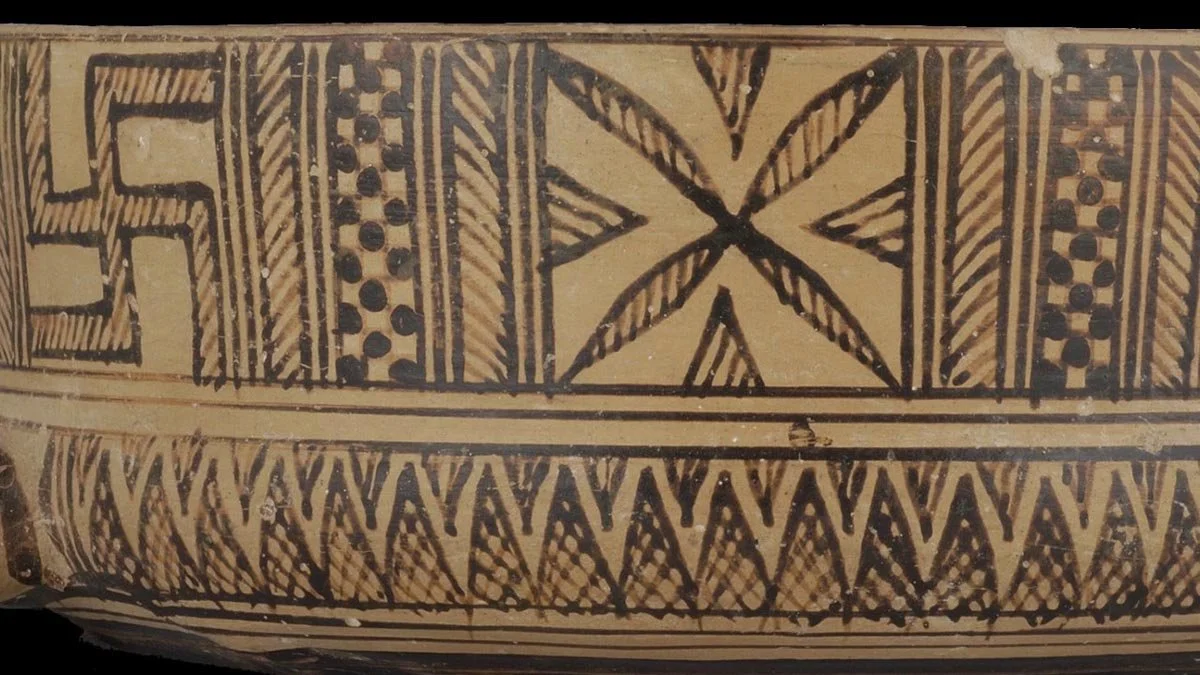
Close-up of a Geometric frieze where meanders, dots and star shapes, including a swastika, lock into a tight rhythm.
Why So Many Lines, Patterns and Tiny Horses?
The dense patterns on geometric vases are not random decoration. They are a visual system that helps artists structure space, guide the eye and signal meaning.
If you look closely at a typical geometric amphora or krater, you will see that the potter and painter treat each band differently. Narrow areas at the neck and foot might carry simple zigzags. The belly, which offers the largest surface, becomes a kind of prime real estate for more complex motifs. Popular patterns include the meander, a continuous right-angled line that modern viewers often call a Greek key, as well as triangles, diamonds and concentric circles made with a compass. We explore these in more detail in our article on Greek patterns and borders and in the focused explainer on the Greek key pattern.
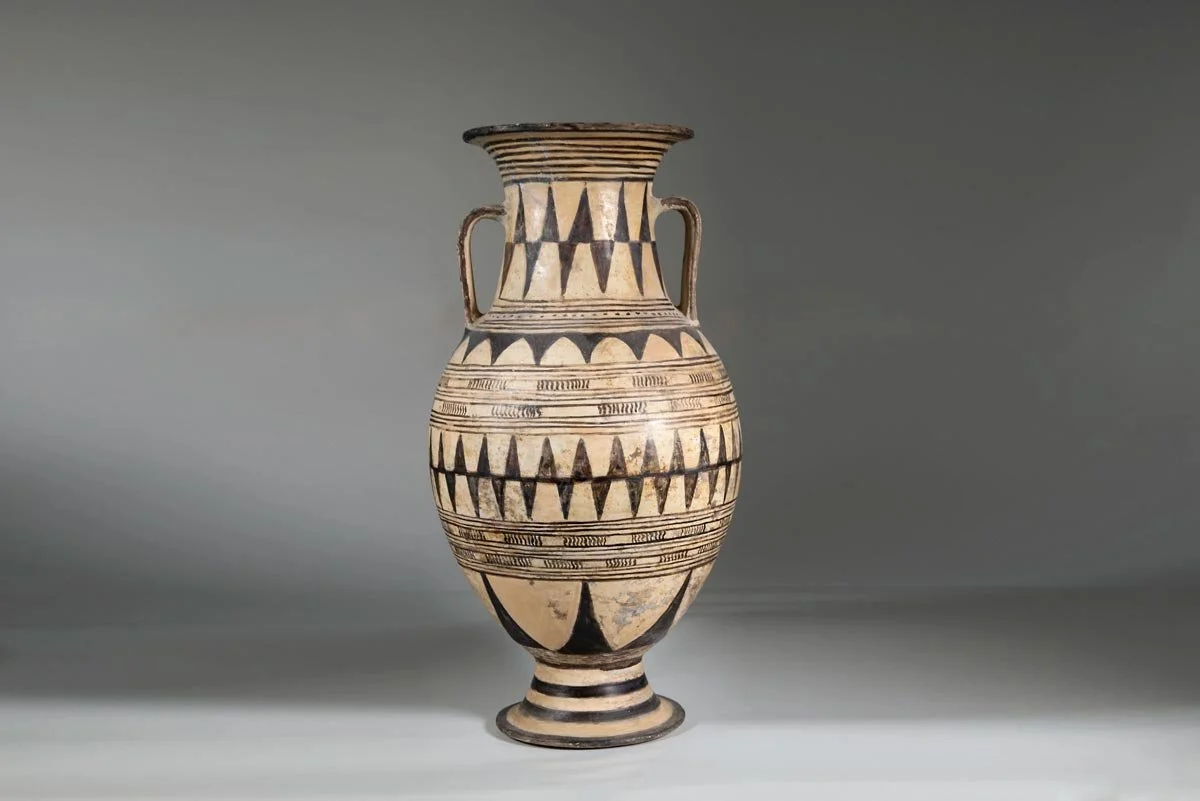
Proto-Geometric amphora where bands and triangles wrap the belly, early Greek pottery testing order through pattern.
At first, animals and humans barely appear. When they do, they keep the same geometric spirit. Horses are reduced to simple shapes: a triangular chest, straight stick legs, a round eye and a single curved line for the neck. They usually march in single file, harnessed to chariots or standing in rows. These tiny horses are not just cute details. In many finds, they are made of bronze or clay and placed in graves or sanctuaries, suggesting that the horse is a powerful status symbol connected to elite identity and warfare. Putting them on vases repeats that signal for anyone who sees the object.
This visual language has a practical side too. Straight lines and repeated motifs are easier to apply with basic tools and dark slip paint. They make the pot readable from a distance, especially in low light around a grave or a sanctuary. The repetition also fills awkward spaces on curved surfaces, helping the painter avoid large empty patches that might crack or look unfinished.
So when we see zigzags, meanders and miniature horses circling a vase, we are seeing more than decoration. We are watching early Greek artists balancing clarity, rhythm and meaning with a fairly limited toolkit. That discipline, learned on clay, will later feed into more complex images on pottery and eventually into patterns on architecture and sculpture.
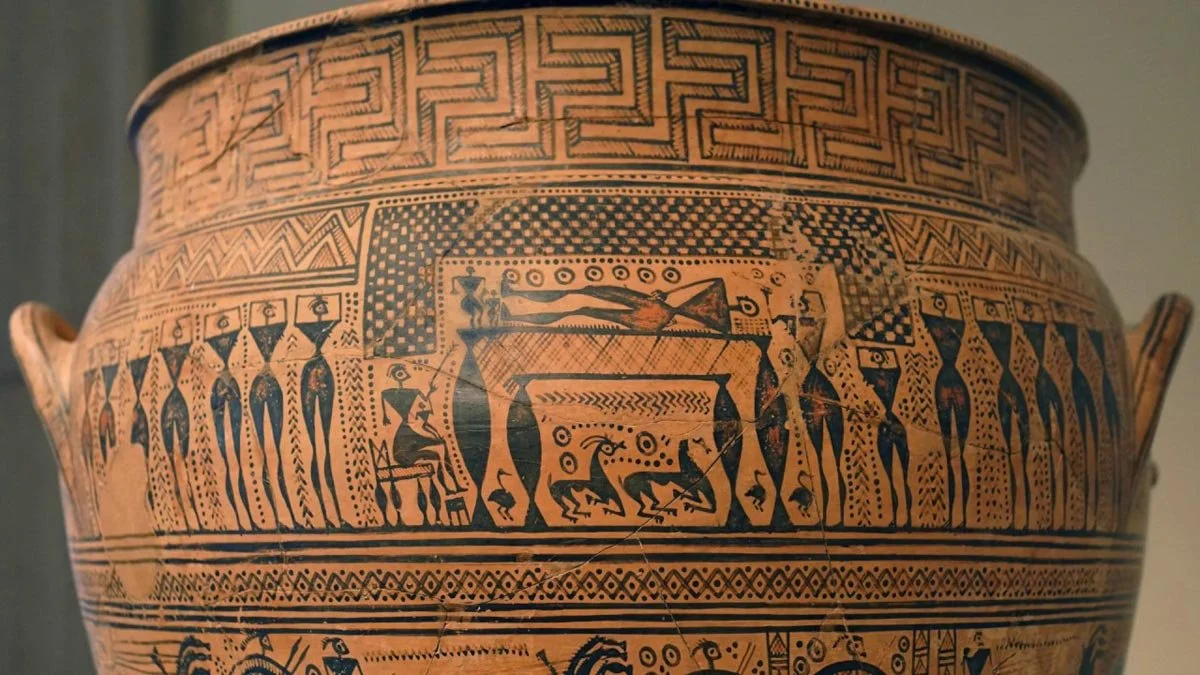
Close view of a large Geometric krater, its dense meanders and tiny mourners turning a funeral into a pattern of signs.
How Do Geometric Patterns Become the First Greek Stories?
By the later eighth century BCE, something new happens on geometric vases. In the middle of all the lines and horses, painters start to stage small scenes. Often these are funerals.
A classic example is a monumental grave marker like the Dipylon amphora or a large terracotta krater from Athens. On these vases, the central band shows a prothesis, the laying out of the body on a bier. The corpse is rendered as a simple, flat figure, usually surrounded by mourners with raised arms. Below or above this scene, another band might show the ekphora, the funeral procession, complete with tiny chariots and more horses. Everything is still geometric and schematic, but the actions are clear enough that even modern viewers can follow them.
What we are seeing here is the birth of narrative in Greek art. For the first time, painters use a sequence of motifs to refer to a specific type of event, not just to fill space. They decide which moment of the ritual to show, how to place figures, and how to use the surrounding patterns to frame the action. Scholars debate whether these scenes refer to particular individuals or to more general ideas about heroic death, but either way they are deliberate, structured images, not random decorations.
This shift also changes how viewers interact with pottery. Instead of just enjoying the patterns, a viewer can now “read” the surface, moving from band to band and reconstructing a story. That habit of visual reading will later be essential when artists move into more detailed myth scenes, especially with the arrival of black-figure vase painting, where figures and inscriptions identify specific heroes and gods.
Geometric narrative scenes are modest compared to the dramatic myths on later vases. Yet they belong to the same family tree. If we compare a Late Geometric funeral krater with a later mythological vase, we can see the continuity: the use of registers, the way important figures occupy central zones, the way horses and chariots signal movement and prestige. In other words, these early bands of pattern and tiny silhouettes quietly train both artists and audiences in visual storytelling, long before marble sculptors carve gods and heroes on temple pediments.
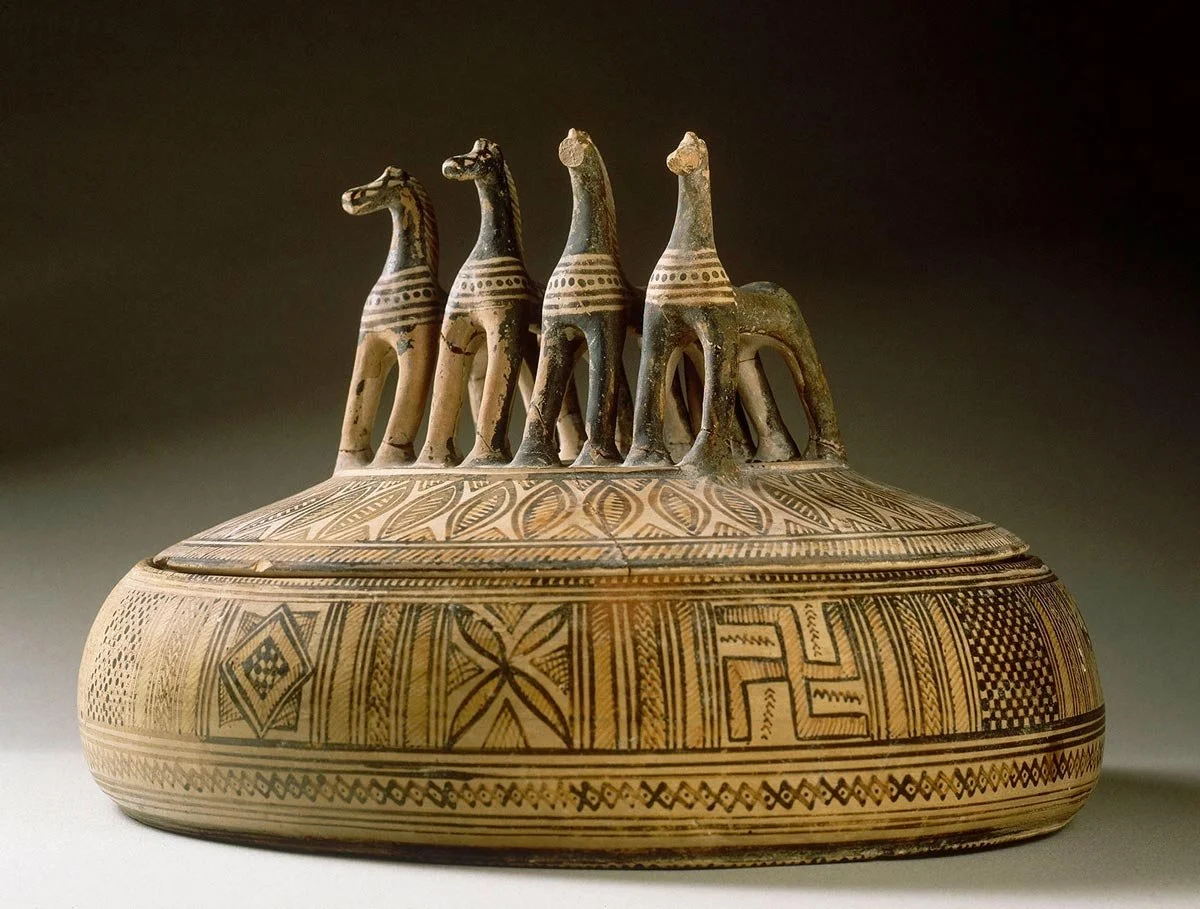
Small Geometric pyxis topped with a ring of horses, turning a simple container into a miniature procession.
Conclusion
Geometric art in Greece can look, at first glance, like pure decoration. Just lines, triangles and circles, with a few miniature horses added for charm. Once we slow down, though, a different picture emerges. We see a visual system that organizes space, signals social identity and, by the late eighth century, starts to carry stories about death, status and community.
By learning to read these vases, we get a rare window into a period of Greek history that leaves few written sources. We watch potters and painters experiment with pattern, then cautiously add figures, then arrange those figures into ritual scenes. That slow evolution helps explain why later Greek art, from figure-painted vases to monumental sculpture, feels so confident about using images to tell complex stories.
Next time you meet a geometric vase in a museum, try tracing the bands with your eyes. Count the horses, follow the meander, and see whether any small figures start to form a scene. In doing that, you are not just looking at an old pot. You are retracing the first steps of Greek narrative art, one zigzag at a time.
You may also like