Dimensions of the Parthenon: The Real Numbers Behind the Design
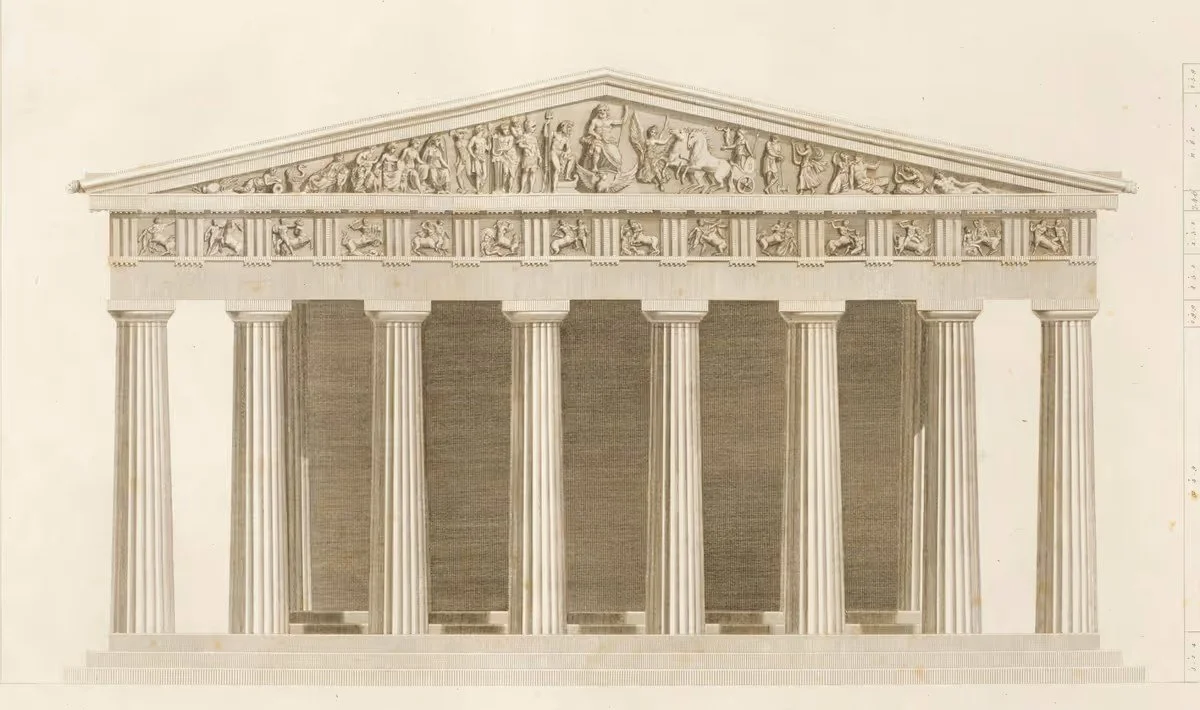
A frontal reconstruction helps us read the main measurements of the Parthenon more clearly.
The Parthenon gets described with big words: perfect, harmonious, “mathematical,” even “mystical.” And honestly, I get why. You look at it and it feels like it has rules.
But if we want to understand the design, we have to do something very unromantic first: get the numbers right. Not the TikTok numbers. Not the “golden ratio overlay” numbers. The real measurements historians and architects actually use.
So in this guide we’ll pin down the Parthenon’s main dimensions, explain where those measurements are taken, and then connect the numbers to what the building does best: look calm, stable, and impossibly controlled. We’ll also deal with the golden ratio rumor in a fair way, using the best “debate framing,” not the loudest claim.
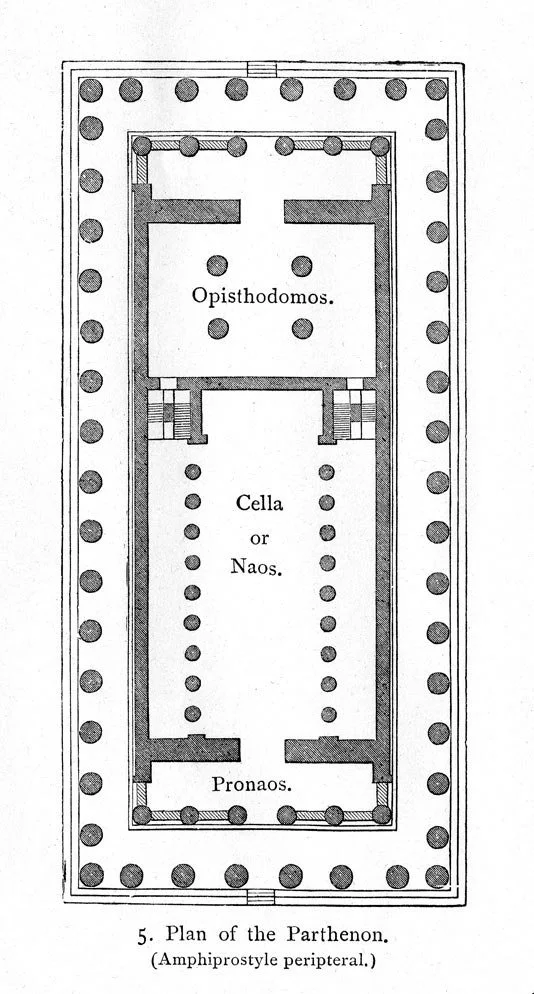
The plan shows the Parthenon’s footprint and internal layout in a direct way.
The “real dimensions” depend on where you measure, and that’s the first lesson
If you take one thing from this article, let it be this: ancient buildings don’t have one single “length” in the way a modern box does. The Parthenon sits on steps, it has a platform, it has columns that project beyond walls, and it has refinements that gently bend what we assume is straight.
So most reliable references will specify the measurement point. A common standard is the top step of the base, basically the level you’d stand on before entering the colonnade.
Here are the core numbers (rounded to the usual architectural shorthand):
Overall footprint (top step): about 69.5 m long by 30.9 m wide
Column layout:8 columns on the short sides, 17 on the long sides
Outer colonnade height: about 10.4 m (roughly 34 ft)
Total outer columns:46 (because corner columns count once, not twice)
Definition: The stylobate is the top surface of the temple steps.
That definition matters because many “dimension” claims are really stylobate claims. And once we’re precise, we can be calmer about small differences across sources. One reference might give 69.50 m, another 69.54 m. That’s not a contradiction. It’s measurement detail.
Now the fun part: those numbers aren’t just data. They’re design decisions.
The Parthenon’s harmony comes from repeatable proportions, not magic numbers
Here’s a strong claim we can actually defend: the Parthenon’s visual harmony is built from proportion systems that repeat across the building.
One famous relationship is the “9:4” feel. If you compare length to width, the ratio is very close to 9 divided by 4. Not because the Parthenon is a calculator. Because Greek architects worked with commensurable relationships, ratios that can be repeated across parts without losing coherence.
This is also why temple plans are so satisfying to look at. They’re not random shapes. They’re designed frameworks where the same logic can show up in:
the spacing of columns
the relationship between platform and colonnade
the rhythm of solids and voids
the way a visitor moves around the perimeter
If you want the plan logic in plain language, how Greek temple plans work gives the mental model you need: a temple is a structure designed to be read from the outside, walked around, and approached in stages.
And this is where the “golden ratio” rumor usually enters the chat.
Myth vs Fact
Myth: The Parthenon was designed with the golden ratio.
Fact: The claim is debated, and many scholars treat it as unproven.
To keep things grounded, it helps to frame it as a debate about measurement choices. Depending on which rectangle you pick on the façade, you can “find” lots of pleasing ratios. That’s why the most honest way to talk about it is exactly what your internal post promises: golden ratio debate, not golden ratio certainty.
If the Parthenon feels “mathematical,” it’s mainly because it’s consistent. The building repeats relationships your eye can learn.
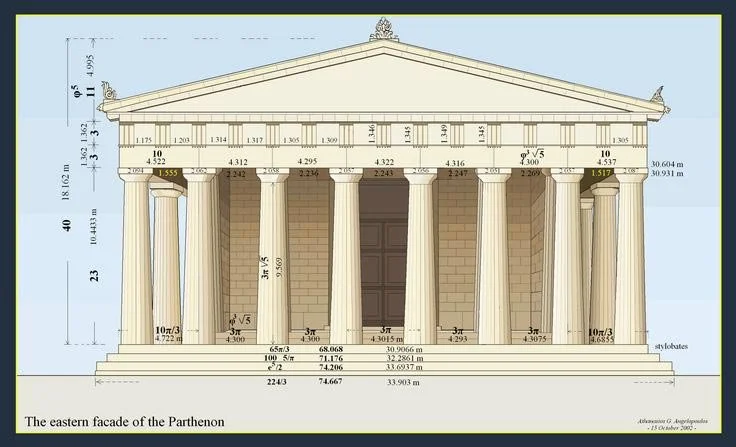
Measured drawings help separate the Parthenon’s real dimensions from simplified online claims.
The Parthenon looks perfectly straight because it’s slightly curved on purpose
This is the part that always makes me smile, because it’s so human.
The Parthenon is famous for architectural refinements, tiny adjustments that fight visual distortion. In plain words, refinements are small built-in corrections that make the building look more perfect from real viewing angles.
The most iconic one is the stylobate curve. The platform is not perfectly flat. It rises slightly toward the center, like a gentle, controlled “crown.” The amount is small, but it’s measurable. On the north side, the maximum rise is on the order of 10 centimeters, and it’s positioned at the center rather than drifting randomly.
Once you learn that, you can’t unsee the intention. This isn’t “old stone settling.” It’s an engineered decision about how humans perceive long straight lines.
And it’s not just the platform. Other refinements include subtle changes in column thickness, column inclination, and spacing that make the temple read as stable rather than sagging, especially when seen against bright sky.
If you want the refinement story as a full visual checklist, this is where optical refinements becomes the perfect companion article. The Parthenon’s “perfection” isn’t a mystical property. It’s a design strategy, repeated patiently across dozens of elements.
Here’s the deeper takeaway: the Parthenon’s measurements are not only about size. They’re about controlled perception.
The numbers also explain how sculpture fits architecture, not “on top of it”
A Parthenon dimension question usually starts with “how big is it,” but it ends with “how does it work.”
Because the Parthenon is not only a building. It’s a building that carries a complete sculptural system. The rhythm of columns creates the rhythm of shadow. The height of the colonnade shapes what you can see from below. The spacing of structural elements sets the “frame” for where sculpture sits and how it’s read as you move.
This is why I love thinking about dimensions as meaning-makers. The temple’s scale and proportions don’t just make it pretty. They organize attention.
And that’s exactly where the sculpture comes in. The images aren’t random decoration added after the fact. The design and the imagery are locked together, which is why how sculpture fits architecture matters even in a numbers-focused article. The sculptural program depends on the architecture’s grid of support, spacing, and sightlines.
Finally, it’s worth remembering that people made these choices. The Parthenon’s coherence isn’t “Greek genius” as a vague compliment. It’s design leadership and planning, which is why the architects behind the numbers belongs here too. Proportion only works if someone is guarding it, detail by detail, across the whole project.

Conclusion
The Parthenon’s dimensions are not just trivia. They’re the blueprint of its calm. A footprint around 69.5 by 30.9 meters, an 8-by-17 colonnade rhythm, columns rising roughly 10.4 meters, and a platform that subtly curves upward by only about a handspan at the center. Those numbers aren’t magic, but they do something close: they teach the eye what “controlled harmony” feels like.
And once we see that, the Parthenon stops being an abstract icon. It becomes a designed experience, measured, corrected, and tuned for human perception.
FAQ
What are the dimensions of the Parthenon? About 69.5 m long by 30.9 m wide when measured at the top step of the base.
How tall are the Parthenon’s columns? Roughly 10.4 m (about 34 ft) for the outer colonnade.
How many columns does the Parthenon have? 46 outer columns total, arranged 8 on the fronts and 17 on the sides.
Is the Parthenon based on the golden ratio? It’s debated and not conclusively proven; many scholars treat the claim cautiously.
What is the stylobate, and why does it matter for measurements? The stylobate is the top surface of the temple steps, and many “dimensions” are taken there.
Sources and Further Reading
Encyclopaedia Britannica — “Parthenon” (2026).
Columbia University (Department of Art History and Archaeology) — “Acropolis 360: Parthenon briefing” (2004).
American School of Classical Studies at Athens (Hesperia) — “The Curve of the North Stylobate of the Parthenon” (1943).
Springer Nature (Reference Work Entry) — “The Restoration of the Acropolis of Athens: A Holistic Approach” (2022).
Cambridge Archaeological Journal — “Did the Greeks Build According to the Golden Ratio?” (2014).
Acropolis Museum — “The Parthenon Gallery”.
You may also like