Canon of Proportions: Greek Formula for Ideal Bodies
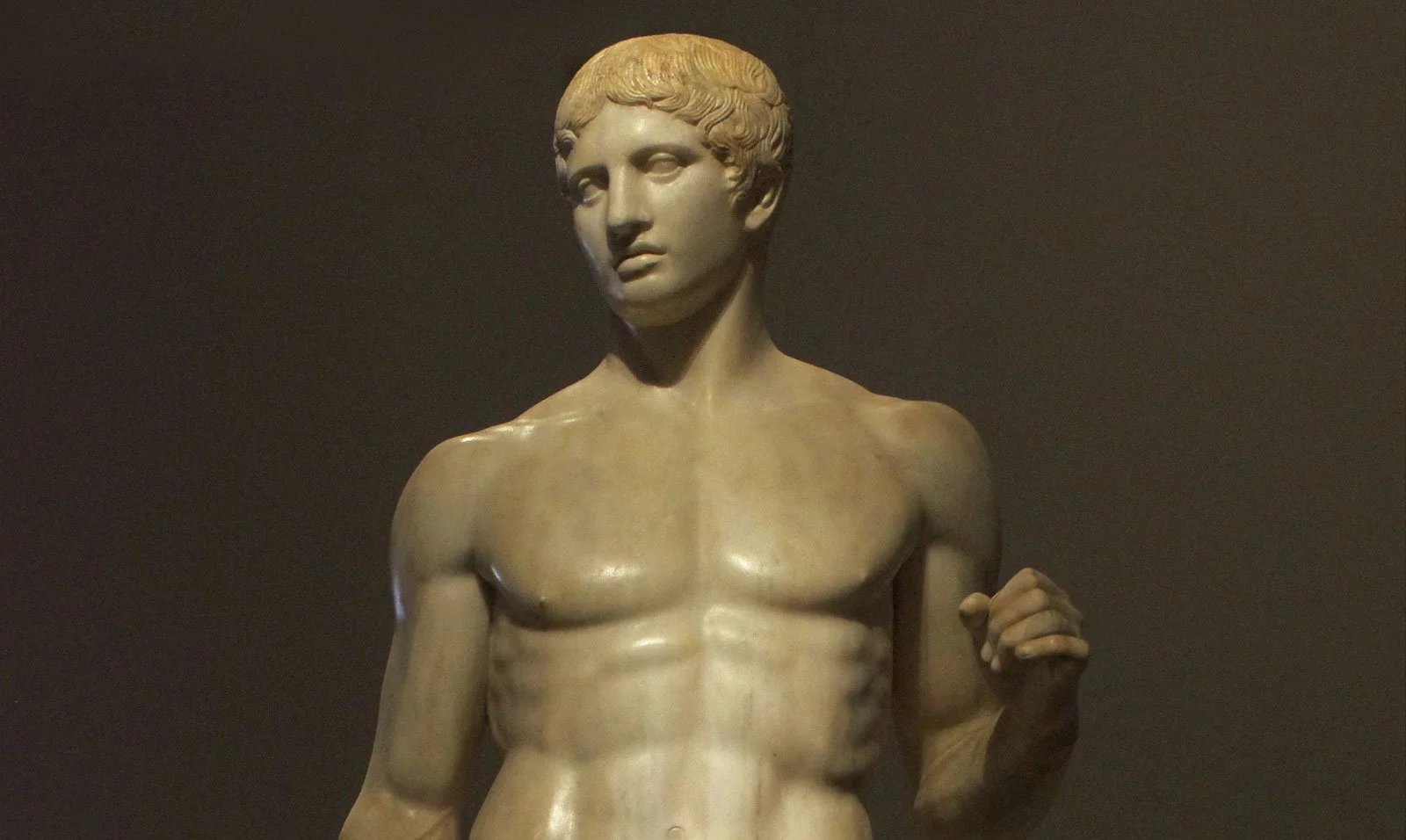
This is the Doryphoros (“Spear Bearer”), the statue that became a cheat-sheet for Classical “ideal” proportions. Notice how calm the face stays, even as the body feels perfectly tuned and alert.
If you’ve ever looked at a Classical Greek statue and thought, “Why does this feel so balanced?” you’re already sensing the thing Greeks cared about almost obsessively: measured harmony. Not “realism” in the modern, documentary sense. More like a body designed to feel right even before you can explain why.
That’s where the canon of proportions comes in. It isn’t a single secret number. It’s a way of building the human figure through relationships: head to torso, torso to legs, weight to counterweight, tension to release. A body as a system.
Definition: The canon of proportions is a rule-based system for ideal body ratios.
The canon of proportions is a tool, not a magic number
When people hear “canon,” they often picture a strict formula. Like: take the height, divide by eight, done. But the Greek idea is more sophisticated and more human.
A canon is basically a standard you can build from. Think of it like a designer’s grid. Not to flatten creativity, but to make decisions consistent. In sculpture, that consistency matters because the medium is unforgiving. Marble doesn’t let you “slightly adjust” without consequences. A proportional plan helps you commit.
Here’s the key shift: the canon is less about measuring a model in front of you and more about designing an ideal. That’s why it sits so naturally inside Greek beauty ideals. Classical artists weren’t trying to copy one specific body. They were trying to produce a body that looks inevitable, like it couldn’t have been any other way.
And once you start noticing that intent, you begin to read statues differently. Instead of asking “Is this anatomically correct?” we start asking “What’s being optimized?” Balance, clarity, calm, control.
That’s also why a canon isn’t only about lengths. It’s about visual logic: how the figure distributes weight, how the torso turns, how muscle groups flow into each other without breaking the calm surface.
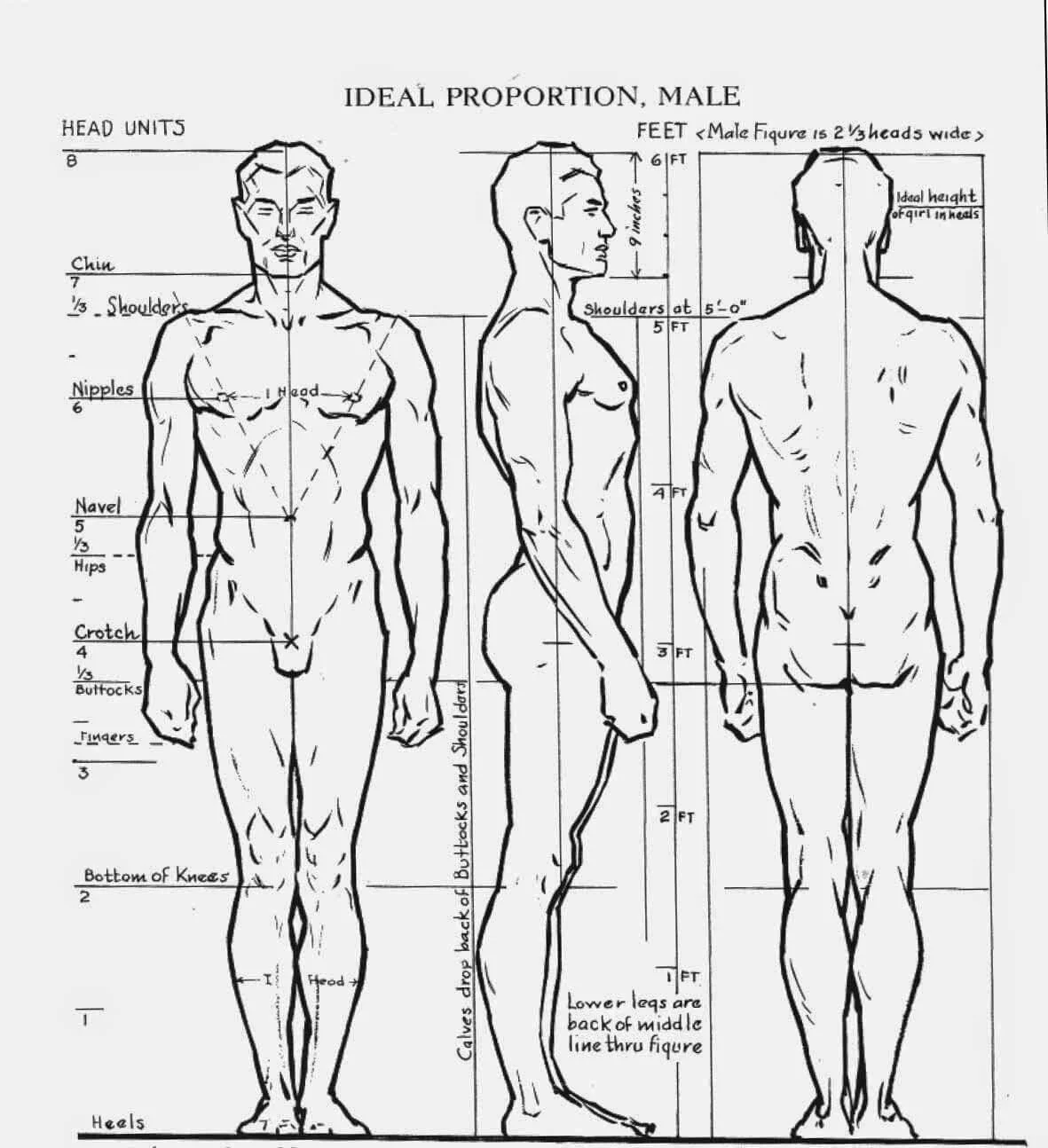
Artists often use “head units” as a simple measuring tool: how many heads tall is the body, where do shoulders/hips/knees land, and so on. It’s not a rule of nature—more like a reusable template that different periods tweak on purpose.
Why would anyone measure beauty?
It sounds strange at first, almost cold: beauty can be measured. But in the Classical mindset, it’s actually hopeful.
The Greeks had this deep belief that the world has order you can understand, and that humans can express that order through craft. A well-made statue isn’t just attractive. It’s a demonstration that reason can shape matter.
So instead of beauty being a personal taste, it becomes something like structured harmony. Not everyone agreed on the exact structure, and not every workshop followed the same system. But the big idea is consistent: ideal bodies come from consistent relationships.
This is also where we should be careful with modern myths. People love to drag in the “Golden Ratio” as if every Greek artist used one universal code. Sometimes ratios do show up in ancient design thinking, but the canon is primarily about proportional coherence, not a single mystical number.
Myth vs Fact
Myth: The Greek canon is the “Golden Ratio” applied to the body.
Fact: The canon is a broader system of relative proportions and balance.
And that balance is not only visual. It’s psychological. The body feels calm because it is designed to avoid extremes. Nothing bulges too much. Nothing twists too violently. Even strength gets edited into a controlled form.
Polykleitos made the canon famous by turning it into a body
If we’re going to name the canon’s superstar, it’s Polykleitos. His treatise (written text) is lost, but ancient writers describe it as a kind of rulebook for making the ideal figure. In other words: the canon wasn’t just an idea floating around. It was something an artist tried to formalize.
And the statue that becomes the usual “face” of this system is the Doryphoros, which is why people love talking about Doryphoros proportions. The figure is not posed like a stiff diagram. It’s relaxed, human, and somehow still mathematical.
That’s the genius. The canon doesn’t produce a robot. It produces a body that feels alive while still feeling ordered.
Polykleitos also connects directly to something many beginners notice before they know the word for it: contrapposto. That’s the weight-shift pose where the hips and shoulders tilt in opposite directions, creating a soft S-curve. If you want the mechanics in plain language, the full contrapposto definition helps. But here’s why it matters for proportion: once a figure shifts weight, the body stops being symmetrical in the simple left-right sense. The balance becomes dynamic.
So the canon isn’t only “these lengths equal those lengths.” It’s also “this tension requires that relaxation,” “this lean needs that counter-tilt.” It’s proportion as cause and effect.
Polykleitos’ rules, as later tradition describes them, become a kind of North Star for Classical sculpture. Not because every artist copies him, but because he proves a point: you can build naturalism out of structure.
That’s why Polykleitos’ canon keeps popping up in art history. It represents the moment Greek sculpture starts treating the body like an integrated system.
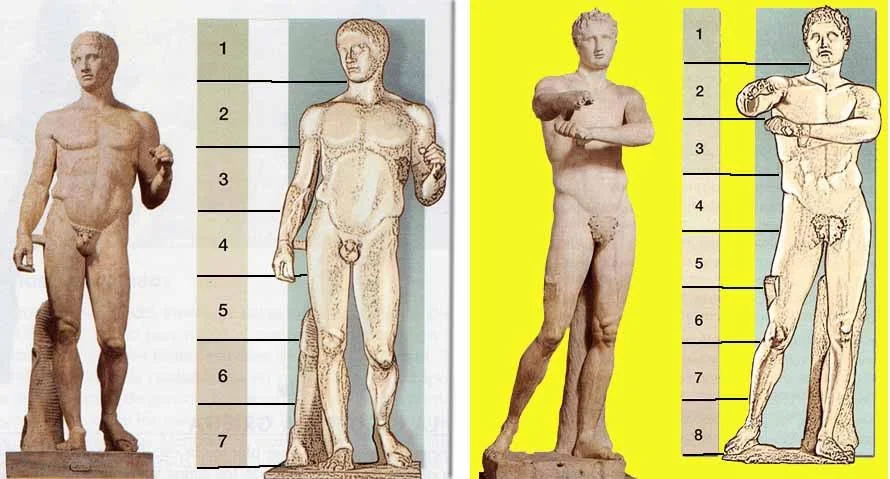
This kind of comparison shows how “the ideal body” isn’t one fixed thing. Polykleitos tends to read as sturdier and more compact, while later ideals (often linked to Lysippos) stretch the figure into a slimmer, taller rhythm.
You can spot the canon without doing any math
One of my favorite things about the canon is that you don’t need a ruler to feel it. The system announces itself through a few consistent visual effects.
Here are three you can actually use in front of a statue:
The body reads as one unit. The head, torso, and legs feel designed together, not stacked parts.
Nothing steals the spotlight. Even muscles are moderated into an overall calm surface.
Balance looks effortless. The figure could shift, breathe, or turn, but it never feels unstable.
If you want a more beginner-friendly checklist for real museum situations, what makes Classical sculpture different breaks down the full “alive body” effect step-by-step.
What we’re really seeing is a kind of visual editing. Classical sculptors keep removing anything that feels accidental. The body becomes a cleaned-up version of human complexity. Not fake, but filtered.
And that filtering is exactly what makes Classical art so influential. Later artists look back and think: this is how you make the human figure “correct.” Even when they disagree with the rules, the canon gives them a baseline to argue against.
The canon shapes ideals, and ideals always leave something out
There’s a quiet tension we should name: a canon creates clarity, but it also creates a boundary.
When you standardize ideal proportions, you start defining what counts as “right.” That has consequences. It can narrow the range of bodies considered worthy of representation. It can make variation feel like error instead of reality.
This doesn’t mean we can’t admire the achievement. We can. A canon is a major technical and conceptual leap. It’s part of why the Classical period feels like such a turning point in the the bigger Greek art timeline. But it’s also worth holding the bigger question in our minds:
What happens when a culture’s idea of beauty becomes a rule?
For me, that question makes the canon more interesting, not less. It turns it from a dry “ratio lesson” into a human story about values. The Greeks weren’t only sculpting bodies. They were sculpting a vision of what a citizen, a hero, or an ideal self should be: controlled, balanced, intelligible.
And once we see that, we can stop treating Classical art as “perfect” in a vacuum. It’s perfect for a purpose.

Conclusion
The canon of proportions isn’t a secret code hidden inside Greek statues. It’s a way of thinking with the body: measuring relationships so the whole figure feels calm, coherent, and alive. And even though the original treatises are lost, the visual logic survives in the sculpture itself, especially in works tied to Polykleitos and the Classical tradition.
If we keep reading the canon as a design choice, not a timeless truth, we get the best of both worlds. We can admire the craft and still ask what those ideals were trying to build in the viewer’s mind.
FAQ
Is the canon of proportions the same as the Golden Ratio?
No, the canon is about relative body relationships, not one universal “magic” number.
Did all Greek sculptors follow the same canon?
Not exactly; different workshops likely used different standards, but the Classical period strongly favored coherent proportional systems.
Which statue best shows the canon in practice?
The Doryphoros is the classic reference point because it turns proportion into a convincing, balanced body.
Is contrapposto part of the canon of proportions?
It’s closely related: contrapposto adds dynamic balance, so proportion becomes about weight and counterweight, not just lengths.
Why do Roman copies matter for studying the canon?
Because most famous originals are lost, Roman copies preserve the type and let us compare proportional patterns across versions.
Sources and Further Reading
Cambridge University Press — “The Canon of Polykleitos: A Question of Evidence” (1978)
The Metropolitan Museum of Art — “The Art of Classical Greece (ca. 480–323 B.C.)” (2008)
J. Paul Getty Museum & Getty Conservation Institute — “Polykleitos and His Followers at Work: How the Doryphoros Was Used” (2017)
Smarthistory — “Polykleitos, Doryphoros (Spear-Bearer)”
Annenberg Learner — “Doryphoros (Canon)”
Brill Open Access — “Canon Creation/Destruction and Cultural Formation: Authority, Reception, Canonicity, Marginality” (2022)
You may also like