Parthenon Golden Ratio: Design Rule or Modern Myth?
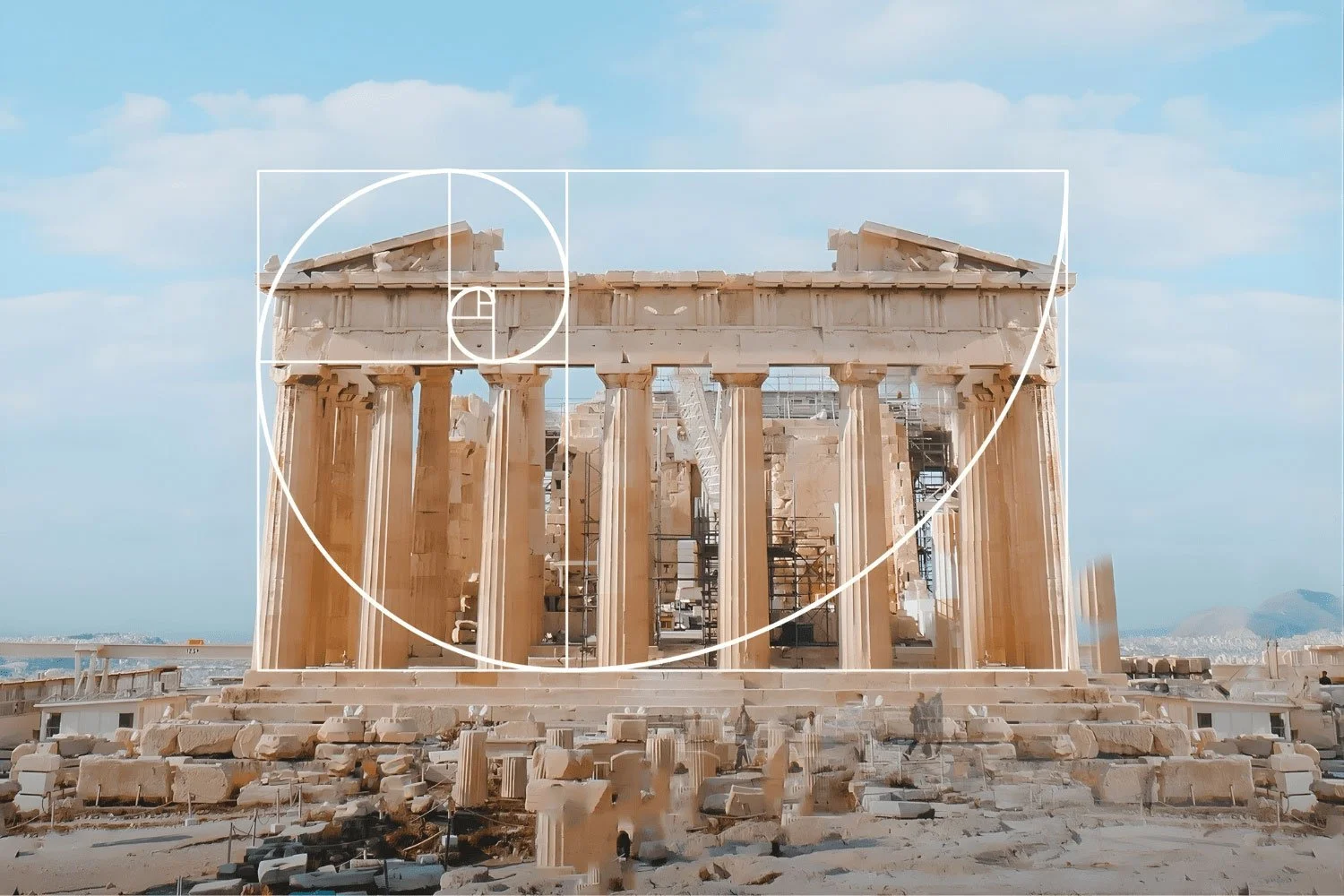
Golden-ratio overlays look convincing, but they do not prove the Parthenon was designed around phi.
The golden ratio story is irresistible. You take a building as famous as the Parthenon, you overlay a perfect rectangle, and suddenly it feels like we’ve uncovered the “hidden code” of Classical beauty. It’s satisfying in the way conspiracy theories are satisfying. One neat rule. One clean explanation.
But the Parthenon is not that kind of object. It’s more interesting and more human. It’s a building built with repeatable proportions, tuned for how we see, and finished with optical corrections that actively disrupt the idea of one frozen mathematical template.
So let’s answer the question properly: Was the Parthenon designed using the golden ratio? We’ll define the golden ratio, look at the best evidence for and against, and then land on what we can say with confidence about the proportions Greek architects actually used.
Definition: The golden ratio is about 1.618, a specific proportional relationship.
The Parthenon “golden ratio” claim survives because it feels visually plausible
If you want to understand the myth, you have to understand why it keeps coming back.
The Parthenon does look mathematically calm. The façade reads as balanced. The column rhythm feels controlled. Even the negative spaces (between columns) look measured. So when someone says “golden ratio,” our eyes go, sure, I can believe that.
This connects directly to Greek ideas of harmony. Classical art often aims for order that feels natural, not forced. The Parthenon is the architectural version of that goal.
But there’s a trap here: “looks harmonious” does not automatically mean “uses φ.” Lots of different ratios can feel harmonious, especially when a building is designed with consistency.
And the Parthenon gives the golden ratio theory an extra boost because it’s easy to draw rectangles on photos. Once you start picking rectangles, you can “find” many pleasing relationships. The problem is that different people pick different rectangles.
Which brings us to the real question.
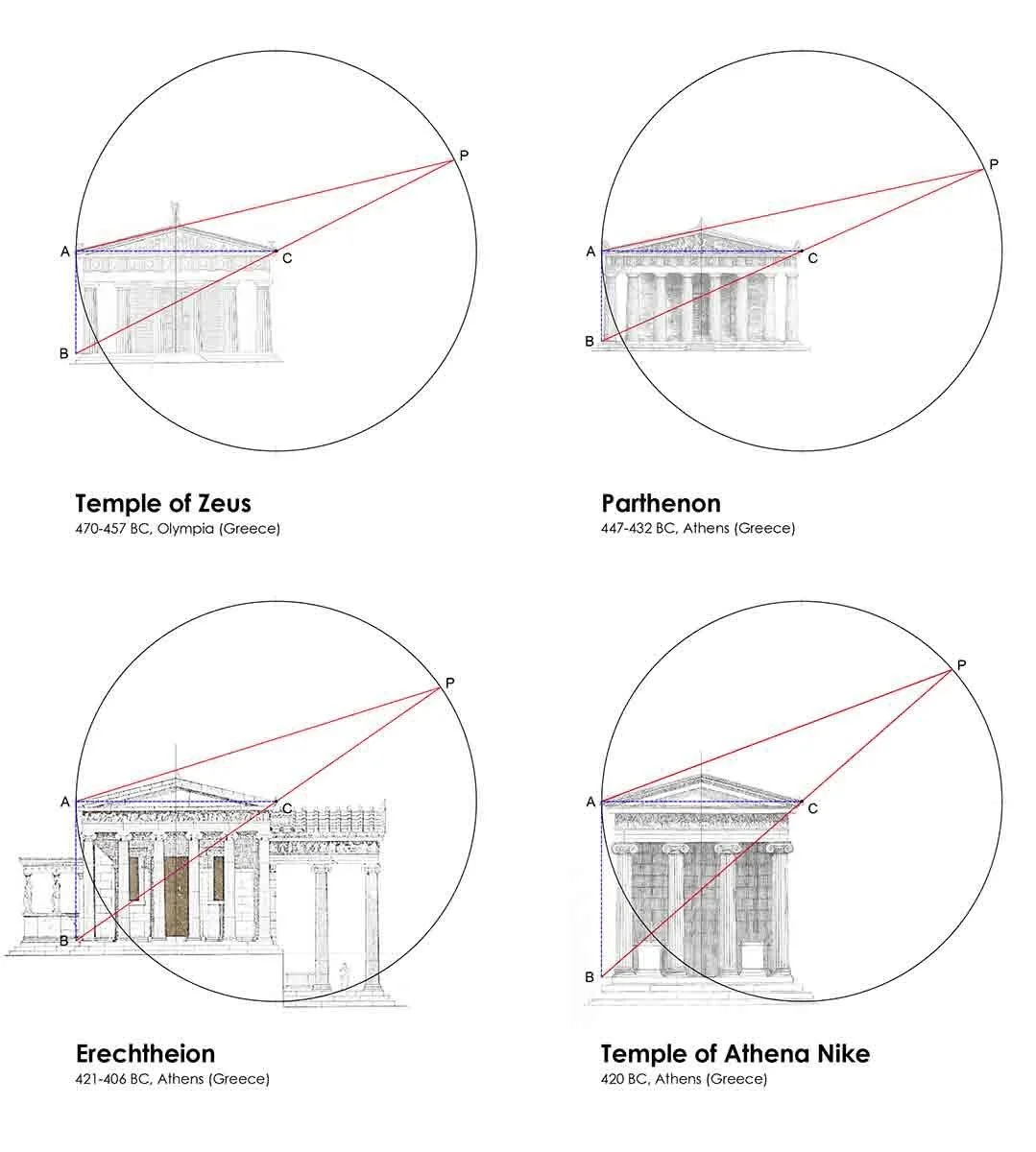
Greek temples were carefully proportioned, but that is not the same as proven golden-ratio design.
The golden ratio claim depends on which rectangle you choose
If the Parthenon was deliberately designed with the golden ratio, we should be able to do two things:
agree on where the golden rectangle is
measure it consistently across reliable surveys
In practice, that’s where the claim gets slippery. People draw different boundaries:
width between outer column edges vs. centerlines
height to the pediment vs. height to the entablature
a façade rectangle vs. a stylobate rectangle
a “visual” rectangle based on a photo perspective (which distorts measurements)
Once we admit that, we see what’s happening. Many golden ratio arguments are not about the Parthenon being designed around φ. They’re about φ being fitted to the Parthenon after the fact.
This is why careful scholarship tends to treat the strong version of the claim skeptically. Not because Greek architects didn’t care about proportion. They absolutely did. But because “golden ratio” is a specific assertion, and it needs specific evidence.
Myth vs Fact
Myth: The Parthenon was intentionally designed around the golden ratio.
Fact: The evidence is debated, and the strongest claims often depend on selective measuring.
If you want a grounded place to start, begin with the real measurements. When we use consistent, documented measurement points, the Parthenon’s proportion story becomes clear without needing φ (phi).
What the Parthenon does show clearly is a preference for simple, repeatable ratios
Here’s the part that gets lost in the golden ratio hype: Greek architects didn’t need an exotic number to build harmony. They had something more practical.
They used proportion systems that were commensurable, meaning ratios built from simple whole numbers. Those ratios are easier to lay out, easier to repeat, and easier to coordinate across a massive project.
The Parthenon is often discussed in terms of a “4:9” or “9:4” proportional feel across major dimensions. That doesn’t mean every part is literally 4:9. It means the design shows a strong tendency toward relationships that can be expressed in that kind of whole-number logic.
If you want the conceptual toolkit behind this approach, how Greek architecture handles proportion is the right mental frame: Greek architecture isn’t random, it’s modular. A building like the Parthenon behaves like a system where a few guiding relationships can echo across many parts.
And if you want to understand why Greeks were comfortable thinking this way, it’s not just architecture. It’s cultural habit. Greek visual culture repeatedly uses pattern, rhythm, and geometric thinking, which is why the Greek obsession with pattern and geometry belongs in this conversation even though it’s earlier in the timeline. The “geometry brain” is already there.
So if we’re hunting for the Parthenon’s design DNA, we don’t need to force a golden rectangle onto it. The building is already proportional in a way Greeks actually used and could execute reliably.
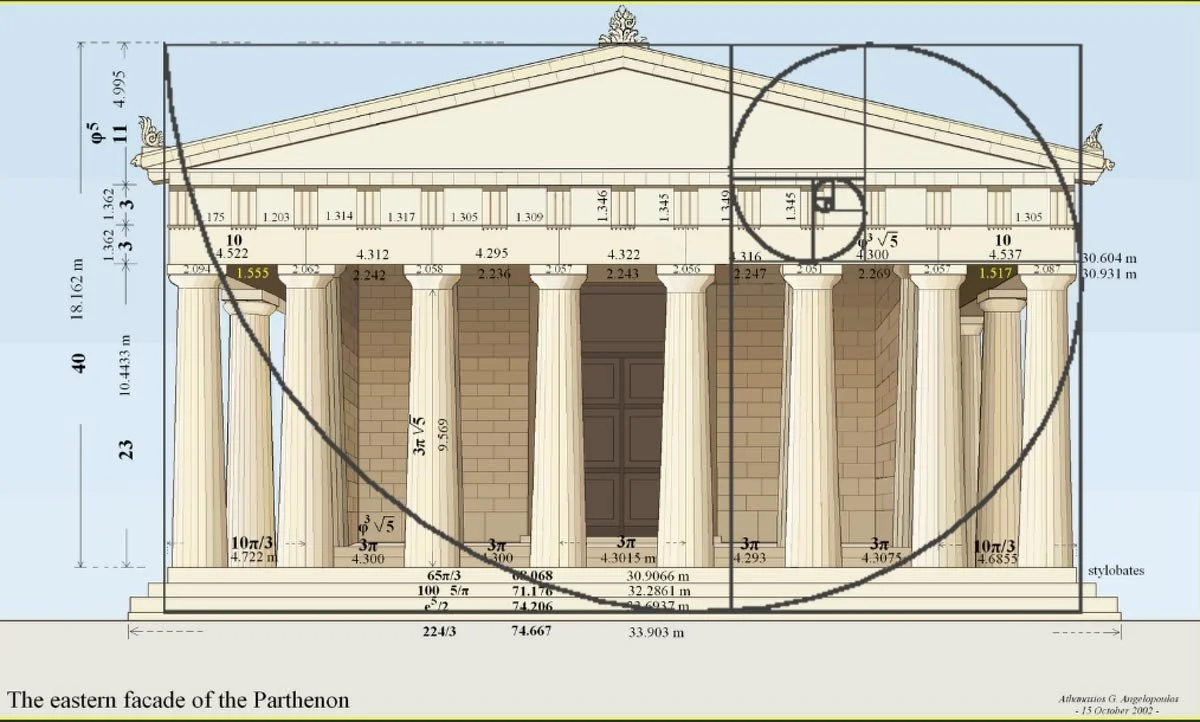
This kind of overlay is why the golden ratio claim keeps circulating, but it still depends on selected measurements.
Optical corrections are the strongest argument against a single fixed “golden rectangle”
Here’s the twist that makes the Parthenon feel almost mischievous: it doesn’t behave like a strict geometric diagram because it’s built for human eyes, not for perfect abstractions.
The Parthenon includes subtle optical corrections, tiny design changes that make the temple look straighter, more stable, and more alive from real viewing positions.
These refinements include:
slight curvature of the stylobate (the top step platform)
subtle adjustments in column placement and spacing
column swelling (entasis) that corrects visual thinning
small shifts that keep the corners from looking weak
All of that is exactly what you explore in optical corrections.
And once you understand refinements, the golden ratio “one rectangle rules all” theory starts to feel less plausible. Because the Parthenon’s perfection is not the perfection of an ideal drawing. It’s the perfection of a building tuned to perception, where slight deviations are part of the plan.
In other words: the Parthenon is too smart to be a static math poster.
So the fair conclusion is not “Greeks hated the golden ratio.” The fair conclusion is: the Parthenon’s design priorities were not about preserving one frozen ratio at all costs. They were about producing a visual experience of harmony.
So what should we say instead of “golden ratio”?
If you want a sentence you can say confidently, without flattening the truth, it’s this:
The Parthenon uses consistent proportional thinking and optical refinements to create harmony, but the claim that it was intentionally designed around the golden ratio is debated and not securely proven.
That’s the balanced position. It respects the building’s mathematics without turning it into a myth.
And here’s the best part: this version is more interesting. Because it leads us back to the real Greek genius, which is not “secret knowledge.” It’s disciplined design:
use repeatable ratios that can be built reliably
coordinate architecture and perception
refine the building until it looks effortless
If you keep those three ideas in mind, you’ll start seeing Classical harmony as a craft problem, not a mystery.

Conclusion
The Parthenon golden ratio story survives because it feels like an elegant explanation for an elegant building. But the Parthenon’s elegance comes from something more grounded: whole-number proportional systems, repeated across the structure, and optical corrections that make the temple look perfect to human eyes.
So is the golden ratio a design rule? For the Parthenon, it’s safer to treat it as a modern overlay, not a proven ancient blueprint. The real design story is still mathematical. It’s just not mystical.
FAQ
Did the Parthenon use the golden ratio? It’s debated. Many strong claims depend on how you choose the measuring rectangle.
Why do people think the Parthenon uses the golden ratio? Because the building looks highly harmonious, and it’s easy to overlay rectangles on photos.
What proportions did Greek architects actually use? They often used simple, repeatable whole-number ratios and modular planning.
Do optical refinements matter for the golden ratio claim? Yes. Refinements intentionally bend “perfect geometry” to improve how the building looks to the eye.
What’s the safest way to talk about Parthenon proportions as a beginner? Start with documented dimensions and then look for consistent proportional patterns, rather than hunting for one magic number.
Sources and Further Reading
Foutakis, Patrice — “Did the Greeks Build According to the Golden Ratio?” (2014)
American School of Classical Studies at Athens (Hesperia) — “The Curve of the North Stylobate of the Parthenon”
Kappraff, Jay — “Analysis of the Proportions of the Parthenon” (2002)
Acropolis Museum — “The Parthenon Gallery”
Encyclopaedia Britannica — “Golden Ratio” (2026)
UNESCO World Heritage Centre — “Acropolis, Athens”
You may also like