What Is the Archaic Smile? Why Greek Statues Seem to Grin
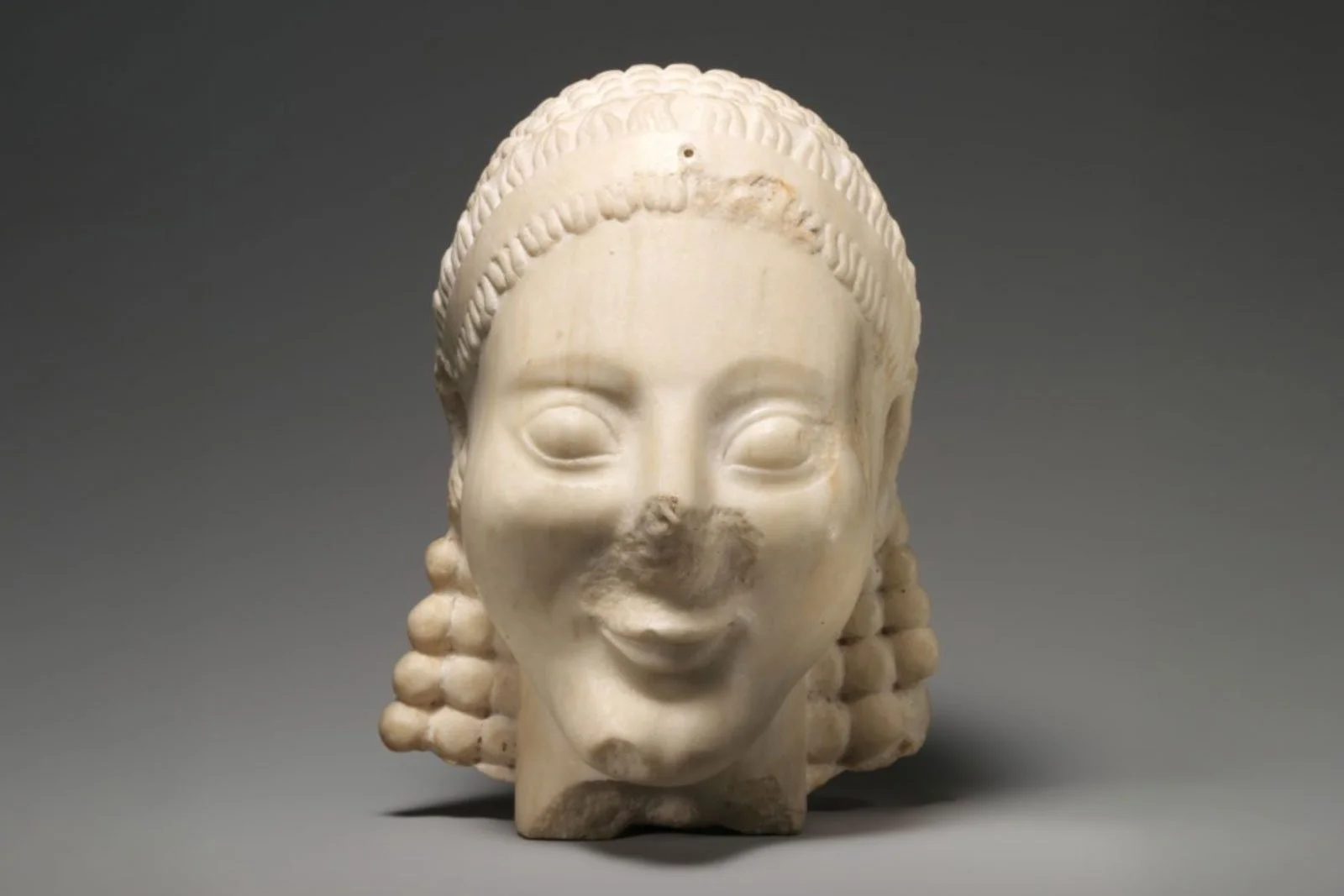
Even damaged, this kore head suggests votive intimacy: a small smiling face once carried into a sanctuary to stand in for a young woman’s presence.
You know that slightly awkward half-grin you see on early Greek statues, like they are in on a joke you missed? That is the archaic smile, and once you notice it, you start seeing it everywhere in early Greek sculpture. At first it just looks… odd. But when we slow down and trace where it appears and what scholars think it meant, that tiny curve of the lips becomes a neat shortcut into how the Greeks imagined ideal bodies and ideal life.
In this guide, we will place the archaic smile inside archaic Greek sculpture, meet some of its most famous faces, and walk through the main theories about why these statues seem to grin at us from across 2,500 years.

The archaic smile is a simple facial trick with big ambitions
If we start with a clean definition, the archaic smile is surprisingly easy to spot. Early Greek sculptors, especially in the 6th century BCE, carved a slight, closed-mouth curve at the corners of the lips on many statues of young men and women. It is not a big laugh or an emotional grin, more like a controlled “Mona Lisa” line tightened across the face.
Definition: The archaic smile is a slight, carved curve of the lips on early Greek statues that suggests liveliness rather than emotion.
You most often meet this expression on free-standing stone figures from archaic Greek sculpture, especially the standard types of kouros and kore. A kouros is a standing nude youth, frontally posed with one leg advanced and fists at his sides. A kore is his female counterpart, a standing, clothed maiden. Both live in the world of ancient Greek sculpture, and both often carry that same small smile across their faces.
This is where the “smile” can be misleading. Our instinct is to read it as happiness, friendliness, maybe even smugness. But in the context of ancient Greek art, the face is quite schematic: almond eyes, patterned hair, symmetrical features and then the little curve of the lips. Instead of expressing a mood, the smile works more like a formula for “aliveness”. It belongs to a toolkit of conventions, alongside rigid posture and idealised bodies, that helped artists move away from blocky stone towards something that felt human and animated.
When we remember that many of these statues stood in sanctuaries or over graves, the smile becomes even stranger. These are images of youths who are dead, or frozen as ever-young offerings to the gods, yet their faces insist on a kind of calm vitality. That tension between death and endless youth sits right at the heart of the archaic smile.
Where to spot the archaic smile: kouroi, korai and famous examples
To really understand the archaic smile, it helps to meet a few statues in person or through photos. Let us start with the standard types and then zoom in on named works.
On a typical kouros, like the ones you might explore in an overview of archaic Greek sculpture, the smile is almost always paired with a strongly frontal pose. The youth stands upright, left leg forward, arms straight down, fists clenched. Muscles are carefully outlined but still stylised. Up at the head, the eyes are wide and open, the hair falls in patterned locks, and the lips curve just enough to break the flatness of the face. In many museum labels or textbooks this becomes the textbook example of the archaic Greek smile.
A more specific case is the Anavysos Kouros, a grave statue for a young warrior near Athens. His body feels fuller than earlier kouroi, with more rounded muscles and a greater sense of weight. Yet his face still carries that familiar half-smile. It does not tell us that “Kroisos” (the name in the inscription) died happily. Instead, the expression supports the epitaph’s idea of a strong, ideal youth who fell “in the front line of battle.” The smile is one more sign that he is presented as vital and perfected, even in death.
On the female side, korai like the famous Peplos Kore from the Athenian Acropolis show the same formula in a different key. The Peplos Kore stands upright, wrapped in a heavy garment, one arm bent and once holding something (now lost). Her face is smooth and symmetrical. The lips curve gently upwards, combined with painted details that originally emphasised eyes, hair and jewellery. Again, the smile does not read as a casual laugh. It feels more like a sign of a blessed, ideal state, appropriate for a votive figure dedicated in a sanctuary.
Once you have these anchors, the smile starts to pop up across many other pieces: on lesser-known kouroi, on other Acropolis korai, sometimes even on early Greek god statues where divinities are still treated in an archaic manner. It becomes a visual habit of a whole period rather than a quirk of a single artist.
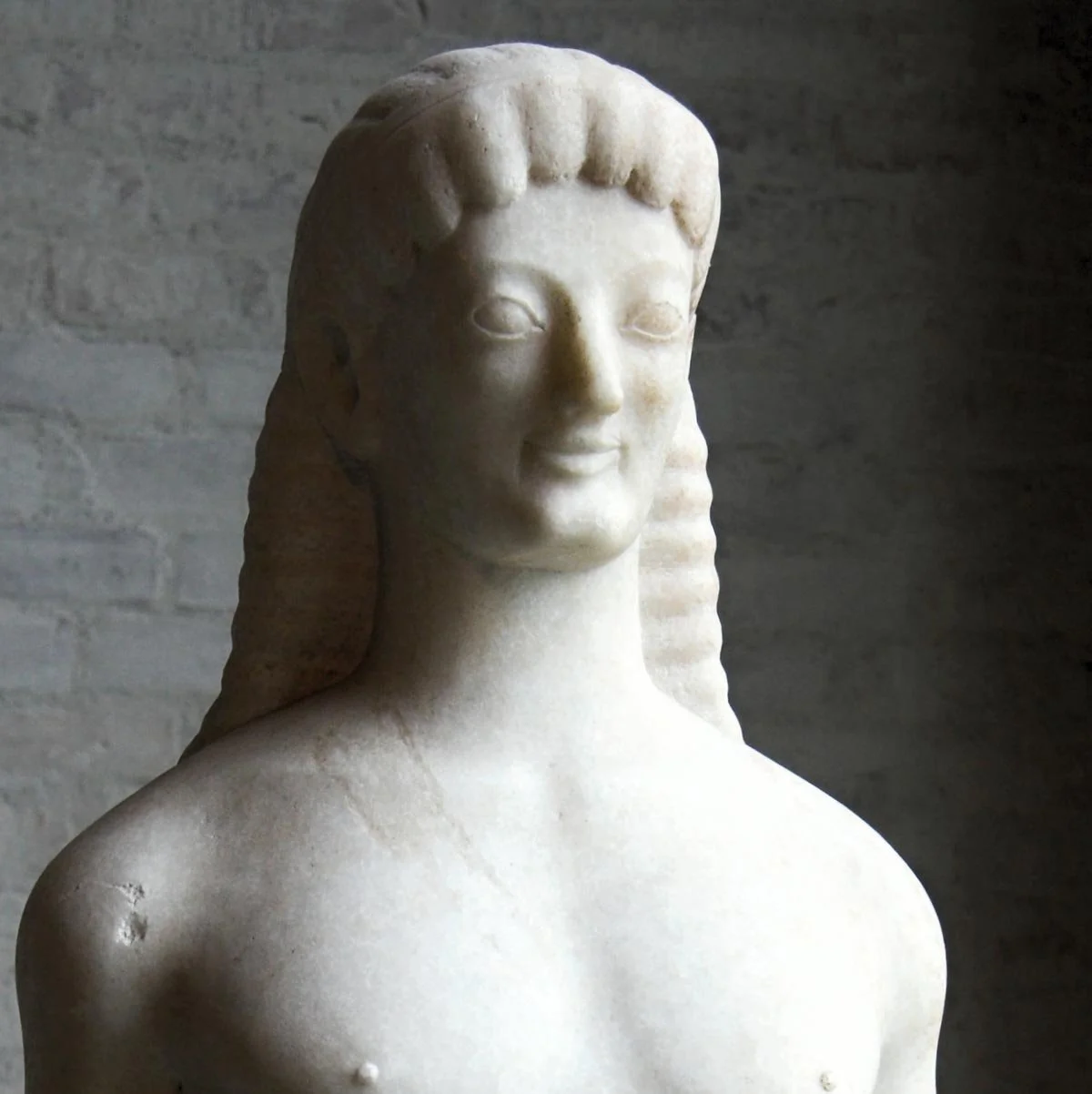
The Kouros of Tenea softens archaic stiffness, giving its stone youth fuller thighs, rounded chest and a faint, knowing archaic smile.
What did the archaic smile mean? Main theories and open questions
So does the archaic smile actually “mean” anything, or is it just a carving trick? Scholars do not fully agree, but a few main ideas keep coming back. It is worth walking through them, not to pick a single winner, but to see how each one opens a different way of reading these faces.
One popular theory is that the smile signals ideal well-being or vitality. In this view, the slight grin marks the figure as being in a perfect state: healthy, youthful, possibly blessed by the gods. This fits well with kouroi used as grave markers and korai used as offerings. The person represented is frozen at their best, so their mouth curves in a way that separates them from normal suffering or ageing.
Another line of thinking focuses on technical and stylistic reasons. Carving a completely neutral mouth in stone is surprisingly hard. A tiny upward curve can help define the corners, avoid a drooping or “dead” look and add a minimum of modelling around the cheeks. In that sense, the archaic smile might have begun as a workshop solution that slowly turned into a convention. When all your teachers carve mouths this way, you copy them, and the style spreads. Over time, viewers start to read “life” into what began as a technical choice.
A third approach connects the smile with social and religious ideals. Because so many of these statues belonged to elite contexts, some scholars have suggested that the expression hints at aristocratic poise. The youth or maiden holds a calm, self-controlled expression that implies superiority, not emotional joy. When the figure stands in a sanctuary, that same poise may signal ritual perfection: the right way to appear before a god in ancient Greek religion, composed and beautiful.
We also have to accept what we do not know. The sculptors never left a manual explaining their intentions. Some statues labelled “archaic” do not smile at all, and the exact curve varies from region to region. That uncertainty can be frustrating, but it is also a good reminder: art history often works with best guesses, carefully argued but always open to new evidence or new ways of looking.
Conclusion
If we circle back to that first encounter in a gallery, the archaic smile hopefully feels less like a weird glitch and more like a deliberate choice tied to a whole visual system. By tracking it across kouros statues, the Anavysos Kouros, the Peplos Kore and other works from archaic Greek sculpture, we see how one small curve of the lips helps statues feel alive, ideal and slightly out of reach.
For me, that is part of the charm of ancient Greek art: even its most basic formulas invite questions rather than closing them down. Next time you walk past an archaic figure with that quiet grin, you can pause and ask yourself which reading feels stronger that day. Vitality? Workshop habit? Ritual perfection? The statue will not answer, but you will look a little longer, and that extra attention is exactly what these works still deserve.
You may also like