Etruscan Pottery: Bucchero Ware, Vases and Greek Exchange
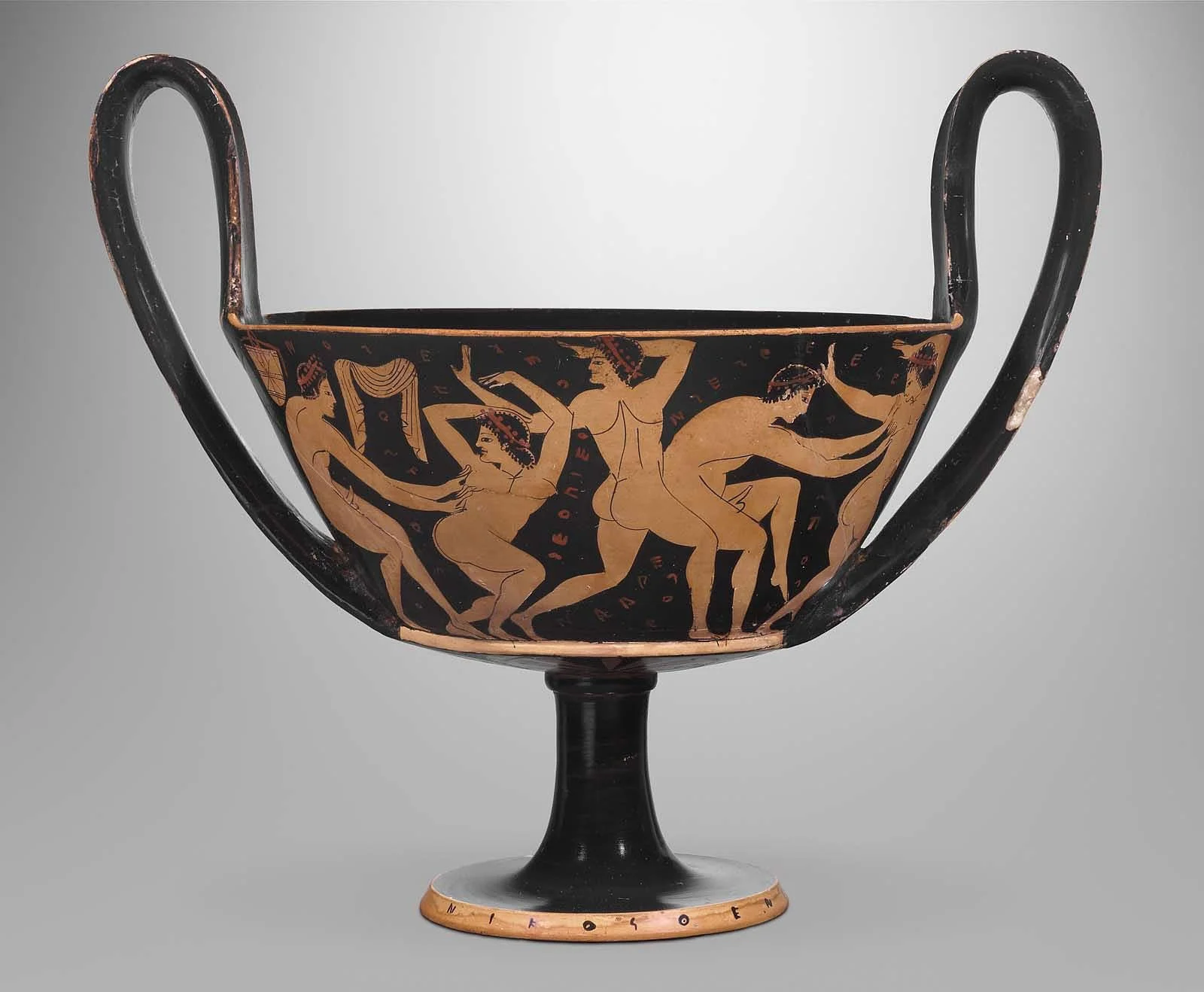
This Greek-made kantharos fits the article well because Etruscan tombs often preserve imported vases alongside local pottery.
Etruscan pottery is not just a side note to Greek ceramics. It has its own materials, shapes, tastes, and history, and one of its most distinctive products, bucchero ware, is unlike anything else in the ancient Mediterranean. At the same time, Etruscan tombs are also full of imported Greek vases, which can make the subject feel confusing at first. So the clearest starting point is this: Etruscan pottery includes both local ceramics and Greek imports, and the relationship between the two tells us a lot about trade, status, and cultural exchange.
That is what makes the topic so interesting. Pottery is never only about containers. In Etruria, ceramics reveal how people drank, dined, stored, displayed, exchanged, imitated, and buried objects. They show local craft traditions, but also Mediterranean connections. Once you separate what was made in Etruria from what was brought into Etruria, the whole picture becomes much easier to read.
Bucchero ware is the fastest way to recognize truly Etruscan pottery
Yes, if you remember one pottery term from Etruscan art, make it bucchero. Bucchero ware is the black ceramic most strongly associated with Etruria, especially from the 7th to the early 5th century BCE. Its surface is usually dark gray to deep black, often glossy, and its shapes can look elegant, sharp, and almost metallic.
That metallic look is important. Bucchero was not trying to imitate ordinary clay vessels. Many bucchero forms echo the world of metal tableware, which gave them an elite, refined character. In some cases the pottery is thin and delicate, in others heavier and more decorated. Either way, the effect is distinctive. This is one of the clearest visual clues in all of Etruscan pottery.
The black color was not simply painted on. It came from the firing process itself, which altered the clay in a reduced-oxygen atmosphere. That means the material identity of bucchero is built into the ceramic body, not just added as surface decoration. For a beginner, that matters because it helps explain why bucchero feels so unified and self-conscious as a medium.
This is also why bucchero fits so well within the larger world of Etruscan art. It is not just functional pottery. It is a designed material language with strong local identity.
Etruscan pottery includes much more than bucchero alone
No, Etruscan ceramics are not only glossy black wares. Bucchero is the most famous local product, but it sits within a broader ceramic culture that includes earlier impasto wares, finer table vessels, storage forms, funerary containers, and locally painted pottery influenced by contact with Greece and other Mediterranean regions.
This matters because beginners sometimes reduce the whole topic to one signature style. In reality, Etruscan potters made different kinds of vessels for different uses. Drinking cups, jugs, bowls, jars, ladles, and ritual forms all belonged to the ceramic world of Etruria. Some are plain and practical. Others are highly finished and clearly tied to display.
Shapes are important here. A vessel type could travel across cultures even if the surface treatment changed. That means Etruscan pottery can sometimes look familiar if you already know Greek shapes, but the local taste often shifts the result. Proportion, decoration, and finish may all move in a more Etruscan direction.
So if someone asks what makes Etruscan artwork in ceramic form distinctive, the answer is not just “black pottery.” It is the combination of local materials, adapted forms, and a strong interest in how objects look on the table and in the tomb.
Greek vases flooded into Etruria, but that does not make them Etruscan pottery
Yes, this is one of the most important distinctions. Large numbers of Greek vases, especially from Athens, were imported into Etruria. Many of the finest surviving Greek black-figure and red-figure vessels were actually found not in Greece, but in Etruscan tombs. That can be surprising at first, but it tells us something important about Etruscan demand and taste.
The Etruscans valued Greek painted pottery highly. These vessels moved through trade networks and entered elite contexts in Etruria, where they were used, displayed, and often buried. In some cases, Greek workshops even seem to have adjusted shapes or production for Etruscan buyers. So the relationship was not passive. Etruria was an active market.
This is where comparison helps. If you want to understand what those imported wares looked like before entering Etruscan contexts, Greek pottery gives the broader ceramic background, while Greek vases helps clarify the painted traditions that Etruscan elites collected so eagerly.
The key point is simple: a Greek vase found in an Etruscan tomb is still a Greek vase. But its presence in Etruria tells us something important about Etruscan cultural choices.
Exchange changed both sides, because trade also reshaped local production
Yes, exchange was not one-way. Greek pottery entered Etruria, but Etruscan workshops also responded to that flow. Local potters borrowed shapes, adapted decorative ideas, and in some cases produced vessels that sit somewhere between Greek models and Etruscan preferences. This is where the ceramic story becomes especially rich.
A good example is the way certain vessel forms were translated across workshops and markets. Some shapes favored in Etruria were picked up in Greek production for export, while some Greek formats were reinterpreted locally. That means pottery becomes a record of negotiation, not just imitation. The Etruscans were not only consuming foreign wares. They were shaping demand and influencing what circulated.
This kind of exchange also helps explain why Etruscan material culture feels so connected to the wider Mediterranean without losing its own identity. Pottery shows the mechanism clearly. Ideas moved through objects, but they rarely stayed unchanged. Once a vessel entered a new workshop, a new ritual setting, or a new burial practice, its meaning shifted.
That is one reason the study of ceramics matters so much. Pottery is one of the best records we have for how ancient people encountered the outside world in everyday and elite life.
Pottery mattered in Etruria because it lived at the table, in ritual, and in the tomb
Yes, the social life of pottery is the real heart of the subject. Ceramic vessels were part of eating, drinking, pouring, storing, gifting, and burying. They belonged to banquets, domestic settings, sanctuaries, and funerary rituals. In other words, they were not neutral containers. They helped organize social behavior.
This is especially clear in tombs. The fact that so many ceramics were buried with the dead shows how closely vessels were tied to status and memory. Pottery could carry food and drink, but it could also carry meaning. A fine imported Greek vase signaled wealth and connection. A bucchero vessel signaled local identity and refined taste. Together, they reveal what Etruscan elites wanted to surround themselves with in life and in death.
That funerary setting also helps explain why so much Greek pottery has survived through Etruria. Without Etruscan burial habits, our knowledge of Greek vase painting would be poorer. In that sense, Etruscan tombs helped preserve not only Etruscan culture but part of Greek material culture as well.
This larger story eventually connects to Rome too. Many habits of exchange, collecting, adaptation, and visual prestige that shaped central Italy before Roman dominance fed into the cultural world Rome inherited. That is why Etruscan influence on Rome is not far away from a topic that seems, at first glance, to be “just pottery.”

Conclusion
Etruscan pottery makes the ancient Mediterranean feel much more connected and much more local at the same time. On one side, there is bucchero ware: unmistakably Etruscan, black, glossy, and strongly tied to local taste. On the other, there are imported Greek vases, prized in Etruria and often buried in tombs. Between those two poles lies the real story: ceramics as evidence of craft, exchange, social ritual, and cultural choice. Once you see that, Etruscan pottery stops looking like a minor category and starts looking like one of the clearest records of how Etruria worked.
FAQ
What is bucchero ware?
Bucchero ware is a distinctive black Etruscan ceramic known for its glossy surface and elegant shapes, often associated with elite tableware.
Was all pottery found in Etruscan tombs made by Etruscans?
No. Many vases found in Etruscan tombs were imported from Greece, especially from Athens.
Why did the Etruscans import Greek vases?
Because Greek painted pottery was highly valued in Etruria for display, banqueting, and burial, especially among elites.
How is Etruscan pottery different from Greek pottery?
Etruscan pottery is best known for bucchero and local ceramic traditions, while Greek pottery is especially associated with painted black-figure and red-figure vase traditions. The two also influenced one another through trade.
Why is pottery so important for understanding the Etruscans?
Because it reveals trade, taste, ritual use, funerary practice, and the way Etruria interacted with the wider Mediterranean world.
Sources and Further Reading
The Metropolitan Museum of Art — “Etruscan Art” (2004)
Smarthistory — “Bucchero” (2021)
Encyclopaedia Britannica — “Bucchero ware” (2026)
The Metropolitan Museum of Art — “Ancient Greek Colonization and Trade and their Influence on Greek Art” (2007)
The Metropolitan Museum of Art — “Terracotta stamnos (jar)” (n.d.)
J. Paul Getty Museum — “Caeretan Hydria” (n.d.)
You may also like