Ancient Greek Religion: Temples, Sacrifices and Belief
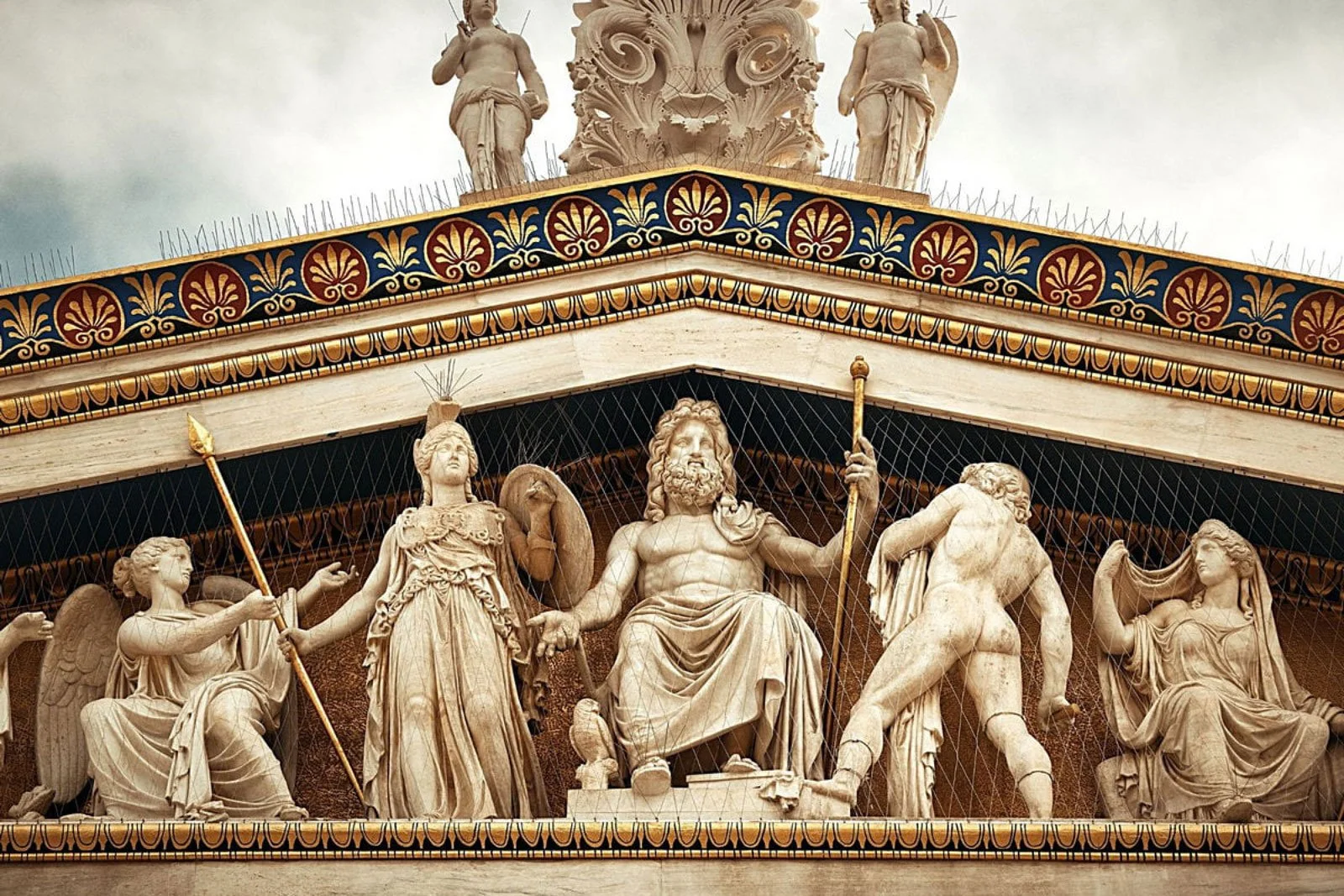
Temple pediments squeeze the gods into a narrow triangle, forcing sculptors to invent tricky poses so myth, hierarchy and architecture share space.
If you only know Greek religion from school, it can sound like a neat list: twelve Olympian gods, a couple of myths, maybe an oracle. On the ground, it was much messier and more physical. Smoke, animal blood, garlands, wine, processions under the sun. For the Greeks, “religion” was not an abstract system in their heads. It was a rhythm of actions that shaped streets, calendars and images.
In this guide, we zoom out from individual myths and ask: what did ancient Greek religion look like as a lived thing. We move from temples and festivals to household shrines, and then circle back to how all of this feeds into ancient Greek art, Greek architecture and the objects we keep meeting on this blog.

Greek religion was less about “belief” and more about shared ritual
One of the first surprises: the ancient Greeks did not even have a single word that matches our modern “religion.” Historians often talk instead about “Greek religion” as a shorthand for a web of practices and stories centred on many gods, heroes and local cults. What mattered most was doing the correct things in the correct way rather than signing up to a formal creed.
Think of it as a layered system. On one level, there was a shared mythological world: Zeus, Athena, Apollo and the rest, with families, quarrels and famous stories. On another level, each city had its own way of hosting those gods. Modern scholars sometimes call this “polis religion” – the idea that every city state wove gods, rituals and festivals into its political life. You could not really have a polis without cults, and you could not have those cults without some kind of civic structure around them.
Then there were all the smaller layers: mystery cults, hero shrines, oracles, healing sanctuaries, and things people did at home. A Greek farmer might sacrifice at the city altar during a festival, consult an oracle about a trip, honour ancestors at a family tomb and still join a mystery cult on top of that. None of these cancelled the others. Religion was additive and local, not a single “membership”.
Myth vs Fact
Myth: Ancient Greeks mainly “believed” in myths as stories in their heads.
Fact: What defined Greek religion was public and private ritual – sacrifices, festivals and offerings that embedded those stories into space and time.
Temples and sacred spaces turned cities into maps of the divine
From the outside, a Greek temple can look like pure architecture: rows of columns, stone steps, a rectangle of white marble. For people living in the time, that building was above all a house for a god. Inside the main room, the cella, stood a cult statue – the official image of the deity – while the main altar for sacrifices usually sat outside, in front of the east-facing façade.
If you have already explored how a Greek temple works in plan, you can now plug it into religious practice. The outer colonnade did not just look nice; it framed processions and created a visible halo around the god’s house. The sculpted friezes and pediments we study in Greek architecture usually show myths or ritual scenes, turning the building into a permanent storybook about divine power and civic identity.
Zoom out again to the scale of a city. A polis was dotted with sanctuaries large and small – urban temples, extra-urban shrines, rural groves. At the Panhellenic sanctuaries of Delphi and Olympia, people from across the Greek world came together to sacrifice, compete and consult oracles. Altars, treasuries and Greek god statues made those places feel like condensed versions of the entire Greek religious map.
So when we talk about temple fronts in architecture history, it is worth remembering that for ancient eyes, these were charged locations, not neutral façades. The geometry of columns and pediments grew directly out of rituals that needed sheltered cult images, altars before the door and space for people to gather, sing, sacrifice and process.
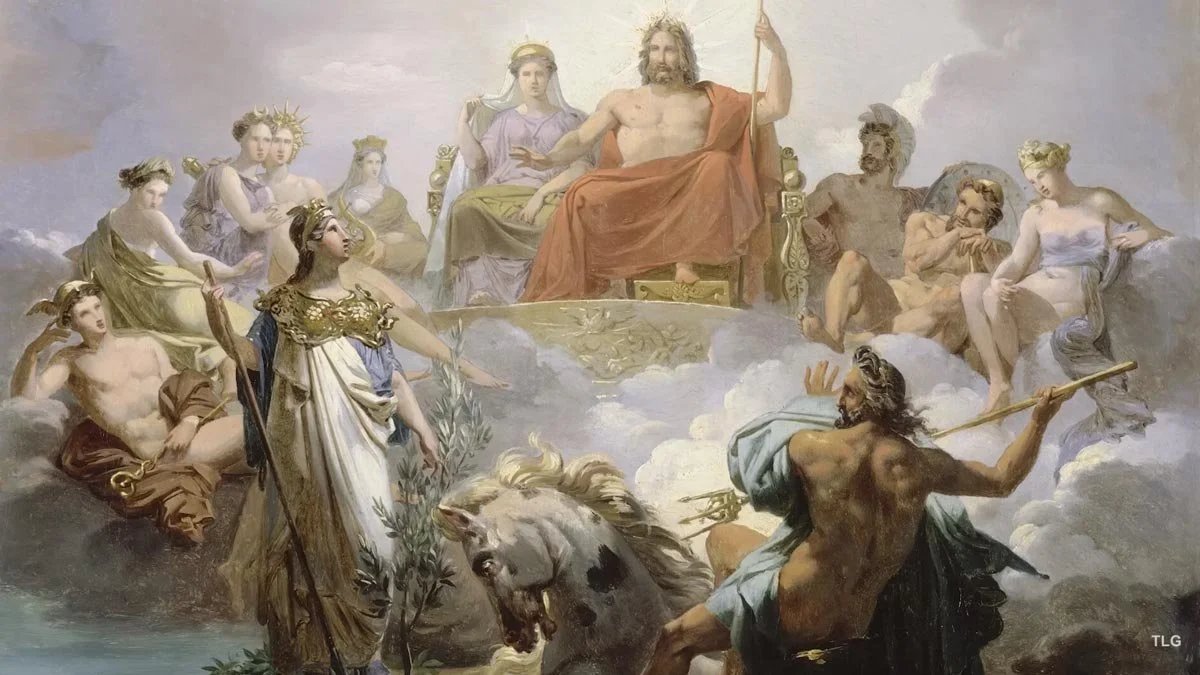
Neoclassical vision of Mount Olympus, gathering the Greek gods around Zeus to visualise the divine family at the centre of myth.
Sacrifices and festivals were how communities met their gods
If there is one act at the centre of Greek religion, it is animal sacrifice. At a typical public ritual, the community processed to an altar, crowned the animal, poured libations of wine, and killed the victim on the altar or nearby. Parts of the animal were burned for the god; the rest was boiled and shared in a sacrificial meal. This was not a side detail. It was how humans and gods entered into relationship, and how the city turned wealth into shared experience.
Festivals stretched this logic across days. At Athens, the Panathenaia for Athena combined processions, sacrifices, music and athletic contests. The Parthenon frieze – which you may have seen in discussions of Greek architecture – is usually read as a long stone version of such a procession. At Olympia, Delphi, Nemea and Isthmia, four-yearly games drew people from all over the Greek world. Competitors raced, wrestled and sang in front of altars and temples; victories were dedicated to gods, and votive offerings – statues, tripods, armour – slowly filled the sanctuaries.
Sacrifice also happened on smaller scales. Individuals might burn incense at a rural shrine, offer a lock of hair before a journey, or dedicate a painted vase in thanks for a safe childbirth. When we study Greek pottery or Greek vases, many of the scenes – processions, libations, altar rituals – make more sense once we see them as reflections of these rites. Even athletic scenes on vases are often tied to religious festivals, not just “sports” in a vacuum.
Household rituals carried the gods into everyday life
Religion did not only live out in front of grand temples. Every home, from modest farmstead to city townhouse, had its own sacred spots. In ancient Greek houses, the hearth was a key focus. The goddess Hestia was linked to every fire that cooked meals and warmed rooms. Small rituals marked events like a child’s birth, a new marriage or a guest’s arrival: a libation poured on the floor, a small sacrifice at the threshold, a wreath hung at the door.
Families often kept small images of gods or protective spirits – simple terracotta figures, miniature altars, painted plaques. These are the kinds of objects you see today in museum rooms on “Greek and Roman life”: not spectacular, but heavily used. They show how religious practice seeped into cooking, cleaning, farming and travel. Public cult and private ritual were not separate universes; they mirrored and reinforced each other.
In this domestic context, myths were less lecture material and more background script. Household rituals to Zeus Ktesios (protector of property) or Apollo Agyieus (guardian of the street) made sense because people already knew stories about those gods. Meanwhile, religious festivals in the city, which you might have experienced in crowded sanctuaries or theatre performances, bounced back into home life through decoration – a new pot with a Dionysian scene, a little figurine brought back from a sanctuary. This is where our guides to ancient Greek fashion, small finds and everyday art plug directly into religion.
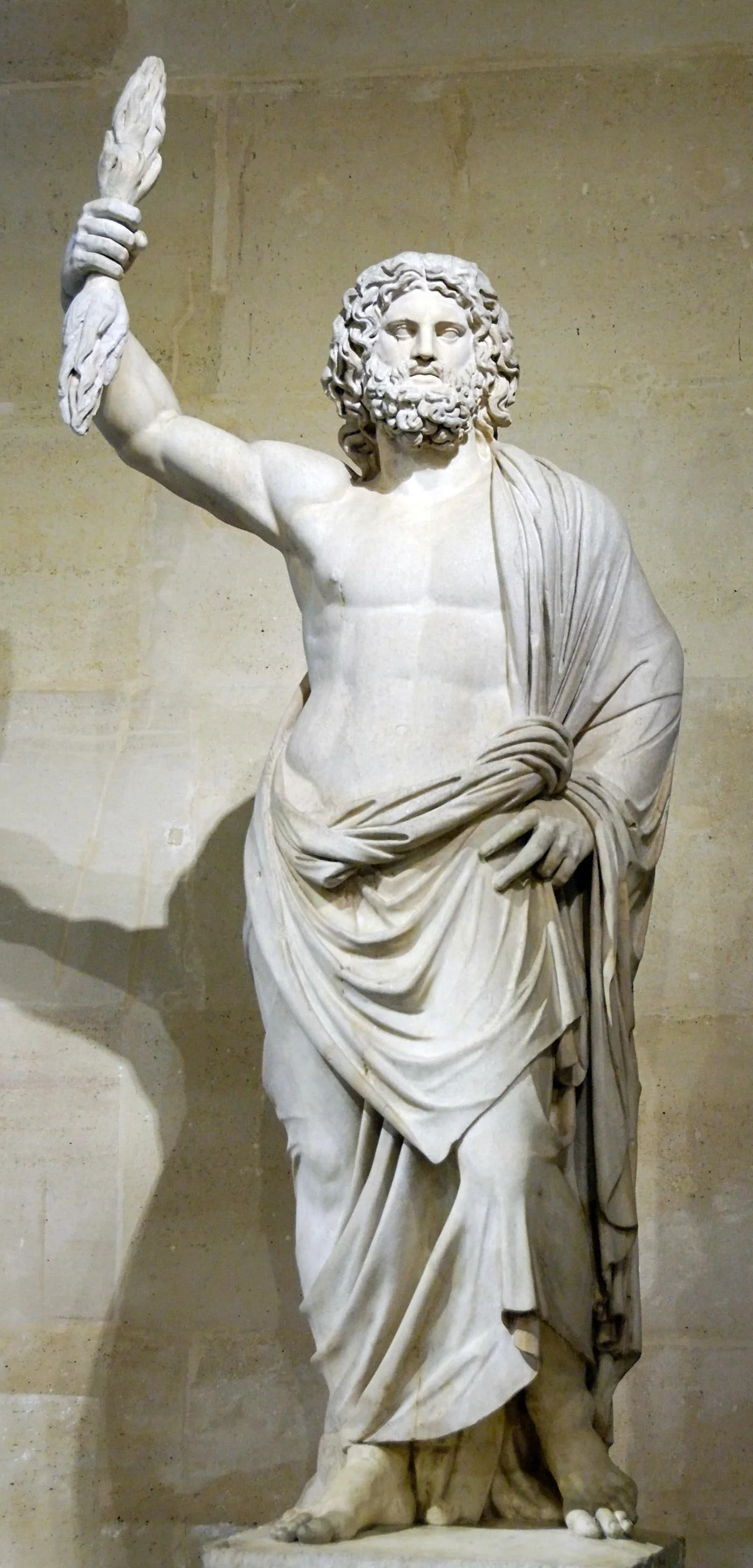
Roman-period cult statue of Zeus from Smyrna, combining idealised muscular body with heavy drapery and authoritative raised gesture.
Why ancient Greek religion matters for art and architecture
For our journey through Greek art, the main takeaway is simple: you cannot separate images from ritual. A temple plan, a sculpted frieze, a painted amphora or a kore statue all sit somewhere inside this religious ecosystem.
The layout of a Greek temple only really clicks when you remember processions and sacrifices. The choices behind Greek god statues – standing or seated, armed or peaceful, nude or draped – respond to cult needs, not just aesthetic taste. Scenes of banquets, races, offerings and even bull sports resonate with rituals and spectacles that go back into Aegean traditions, including things like Minoan bull-leaping. Religion gives these images their original “logic”.
At the same time, art and architecture feed back into belief. Seeing a colossal Athena in her marble temple, or walking through streets lined with votive statues, must have made the gods feel very present. The look of ancient Greek art – its bodies, gestures, drapery, even its patterns like the famous meander – is deeply shaped by centuries of religious practice. When artists in later periods, from Romans to Neoclassicists, imitate Greek forms, they are also (often unconsciously) echoing that religious past.
Conclusion
Ancient Greek religion is easiest to grasp if we stop imagining it as a “belief system” and start seeing it as a dense fabric of actions in specific places. Temples, altars and sanctuaries organised city space; sacrifices and festivals organised time; household rituals stitched gods into cooking fires and doorways.
Once we carry this fabric in the back of our minds, the artworks we keep bumping into on The Art Newbie start to change. A kouros is not just a beautiful statue; it is a grave marker in a religious landscape. A kore is not just a pretty dress study; she is a votive figure on the Acropolis. A frieze is not just decoration; it is a stone festival. From here, every step into Greek architecture, ancient Greek houses or ancient Greek art becomes a bit less abstract and a bit more like walking through a lived religious world.
Sources and Further Reading
You may also like