Athena Statue: How to Identify Her by Armor and Symbols
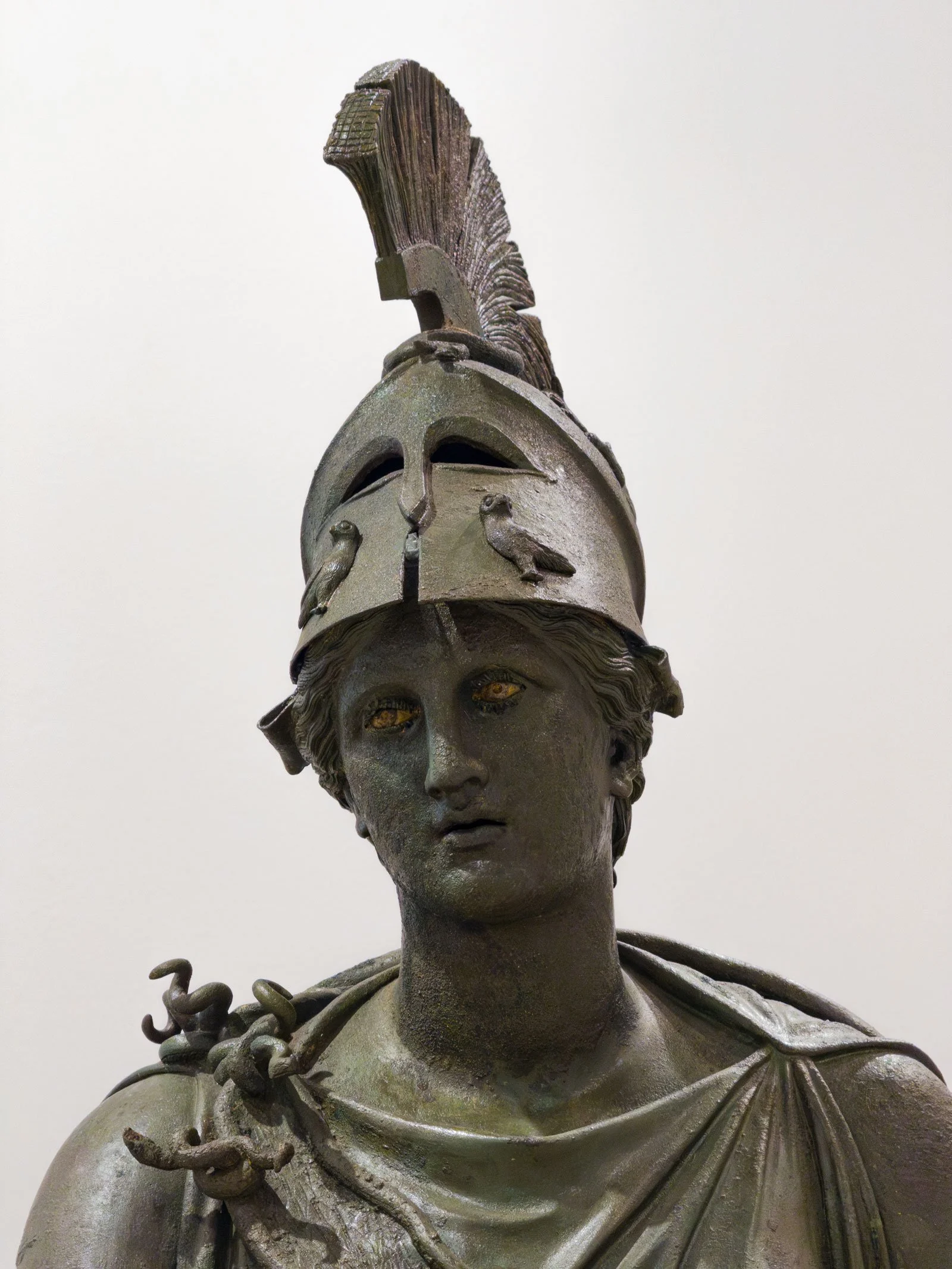
The helmet is one of the fastest ways to identify Athena.
Athena is everywhere in Greek art. And yet she can be oddly hard to spot at first, especially when a statue is damaged, missing its hands, or stripped of the one object that would have made it obvious.
The secret is that Athena rarely arrives “empty-handed.” She arrives with a visual biography: helmet, shield, aegis, a certain kind of calm authority. Once we learn her story, we learn her costume. And once we learn her costume, we start recognizing her in places we didn’t expect, from tiny bronzes to the biggest temple sculpture on earth.
This is a myth-led guide, so we’re going to do it the Greek way: story first, symbols second. Then we’ll turn those symbols into a practical checklist you can use in a museum in under ten seconds.
Athena’s origin story explains why she looks like a strategist in armor
Athena’s “brand” begins with her birth myth.
She is not born like other gods. In many versions, she bursts fully formed from Zeus’s head, already armed, already capable, already intense. It’s a myth that does two things at once.
It gives her authority. She is close to Zeus’s mind, not his household.
It gives her identity. She is wisdom that can fight.
That second part is the key. Athena is not Ares. Ares is battle as chaos. Athena is battle as planning. So when artists want to show a goddess of strategy, protection, and civic order, they give her armor, but they keep her expression controlled.
This is where it helps to remember that Greek statues of gods often rely on attributes, repeated objects that identify a deity. If you want the “bigger map” of how this works across the pantheon, the god attributes guide is the wider toolkit. Athena is one of the easiest once you know her kit, because her kit is consistent.
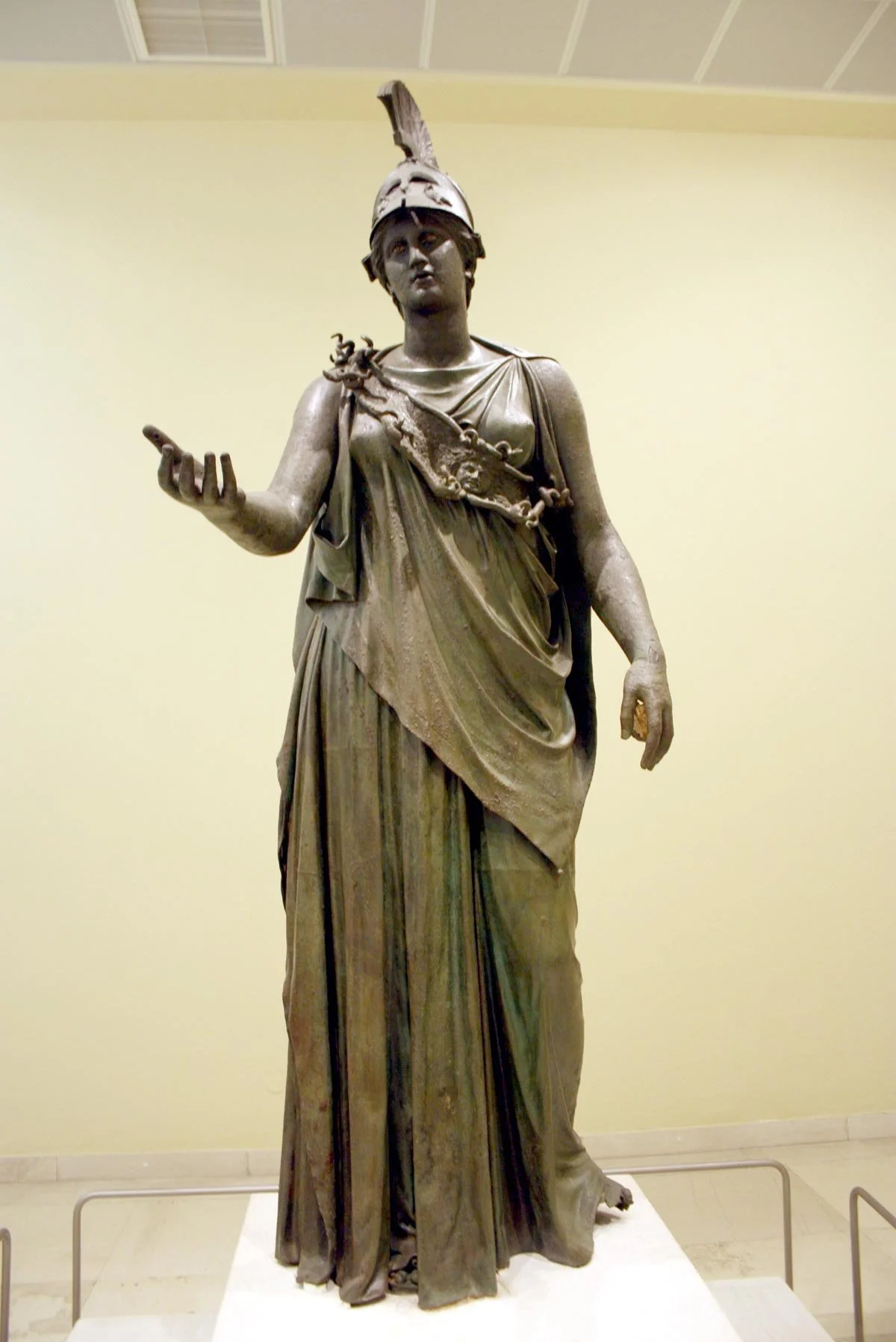
Even without every original attribute, a helmeted upright figure like this reads clearly as Athena.
The helmet is Athena’s fastest visual clue
If you have only one second, look for the helmet.
A helmet is not just “war gear.” In Athena’s case it signals strategic authority. Many gods can carry weapons. Athena wears the mindset of command on her head.
The helmet also does something practical in sculpture: it gives a clear silhouette. Even when the statue is broken or distant, a crested helmet reads quickly against sky or museum wall. That’s why Athena can be identified even when her hands are missing.
But helmets can travel. Warriors and heroes also wear them. So the helmet alone is a strong clue, not a final proof. We want a second sign.
That second sign is often the aegis.
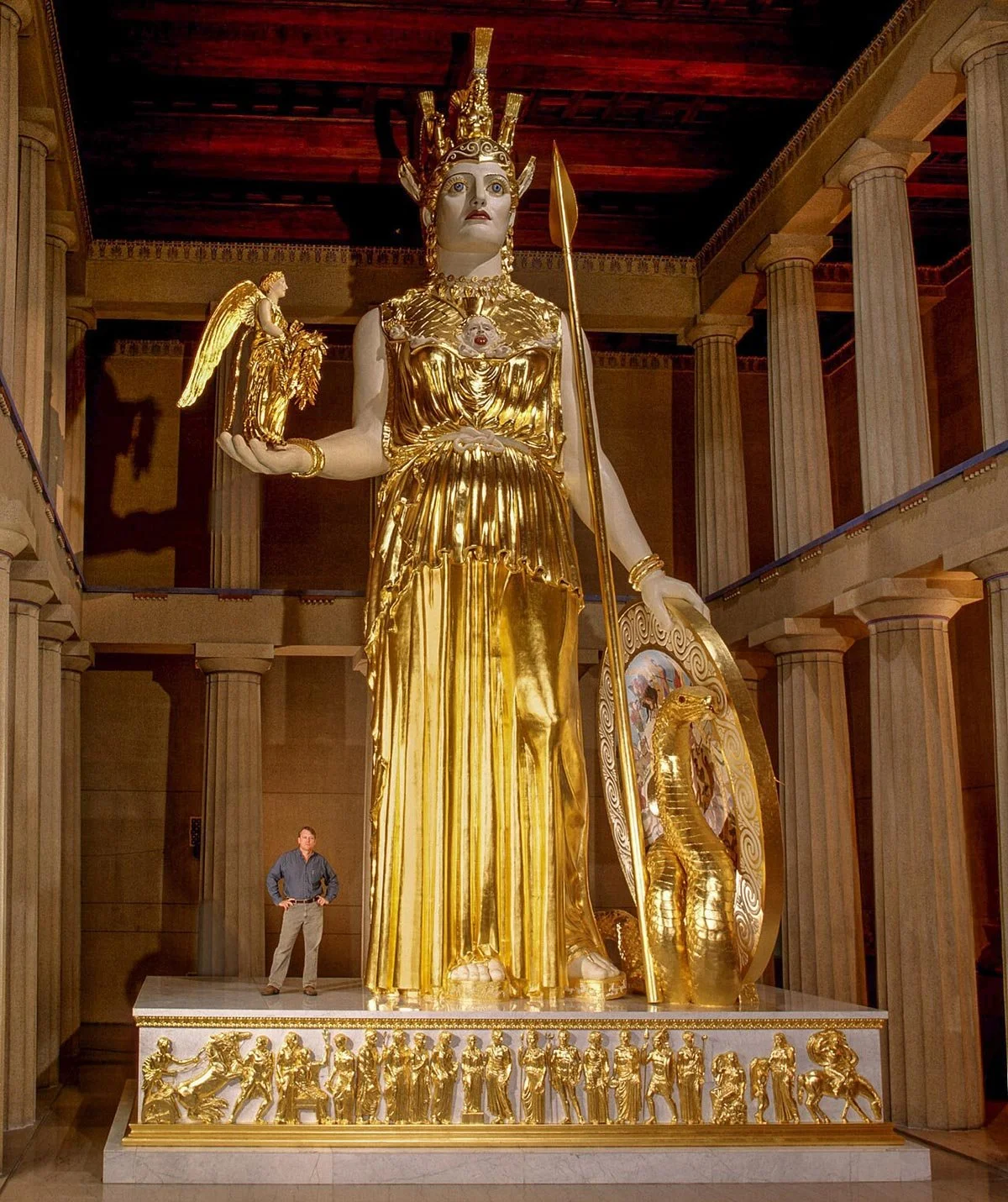
Athena Parthenos gathers Athena’s main signs in one image: helmet, spear, shield, and Nike.
The aegis is Athena’s signature, and its myth is darker than it looks
The aegis is one of those words that sounds academic until you realize it’s basically Athena’s terrifying badge of protection.
Definition: The aegis is a protective mantle, often with Medusa’s head.
In art, the aegis can look like a short skin or cloak draped over the chest or shoulders, sometimes edged with snakes. Often it carries a gorgoneion, the face of Medusa. This is where the identification gets very strong, because the aegis is far more specific to Athena than “spear” or “helmet” alone.
And the myth behind it matters for how we read it. Medusa is a monster whose gaze turns people to stone. In myth logic, using her image on armor turns the threat into protection. It’s like the ultimate deterrent: you don’t just fight Athena. You fear her.
This is also why Athena can look “calm” and still feel powerful. Her power is not emotional display. It’s controlled intimidation.
If you want to go deeper into how each symbol behaves, Athena symbols (owl, olive, aegis) is the best close reading, because it treats the attributes as a system rather than a list.
Spear and shield are common, but Athena uses them in a very specific way
Spear and shield are not uniquely Athena. They’re common across Greek art. The trick is how Athena carries them.
Athena tends to read as:
defensive rather than aggressive
upright rather than lunging
prepared rather than attacking
So if you see a goddess with a spear and shield, and her posture is stable and authoritative, Athena becomes likely. If the figure looks like pure war fury, Athena becomes less likely.
Also, Athena often appears with the shield as an identity surface. Artists decorate shields with myths and symbols, and Athena’s shield can be a storytelling zone. That logic is one reason Athena shows up so powerfully in Parthenon imagery, where myth is staged as civic meaning.
To see Athena functioning at temple scale, the strongest anchor is Athena in the pediments. There, she isn’t just a deity. She’s an origin story and a claim of ownership.
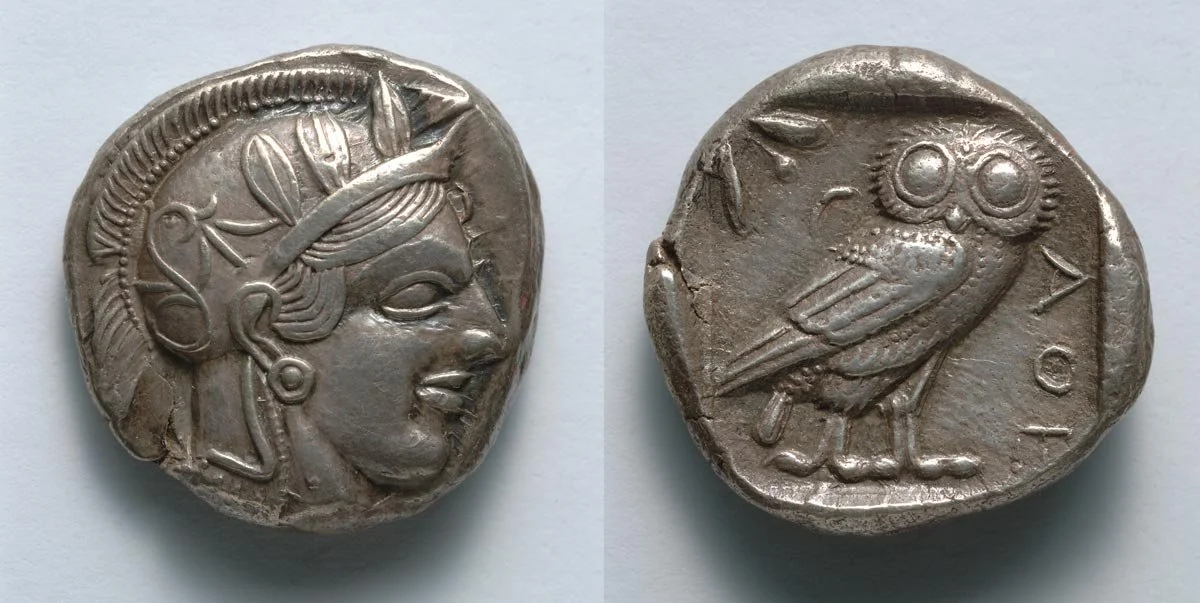
Athena and the owl are one of the most famous symbol pairings in Greek art.
Owl and olive are Athena’s “quiet” symbols, but they’re often the clincher
Sometimes a statue is missing the loud stuff. No helmet. No spear. No shield. Or it’s so worn that armor details blur into stone.
That’s when Athena’s quieter symbols become decisive.
Owl: wisdom, vigilance, Athens itself.
Olive: peace through prosperity, the cultivated city, Athena’s gift.
In the famous myth, Athena competes with Poseidon for patronage of Athens, and her olive tree “wins” the city. This is why olive imagery shows up constantly in Athenian identity, not just in religious art.
The owl and olive also help when you’re looking at objects beyond statues, like coins and small bronzes, where Athena’s face and symbols become a shorthand for the entire city.
Here’s a useful mini-snippet to keep your museum brain calm:
Myth vs Fact
Myth: Athena is “just a war goddess.”
Fact: She is a strategy-and-civic-order goddess who uses armor as authority.
So if you find an owl, Athena moves up the suspect list fast. If you find an olive sprig, the list gets shorter.
Again, for the full symbolic logic in one place, Athena symbols (owl, olive, aegis) is the cleanest reference.
Athena Parthenos is the ultimate “identification bundle”
If you want Athena turned up to maximum, it’s Athena Parthenos.
The colossal statue inside the Parthenon is lost, but the descriptions and copies preserve the idea: Athena as city protector, armed, authoritative, and glittering with wealth. In that form, Athena’s identity signals are not subtle. They’re stacked.
Helmet. Aegis. Shield. Spear. Victory imagery. Guardianship.
Even if we’re reading from fragments, the logic is consistent with how Greek cult images worked: they weren’t just “pretty statues.” They were designed presences inside sacred space.
So when you’re trying to identify Athena in smaller works, it’s useful to hold Athena Parthenos in your mind as the “full costume,” then notice which parts survive in the statue you’re looking at.
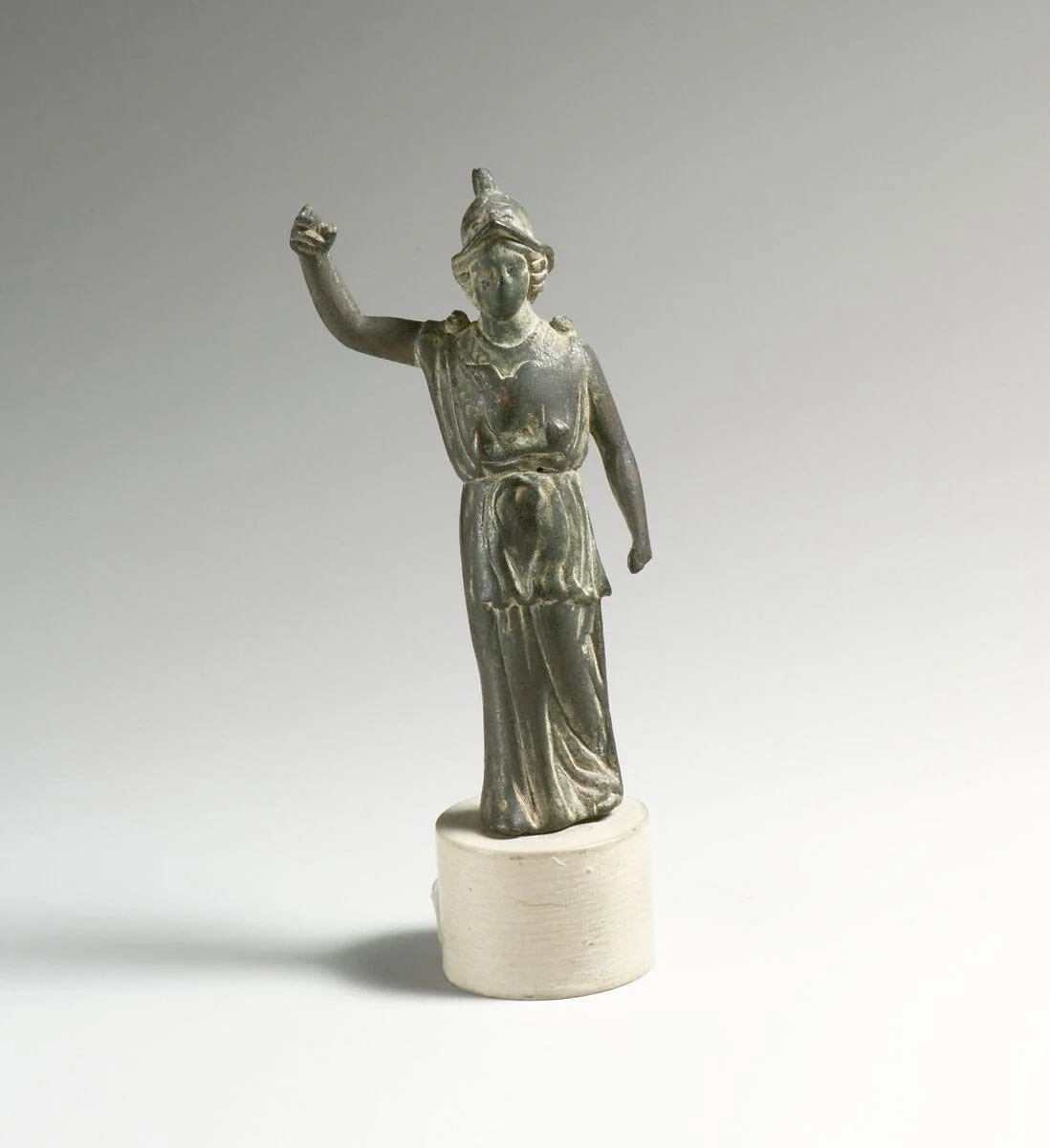
Even in small bronzes, Athena stays readable through helmet, stance, and martial identity.
The Archaic “before” reminds us Athena didn’t always look Classical
Athena’s symbols are consistent, but her style changes with time.
Before Classical Athens gave us the Parthenon world, the Acropolis already had offerings and statues that show a different visual language: more patterned surfaces, more frontality, a different relationship between clothing and identity.
That’s why Athena’s Acropolis before the Parthenon is such a helpful reference. Even though the Peplos Kore is not always treated as Athena by every scholar, it sits in the exact context where questions of goddess identity, clothing, and offerings become real. It teaches you to look for the “coded” parts of Greek sculpture early: costume, gesture, and attribute logic, not facial likeness.
And it also teaches a bigger lesson: the same goddess can be recognized by symbols even as artistic style evolves. Athena doesn’t need a single fixed face. She needs a readable kit.
A practical 10-second checklist you can actually use
If you’re in front of a statue and you want a fast answer, scan like this:
Helmet: especially crested, authoritative.
Aegis: mantle on chest, often with Medusa head and snake edge.
Spear and shield: usually controlled, protective stance.
Owl: the strongest “quiet” ID clue.
Olive: sprig, wreath, or tree reference, often tied to Athens.
Overall vibe: calm power, strategy more than rage.
If you get two or three of these together, Athena is a very strong identification.
And if you want the wider context of how these attributes sit inside the Greek “god recognition system,” loop back to the god attributes guide and you’ll start spotting patterns across Apollo, Zeus, and others too.

Conclusion
Athena is identifiable because she’s consistent. Her myths give her armor as identity, not as costume. Her aegis carries protection with a frightening edge. Her owl and olive link her to wisdom and to Athens itself. And her most monumental form, Athena Parthenos, bundles those signals into a single overwhelming image of civic guardianship.
Once we learn to read those symbols, we stop guessing “which goddess is this?” and start reading Greek art the way it was meant to be read: as a visual language where story and image reinforce each other.
Sources and Further Reading
The Metropolitan Museum of Art — “Greek Gods and Religious Practices” (2003)
The Metropolitan Museum of Art — “Bronze statuette of Athena flying her owl” (n.d.)
Acropolis Museum — “Statue of a Kore. The ‘Peplos Kore’” (n.d.)
Acropolis Museum — “Athena Parthenos” (2024)
Center for Hellenic Studies, Harvard — “Hesiod, Theogony (selection on Athena’s birth)” (n.d.)
British Museum — “Athenian silver coin with Athena and owl” (n.d.)
Smarthistory — “Piraeus Athena” (n.d.)
You may also like