Venus de Milo: Why This Armless Statue Became So Famous
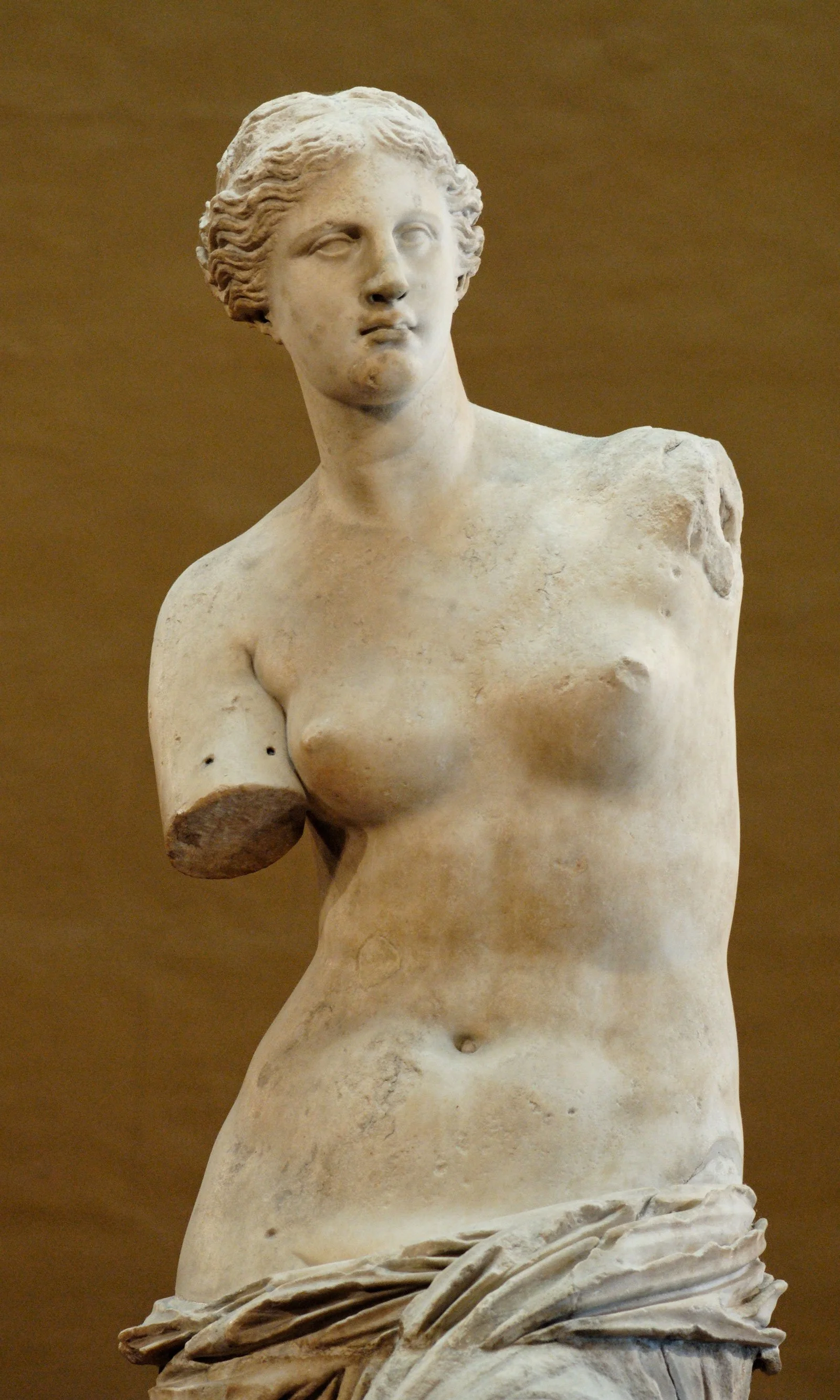
The Venus de Milo became iconic not despite the missing arms, but partly because of them.
The Venus de Milo became famous for more than one reason at once. Yes, it is the armless statue in the Louvre that almost everyone recognizes. But the real reason it became iconic is deeper: it seems to combine ideal beauty, mystery, damage, and historical timing in one unforgettable image. It is ancient, but it also feels strangely modern in the way it invites projection. We do not only look at it. We imagine what is missing.
In simple terms, the Venus de Milo is a Hellenistic Greek statue, usually identified as Aphrodite, made around the mid-2nd century BCE and found on the island of Melos in 1820. It became one of the defining images of ancient art not because it is perfectly preserved, but because it is not. Its broken state became part of its power.
That is what makes the statue so important. It is not just a beautiful survival from antiquity. It is a work whose fame was built by art, history, accident, and modern taste all at once.
The statue is famous because it feels complete even while being broken
This is the first thing worth noticing. The Venus de Milo is damaged, but it does not feel ruined in the ordinary sense. The arms are gone, and some original details are lost, yet the statue still holds together with remarkable visual force. The body twists gently. The drapery grips the hips and legs. The torso opens upward with extraordinary calm. Even in fragments, the figure feels whole.
That matters because the missing arms do not simply take something away. They create one of the work’s central effects. We cannot fully close the image. We have to imagine it.
This is one reason the statue became so famous in modern culture. It seems to offer ideal beauty while still preserving mystery. A fully intact figure tells you more. The Venus de Milo tells you less, and in doing so it leaves more room for fascination. The statue is always partly withheld.
That also helps explain why it stands out even within the history of female Greek statues. Many ancient figures are beautiful. Fewer are beautiful in a way that feels unfinished and complete at the same time.
It belongs to the Hellenistic world, but it does not look dramatic in the obvious way
The Venus de Milo is usually dated to about 150 BCE, which places it firmly in the Hellenistic age. That can surprise beginners. A lot of people hear “Hellenistic” and expect maximum drama: twisting bodies, emotional struggle, explosive movement. This statue is different.
Its power is quieter.
The body has a more complex twist than many Classical figures, and the drapery creates a richer bodily rhythm than earlier Greek sculpture often preferred. But the face remains controlled. The posture is poised. The overall mood is not theatrical crisis. It is composed sensuality.
That is one reason the statue is so revealing within ancient Greek sculpture. It reminds us that Hellenistic art was not only about extreme emotion. It could also work through softer, subtler effects. The Venus de Milo belongs to a later Greek world, but it does not abandon ideal beauty. It reinterprets it.
So the statue became famous partly because it sits in a fascinating middle ground. It is not purely Classical calm, and it is not fully dramatic in the way later viewers often imagine Hellenistic art. It carries both restraint and sensuality at once.
It is usually identified as Aphrodite, which gives the figure an extra layer of meaning
The standard interpretation is that the statue represents Aphrodite, the Greek goddess of love and beauty, known to the Romans as Venus. That identification is one reason the statue became so iconic. It is not just a woman. It is a goddess whose whole visual tradition is tied to beauty, desire, and the body.
That said, the missing arms mean some of the original identifying clues are gone. A hand holding an apple was reportedly found near the statue, and that object helped support the Aphrodite reading. Even so, the lost pose leaves room for debate. We know enough to place the figure within the visual world of Aphrodite, but not enough to remove every question.
This tension between clarity and uncertainty matters a lot. The statue’s meaning is not vague, but it is not fully locked either. That openness helps explain its modern afterlife. The Venus de Milo is easy to recognize, yet hard to exhaust.
It also belongs to the wider story of ancient Greek art, where divine beauty often becomes a way of thinking through ideal form. What makes this statue unusual is how much that ideal still depends on incompleteness.
Its modern fame grew because it arrived at exactly the right historical moment
The Venus de Milo did not become iconic only because it was beautiful. It also became iconic because of when and how it entered modern Europe.
After being discovered on Melos in 1820, the statue was acquired for France and entered the Louvre in 1821. This happened at a moment when the Louvre, after the fall of Napoleon, had lost major works and was especially ready to celebrate a new ancient masterpiece. The Venus de Milo arrived not just as an archaeological object, but as a cultural event.
That modern history matters because museums do not simply display fame. They help produce it.
Once the statue entered the Louvre, it became part of a larger story about ancient beauty, national prestige, and the canon of great art. Reproductions spread. Writers discussed it. Artists copied it. The broken body became one of the most recognizable silhouettes in the world.
So when we ask why the Venus de Milo became famous, the answer is not only ancient. It is also modern. The statue had to survive antiquity, be rediscovered, be collected, and be turned into an icon.
The statue still matters because it shows how powerful a fragment can be
The Venus de Milo is one of the best reminders that ancient sculpture does not need to survive perfectly to remain powerful. In some ways, the loss is part of the work’s meaning now. The missing arms turned the statue into a puzzle, but they also sharpened its image. The body, the twist, the drapery, and the face have to carry more weight because so much else is gone.
That is why the statue still matters. It is not only a masterpiece of Greek sculpture. It is also a masterpiece of survival and afterlife. It shows how ancient art can keep changing meaning as it moves from one historical world to another.

Conclusion
The Venus de Milo became famous because it brings together several things almost impossibly well: ideal beauty, Hellenistic subtlety, divine identity, physical damage, and modern museum fame. It is not just “the armless statue.” It is a work whose missing parts became part of its legend, and whose quiet power proved strong enough to survive both antiquity and modern reinvention.
That is why it still stands as one of the defining images of ancient art. Not because it gives us everything, but because it does not.
FAQ
What is the Venus de Milo?
The Venus de Milo is a famous ancient Greek marble statue, usually identified as Aphrodite, from the Hellenistic period.
Why is the Venus de Milo so famous?
It became famous because of its beauty, its damaged but compelling form, its discovery story, and its huge modern visibility in the Louvre.
Why does the Venus de Milo have no arms?
The arms were already missing when the statue was discovered in 1820.
Is the Venus de Milo Greek or Roman?
It is Greek, not Roman, and is generally dated to the mid-2nd century BCE.
What does Venus de Milo mean?
“Venus” is the Roman name for Aphrodite, and “de Milo” refers to Melos or Milos, the island where the statue was found.
Is the Venus de Milo a Hellenistic sculpture?
Yes. It belongs to the Hellenistic age, even though its mood is calmer than many people expect from Hellenistic art.
You may also like