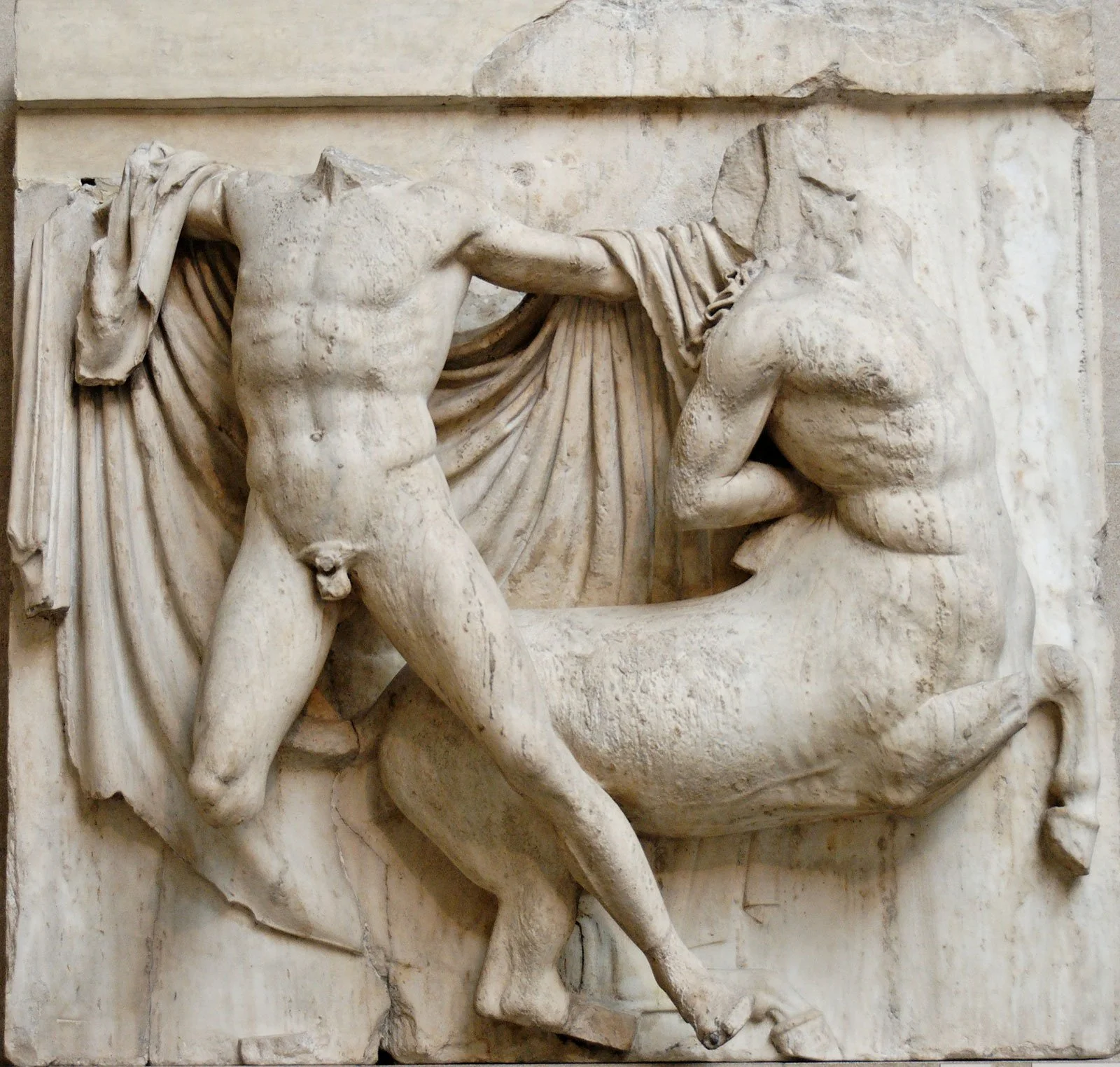
The metopes compress mythic violence into single high-impact scenes.
The Parthenon metopes are the part of the temple that refuses to be “calm.” You can feel it even in fragments: bodies grappling, weapons raised, monsters twisting, humans fighting back. If the Parthenon frieze is a composed civic procession, the metopes are the building’s combat narrative.
And the surprising thing is how systematic that violence is. Each side of the Parthenon tells a different mythic battle. Together, those battles form a single idea: order has to be defended, repeatedly, against chaos.
This is our quick dossier. We’ll define what a metope is, walk through the four battle cycles, and then connect them to the Parthenon’s larger message inside the full sculpture program.
Definition: A metope is a square relief panel in a Doric frieze.
Metopes are designed for impact, not detailed reading
A metope is a single framed scene, usually with a high-contrast composition. Unlike a continuous frieze, it doesn’t unfold slowly. It hits you in one punch.
That’s why metopes are perfect for conflict. They compress an entire myth into a few bodies and one decisive moment. And because they sit high on the exterior, the scenes have to read fast: silhouette, gesture, tension.
This is also why comparing the metopes to the frieze is so helpful. The frieze creates rhythm and civic order. The metopes show crisis and violence. That contrast is the first clue that the Parthenon is speaking in multiple registers, which is exactly what we explore in frieze vs metopes.
If we want the Parthenon to make sense as a whole, we have to accept this: “Classical calm” isn’t the only mood. The building also stages chaos so that order looks earned.
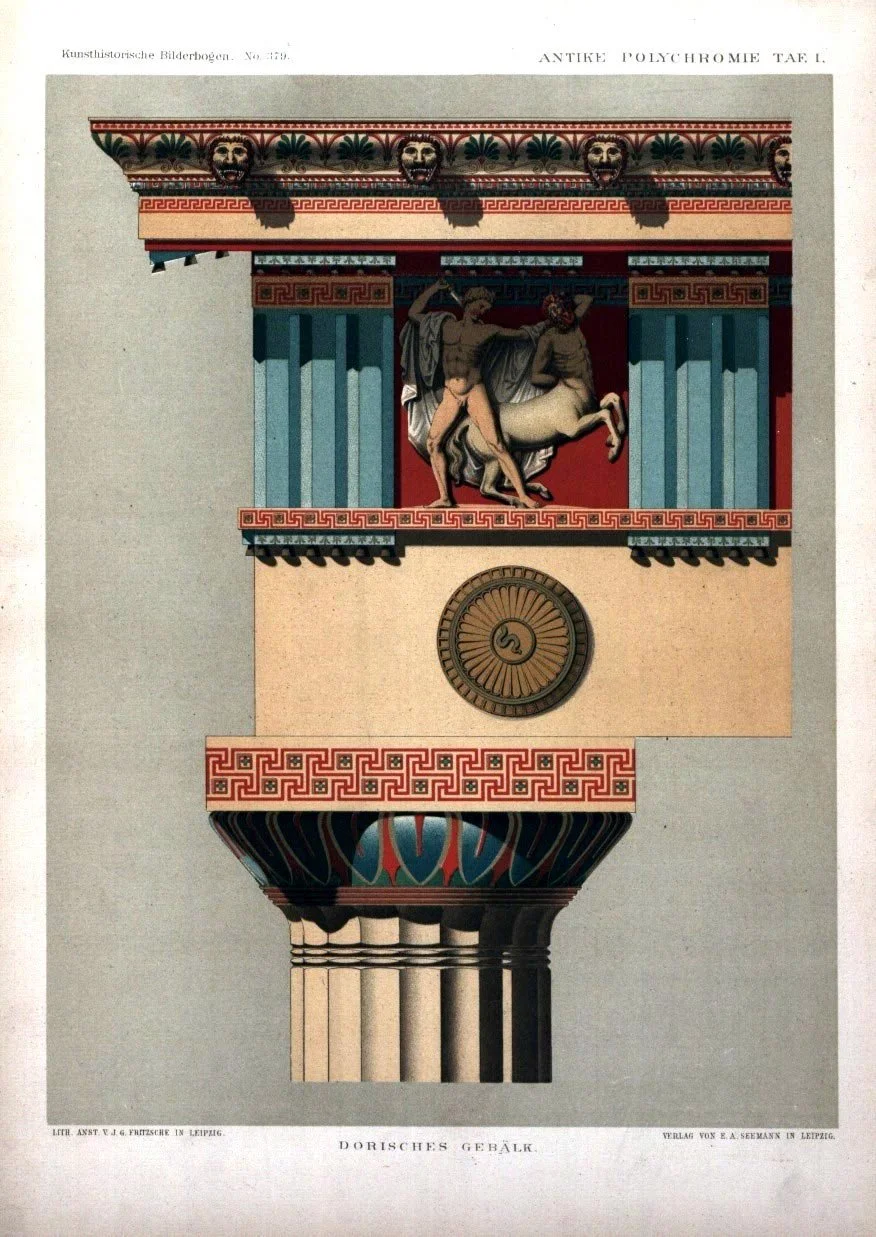
The metopes were part of a brightly painted exterior, not plain white stone.
The four mythic battles map a moral geography around the temple
The Parthenon metopes are traditionally grouped by side, each side showing a different battle cycle. Scholars debate some details and reconstructions, but the broad structure is stable enough to be teachable.
Here are the four battles most commonly associated with the four sides:
Centauromachy: Lapiths vs Centaurs
Amazonomachy: Greeks vs Amazons
Gigantomachy: Olympian gods vs Giants
Trojan War: Greeks vs Trojans
The important part is not memorizing the Greek names. It’s noticing what these stories have in common.
Each one stages a clash between an “ordered” world and a threatening “other,” whether that other is monstrous (Giants, Centaurs) or culturally foreign (Amazons, Trojans as outsiders in Greek imagination). The temple wraps itself in these repeated claims: civilization is fragile, and it must be defended.
That’s why metopes become a visual partner to Classical art and order vs chaos. Classical art loves harmony, but harmony is often defined by what it excludes. Chaos is the foil that makes order feel like a virtue.
Centaurs vs Lapiths is the most visceral: the fight between self-control and appetite
The Centauromachy is famous because it’s so physically direct. A centaur is half-human, half-horse, often used as a symbol of uncontrolled appetite and violence. The mythic story usually involves a wedding feast where centaurs lose control, and the Lapiths fight back.
As imagery, it’s almost too perfect for architectural propaganda: the human world threatened by animal force, civilization threatened by impulse.
Even if you don’t know the story, you can read the contrast. Human bodies are carved with clarity. Centaur bodies twist with wild energy. The frame becomes a moral diagram: order pushes against chaos.
That “self-control vs excess” theme fits the Parthenon’s larger identity as a building about civic ideals. It doesn’t just honor Athena. It models what Athens wants to believe about itself: rational, disciplined, capable of defending its order.
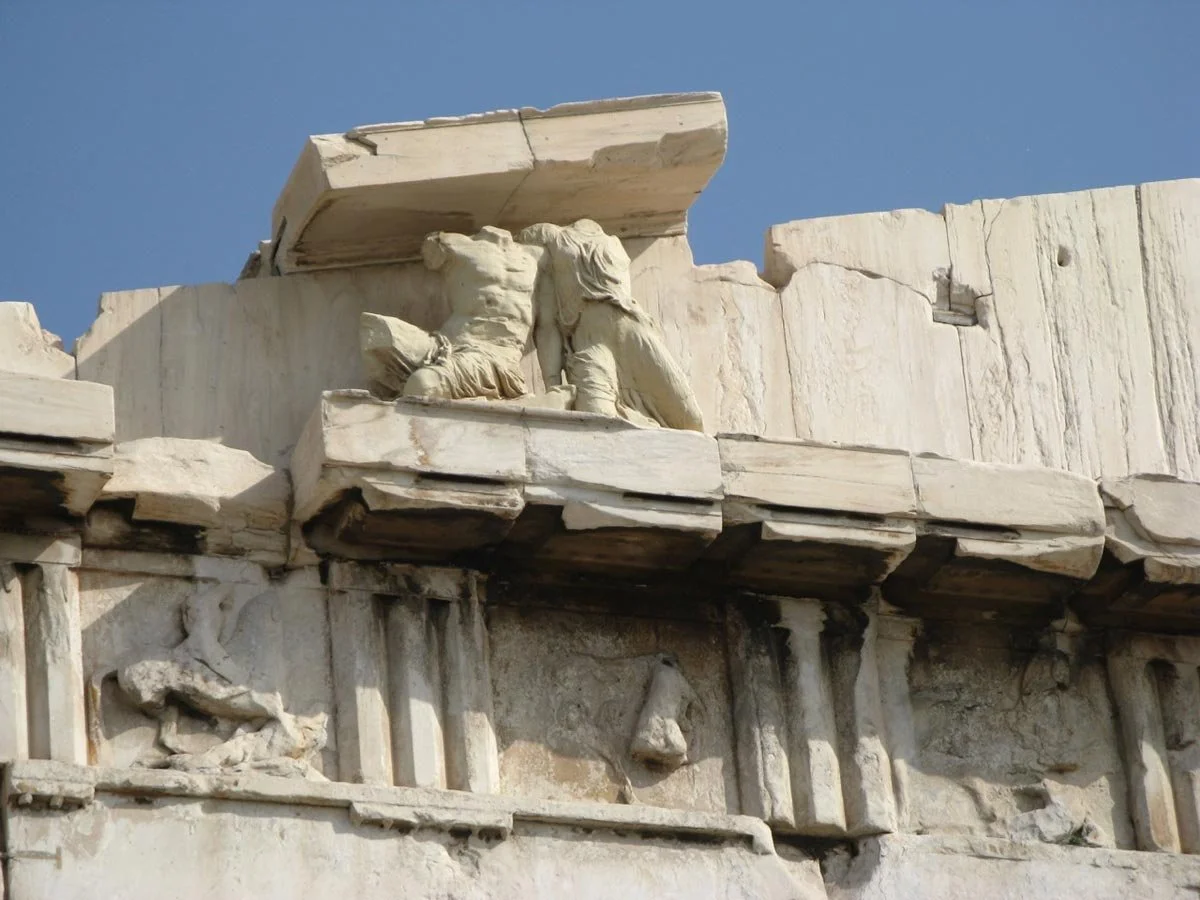
This close view helps show where the sculptural panels sat on the temple’s exterior.
Amazons vs Greeks frames conflict as cultural threat, not only physical struggle
The Amazonomachy is different. Amazons are not monsters. They are human, which makes the story more politically usable.
In Greek myth, Amazons are often imagined as outsiders who invert Greek gender norms and threaten Greek social order. That doesn’t mean the myth is “true.” It means it was useful. It created a dramatic narrative of “us vs them” that could be repeated across art.
On the Parthenon, that myth can function as a warning and a self-praise at once: Athens can defeat threats that feel culturally destabilizing.
This is also where gods can become relevant in subtle ways. Myth battles are rarely only human affairs. Divine forces hover behind the scenes, and the Parthenon’s sculptural world is full of gods and their symbolic roles. If you want to track how deities appear and behave across sculpture more generally, how gods show up in sculpture helps you read divine presence as a pattern, not a random cameo.
Giants vs gods is the cosmic version: order is literally divine law
The Gigantomachy is the most foundational battle, because it’s not just about a city defending itself. It’s about the universe being stabilized.
The Giants represent a primordial threat, and the Olympian gods represent the cosmic order that makes civilized life possible. In temple imagery, this story is a way of saying: the god you worship is part of the force that keeps the world from sliding into chaos.
For the Parthenon, that matters because Athena is not a minor deity. She’s a guardian figure, a strategist, a protector. A cosmic battle scene supports her authority at the most fundamental level.
This is the layer where myth becomes metaphysics. It’s not about a specific historical enemy. It’s about the principle that order has to win.
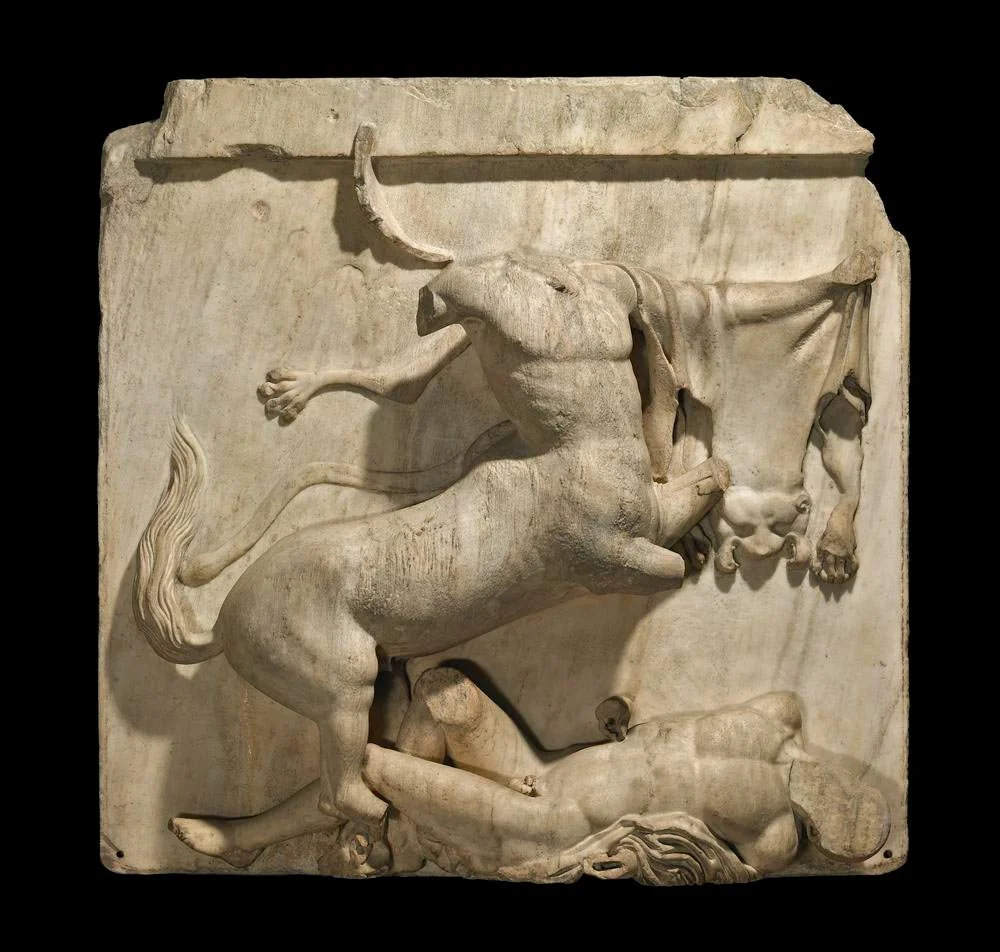
Centaur scenes are some of the clearest examples of the metopes turning myth into order-versus-chaos imagery.
The Trojan War cycle anchors the whole thing in heroic history
The Trojan War is the most “human” of the four. It’s still myth, but it’s myth with named heroes and a long narrative tradition.
In Greek cultural memory, the Trojan War becomes a reference point for identity: bravery, loss, honor, and the costs of conflict. Placing Trojan imagery on the Parthenon’s exterior wraps Athens’ present inside the prestige of heroic past.
It also reinforces the building’s public voice: Athens isn’t just any city. It places itself inside the highest-status stories the Greek world tells about itself.

Conclusion
The Parthenon metopes are not random violent decorations. They are a structured cycle of four mythic battles designed to frame the temple’s exterior with one repeating idea: order must defeat chaos. Centaurs, Amazons, Giants, and Trojans aren’t only enemies. They’re symbolic threats that make civilization, law, and divine protection feel necessary and justified.
And when we place them beside the Parthenon’s calmer imagery, the full message sharpens. The frieze shows civic order. The metopes show what that order is always up against. The pediments show mythic foundations. Together, they form one consistent claim about Athens and Athena.
If you want to see that mythic layer at its most monumental, the companion piece myth scenes on the pediments is the next step in the program.
FAQ
What are the metopes of the Parthenon?
Square relief panels on the exterior Doric frieze, each showing a mythic scene.
What four battles do the Parthenon metopes depict?
Centaurs vs Lapiths, Greeks vs Amazons, gods vs Giants, and the Trojan War.
Why are the metopes so violent compared to the frieze?
Because they communicate “order vs chaos” through high-impact conflict imagery, while the frieze emphasizes civic ritual order.
Do the metopes have a political meaning?
Likely yes. Mythic enemies can symbolize threats to civic order and reinforce Athens’ identity.
Sources and Further Reading
Acropolis Museum — “Metope” (n.d.)
Acropolis Museum — “Sculptural decoration” (n.d.)
British Museum — “The Parthenon Sculptures” (n.d.)
Boardman, John — “The Parthenon and Its Sculptures” (1985)
Osborne, Robin — “The viewing and obscuring of the Parthenon frieze” (1987)
You may also like