Laocoon and His Sons: Why This Sculpture Feels So Intense
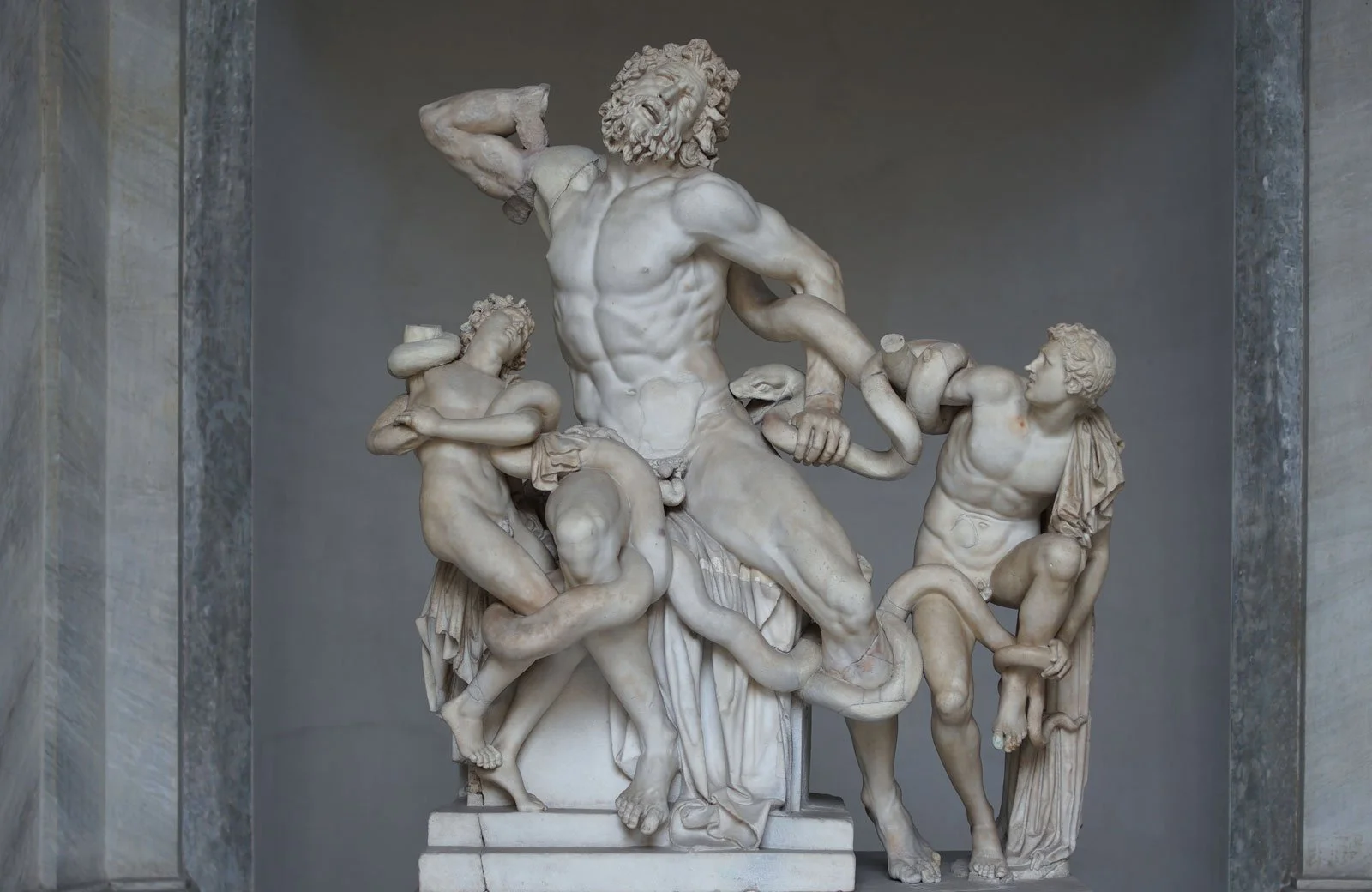
Laocoön becomes unforgettable because every body in the group feels locked under pressure.
Laocoon and His Sons still hits hard because it does almost everything at once. It gives us twisting bodies, visible pain, tangled movement, and a moment of fear that feels as if it is still unfolding. If a lot of earlier Greek sculpture asks us to admire balance, this sculpture asks us to feel pressure. That is why it matters.
In simple terms, the Laocoon group shows the Trojan priest Laocoon and his two sons being attacked by serpents. It is one of the most famous sculptures from the Greek world, usually discussed as a masterpiece of Hellenistic drama, even though scholars still debate the exact date and whether the surviving marble group is a late Hellenistic original or a Roman-era version of a Greek design. Either way, its artistic power is unmistakable. This is one of the clearest examples of how ancient sculpture can turn stone into crisis.
The subject is mythological, but the intensity feels physical first
You do not need to know the full Trojan War story for the sculpture to work. That is part of its brilliance.
The figures are locked into a struggle with serpents that coil around their bodies and pull them into a web of tension. Laocoon strains upward and outward at the same time. One son seems more trapped, the other more vulnerable. No one is simply posing. Every limb is involved in resistance.
That physical intensity is what makes the sculpture feel so immediate. In many works of ancient Greek sculpture, the body is idealized into calm coherence. Here the body is still idealized, but idealization has been pushed into a different emotional register. Muscles contract, torsos twist, and the whole group seems to tighten under force.
This is why the sculpture can feel almost modern. It does not only show bodies. It shows bodies under attack.
The composition feels intense because it refuses stable balance
A lot of Greek sculpture creates power through stability. Laocoon and His Sons creates power through instability.
The group is built around diagonals, spirals, and crossing lines. Nothing settles fully. The serpents function almost like moving lines drawn through the bodies, binding the three figures into one sculptural knot. That is why the work is so much more than three separate statues placed side by side. It is a single dramatic system.
This matters because the sculpture turns space into part of the struggle. Arms reach outward. Legs open and brace. The viewer’s eye cannot rest in one calm center. It keeps moving across the group, tracing pain, resistance, and collapse.
That is one reason the work became so famous in the long history of ancient Greek art. It shows what happens when Greek sculptural intelligence is pushed toward maximum tension. Beauty does not disappear. But beauty is no longer calm. It is strained into drama.
The sculpture feels emotional because pain is visible without becoming chaos
The emotional force of Laocoon and His Sons comes from control as much as from suffering.
The figures are not messy. The carving is highly organized. Anatomy remains legible. The bodies are still beautifully composed. That is exactly why the pain lands so strongly. We are not looking at shapeless panic. We are looking at a perfect sculptural system built to communicate breaking point.
Laocoon’s face matters here. He does not read as blankly heroic. The mouth, the brow, and the entire head suggest effort and agony. But even this expression is measured within the structure of the group. The sculpture knows how far to go without losing formal power.
That balance between emotional charge and formal control is one of the main reasons the work feels so intense. It does not merely describe suffering. It stages suffering.
Why it matters
This sculpture matters because it shows how far Greek art could push movement, emotion, and bodily tension without giving up intelligence or craft.
It is also historically important because it became one of the most influential ancient sculptures in Europe after its rediscovery in Rome in 1506. Artists, collectors, and writers treated it as a masterclass in expressive anatomy and dramatic composition. The group helped shape later ideas about what sculpture could do when it aimed not just for beauty, but for emotional force.
At the same time, the work remains a useful beginner’s guide to the more intense side of Greek art. If you want to understand why later Greek sculpture can feel so different from earlier calm idealism, Laocoon and His Sons makes that shift visible immediately.

Conclusion
Laocoon and His Sons feels so intense because everything in it is under pressure: the bodies, the space, the composition, and the emotions. The sculpture turns myth into physical struggle and physical struggle into artistic form. It is one of the clearest examples of ancient art using beauty not to calm us, but to tighten the experience.
That is why the sculpture still matters. It does not only survive as a famous object. It still transmits force.
FAQ
What is Laocoon and His Sons?
It is a famous ancient sculpture showing the Trojan priest Laocoon and his two sons being attacked by serpents.
Why is Laocoon and His Sons so famous?
It is famous because of its extreme emotional intensity, complex composition, and major influence on later European art.
Is Laocoon and His Sons Greek or Roman?
It is usually treated as a work in the Hellenistic Greek tradition, but scholars still debate whether the surviving marble group is a late Greek original or a Roman-era marble version.
Who made Laocoon and His Sons?
Ancient tradition connects it to the Rhodian sculptors Agesandros, Athenodoros, and Polydoros.
Where is Laocoon and His Sons today?
It is in the Vatican Museums.
Why does the sculpture feel so dramatic?
Because the figures are arranged in a tightly interlocked composition full of twisting bodies, visible effort, and emotional strain.
Sources and Further Reading
Smarthistory — “Athanadoros, Hagesandros, and Polydoros of Rhodes, Laocoön and his Sons” (n.d.).
Encyclopaedia Britannica — “Laocoön” (Greek sculpture) (2026).
The Metropolitan Museum of Art — “Art of the Hellenistic Age and the Hellenistic Tradition” (2007).
The Metropolitan Museum of Art — Art of the Hellenistic Kingdoms: From Pergamon to Rome (2021).
You may also like