Etruscan Art: Style, Materials and Main Themes
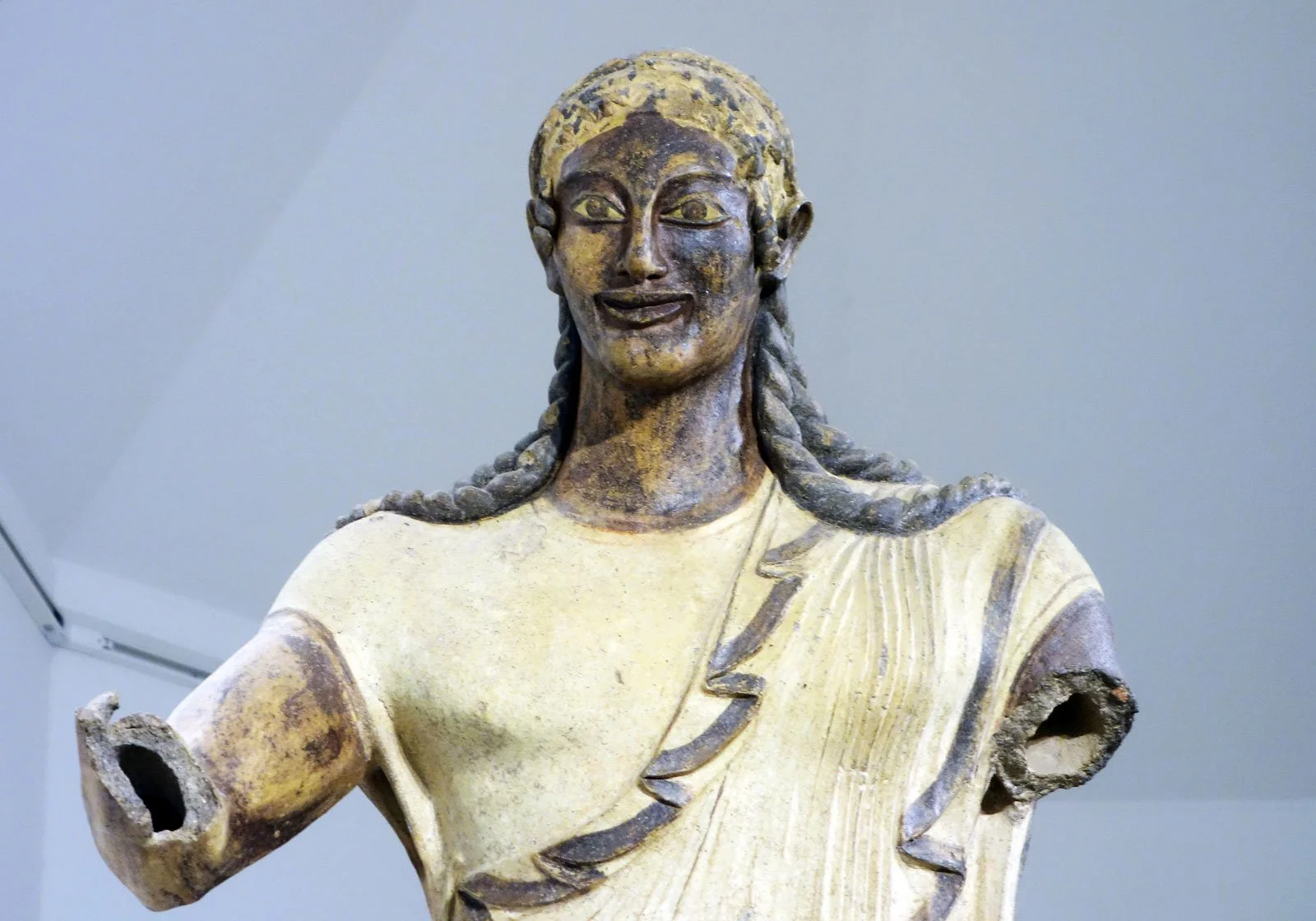
Apollo of Veii is a strong example of Etruscan art because it combines movement, color, and terracotta with unusual force.
Etruscan art feels unusually alive. It is tactile, direct, and often emotionally close to everyday life. Instead of aiming only for ideal beauty in the Greek sense or imperial grandeur in the Roman one, Etruscan artists often gave us something more intimate: banquets, dancers, musicians, reclining couples, bronze mirrors, painted tombs, terracotta gods, black pottery, and objects made to be handled, worn, used, or buried. That is why Etruscan art can feel both ancient and surprisingly human.
A beginner-friendly way to understand it is this: Etruscan art is the visual language of a city-based civilization in central Italy that cared deeply about ritual, status, memory, and presence. Much of it survives in tombs, which is why funerary art plays such a large role. But Etruscan art was never only about death. It was also about feasting, religion, performance, craftsmanship, political identity, and the pleasures of material life. Once you see that, the subject opens up quickly.
Etruscan art is easiest to recognize by its energy and physical presence
Yes, style is the best place to begin. If someone asks what the main Etruscan art characteristics are, the clearest answer is that Etruscan art often feels animated, tactile, and socially present. Figures gesture strongly. Faces can be stylized but expressive. Bodies may not follow the same ideal proportions prized in Classical Greek art, yet they often feel more immediate, as if they are trying to meet the viewer halfway.
This is one reason Etruscan art is hard to reduce to one formula. It changed over time, and it borrowed from Greek and Near Eastern models, especially during the Orientalizing and Archaic periods. But even when Etruscan artists adapted outside influences, they often translated them into something more frontal, more decorative, and more rooted in ritual or social encounter. A reclining figure on a sarcophagus, for example, is not just a study of anatomy. It is a presence. It greets, gestures, and participates.
That physical directness is a major clue to Etruscan art style. So is the way art is tied to setting. Many of the most famous works were not isolated “masterpieces” in the modern sense. They belonged to tombs, temples, banquets, domestic objects, and sacred spaces. Etruscan art often works best when you imagine it in context: painted on a tomb wall, set on a roofline, held in the hand, worn on the body, or placed beside the dead.
If you want a closer breakdown of those formal habits, Etruscan art style is the natural next step. This article gives the wide view, but style becomes clearer when you isolate the recurring visual clues.
Terracotta, bronze, pottery, and paint were the main materials of Etruscan art
The material range of Etruscan art is one of its great strengths. Unlike Greek art history, which is often taught through marble sculpture and stone temples, Etruscan art is deeply shaped by media that feel more flexible, more colored, and more closely tied to craft traditions. The main materials to remember are terracotta, bronze, ceramic, paint, gold, and carved stone.
Terracotta was especially important. This is fired clay, and in Etruria it was not a secondary material. It was central. Etruscan artists used terracotta for sculpture, sarcophagi, cinerary urns, temple decoration, and architectural reliefs. Some of the most famous Etruscan works, including roof sculpture from sanctuaries and reclining figures from funerary monuments, depend on terracotta’s ability to carry color, mass, and lively modeling. It allowed artists to make large, visible works without relying on marble in the Greek way.
Bronze was just as important in a different register. Etruria was rich in metal resources, and Etruscan workshops became highly skilled in bronze casting and engraving. Bronze statues, votive objects, mirrors, cistae, fittings, and luxury goods all reveal a culture deeply invested in metalworking. Mirrors are especially revealing because they often carry engraved mythological scenes with labeled figures, showing both visual refinement and the role of writing in identifying gods and heroes.
Pottery also matters enormously. The most distinctive Etruscan ceramic type is bucchero, the glossy black ware strongly associated with Etruria. Bucchero can look elegant, severe, and technically impressive at the same time. Its dark surface is not just paint. It comes from a firing process that changes the color of the clay itself. That gives bucchero a unified, almost metallic appearance that made it a signature product of Etruscan workshops.
If you want to go deeper into that medium, Etruscan pottery deserves a separate look, because pottery in Etruria includes both locally made ceramics like bucchero and large numbers of imported Greek vases used and buried in Etruscan contexts.
Tombs became major image spaces because they preserved memory, identity, and status
This is one of the key ideas in the whole subject. Much of what survives from Etruscan art comes from funerary contexts, and that is not accidental. Tombs were major spaces of representation. They preserved objects, paintings, sculpture, inscriptions, and architecture because the Etruscans invested heavily in the afterlife and in the commemoration of family identity.
That helps explain why Etruscan art is so often described as funerary. But it is important not to misunderstand that word. Funerary means connected to burial and remembrance, not necessarily gloomy or obsessed with death alone. Many Etruscan tomb images are full of life. They show banquets, dancers, musicians, servants, athletes, animals, and moments of social interaction. These scenes suggest that the afterlife was imagined not only as a place of loss, but as a continuation of status, memory, ritual, and even pleasure.
The tombs at Tarquinia are especially famous because they preserve painted interiors that give us one of the richest surviving windows into Etruscan visual culture. The subjects are varied, but the atmosphere is often rhythmic and animated. Figures move across walls in strong silhouettes and bright colors. The point is not illusionistic realism in the later Roman sense. The point is presence, order, and meaningful activity.
Sarcophagi also play a major role here. The famous reclining couples on Etruscan sarcophagi are among the clearest examples of how Etruscan art combines funerary purpose with social vitality. The dead are not shown as passive remains. They appear as if participating in a banquet, speaking, gesturing, and facing the viewer. This makes Etruscan funerary imagery feel strikingly relational.
For that reason, Etruscan funerary art is not a narrow subtopic. It is one of the main routes into the whole civilization.
Wall painting and fresco-like tomb decoration reveal the most vivid side of Etruscan art
If you want the most immediately memorable Etruscan artwork, tomb painting is often where people begin. Strictly speaking, not every painted tomb surface should be flattened into the modern word “fresco” without care, since ancient wall-painting techniques can vary. But for a general reader, the important point is that Etruscan tomb interiors were painted with lively scenes that are among the most vivid works of pre-Roman Italy.
These paintings matter for several reasons. First, they preserve color, and color changes everything. Ancient art is often imagined as white stone, but Etruscan visual culture was intensely polychrome, meaning multi-colored. Red, blue, black, yellow, and white animate figures, garments, birds, plants, couches, and architectural details. Second, the paintings preserve movement. Dancers step, banqueters recline, musicians perform, and animals dart across the surface. Third, they preserve social worlds that would otherwise be lost.
The Tomb of the Triclinium is a famous example because it shows reclining banqueters and attendants in a scene that captures exactly the mixture of elegance, ritual, and animation that defines so much Etruscan painting. Other tombs present hunting, fishing, processions, games, or mythological references. Across these works, the emphasis is often less on deep space and more on legibility, rhythm, and patterned placement across the wall.
This is where a beginner often realizes that which of the following describes Etruscan art has a very clear answer: bold color, strong contour, funerary setting, lively social scenes, and a close connection between image and ritual space.
If you want to focus on the painted tradition itself, Etruscan frescoes takes that visual world on its own terms.
Etruscan art often looks different from Greek art because it values relation over ideal perfection
This comparison is useful, as long as it is handled carefully. Etruscan artists were in close contact with Greek art, and Greek influence was strong. Greek pottery circulated in Etruria. Greek myths appear in Etruscan imagery. Greek sculptural formulas mattered. But Etruscan art does not simply copy Greek models. It often pushes them in a different direction.
Greek Classical art, at least in its most famous forms, often emphasizes ideal proportion, controlled anatomy, and a certain visual balance. Etruscan art can be more flexible and more socially charged. Faces may be more schematic. Gesture may matter more than exact anatomical realism. A couple on a sarcophagus is less about perfectly modeled musculature and more about shared presence, communication, and the social meaning of lying together at a banquet.
The same is true of architecture and sculptural setting. Greek sculpture is often imagined in relation to marble and stone permanence. Etruscan sculpture is frequently tied to painted terracotta and architectural placement, especially on temple roofs and funerary monuments. That gives it a different relationship to color, weather, and visibility.
This is why Etruscan art can feel less “idealized” and more embodied in life. That should not be read as a lack of skill. It reflects different priorities. Etruscan artists were often more interested in what an image does than in perfecting one abstract canon of beauty.
Religion, myth, feasting, and the afterlife are the main themes that repeat across Etruscan art
Thematic repetition is one of the best ways to orient yourself. Etruscan art returns again and again to a few major concerns, and once you notice them, the whole field becomes easier to read.
One major theme is feasting. Banquets appear in painting, sculpture, and funerary contexts because elite dining was both a social activity and a symbolic one. It expressed wealth, status, identity, and continuity between life and the afterlife.
Another major theme is ritual and religion. Votive objects, temple sculpture, bronze offerings, and depictions of divine or sacred figures show how strongly art was tied to worship. This includes not only the gods themselves, but also the spaces and objects through which divine relations were managed.
A third theme is myth. Etruscan artists depicted stories related to the wider Mediterranean mythological world, but often in distinctly local ways. Names, emphases, and visual combinations could shift. This matters because it shows the Etruscans as active interpreters of myth, not passive borrowers.
A fourth theme is the afterlife. Tombs, urns, sarcophagi, painted chambers, and commemorative imagery all point to a culture deeply invested in what happens after death, or at least in how the dead continue to be represented. In later periods, funerary imagery can become darker and more explicit about underworld beings and mortality, which shows that Etruscan attitudes toward death were not static across time.
Finally, there is the theme of status through objects. Jewelry, bronze mirrors, cistae, fine ceramics, carved furnishings, and luxury imports all reveal how art overlapped with social display. Etruscan art is not only a gallery of images. It is a whole material world.
The best way to understand Etruscan art is to see it as part of life, not separate from it
This is perhaps the most important takeaway. Etruscan art was not isolated into a separate category called “fine art” in the modern sense. It lived in tombs, temples, banquets, bodies, and built environments. It shaped how gods were approached, how families remembered the dead, how elites displayed themselves, and how cities gave visual form to belief and power.
That is why the field feels so rich. A bronze mirror is both functional object and mythological image. A painted tomb is both burial chamber and social statement. A terracotta roof sculpture is both architecture and narrative form. A bucchero vessel is both container and sign of local identity. The categories overlap constantly.
For a beginner, that overlap is useful. It means you do not need to memorize Etruscan art as a list of disconnected masterpieces. You can understand it through habits: lively presence, funerary importance, strong craft traditions, rich materials, and repeated themes of ritual, feasting, identity, and the afterlife. Once those habits are clear, the individual works start to make sense.

Conclusion
Etruscan art matters because it shows us a civilization through the things it made most vividly: painted tombs, terracotta sculpture, bronze objects, black pottery, and images tied to ritual and remembrance. Its style is often bold, direct, and socially alive. Its materials are grounded in craft, color, and tactile presence. Its themes return again and again to feasting, myth, religion, status, and the afterlife. Seen that way, Etruscan art is not just a prelude to Rome or a variation on Greece. It is one of the most distinctive visual cultures of ancient Italy.
FAQ
What is Etruscan art known for?
Etruscan art is best known for tomb paintings, terracotta sculpture, bronze work, bucchero pottery, and funerary monuments such as sarcophagi and cinerary urns.
What are the main characteristics of Etruscan art?
Its main traits include lively figures, strong gesture, rich color, tactile materials, funerary settings, and a close connection between art, ritual, and social life.
Why is so much Etruscan art funerary?
Because tombs preserved a large amount of Etruscan visual culture. Burial spaces were also major places for expressing family identity, status, ritual, and ideas about the afterlife.
What is bucchero in Etruscan art?
Bucchero is a distinctive black Etruscan ceramic ware known for its glossy surface and elegant forms.
How is Etruscan art different from Greek art?
Etruscan art often feels more direct, tactile, and socially immediate. It uses Greek influences, but often with different priorities, especially in gesture, funerary context, and terracotta-based sculpture.
Sources and Further Reading
The Metropolitan Museum of Art — “Etruscan Art” (2004)
Smarthistory — “The Etruscans, an Introduction” (2015)
Smarthistory — “Bucchero” (2021)
Smarthistory — “Tomb of the Triclinium” (2015)
Smarthistory — “Temple of Minerva and the Sculpture of Apollo (Veii)” (2015)
Encyclopaedia Britannica — “Etruscan art” (2026)
UNESCO World Heritage Centre — “Etruscan Necropolises of Cerveteri and Tarquinia” (2004)
You may also like