Etruscan Architecture: Temples, Houses and City Gates Explained
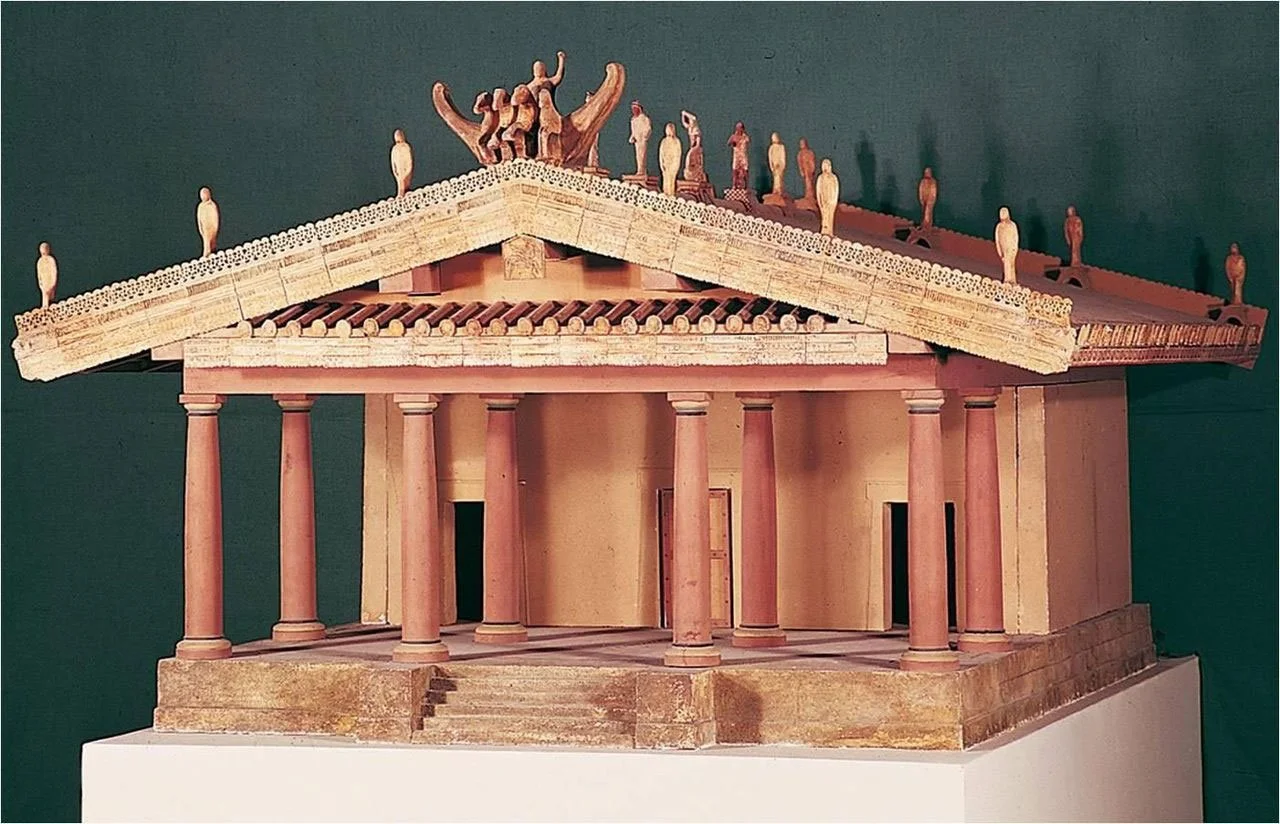
The Portonaccio Temple helps explain the frontal, podium-based character of Etruscan temple architecture.
Etruscan architecture survives in fragments, but those fragments are enough to tell a surprisingly clear story. The Etruscans built temples with deep porches and painted terracotta roofs, houses that helped shape later Italic domestic forms, fortified cities with walls and gates, and tombs that often preserve the best clues to how their buildings once looked. If Greek architecture often reaches us through marble monuments, Etruscan architecture reaches us through foundations, roofing systems, urban remains, and a great deal of careful reconstruction.
That uneven survival is part of what makes the subject interesting. Many Etruscan buildings were made with materials such as wood, mud brick, and terracotta, so far less survives above ground than in the Greek world. But this does not mean the architecture was simple or minor. It means we have to read it differently. We learn from temple podiums, carved tufa blocks, drainage works, city walls, tomb chambers, and architectural decoration. Once you know that, the field becomes much easier to understand.
Etruscan architecture looks fragmentary today because it was built in different materials from Greek architecture
Yes, material is the first key. One reason Etruscan buildings seem harder to picture than Greek ones is that they were often built with perishable materials, meaning materials that decay more easily over time. Wood, mud brick, and clay-based roofing elements do not survive in the same way as marble and cut stone. Stone was certainly used, especially for foundations, platforms, walls, and gates, but many of the visible upper parts of Etruscan buildings have been lost.
This matters because it can create the wrong impression. A beginner might assume that if less survives, the architecture must have been less developed. In fact, Etruscan architecture was highly organized and technically thoughtful. It simply depended on a different material logic. Roofs were often visually rich, loaded with painted terracotta revetments, antefixes, and sculptural figures. Temples were designed to be seen frontally, approached in a clear direction, and experienced through color as much as mass.
This is also why comparison with Greek architecture is useful. Greek and Etruscan building traditions were in contact, but they did not solve the same problems in the same way. Greek architecture often emphasizes stone permanence and exterior sculptural balance. Etruscan architecture often emphasizes frontal approach, roof display, and a stronger dialogue between timber construction and terracotta surface.
Etruscan temples were frontal, high-platform buildings with deep porches
This is the clearest architectural type to remember. An Etruscan temple was usually set on a high podium, meaning a raised platform, and approached mainly from the front. It often had a deep porch with columns and one or more inner rooms, called cellae, for the deity or deities worshipped there. That strong frontality is one of the most important differences from the better-known Greek temple.
Why does frontality matter? Because it shapes the whole experience of the building. Many Greek temples invite you to move around them and appreciate them from multiple sides. Etruscan temples tend to direct you much more strongly toward a frontal encounter. The stairs are usually concentrated on the front. The porch becomes a major threshold zone. The building does not present itself equally in every direction.
The Portonaccio Temple at Veii is one of the most important examples for reconstructing this type. Built in the late 6th century BCE, it helps us understand how Etruscan temples worked in plan, structure, and decoration. It had a deep columned porch, a rectangular layout, and spectacular roof sculpture. That roof sculpture matters because the temple was not only a mass of walls and columns. It was an animated, highly visible object, with painted terracottas making the upper zone of the building visually active.
This is where a comparison with the Greek temple becomes especially useful. A Greek temple is often taught through stone columns, peristyles, and ideal proportional order. An Etruscan temple is usually more axial, more podium-based, and more invested in the visual power of the roofline and porch. They belong to the same broad Mediterranean world, but they do not produce the same architectural effect.
Roofs were not secondary details. They were one of the most expressive parts of Etruscan architecture
Yes, the roof was a major visual event. Because the upper parts of Etruscan buildings often relied on timber construction and terracotta coverings, the roofline became a place for decoration, protection, and public display all at once. Painted plaques, terracotta moldings, antefixes, and sculptural figures gave temples a much richer and more colorful presence than the bare remains suggest today.
This is easy to underestimate because modern reconstructions and archaeological remains can make ancient architecture look dry and technical. In reality, Etruscan temples were strongly colored and highly crafted. Antefixes, which are upright decorative elements placed along the edge of the roof, could take the form of heads, mythological beings, or floral designs. Akroteria, sculptural figures placed on the roof ridge, added drama and visibility from a distance.
That means an Etruscan temple was never just a plan. It was also a silhouette against the sky. This is one reason terracotta mattered so much. Fired clay could be shaped, painted, and repeated across the roof in ways that made the building legible and impressive from afar. In Etruria, architecture and sculpture were deeply intertwined.
Houses are harder to reconstruct, but they tell us a great deal about daily life and later Roman design
Yes, domestic architecture is less well preserved than temples and tombs, but it still matters enormously. One of the earliest clues comes from hut urns, funerary urns shaped like houses. These give us indirect evidence for early domestic forms, including roof types and basic structural ideas. Later evidence, archaeological remains, and ancient traditions suggest that Etruscan houses developed into more organized rectilinear plans, and that the atrium house type later familiar in Roman domestic architecture may have strong Etruscan roots.
The atrium is the central interior space of a house, often open or partially open above, around which rooms are organized. In Roman architecture it becomes a defining feature of the domus, but many scholars trace the concept back to Etruscan domestic building. That does not mean every Roman house is simply an Etruscan house repeated. It means the domestic logic of central Italian architecture did not begin with Rome alone.
This is an important reminder that architecture is not only about temples and monuments. The Etruscans shaped ways of living indoors as well as ways of building sacred space. Houses organized family life, social hierarchy, storage, work, and reception. Even when the physical remains are sparse, domestic architecture helps us understand that Etruscan cities were not just ceremonial centers. They were lived environments.
Tombs also help here. Many Etruscan tomb chambers include carved or painted architectural details that imitate beams, doorways, ceilings, and furnishings. These are not exact copies of houses, but they preserve architectural memory. In a culture where tombs often mirror life, funerary space becomes one of the best archives of domestic form.
Walls and gates show that Etruscan cities were planned, fortified, and technically ambitious
This is one of the most concrete sides of Etruscan architecture. The Etruscans were builders of urban space, not only isolated monuments. Their cities often occupied defensible plateaus and were enclosed or defined by walls, gates, roads, and sacred precincts. In several places, stone fortifications and gate structures still survive well enough to make that urban ambition visible.
City gates are especially revealing because they combine engineering, defense, and civic identity. They were practical thresholds, but also symbolic entrances to the city. Built in carefully cut stone or tufa, some of these gates show how seriously the Etruscans treated masonry and urban form. A gate is never only a hole in a wall. It organizes arrival, control, and the visual statement of the city to outsiders.
This is also where the topic of the Etruscan arch enters. The older popular story often gives the Etruscans credit as if they simply invented the arch for Rome. The reality is more nuanced. Arches existed in other cultures before them, but the Etruscans played an important role in developing and transmitting the true arch in stone in Italy. Surviving Etruscan and late Etruscan gates show this clearly enough to make the tradition significant, even if the story should not be oversimplified into a single invention myth.
If you want to look at that question directly, Etruscan arch is the place to explore the form itself, because the gate and the arch are deeply linked in the Etruscan urban world.
The Etruscan arch matters, but it matters most as part of a larger building culture
Yes, the arch is important, but it makes the most sense when seen in context. What made the Etruscans architecturally influential was not one isolated structural trick. It was the combination of podium temples, deep porches, axial planning, roof terracottas, urban fortifications, gateways, and domestic forms that Rome later encountered and adapted.
That matters because Roman architecture is often told as a story that begins with Rome and then becomes grand through Greek borrowing. The Etruscans complicate that story in a productive way. They remind us that before Roman architecture became imperial, it was already shaped by Italic and Etruscan building traditions. The Roman temple type, especially in its early phases, owes a great deal to Etruscan precedent. So does the broader idea of a monumental urban gateway and certain domestic planning habits.
In other words, the Etruscans matter not because every Roman building is “really Etruscan,” but because they helped establish a built vocabulary that Rome later absorbed, expanded, and monumentalized.
Etruscan architecture influenced Rome most strongly through temple form, urban habit, and construction practice
This is where the legacy becomes clearest. The Romans inherited and transformed several key aspects of Etruscan architecture. The most obvious is the temple type: high podium, frontal emphasis, and deep porch. Early Roman temple architecture belongs to this Italic-Etruscan world before later Hellenizing trends reshape it more strongly.
Urban construction is another legacy. Drainage systems, sacred topography, city organization, and masonry traditions all mattered in early Rome. Even when the Romans later surpassed Etruscan models in scale and engineering ambition, they did not begin from nothing. They built on central Italian habits already in circulation.
Then there is the matter of symbolic architecture. Etruscan gates, sanctuaries, and monumental approaches helped establish the idea that architecture could project political order and civic identity. That is a major Roman concern too, and one reason the transition from Etruria to Rome is so important architecturally.
If you want the direct follow-through, Etruscan influence on Roman architecture is the natural continuation of this article, because it shows how these building habits survive, change, and become part of the Roman architectural tradition.
The best way to understand Etruscan architecture is to reconstruct a whole built environment, not just single monuments
Yes, this is the most useful mindset. Etruscan architecture is easiest to grasp when you stop expecting a landscape of isolated standing masterpieces and start imagining a whole city. Picture a fortified plateau settlement. There are gates cut through walls, roads and sacred zones, houses organized around domestic interiors, temples raised on podiums with deep porches, and roofs alive with painted terracotta figures. Nearby, there are tombs that preserve versions of architectural form under the ground.
Once you imagine that total environment, the fragments make much more sense. A roof plaque is not just a decorative shard. It belonged to a highly visible temple. A carved block from a gate is not just masonry. It belonged to a fortified urban threshold. A tomb chamber with beam-like carving is not just funerary decoration. It preserves memory of domestic or sacred architecture above ground.
That is why Etruscan architecture deserves to be seen as a full architectural culture. Its remains are incomplete, but its logic is not. It was urban, symbolic, technically capable, and deeply influential in the making of ancient Italy.

Conclusion
Etruscan architecture survives unevenly, but it is far from unknowable. Its temples were frontal, podium-based, and visually animated by terracotta roofs. Its houses shaped central Italian domestic traditions, probably including the roots of the atrium house. Its cities were fortified and articulated by walls and gates, and its use of the arch became an important part of the architectural story of Italy. Taken together, these forms show an architecture that was practical, expressive, and foundational to the world Rome would later inherit and transform.
FAQ
What is Etruscan architecture known for?
It is best known for podium temples with deep porches, painted terracotta roof decoration, fortified cities, monumental gates, and an important role in the early development of Roman architecture.
Why does so little Etruscan architecture survive?
Because many Etruscan buildings used wood, mud brick, and terracotta, which do not survive as well as marble and large stone construction.
What was distinctive about an Etruscan temple?
An Etruscan temple usually had a high podium, a strong frontal orientation, a deep porch, and rich terracotta decoration on the roof.
Did the Etruscans invent the arch?
Not in an absolute sense. Arches existed earlier elsewhere, but the Etruscans played an important role in developing and transmitting the true stone arch in Italy.
How did Etruscan architecture influence Rome?
It influenced Rome through temple design, domestic planning traditions such as the atrium concept, urban construction habits, and the wider architectural language of power and civic order.
Sources and Further Reading
Smarthistory — “Temple of Minerva and the sculpture of Apollo (Veii)” (2015)
The Metropolitan Museum of Art — “Italian Peninsula, 1000 B.C.–1 A.D. | Chronology” (n.d.)
Encyclopaedia Britannica — “Construction: Roman achievements” (2026)
Encyclopaedia Britannica — “Domus” (2026)
Encyclopaedia Britannica — “Western architecture: Iron Age cultures” (2026)
World History Encyclopedia — “Etruscan Architecture” (2017)
You may also like