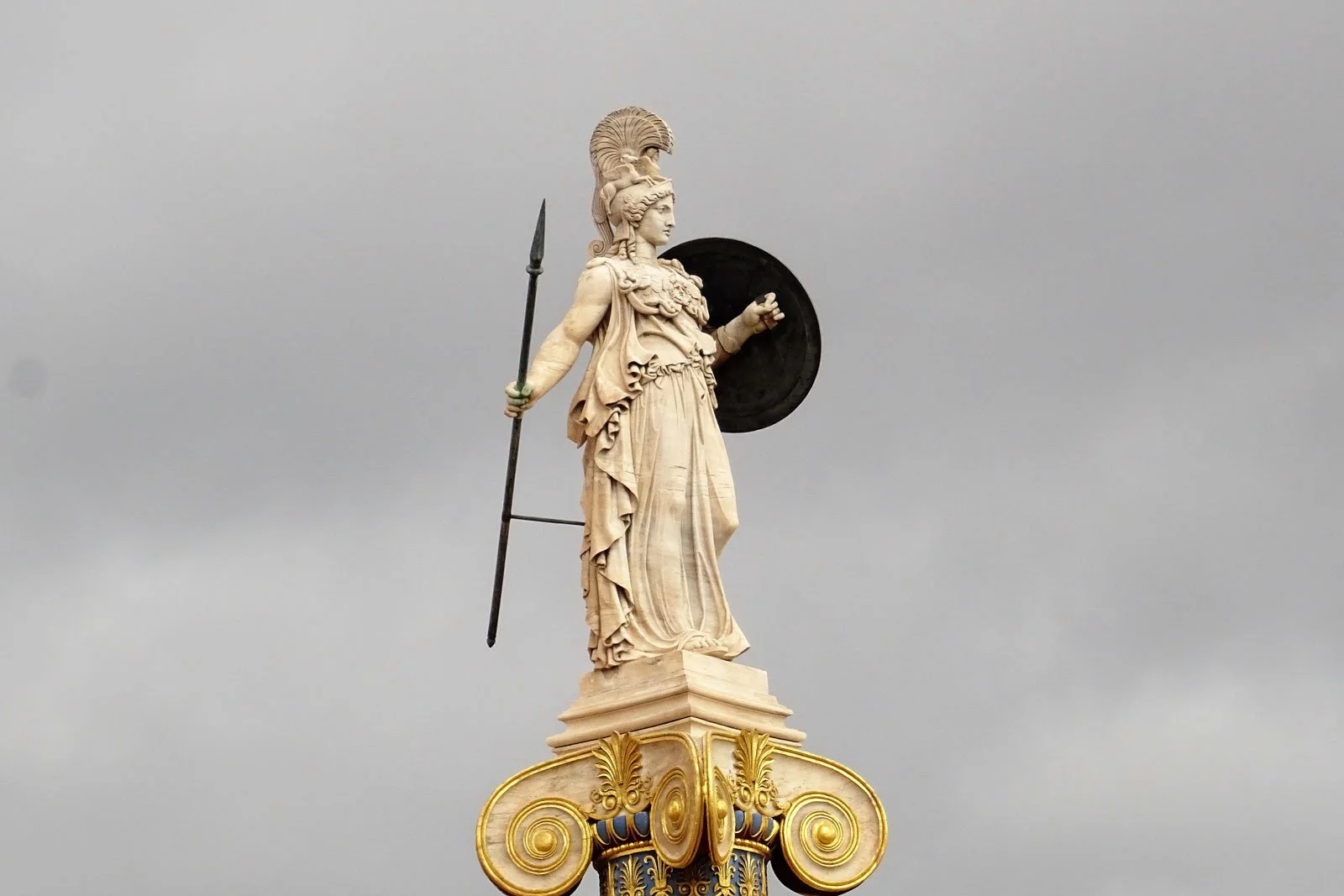
High above the street, Athena’s spear, shield and helmet announce that the city stands under her protection, mixing mythology, politics and image.
If you stripped away every label in a museum and left only the statues, coins and vases, how would you know when Athena walks into the room?
Luckily for us, the goddess comes with a symbol toolkit that artists used again and again: owl, olive tree, helmet, spear and the strange snakeskin cloak called the aegis. One glance at these, even in fragmentary form, and your brain goes “Athena” almost automatically. In this guide, we unpack that visual kit so you can spot her instantly across Greek god statues, coins, reliefs and painted pottery, and connect it back to what we know about ancient Greek religion and ancient Greek art.

Athena’s symbols work like a visual signature
Athena is one of the easiest Greek gods to recognise, because artists rarely show her “plain.” There is almost always some combination of helmet, spear, shield, owl, olive or aegis attached to her. These are not random accessories. They act like a visual signature that compresses her myths and powers into a few objects you can draw quickly on a vase or carve on a coin.
Think of her as sitting at the intersection of three roles:
Strategic war: unlike Ares’ chaotic violence, Athena embodies planned, disciplined warfare.
Wisdom and craft: she protects cities, law courts and artisans.
Civic identity: as patron of Athens, she stands for the community itself.
Each symbol leans more heavily on one of these roles. The helmet and spear shout “warrior.” The owl whispers “wisdom” and sharp perception. The olive tree anchors her to the city of Athens and its prosperity. The aegis, that magical goat-skin with a gorgon head, combines protection, fear and divine authority.
Once you tune into this, browsing museum collections becomes a kind of treasure hunt. You start to see Athena in corners: a tiny owl beside a profile on a coin, a helmeted head on a fragmentary relief, a shield edge with a gorgon face. The more you absorb the symbol set, the more confidently you can connect objects back to the goddess, even when the piece is broken or badly damaged.
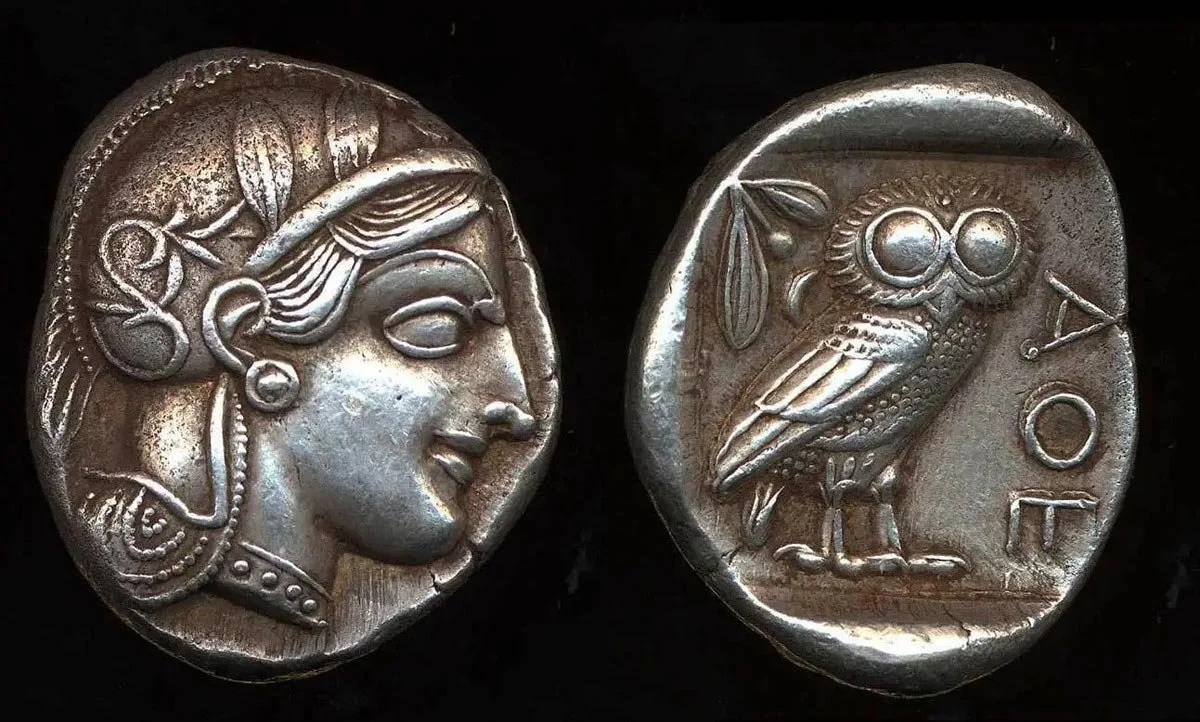
This famous Athenian tetradrachm pairs Athena’s sharp profile with her wide-eyed owl, turning divine symbols into everyday money.
Owls and olive trees root Athena in the city of Athens
Two of Athena’s most famous symbols, owl and olive tree, are not just random nature picks. They are tied directly to how Athenians told the story of their own city.
In one myth, Poseidon and Athena compete to become patron of the new city on the Acropolis. Poseidon strikes the rock with his trident and makes a saltwater spring. Athena plants an olive tree, useful for oil, wood and trade. The gods judge her gift more helpful, so the city becomes Athens, and the olive becomes a sign of her protection and of the city’s wealth.
The owl works on a different level. Owls see in the dark and turn their heads in uncanny ways, which made them a natural symbol for sharp vision and intelligence. On Athenian silver coins, Athena’s armored head appears on one side and a neat little owl on the other, usually with an olive sprig and the letters ΑΘΕ (“of the Athenians”). These “owl” tetradrachms became one of the most recognisable currencies of the ancient world, to the point that you could almost identify Athens by the bird alone.
So when you see an owl perched beside a female figure, or an olive branch near a helmeted head, you are not just being told “wisdom” and “peace.” You are being shown Athena as the city itself, guardian of its economy, ships and courts. That tight bond between goddess and polis explains why she appears everywhere in Athenian visual culture, from Greek paintings to small votive figurines.
Myth vs Fact
Myth: The owl is only a generic symbol of wisdom.
Fact: In Greek art, the owl is specifically tied to Athena and to Athens’ civic identity, especially on coins and shields.
Helmet, spear and aegis show her as a strategic warrior
If owl and olive are about knowledge and city life, helmet, spear and aegis are about how Athena operates in battle.
On vases, reliefs and cult statues, Athena usually wears a crested helmet pushed back on her head, leaving her face visible. It is not the fully closed, terrifying helmet of a front-line hoplite. It is a compromise between readiness and calm control. In one hand she often holds a spear, sometimes vertical like a staff, sometimes angled as if she is about to move forward. These elements tell you she is a warrior, but also someone who observes, plans and then strikes.
The aegis is more mysterious. Ancient writers describe it as a special protective goat-skin given by Zeus. In sculpture and painting, it often appears as a short fringed cloak or breastplate decorated with writhing snakes and a gorgoneion – the head of Medusa. Sometimes it spreads over her chest; sometimes it hangs from her shoulders. The combination of animal skin and monstrous face turns her into a walking boundary between order and chaos: she brings terror to enemies and safety to allies.
You can see this mix clearly in reconstructions of the Athena Parthenos, the colossal cult statue once inside the Parthenon. Descriptions and Roman copies show her standing, fully armed, wearing an aegis with gorgon and snakes, holding a spear and a shield, with a small winged Nike in her hand. Every part of her outfit tells you something: victory, protection, wisdom, and the ability to unleash controlled fear when needed. If our wider piece on Greek god statues looks at divine images in general, here the aegis is what really locks Athena into her specific role.
Spotting Athena across statues, vases and painted fragments
Once you know her symbols, Athena starts showing up everywhere in the Greek visual world. And that is where this article plugs back into other entries in your Greek cluster.
In sculpture, she appears in everything from small bronzes to major works. Archaic figures echo the vocabulary you have already met in Peplos Kore: rigid stance, patterned hair, archaic smile. Add a helmet, spear or aegis and a generic “young woman” becomes a specific goddess. On later Classical and Hellenistic pieces, her pose relaxes into gentle contrapposto, but the basic toolkit remains the same – helmet, spear, shield, sometimes an owl or serpent by her side.
On pottery, especially in black-figure and red-figure styles, Athena is a favourite character in myths of heroes and city life. If you read our guide to Greek black-figure pottery and Greek vases, you already know how painters rely on outlines and a few interior lines to build figures. That makes symbols even more crucial. A small owl in the field, a spear and shield, a sprig of olive near a lady in a long chiton – that is often all the painter needs to say “Athena is here.”
Even in the very rare ancient Greek paintings on walls or panels, where colour and shading play a bigger role, the same code applies. She can lose her helmet in some scenes, or be shown in more relaxed dress, but the artist usually drops at least one anchor: the aegis, an owl, or an olive.
What I find helpful is to treat every encounter with her symbols as a quick check-in with the larger system. How is this particular artist balancing warrior, wisdom and city? Is the owl tucked away like an inside joke, or placed boldly in the centre? Is the aegis soft, almost decorative, or full of wriggling snakes that still feel threatening? Those choices tell you as much about the artwork’s time and place as a date or inscription would.
Conclusion
Athena’s symbol set is one of the clearest examples of how Greek art builds a visual language from repeated signs. Owl, olive, helmet, spear and aegis are not decorative extras. Together, they tell you who she is, what she protects and why Athens cared so much about her.
Once you start reading those symbols, scenes on coins, vases, reliefs and statues rearrange themselves. A little bird on a silver tetradrachm suddenly stands for an entire city’s identity. A fringed goatskin with a gorgon becomes a portable storm of divine power. A simple sprig of olive near a figure on a pediment recalls the mythic contest that “founded” Athens.
From here, you can circle back into Greek god statues for a broader look at divine images, into ancient Greek religion for the rituals and festivals around Athena, or into ancient Greek art for the bigger timeline. The more these threads connect, the less intimidating the classical world feels, and the more it starts to read like a visual system you can actually learn.
Sources and Further Reading
University of Oxford, Classical Art Research Centre — “Athena (Roman Minerva)”
TheCollector — “Athena’s Symbols and Their Meanings: The Owl, Olive Tree, and Gorgoneion”
ThoughtCo — “What Are the Symbols of the Greek Goddess Athena?”
Cleveland Museum of Art — “Tetradrachm: Head of Athena (obverse); Owl (reverse)”
Museum of Fine Arts, Boston — “Statue of Athena Parthenos (the Virgin Goddess)”
You may also like