Etruscan Period Explained: Timeline, Phases and Key Dates
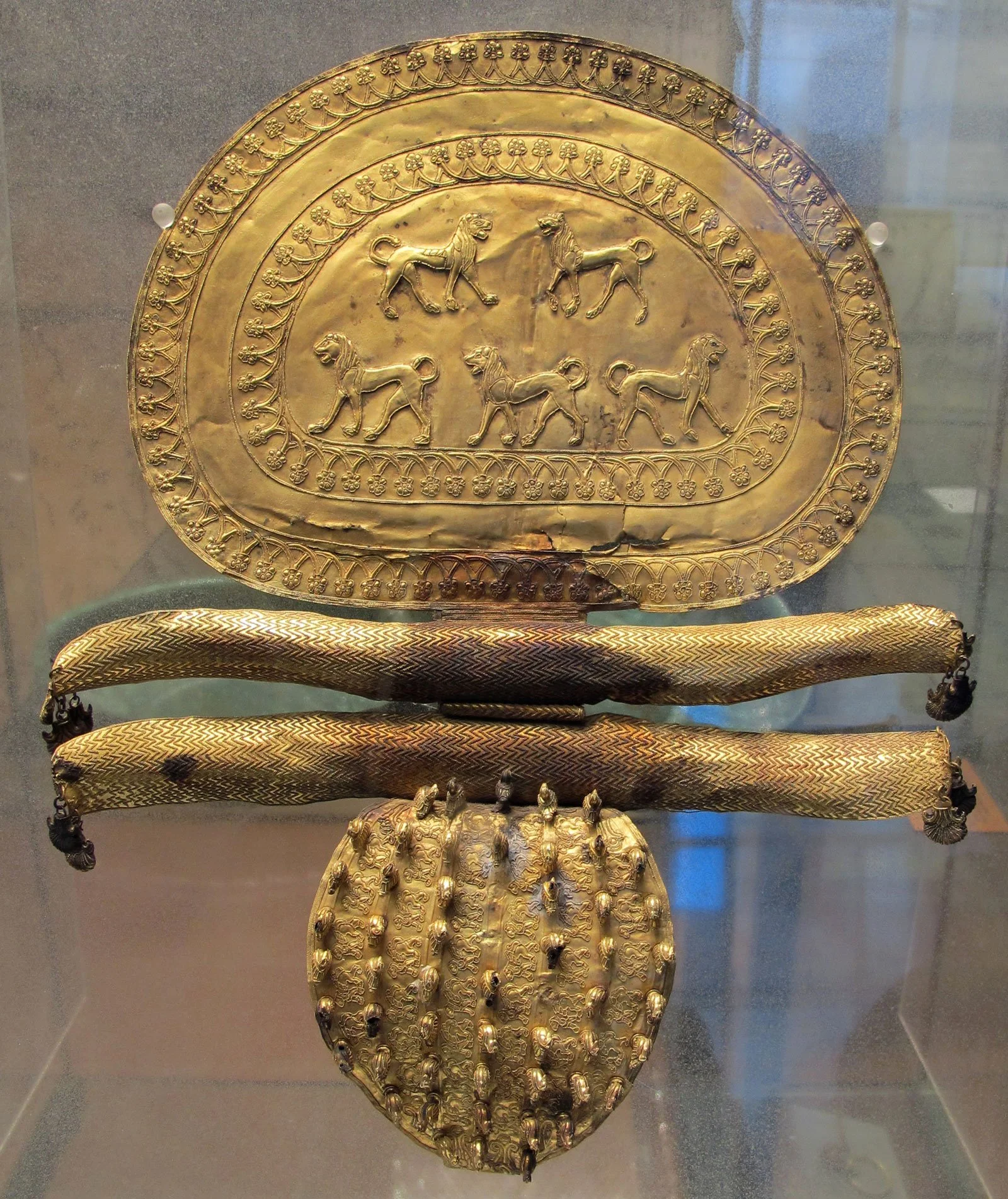
This gold fibula from the Regolini-Galassi Tomb captures the wealth and elite display of the Orientalizing period.
The Etruscan period is not one brief moment before Rome. It is a long arc that begins in the Iron Age, grows into one of the most powerful cultures in central Italy, and ends only gradually under Roman control. For most beginners, the confusing part is not the names alone. It is the fact that “Etruscan” can refer both to a people and to several different phases of development across many centuries.
The clearest way to understand the timeline is this: the story begins with Villanovan roots around the 9th century BCE, becomes clearly Etruscan by around the 8th to 7th centuries BCE, reaches major wealth and power in the 7th and 6th centuries BCE, then enters a long period of pressure, decline, adaptation, and Roman absorption from the 5th to the 3rd centuries BCE and beyond. That is the broad shape. Once you see that shape, the dates stop feeling random.
The Etruscan period is longer than most people expect
Yes, it is a long timeline. Depending on how a source defines the beginning, the Etruscan story can stretch from about 900 BCE to 90 BCE, with roots in the Villanovan culture and a distinct Etruscan identity visible by around 700 BCE. That already tells you something important: this is not a minor prelude. It is a civilization with deep foundations, internal phases, and a long afterlife even under Roman rule.
A lot of confusion comes from overlapping labels. Some timelines begin with Villanovan culture, the Iron Age culture from which the Etruscan world developed. Others start only when the culture becomes recognizably Etruscan in language, urban identity, and visual style. Both approaches are useful, as long as you know what is happening. The Villanovan phase is the root system. The Etruscan civilization is the larger tree that grows from it.
It also helps to remember where this takes place. The Etruscans came from Etruria, the region of central Italy that roughly overlaps with much of modern Tuscany and parts of Lazio and Umbria. If you want to picture that geography more clearly, anEtruscans map makes the timeline much easier to follow, because the rise of Etruscan power is closely tied to cities, trade routes, mineral resources, and contact with the wider Mediterranean.
The Villanovan phase is where the story begins
This is the starting point. The Villanovan phase, usually dated roughly from the 9th century BCE, belongs to the early Iron Age of central and northern Italy. It is named after a site near Bologna, but the culture was spread more widely. If you are asking where were the Etruscans from, this is the first serious answer: they emerged from communities already living in Italy, not from a blank beginning.
What does this early phase look like? It looks smaller, simpler, and less urban than later Etruscan culture, but the foundations are already there. Burials are especially important. Cremation was common, and ashes were placed in urns, sometimes even in hut urns, small containers shaped like houses. These are not charming oddities. They show us what early dwellings may have looked like and reveal how closely daily life and funerary ritual were linked.
This is also the phase in which scattered settlements begin to move toward something more organized. Over time, clusters of villages on hills start to coalesce into larger communities. In other words, the Villanovan world is not yet the fully urban Etruscan civilization, but it is already moving in that direction. That is why many historians treat it as the earliest phase of the same larger story.
If you want the fuller cultural picture behind the dates,who were the Etruscans is the bigger entry point. This article is about the timeline, but the timeline only makes sense when you see that these phases belong to a real society with cities, religion, trade, and art.
The Orientalizing period is when wealth changes everything
This is the first great turning point. The Orientalizing period, broadly the 7th century BCE, is when Etruscan society becomes dramatically richer, more connected, and more visibly elite. The name “Orientalizing” does not mean the Etruscans came from the East. It means their art and luxury culture show contact with eastern Mediterranean models, materials, and motifs.
Why does this period matter so much? Because this is when Etruria becomes a major player in Mediterranean exchange. The Etruscans traded metals and other resources, and in return they came into close contact with Greeks, Phoenicians, and other cultures. That contact brought not only goods but also styles, technologies, and new forms of display. Tombs become more elaborate. Goldwork, ivory, bronze vessels, and imported objects appear in richer burial contexts. Elite identity becomes more visibly staged.
This is also the phase when the gap between earlier, more modest funerary forms and later monumental burial becomes easy to see. A tomb is no longer just a place of disposal. It becomes a statement of rank, lineage, and wealth. That helps explain why Etruscan archaeology is so strongly shaped by cemeteries and grave goods. Burials preserve the moment when Etruscan society becomes more stratified, more outward-looking, and more visually ambitious.
If the Villanovan phase is the root system, the Orientalizing phase is the moment when the civilization suddenly expands in scale and confidence.
The Archaic period is the Etruscans at full strength
This is the high point. In broad terms, the Archaic period runs through the 6th century BCE and into the early 5th. This is when Etruscan cities are powerful, wealthy, and regionally dominant. Their influence extends well beyond the core of Etruria, reaching north into the Po Valley and south toward Campania. This is also the period most people picture when they think of the Etruscans at their strongest.
Urban life is central here. The Etruscans were not a loose rural culture. They were a civilization of city-states, with major centers such as Tarquinia, Cerveteri, Veii, Vulci, Chiusi, and others. Their sanctuaries, tombs, workshops, and political networks all reflect a mature urban world. This is also when Etruscan power is deeply entangled with early Rome. The traditional story of the Tarquin kings belongs to this wider moment of strong Etruscan influence in central Italy.
Artistically, this is one of the richest phases too. Temples, terracotta sculpture, painted tombs, bronze work, and ceramics all show a culture at full visual confidence. If you want to see what that looks like in objects and images,Etruscan art becomes essential here, because the art does not just decorate the timeline. It is one of the clearest ways the timeline becomes visible.
So when people ask when Etruscan civilization “really” begins, the most practical answer is this: its roots go back earlier, but by the Archaic period it is unmistakably one of the major cultures of ancient Italy.
The Classical and Hellenistic periods are a story of pressure, adaptation, and Roman conquest
This is where the timeline becomes more complicated. The Classical period, roughly the later 5th and 4th centuries BCE, is not simply a collapse, but it is no longer the age of maximum Etruscan expansion. External pressure increases. Greek competition affects Etruscan power at sea. Rome grows stronger. In the north, Celtic movements also reshape the political landscape. The result is not instant disappearance but a long weakening of Etruscan dominance.
One symbolic date often mentioned is 396 BCE, when Rome captured Veii after a long siege. That does not end the Etruscan world, but it does show that Rome is no longer a neighbor at the margins. It is becoming the decisive force. Over the 4th and 3rd centuries BCE, one Etruscan city after another comes under Roman pressure, treaty, defeat, or control.
This later phase is often called the Hellenistic period in Etruscan chronology, broadly the 3rd to 1st centuries BCE, and it overlaps with Roman conquest. That overlap matters. The Etruscans do not vanish in a single year. Their cities continue. Their art continues. Their language continues for a time. But political autonomy shrinks, and Roman hegemony becomes the frame within which Etruscan life now unfolds.
By the mid-3rd century BCE, Etruria is effectively under Roman dominance. By 90 BCE, when Roman citizenship is extended across Italy during the Social War era, the old independent civic identity of the Etruscan city-states is largely finished in political terms. Cultural traces continue longer, but the Etruscan period as a distinct historical era has effectively come to an end.
If you want to follow what survives from this process,Etruscan influence on Rome is the natural next step, because Roman Italy did not erase the Etruscans cleanly. It absorbed a great deal from them.
Why does the timeline matter? Because it changes how you see the Etruscans
It matters because the Etruscans were not static. They were not one style, one date, or one fixed identity. The timeline shows a civilization that grows from Iron Age communities into urban power, becomes wealthy through exchange, reaches a strong artistic and political peak, and then adapts under the pressure of larger forces.
That is why the phrase Etruscans history should never be reduced to “they came before Rome.” They did come before Roman domination, but they also shaped the world Rome inherited. Their cities, rituals, art, temple forms, and patterns of elite display were part of the cultural landscape from which Roman civilization emerged.
Once you understand the phases, the labels start to make sense. Villanovan is the root. Orientalizing is the moment of expansion and imported luxury. Archaic is the age of power. Classical and Hellenistic are the long centuries of transformation under pressure. That is the Etruscan period in a form that is actually readable.

Conclusion
The Etruscan period runs from Iron Age beginnings to Roman absorption, but the most useful way to remember it is as a sequence of changes, not just dates. First come Villanovan roots. Then wealth and Mediterranean contact reshape society in the Orientalizing period. Then the Etruscans reach their height in the Archaic age. After that, pressure from Rome and others turns the later centuries into a long story of survival, adaptation, and loss of independence. Once you see that pattern, the timeline stops feeling technical and starts feeling historical.
FAQ
When did the Etruscan period begin?
It depends on where you start the count. If you include Villanovan roots, it begins around the 9th century BCE. If you mean clearly identifiable Etruscan culture, many timelines begin around the 8th to 7th centuries BCE.
What are the main phases of the Etruscan period?
The most common sequence is Villanovan, Orientalizing, Archaic, Classical, and Hellenistic or Roman-conquest phase.
When were the Etruscans at their peak?
Their strongest period was broadly the 7th and especially the 6th century BCE, when Etruscan cities were wealthy and influential across much of central Italy.
When did the Etruscan period end?
Politically, Roman domination was largely in place by the mid-3rd century BCE, but Etruscan culture and language continued afterward. Many broad timelines end around 90 BCE.
Did the Etruscans disappear suddenly?
No. Their decline was gradual. Roman expansion, regional conflict, and changing power balances weakened their independence over several centuries.
Sources and Further Reading
The Metropolitan Museum of Art — “Etruscan Art” (2004) (The Metropolitan Museum of Art)
The Metropolitan Museum of Art — “Italian Peninsula, 1000 B.C.–1 A.D. | Chronology” (n.d.) (The Metropolitan Museum of Art)
Encyclopaedia Britannica — “Ancient Italic people: Etruscans, Latins, & Samnites” (2026) (Encyclopedia Britannica)
Smarthistory — “The Etruscans, an Introduction” (2015) (Smarthistory)
UNESCO World Heritage Centre — “Etruscan Necropolises of Cerveteri and Tarquinia” (2004) (Centro Patrimonio Mondiale dell'UNESCO)
You may also like