Etruscan Frescoes: Tomb Wall Paintings, Banquets and the Afterlife
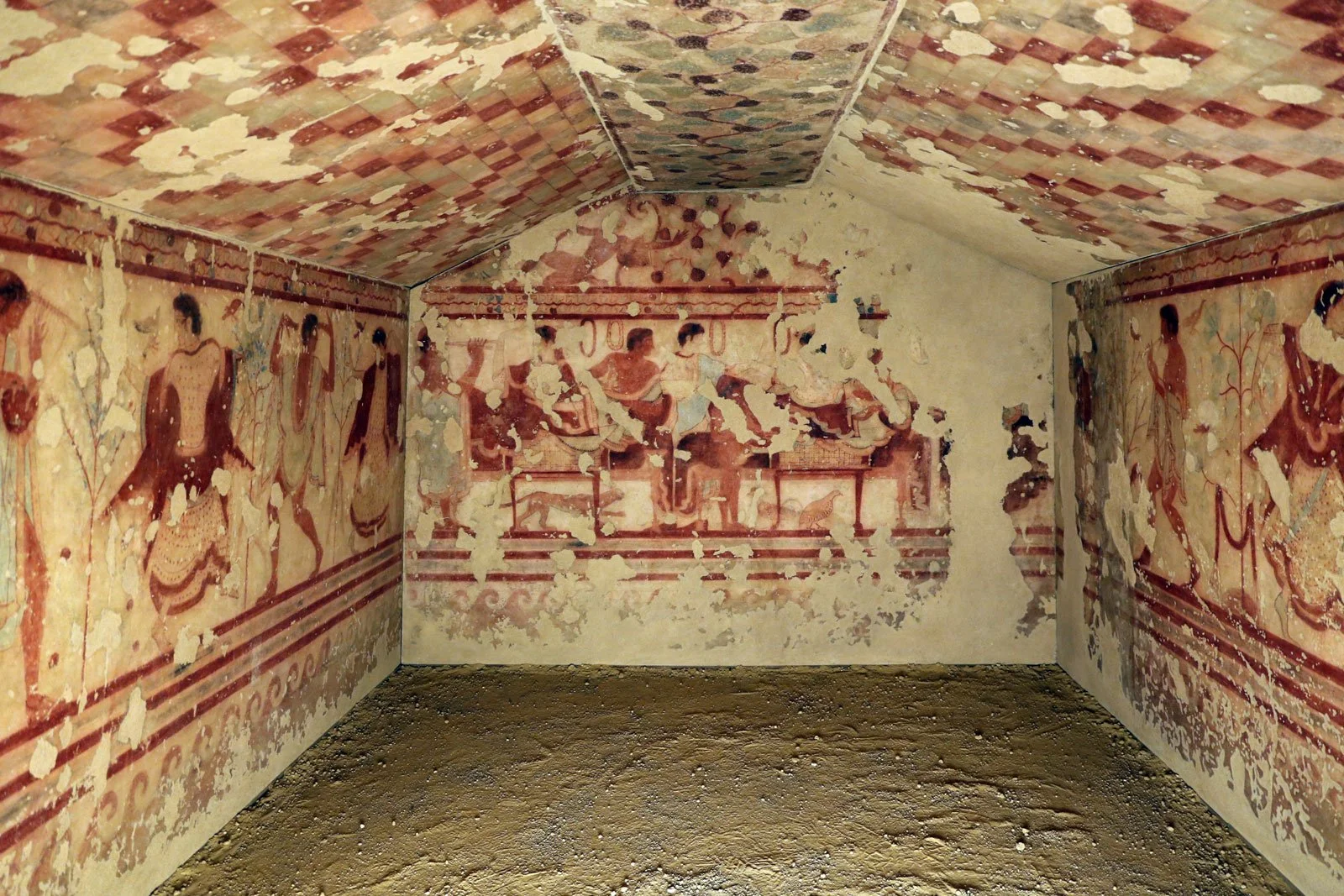
The Tomb of the Triclinium shows why Etruscan tomb painting feels so alive: the chamber is filled with movement, color, and social ritual.
Most ancient painting has disappeared. That is one reason Etruscan frescoes matter so much. They survive mainly in tombs, especially at Tarquinia, and they preserve a world of banquets, dancers, musicians, athletes, animals, rituals, and changing ideas about the afterlife. For a beginner, the simplest way to understand them is this: these wall paintings are one of the clearest surviving windows into how the Etruscans imagined life, memory, and death.
They are also more vivid than many people expect. Etruscan tomb painting is not usually solemn in the narrow sense. Much of it feels rhythmic, social, and full of movement. Figures stride, recline, play instruments, dive into water, or turn toward one another with sharp, readable gestures. That liveliness is exactly what makes these paintings so memorable. They are funerary, but they are also deeply about life.
Etruscan frescoes survive mainly in tombs, and that shapes everything about them
Yes, the tomb context is the first thing to understand. We do not have large surviving cycles of Etruscan painting from houses, public halls, or temples in the way we might wish. What survives best comes from burial chambers cut into rock and decorated on the interior. That means our picture of Etruscan wall paintings is inseparable from funerary culture.
This matters for two reasons. First, tombs protected the paintings from total disappearance. Second, the paintings were made for a very specific purpose: to accompany the dead, to stage memory, and to give visual form to beliefs about status, ritual, continuity, and the next world. That is why the painted scenes are not random decoration. They belong to a carefully shaped environment.
This also explains why Tarquinia is so central. The painted tombs of the Monterozzi necropolis preserve one of the richest bodies of pre-Roman wall painting anywhere in the Mediterranean. If you want the site-based view of this tradition, Necropolis of Tarquinia is the place where the broader story becomes physical and spatial.
For the larger visual context, Etruscan art helps show where these paintings sit within the wider world of sculpture, pottery, bronze work, and funerary objects.
Banquets are everywhere because they stand for status, memory, and the good life
Yes, one of the most recognizable themes in Etruscan painting is the banquet. Reclining figures, attendants, vessels, music, and festive settings appear again and again. At first glance, these scenes can look simply cheerful, as if the tomb were decorated with a party. But the banquet means more than pleasure alone.
In the Etruscan world, elite dining was a social ritual. It was tied to rank, family, hospitality, performance, and identity. When banquets appear in tomb paintings, they do not only show what people enjoyed in life. They also help carry that world into death. The tomb becomes a place where social presence continues. The dead are remembered not as absent remains, but as participants in a meaningful, ordered world.
That is why banquet scenes often feel unusually immediate. The figures are not frozen in detached poses. They recline, turn, gesture, and interact. The image invites us to imagine the sound of music, the rhythm of conversation, and the structure of a shared meal. This is one of the reasons Etruscan funerary painting can feel more intimate than many later monumental traditions.
If you want to follow that funerary dimension more closely, Etruscan funerary art is the natural companion article, because tomb painting makes the most sense when read alongside urns, sarcophagi, grave goods, and burial architecture.
These paintings feel alive because color, outline, and gesture do so much work
Yes, their visual language is a huge part of their power. Etruscan wall paintings often rely on strong contour, flat but vivid color, clear silhouettes, and sharply readable movement. They are not trying to create illusionistic depth in the later Roman sense. Instead, they make the wall active through rhythm, pattern, and placement.
This is why the figures remain so memorable. A dancer bends with elastic energy. A musician turns in profile. A bird, fish, or animal cuts across the painted field with quick clarity. Bodies are often simplified, but not dull. The simplification makes them legible and dynamic. The paintings are easy to read from a distance, which is exactly what mural decoration in a tomb chamber needs.
Color matters just as much. Reds, blacks, blues, yellows, and whites organize the scene and give it emotional force. Even when the palette is limited, the effect is strong. The paintings remind us that ancient art was not a colorless world of bare stone. It was a world in which surface and hue played a major role.
Because so much Greek monumental painting has been lost, Etruscan tomb painting also helps us imagine what ancient wall painting could do more broadly. The comparison is not exact, but it is useful. If you want that wider Mediterranean frame, Greek paintings can help place Etruscan murals beside another tradition that survives only in fragments.
Not all Etruscan frescoes mean the same thing, because ideas about death changed over time
No, the paintings are not all expressing one simple message. Early and Archaic tomb paintings often emphasize banquets, dancing, hunting, games, and scenes that feel socially confident and outward-looking. Later tomb imagery can become darker, more mythological, and more explicit about the dangers and uncertainties of the underworld.
That shift matters. It shows that Etruscan beliefs about death were not fixed. Over time, the visual language of the afterlife became more complex and sometimes more troubling. Figures connected to the underworld begin to appear more often. The tomb no longer functions only as a continuation of elite life. It can also become a place where transition, judgment, or supernatural forces feel more present.
This development makes Etruscan painting historically rich. It is not just beautiful evidence. It is evidence of change. By looking at different tombs across different centuries, we can see shifts in mood, ritual emphasis, and cultural contact. That is one reason the paintings are so valuable for art history and for the history of belief.
So when someone asks what Etruscan fresco paintings show, the answer is not just “banquets.” They show a civilization thinking visually about memory, prestige, ritual, pleasure, and death across time.
The best way to read these paintings is to see them as rooms, not isolated images
Yes, this changes everything. Modern books and museum displays often show Etruscan tomb paintings as cropped images: one dancer, one banquet wall, one detail of birds or fish. That is useful, but it can make us forget that the paintings were designed as part of an interior space.
A tomb chamber is an environment. The walls, ceiling, architectural framing, painted figures, and burial setting all work together. A row of dancers does not just decorate a flat panel. It activates the chamber. A banquet scene does not just illustrate a meal. It reshapes the atmosphere of the room. The tomb becomes a place of encounter between the living and the dead.
This is why Etruscan wall painting feels so spatial even when it is not illusionistic in the Roman way. It is not trying to open a false window onto another world. It is transforming the chamber you are actually in. That makes the experience more immediate and more ritualized.
Once you start reading the paintings this way, their logic becomes much clearer. They are not loose images gathered from daily life. They are carefully chosen scenes placed in a funerary room to guide memory and meaning.

Conclusion
Etruscan frescoes matter because they preserve something ancient art rarely gives us in such quantity: painted rooms that still speak with color, movement, and human presence. Surviving mainly in tombs, they show banquets, music, ritual, sport, animals, and changing visions of the afterlife. They are funerary, but they are never only about death. They are about how a civilization wanted life, memory, and identity to continue beyond the grave. That is why these wall paintings still feel so immediate.
FAQ
Where do most Etruscan frescoes survive?
Mostly in tombs, especially in the necropolis of Tarquinia.
What do Etruscan wall paintings usually show?
Common subjects include banquets, dancers, musicians, athletes, hunting scenes, animals, and later underworld imagery.
Why are banquets so common in Etruscan tomb painting?
Because banquets expressed elite life, social identity, and the idea that meaningful forms of life could continue in the afterlife.
Are Etruscan frescoes really frescoes in the strict technical sense?
The term is widely used, but ancient wall-painting techniques can be more varied than the simplified label suggests. In practice, “Etruscan frescoes” is the common name for these painted tomb walls.
Why are Etruscan frescoes important for art history?
Because so little ancient wall painting survives, these tomb paintings are one of the richest sources for understanding pre-Roman painting in the Mediterranean.
Sources and Further Reading
Smarthistory — “Tomb of the Triclinium” (2015)
UNESCO World Heritage Centre — “Etruscan Necropolises of Cerveteri and Tarquinia” (2004)
UNESCO World Heritage Centre — “Cerveteri and Tarquinia (Italy) No 1158” (2003)
Encyclopaedia Britannica — “Etruscan art” (2026)
Encyclopaedia Britannica — “Tomb of the Augurs” (2026)
The Metropolitan Museum of Art — “Etruscan Art in The Metropolitan Museum of Art” (2023)
You may also like