Athena Parthenos: What We Know About the Lost Colossal Statue
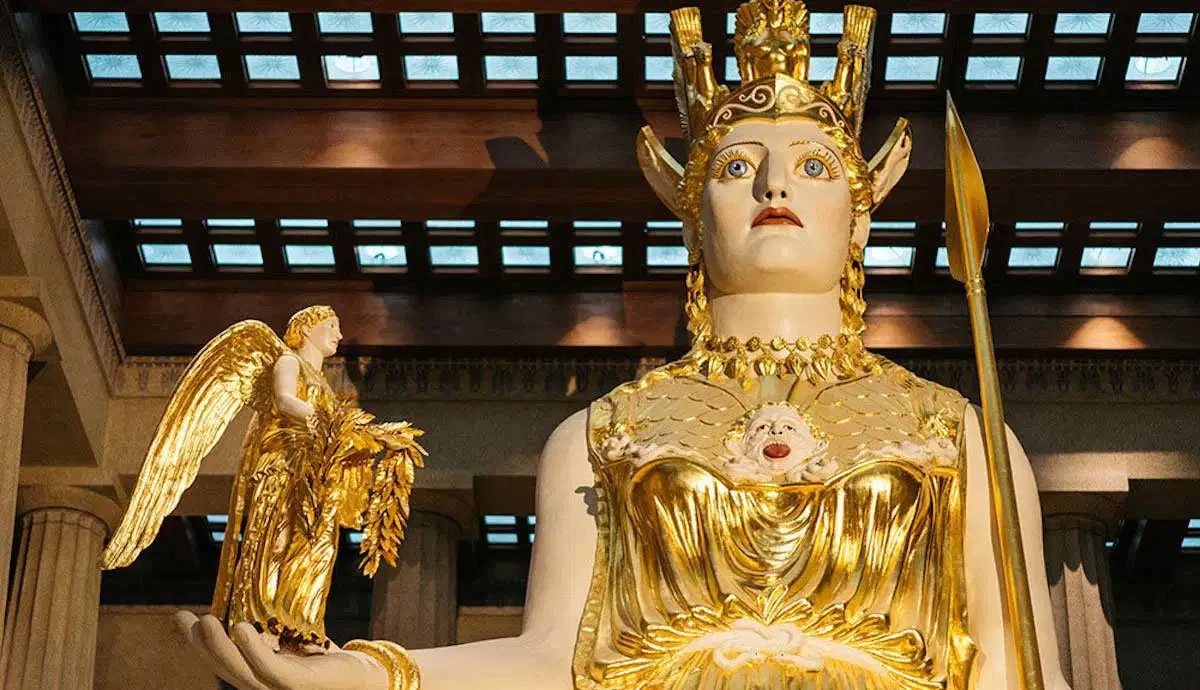
Athena Parthenos was a colossal cult statue that showed the goddess as armed, radiant, and victorious.
Athena Parthenos is one of the strangest “famous artworks” in history, because we can’t actually go see it. The original is gone. What survives is a trail of clues: ancient descriptions, financial records, and smaller copies that act like souvenirs of something enormous.
And yet, Athena Parthenos still sits at the center of the Parthenon story. If we want to understand the temple’s meaning, we have to imagine what stood inside it: a towering, armored Athena, shining with gold, staring out from the dim interior like a designed presence rather than a decorative object.
This article is our reconstruction guide. We’ll sort the evidence by strength, rebuild the statue’s likely appearance, and explain why it mattered so much to Athens, not just religiously, but civically. If you want the wider context first, keep why Athena matters here nearby as the “big message” lens.
Definition: Chryselephantine means gold-and-ivory over a core.
We know about Athena Parthenos through three evidence layers, not one lucky source
The statue isn’t guesswork. It’s a puzzle with different kinds of pieces.
The first layer is text. Ancient authors describe what visitors saw and what the statue signified. These accounts are valuable, but they’re also filtered through time, memory, and rhetorical style. They tend to give us big features, not technical drawings.
The second layer is copies and echoes. Roman-era replicas, smaller statuettes, and related images preserve the statue’s type: the stance, the costume elements, the objects she held. But copies can simplify, add supports, or adapt details to new materials, especially when translating a gold-and-ivory original into marble.
The third layer is the most underappreciated and, in many ways, the most solid: records. Inscriptions tied to the statue’s construction give us hard information about oversight, accounting, and the fact that the project was controlled and audited. That record-keeping alone tells us Athena Parthenos was a state-scale undertaking, not just an artist’s vision.
When we hold these layers together, we get a more reliable reconstruction than any single source could provide.
This layered method also keeps us honest about what we can say confidently versus what should stay “best guess.” If you’ve ever felt uneasy about overly confident reconstructions, this is the reason: the evidence has different weights, and we should treat it that way.
And one more thing: Athena Parthenos was part of a designed environment. The inside statue and the outside imagery weren’t separate worlds. They were one system, which is why the whole program belongs in the background of every “Athena Parthenos” conversation.
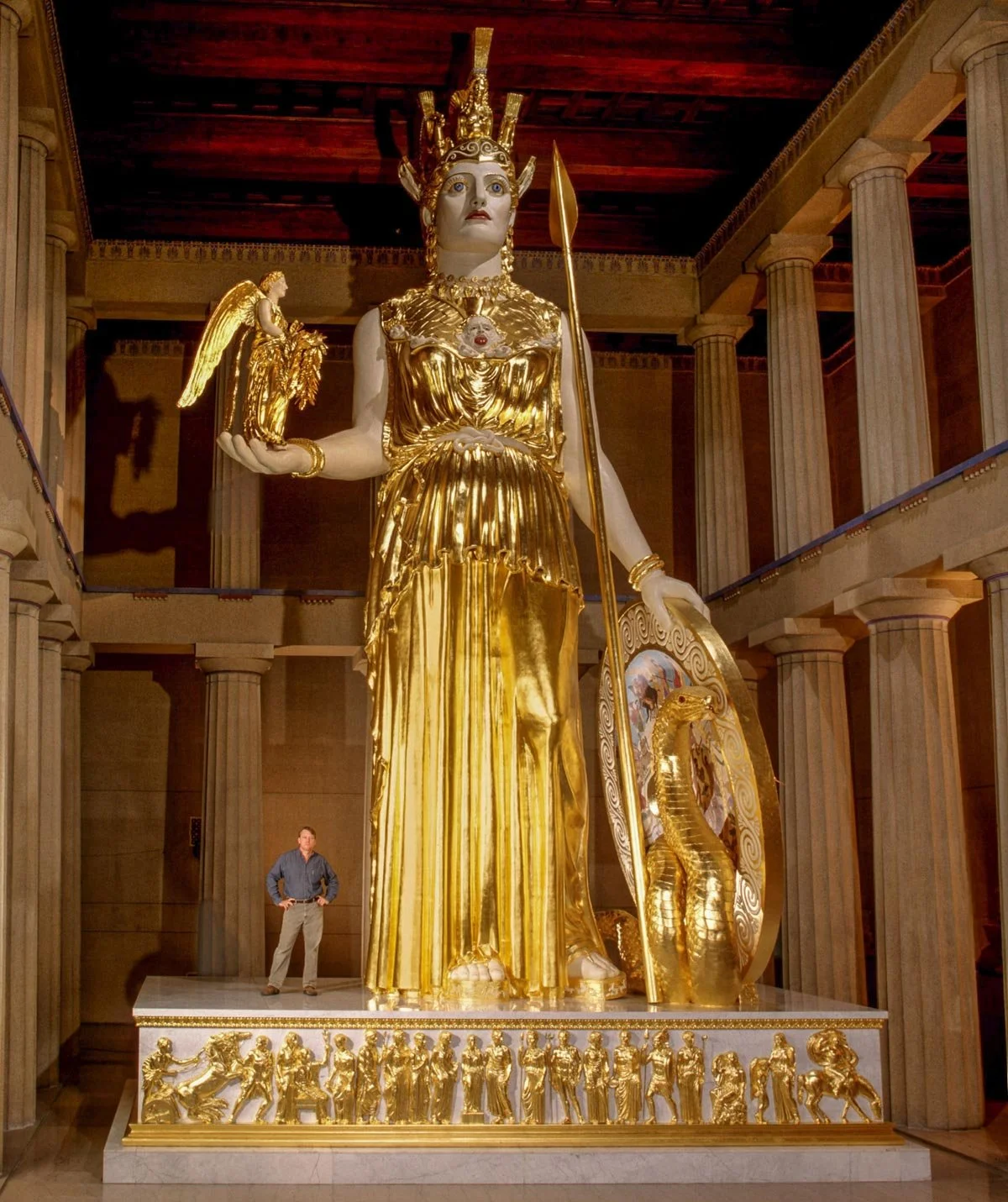
This reconstruction gives a sense of the statue’s huge scale inside the Parthenon.
The materials were the message, because the statue doubled as sacred presence and treasure
Athena Parthenos wasn’t “a big statue.” It was a high-tech object in ancient terms.
Chryselephantine construction means the visible surfaces were precious: ivory for flesh, gold for armor and garments, assembled over an internal structure. That does two things at once.
First, it produces an almost unreal visual effect. Imagine torchlight or reflected daylight catching gold surfaces. Imagine ivory skin glowing softly rather than reading like stone. This is not the experience we associate with white museum marble.
Second, it makes the statue a literal reserve of value. Gold is not just symbolic. It’s portable wealth.
This is why Athena Parthenos sits inside the Parthenon meaning story so powerfully. The statue isn’t merely a focus of devotion. It’s also a statement about what Athens can command, display, and protect. That’s the “state project” energy behind why Athena matters here.
The inscriptions and administrative attention strengthen that reading. Athens treated the statue as something that required transparency and control, not just admiration. Even if we keep our tone gentle, the implication is hard to miss: Athena Parthenos was a sacred image and a civic asset at the same time.
If this feels like an uncomfortable overlap, it’s worth remembering that Greek religion and civic life were deeply intertwined. The temple was not a private spiritual retreat. It was public religion, public wealth, public identity, all layered into one place.
And that brings us to the statue’s appearance, because the iconography is where the message becomes visible.
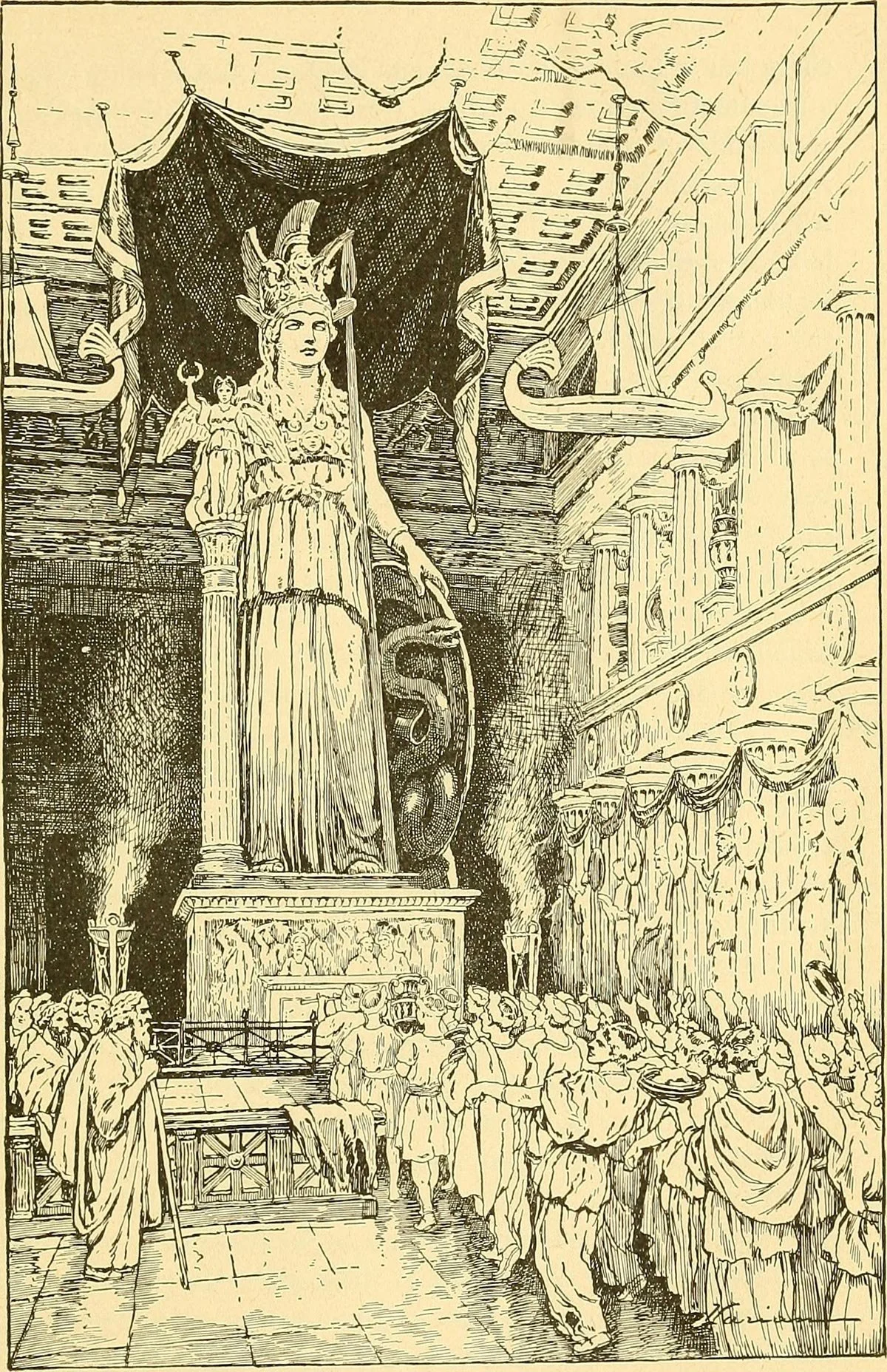
Older reconstructions help us imagine how overwhelming the statue must have looked in the cella.
The statue’s iconography was Athena condensed into one readable “identity”
If we had one minute to identify Athena Parthenos, we’d look for her kit.
Athena is recognizable because she carries repeated signs. An attribute is a repeated symbol that identifies a deity. Athena’s set includes armor, protection, and city guardianship. If you want the full pattern language, Athena’s symbols is the clearest beginner guide.
Athena Parthenos, as reconstructed from texts and copies, is usually described as:
armored and helmeted, not soft or domestic
wearing the aegis (protective mantle), often with a Gorgon head at the chest
holding a small Nike figure (Nike = personified victory) in one hand
holding a shield and spear on the other side
accompanied by a sacred snake, linked to Athenian mythology and guardianship
Even without getting lost in details, you can feel the logic. This is not “Athena in general.” This is Athena as the city’s power and protector, made monumentally visible.
And then there’s the narrative layer. The shield decoration, for example, was not an innocent pattern. Myth battles like Amazonomachies are cultural metaphors. They often encode “order vs. chaos,” “civilization vs. threat,” and they slot Athens into the role of defender.
This is why the statue doesn’t stand alone as an interior marvel. It rhymes with the temple’s exterior storytelling, especially the civic and mythic themes we read when we’re reading the frieze outside.
So the iconography does what the Parthenon does in general: it takes religion, civic identity, and political confidence, and it compresses them into a form that can be recognized quickly.
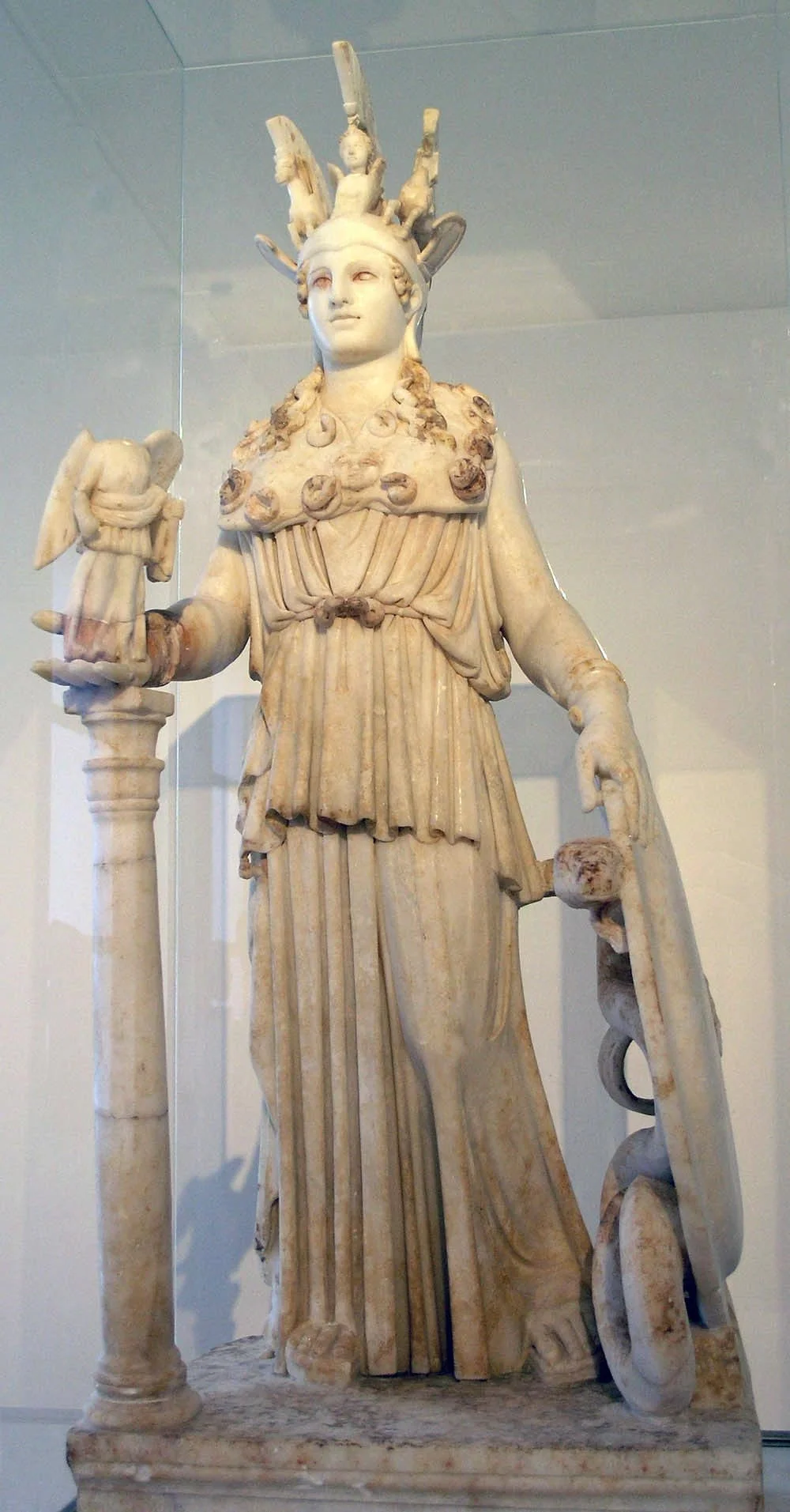
The Varvakeion Athena is one of the most important small copies for reconstructing the lost original.
The copies are our lifeline, but they also teach us humility
Here’s the paradox: we rely on copies to see Athena Parthenos at all, but copies are not the same thing as the original.
A Roman marble replica has different needs than a gold-and-ivory colossus. Marble may require supports. Details can be simplified. Certain elements may be emphasized because they look good in stone rather than because they were central in the original.
So when we say “we know what Athena Parthenos looked like,” what we really mean is: we can reconstruct a strong probable type, with some details that remain debated.
A good example is the support question. Some replicas show a supporting column under the hand that held Nike. That could be a copyist’s solution to marble physics rather than a feature of the original. So we keep it as “possible,” not “certain.”
There’s also the color problem. Many people picture Athena Parthenos as white because we’ve been trained by museums. But even marble statues were often painted, and chryselephantine statues were literally built out of contrasting materials. This is why ‘white marble’ is a myth is not a side topic here. It’s central. Athena Parthenos was never meant to read as monochrome.
So the copies give us form, yes. But they also remind us what we lost: the sheen, the material contrast, the interior lighting experience, the scale pressure of standing in front of something that nearly fills a room.
In a way, Athena Parthenos is the perfect lesson in how we study antiquity. We reconstruct from fragments. We triangulate. We get closer, but we never fully “recover.”

Conclusion
Athena Parthenos is lost, but not unknowable. We can reconstruct her through layered evidence: ancient descriptions, surviving copies, and the hard reality of inscriptions and oversight. What emerges is a statue that was not only devotional, but civic and symbolic, a gold-and-ivory embodiment of Athens’ relationship with its patron goddess and its own public identity.
And once we see that, the Parthenon changes shape in our minds. It becomes easier to understand why Athena matters here, how the exterior images form the whole program, and why the interior centerpiece had to be overwhelming, not merely beautiful.
FAQ
What was Athena Parthenos?
A colossal chryselephantine statue of Athena that stood inside the Parthenon.
Who made Athena Parthenos?
The project is traditionally attributed to Pheidias and his workshop, working within a state-controlled building program.
How do we know what it looked like if it’s lost?
Through ancient written descriptions, Roman copies and replicas, and inscriptions tied to its construction and oversight.
Why was it made of gold and ivory?
Because the materials created an overwhelming divine presence and signaled civic wealth and authority.
Was it really “white” like marble statues today?
No. The original used gold and ivory, and Greek sculpture culture also involved color, so the monochrome look is a modern filter.
Sources and Further Reading
Acropolis Museum — “The lost statue of Athena Parthenos” (2019)
Acropolis Museum — “Athena Parthenos: The inscriptions” (2020)
Encyclopaedia Britannica — “Athena Parthenos” (2026)
American School of Classical Studies at Athens (Hesperia) — “The Composition of the Amazonomachy on the Shield of Athena Parthenos” (1966)
Hurwit, Jeffrey M. — “Beautiful Evil: Pandora and the Athena Parthenos” (1995)
van Rookhuijzen, Jan Zacharias (American Journal of Archaeology) — “The Parthenon Treasury on the Acropolis of Athens” (2020)
You may also like