Greek Statue 101: 6 Visual Clues for Classical Style
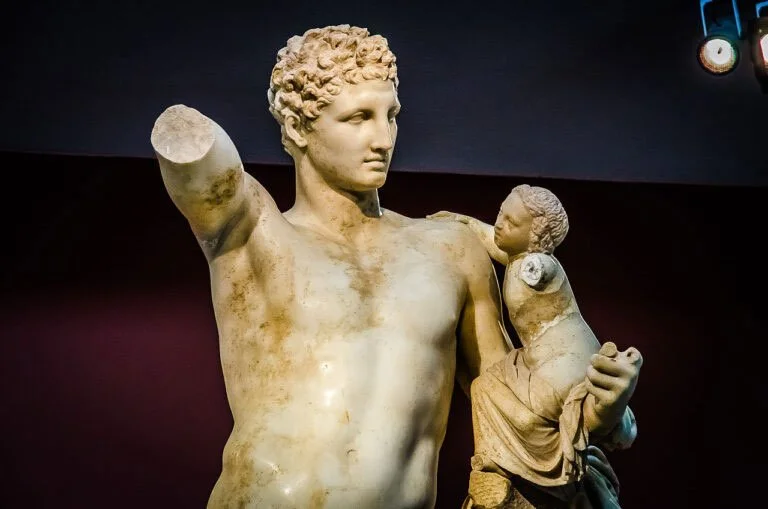
This is one of those rare moments where a “god statue” feels almost human: the adult’s calm posture meets the child’s small, lively gesture. Look at how bodies communicate without dramatic faces—just stance, touch, and weight.
You’re in a museum. You’re standing in front of a nude marble guy (again). The label says “Greek, Classical.” And your brain goes: Okay, but what am I supposed to be seeing?
Here’s the good news: you don’t need to memorize a hundred names to get started. Classical Greek statues have a very specific visual logic, and once you learn a few cues, the style becomes surprisingly easy to spot. We’re going to walk through six of them, the same way you’d scan a figure in real life: stance first, then structure, then surface, then materials.
To make the “before” feeling real, keep in the back of your mindan Archaic kouros as the ‘before’. Classical style is, in many ways, a direct answer to that earlier stiffness. And if you want the bigger framework behind all this, it helps to knowwhat makes Classical sculpture different.
A Classical Greek statue stands like it has weight
If a statue looks like it could actually shift its weight and not fall, you’re already close. Classical sculptors became obsessed with how bodies distribute mass. They stopped treating the figure as a front-facing sign and started treating it as a living structure under gravity.
The big visual giveaway is what we often call the contrapposto shift. Contrapposto means “counter-pose,” basically: weight on one leg, body subtly tilts. One hip rises. The shoulders respond. The spine starts to curve. Even if the statue is standing still, the pose implies a moment in time, like the figure just paused mid-step.
If you compare that to the straight-on, evenly loaded stance of an Archaic kouros as the ‘before’, the change feels almost emotional. The body stops performing “statue,” and starts performing “human.”
Definition: Contrapposto is a standing pose with shifted weight.
Classical bodies look balanced, not perfectly symmetrical
Here’s a sneaky one: Classical statues rarely aim for mirror symmetry. Instead, they aim for balance. The figure is “even” overall, but not identical on both sides.
This is why classical art can feel so calm. A body with weight on one leg should look slightly asymmetrical. The genius move is that Greek sculptors make that asymmetry feel stable. The relaxed leg doesn’t look lazy. The bent arm doesn’t feel random. Everything still adds up to a clear, controlled whole.
Once you start noticing this, you’ll see it everywhere in what ‘Classical’ looks like. The point isn’t realism as “copying.” It’s realism as editing. Nature, but cleaned up into something legible.
A quick museum test: look at the silhouette. If the outline has gentle variation (one side more open, the other more compact) but still reads as composed, you’re probably in Classical territory.
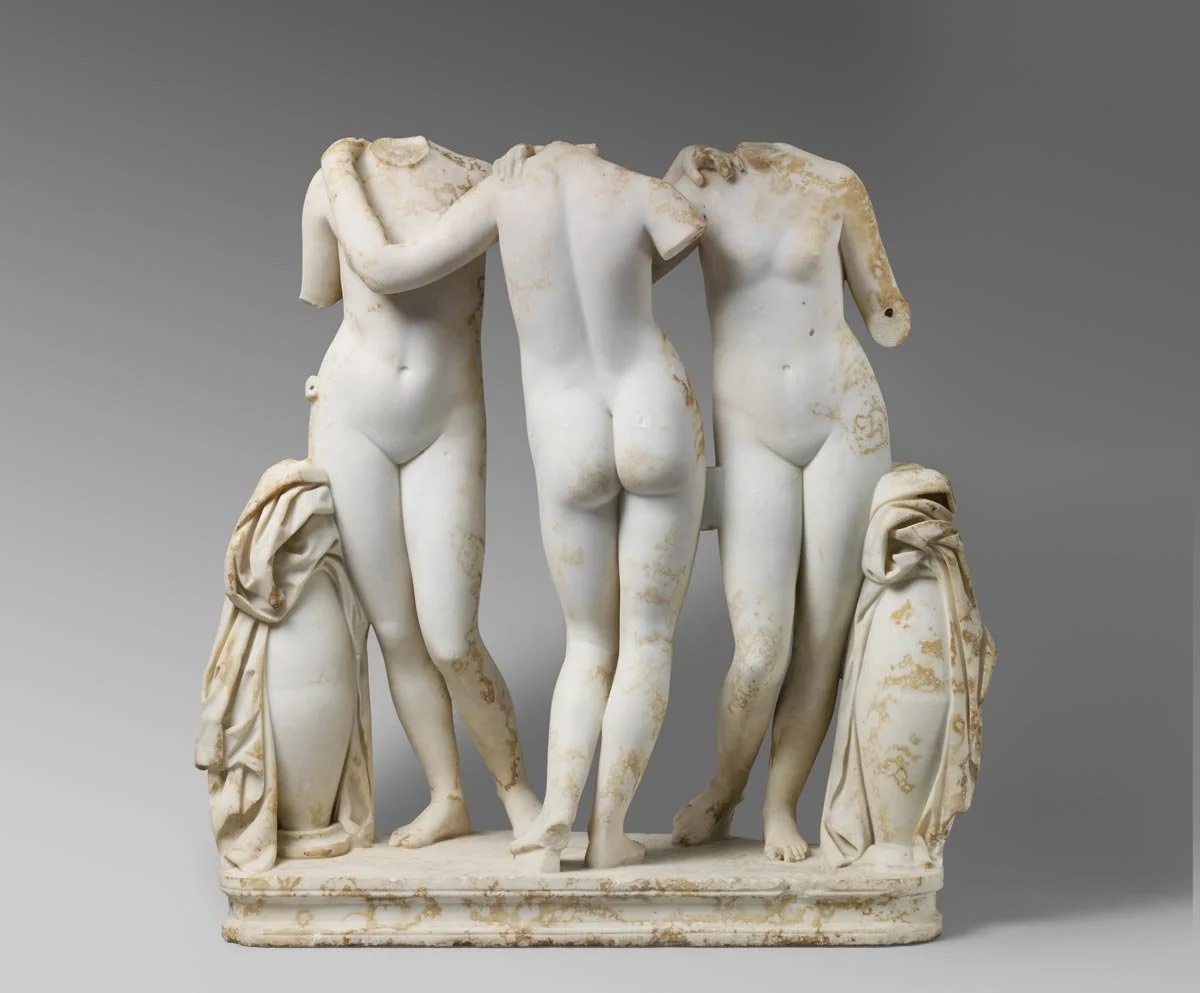
Group sculptures teach a different skill: instead of reading one body, you read relationships—how arms connect, how weight shifts ripple from figure to figure, how symmetry becomes a kind of choreography.
Proportion is a rule system, not a guess
Classical Greek sculptors didn’t just “eyeball” bodies. Many worked with a proportion system: a set of relationships between parts that makes the whole figure feel unified. The famous term here is canon of proportions, basically: a consistent ratio-based body plan.
The poster child is Polykleitos’ Doryphoros, the statue that became a kind of proportion manifesto. Even if you’ve never seen it in person, its logic shows up in countless “Classical-looking” figures: head-to-body relationships that feel intentional, limbs that look harmonized, torsos that don’t stretch or squash in odd ways.
You don’t need exact math to use this clue. Just look for the feeling of measured consistency:
The head doesn’t look too big for the torso.
The limbs feel scaled to the chest and hips.
The body reads as one coherent “design,” not a stack of parts.
That coherence is one reason classical statues feel “perfect” even when they’re depicting effort, like athletes or warriors. The effort lives inside an organized system.
Anatomy looks like it responds to movement
This is the point where Classical sculpture starts to feel almost unfairly good. Muscles aren’t drawn as decorative shapes. They look like they’re doing jobs.
In earlier styles, you can get “muscle badges,” lines that announce strength. In Classical work, muscle transitions often soften, and details become conditional: they appear because the pose requires them. A bent knee changes the tension in the thigh. A turned head subtly activates the neck. A relaxed arm doesn’t keep the same crisp definition as a flexed one.
This is why the stance clue matters so much. Once the weight shifts, the sculptor has to solve the whole chain reaction. When it’s done well, the statue feels alive not because it’s moving, but because it could.
If you want a mental timeline for this shift, it’s useful to place Classical calm against earlier experiments in Ancient Greek sculpture: from Archaic smiles to Classical calm. You can almost watch artists learning how to translate a living body into stone.
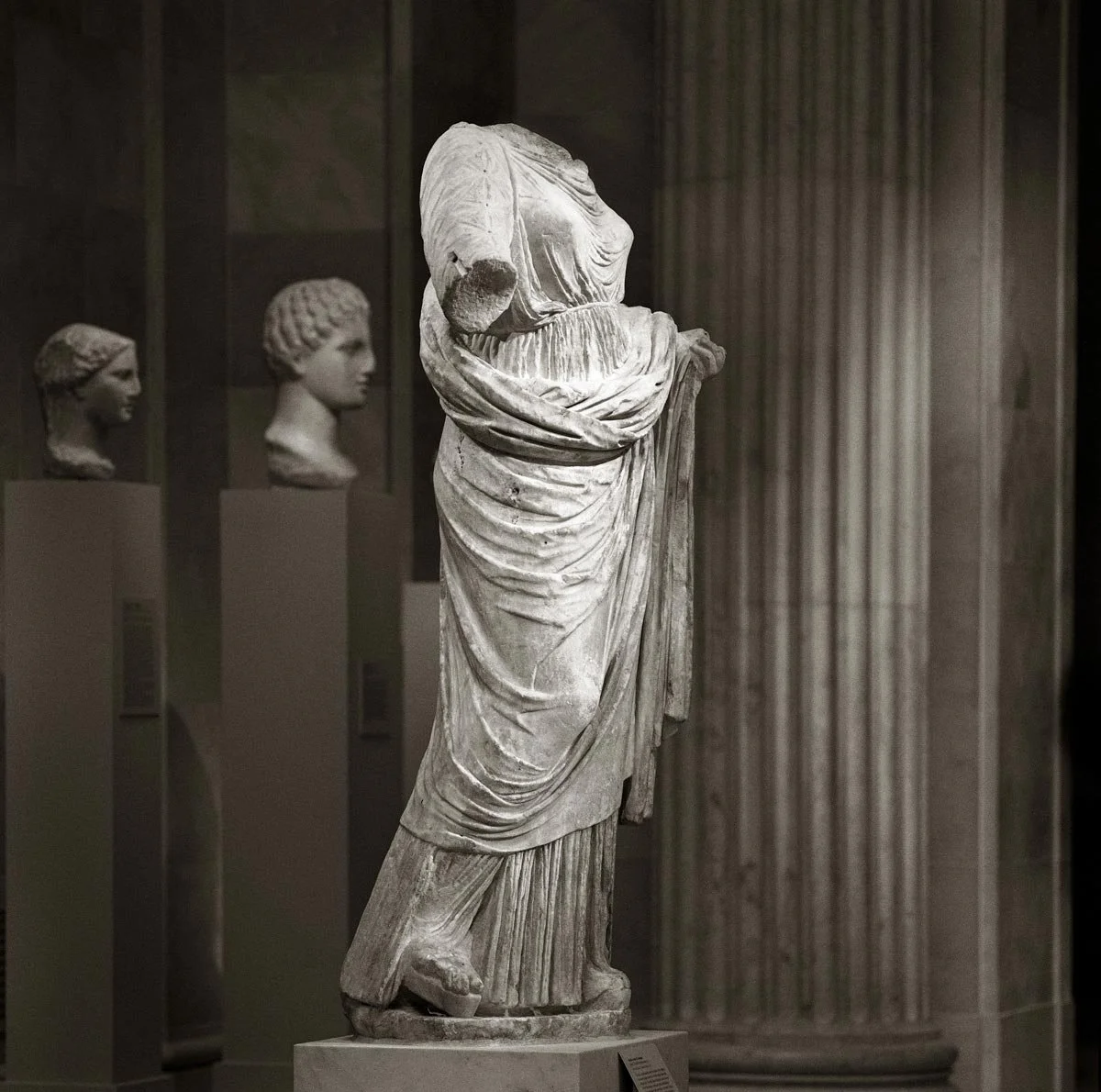
Greek drapery isn’t just clothing—it’s a way of sculpting movement. Follow the folds like rivers: they show where fabric is pulled tight, where it hangs heavy, and where the body pushes through.
Faces get quieter, and that’s on purpose
One of the quickest “spot it” clues is the face. Classical faces tend to look controlled. The expression is often neutral, even when the body is active.
This is a style choice, not a lack of skill. A calm face helps the figure read as ideal, timeless, and self-possessed. It also reduces distraction. You’re meant to focus on proportion, stance, and overall harmony. That vibe is part of why classical art becomes a defining visual language for the Classical Period timeline and its cultural self-image.
So if you’re torn between “Is this late Archaic or Classical?” check the mouth and eyes. If you sense the older “smile as a pattern,” you might still be in pre-Classical territory. If the face feels emotionally restrained, Classical is a strong bet.
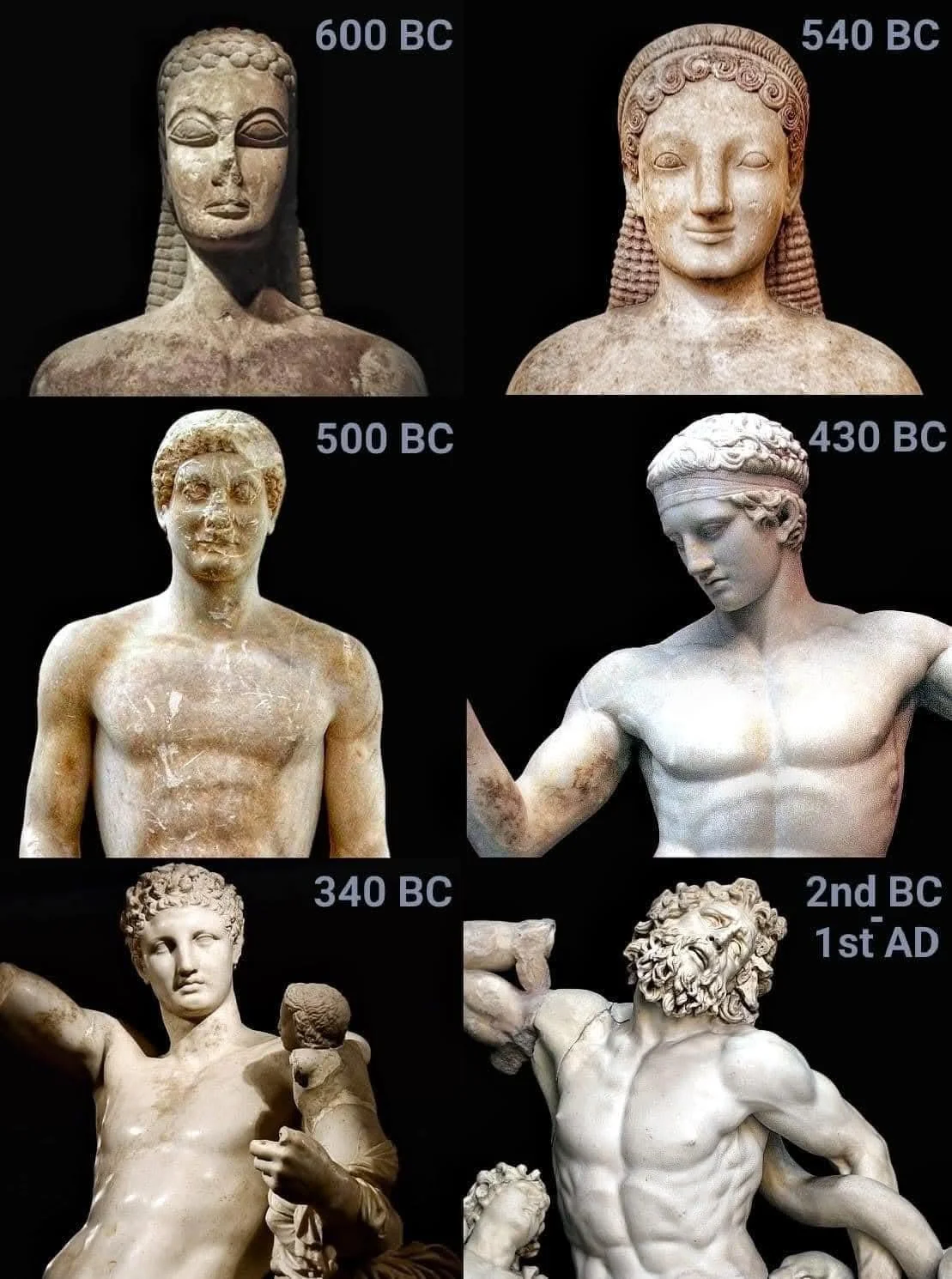
Side-by-side comparisons are the fastest way to learn style: rigid symmetry loosens into contrapposto, faces lose the “Archaic smile,” and bodies begin to look like they breathe. It’s not “better,” just a shifting set of choices.
Materials and finishing details were part of the illusion
Most of us learn Greek statues as “white marble masterpieces,” but that’s not the full story. Classical sculptors used material and finish strategically to push lifelikeness.
Start with the basic fork: bronze vs marble. Bronze can hold thinner forms, sharper edges, and more daring extensions. It also supports details that scream “alive,” like inlaid eyes and separately worked lashes. Marble has its own strengths, especially in light-catching surfaces and drapery, but it’s more limited structurally.
Then there’s the thing that surprises almost everyone the first time: Greek statues in color. Many sculptures were painted, and even when the paint is mostly gone today, the original viewing experience included color cues that sharpened forms, added contrast, and made features readable from a distance.
This matters for identification because Classical style isn’t just pose and anatomy. It’s a whole package of choices designed to make the body feel convincing and ideal at the same time. When you notice tool marks, polish zones, drilled hair, or remnants of pigment, you’re seeing the “finished product” mindset, not just carved stone.
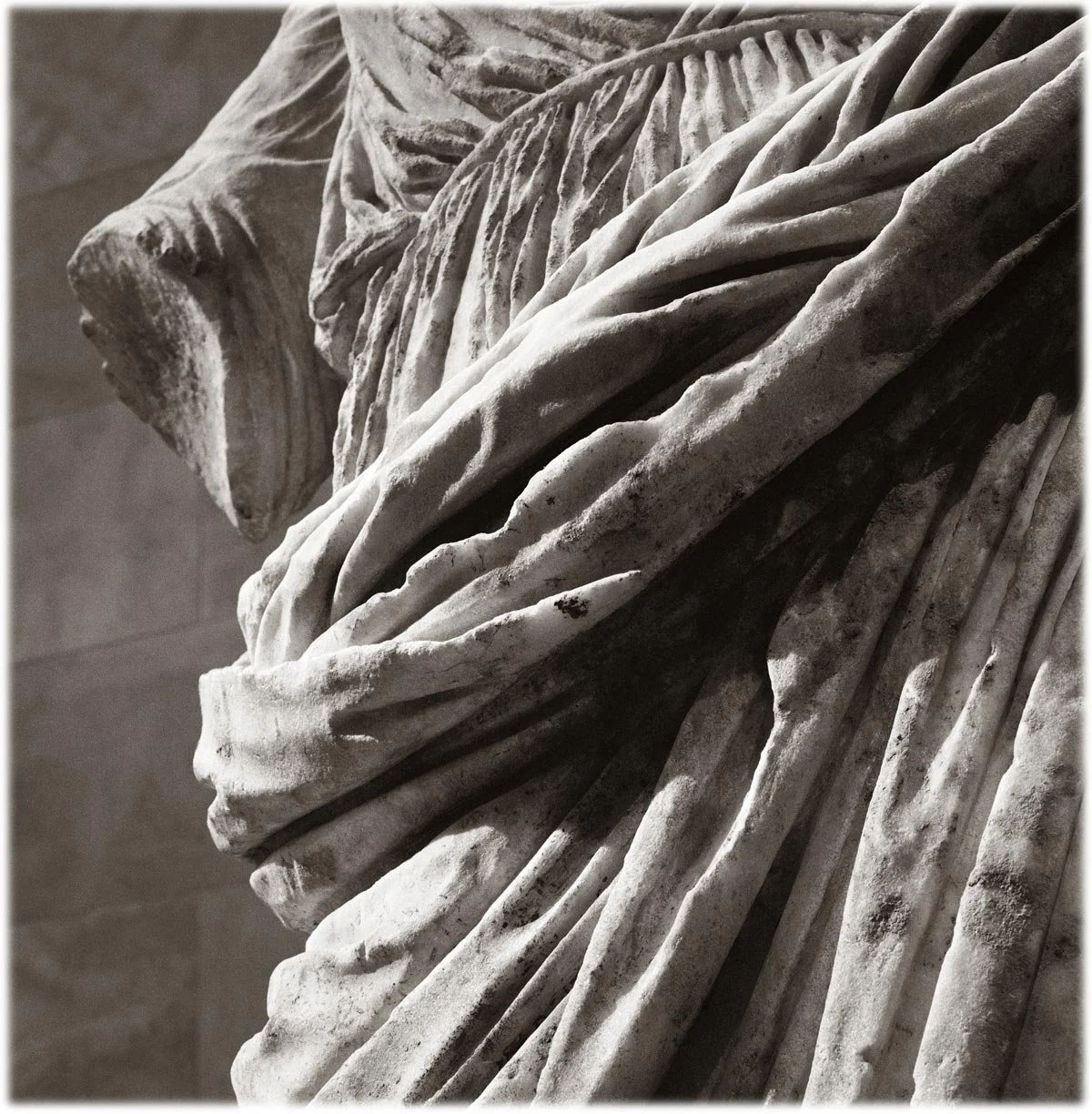
Zooming in is where the craft becomes obvious: some folds are carved crisp like edges, others soften into rounded valleys. This push-pull is how stone can start to feel like cloth.
Conclusion
Once you know what to look for, the Classical look stops being a vague “museum label” and becomes a set of readable decisions: weight, balance, proportion, responsive anatomy, quiet expression, and material strategy. And the best part is that these clues work even when a statue is damaged or fragmentary. A missing head can still have Classical hips. A broken arm can still preserve the logic of a pose.
If you want, next time you’re in front of a Greek figure, try this: don’t start with the face. Start with the feet. Ask where the weight is, and let the rest of the body answer. That tiny habit turns “I don’t get it” into “Oh, I see what they’re doing.”
FAQ
How can I tell if a Greek statue is Classical in five seconds?
Look for a believable weight shift, especially a relaxed leg with the hips subtly tilting.
Does contrapposto automatically mean “Classical”?
It’s a strong clue, but you still want proportion, anatomy, and expression to support it.
Were Classical Greek statues really white?
Many were painted, and even “white” marble statues often had added color details.
Why do so many Classical statues look so calm?
A restrained expression reinforces the ideal, timeless mood of the Classical style.
Sources and Further Reading
The Metropolitan Museum of Art — “The Art of Classical Greece (ca. 480–323 B.C.)” (2008)
The Metropolitan Museum of Art — “The Technique of Bronze Statuary in Ancient Greece” (2003)
Smarthistory — “Polykleitos, Doryphoros (Spear-Bearer)” (n.d.)
Acropolis Museum — “Archaic Colours” (n.d.)
Basso, Elena; Carò, Federico; Abramitis, Dorothy H. — “Polychromy in Ancient Greek Sculpture: New Scientific Research on an Attic Funerary Stele at the Metropolitan Museum of Art” (2023)
Deutsches Archäologisches Institut — “A Bronze Foundry of Classical Times in the Sanctuary at Kalapodi” (2025)
Liebieghaus Skulpturensammlung — “Gods in Color: Golden Edition” (n.d.)

You may also like