Ancient Greek Sculpture: From Archaic Smiles to Classical Calm
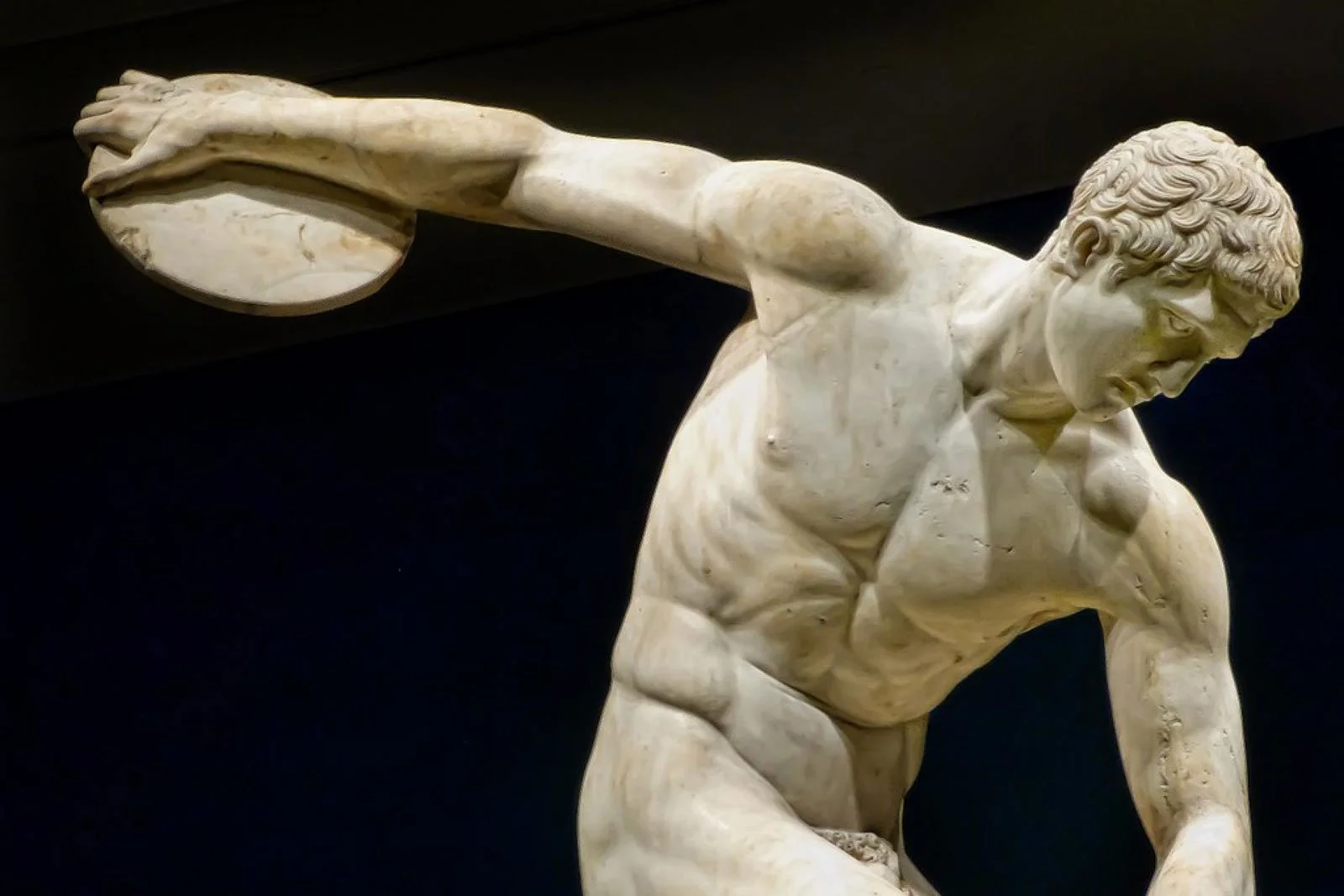
The Discobolus freezes an ideal classical body in motion, balancing athletic power with mathematical harmony.
Stand in front of an early Greek statue and it can feel like you are being stared down by a very determined mannequin. The body is straight, the fists are clenched, one leg steps forward, and the mouth curls into that famous fixed grin. Walk a few rooms further and suddenly statues are leaning, twisting, resting their weight on one leg, breathing almost quietly. Same culture, same marble, completely different feeling.
This article is about that transformation. We will follow ancient Greek sculpture from stiff, frontal figures with archaic smiles to the calm balance of Classical masterpieces and the more emotional works that follow. Along the way, we will connect what you see in museums to the bigger map of ancient Greek art and zoom in on a few key statues that act like checkpoints.
Ancient Greek sculpture is the three-dimensional art of Greek-speaking communities from roughly 700 to 30 BCE, including freestanding statues and architectural reliefs in stone, bronze and other materials.

Greek Sculpture Periods Form a Slow Relaxing of the Body
A useful way to approach Greek sculpture is to think of it as a timeline of poses. Over time, bodies slowly relax, turn and start to occupy space more naturally.
At the start, in the Archaic period, sculptors carve kouroi and korai: standing youths and maidens that we unpack in detail in our guide to Archaic Greek sculpture. Kouroi are nude, front-facing, left leg advanced, arms tight to the sides. Korai are clothed, often holding offerings, with elaborate hair and patterned garments. Both types share the same basic formula: symmetry, frontality and an overall rectangular feel.
By the early Classical period, around the fifth century BCE, that formula begins to loosen. Sculptors introduce contrapposto, a pose where the weight shifts onto one leg while the other relaxes. The hips and shoulders respond with a gentle counter-tilt. A statue like the Doryphoros (Spear Bearer), although known through later Roman copies, is the textbook example. The body still looks idealized and controlled, but it finally behaves like a body we recognise from real life. This is where classical Greek sculpture gets its reputation for calm, balanced naturalism.
Later, in the Hellenistic period, artists keep the anatomical knowledge of Classical sculpture but allow themselves more drama. Bodies twist more violently, muscles strain, drapery whips around, faces show fear or effort more openly. Even quiet works, like portraits of older people or children, explore types that Classical sculptors rarely touched.
The crucial thing is that none of these periods erase the previous one. Archaic geometry lingers in Classical compositions; Classical balance underpins Hellenistic experiments. If you keep that continuity in mind, the progression from archaic smiles to Classical calm feels less like a sudden jump and more like a careful, centuries-long drawing lesson in three dimensions.
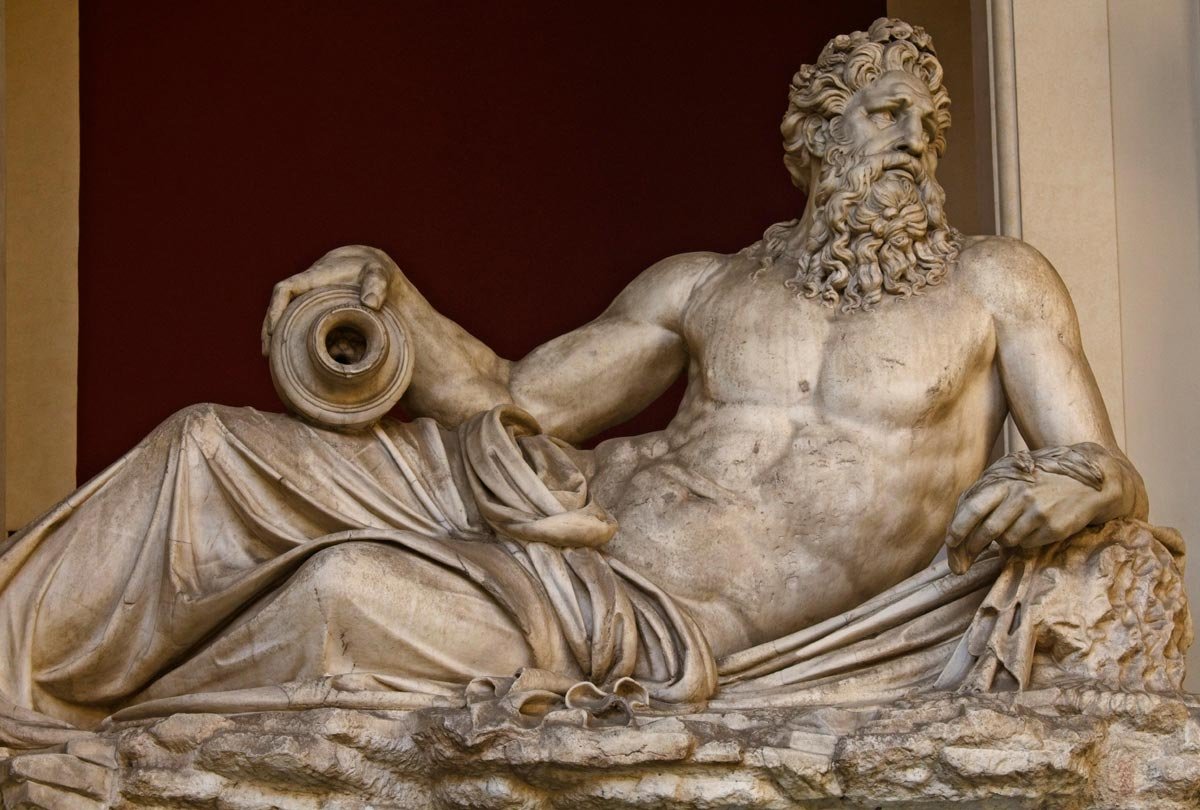
Reclining river god leans on one arm, muscular body relaxed yet monumental, water jar in hand hinting at his life-giving stream.
From Kouroi and Korai to the First Natural Bodies
The best way to feel the early stages of this story is to stand in front of a kouros and a kore and really look. These statues are the labs where Greek sculptors practice turning geometry into flesh.
A kouros statue is a standing nude youth, often used as a grave marker or a dedication in a sanctuary. Early examples are almost diagrammatic: sharp knees, triangular torsos, rigid arms. If you want a focused walkthrough of the type, our explainer on the kouros statue breaks the main features down. A particularly important late example, the Anavysos Kouros, shows how far sculptors have come by the late Archaic period. The chest swells, the thighs look capable of bearing weight, the transition from ribs to belly feels more organic. Yet the overall pose is still frontal and formulaic.
Korai are their clothed counterparts: standing maidens draped in layered garments, often richly painted. The famous Peplos Kore, for instance, wears a thick, belted garment and once carried bright colours and metal jewellery. Here the sculptor uses folds and edges of fabric to suggest the body underneath. The geometry of the pose remains strict, but the surface becomes a playground of light, shade and pattern.
Both types share one detail that almost everyone notices: the archaic smile. This slight upward curve of the lips appears on many Archaic faces, regardless of subject. It likely signals a state of life and favour rather than a specific mood. Technically, it lets sculptors model cheeks and mouths in a way that catches light and gives volume. We dive into interpretations of this expression in our focused article on archaic smile sculptures.
What matters here is that kouroi and korai sit exactly at the point where ancient Greek sculpture moves from rigid pattern to embodied presence. When you compare an early kouros with the Anavysos example, or an early kore with the Peplos Kore, you can almost watch the stone figuring out how to become skin and bone.
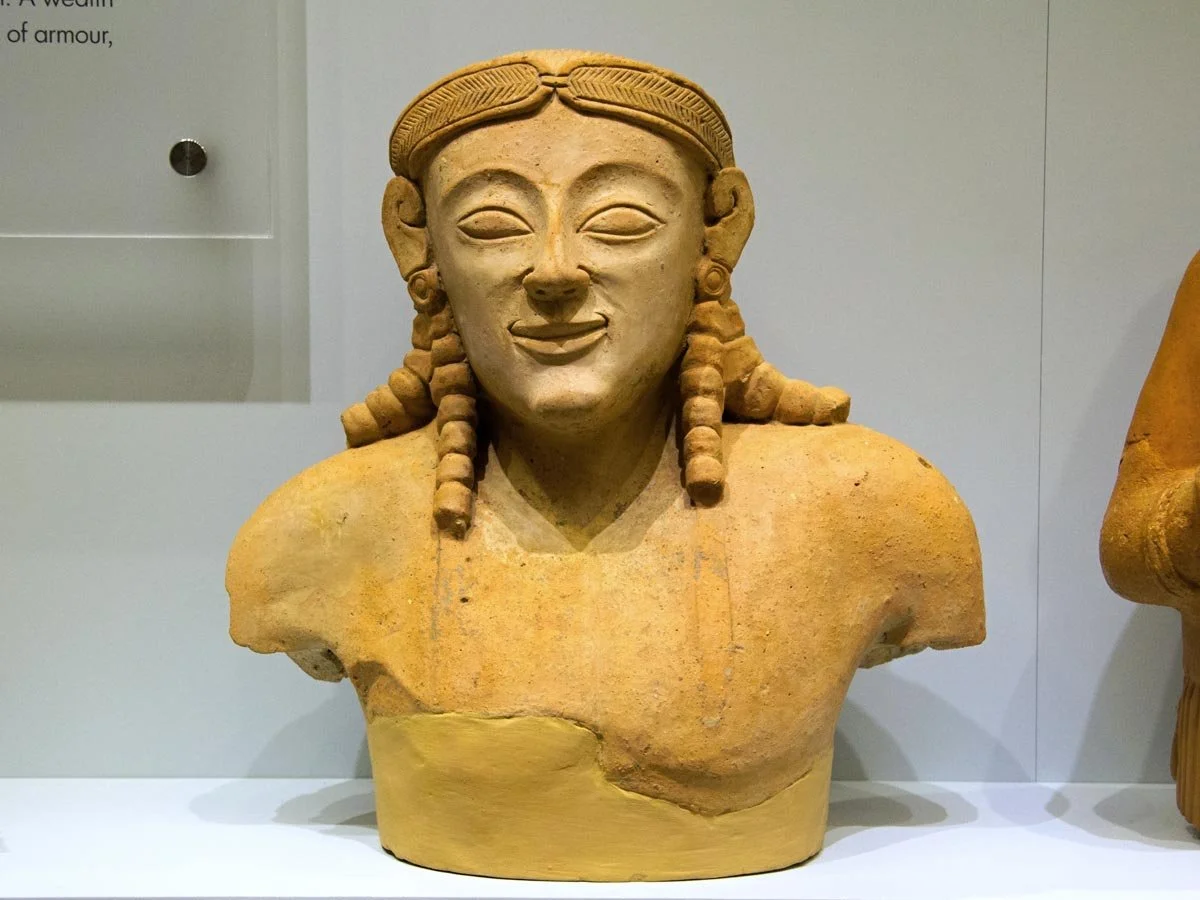
Terracotta kouros from Crete, his patterned hair and quiet smile showing how the archaic body could be modeled even in clay.
Classical Greek Sculpture Finds Calm in Movement
By the early Classical period, Greek sculptors are no longer satisfied with frontal, equally weighted poses. They start asking a different question: how can a statue look both stable and as if it just moved or is about to?
The answer is contrapposto. In this pose, one leg (usually the right or left depending on the statue) carries most of the weight, while the other bends slightly or rests. The pelvis tilts, the spine curves gently, and the shoulders respond with a counter-tilt. The head may turn a little, breaking away from strict frontality. The whole figure forms a subtle S-curve. This is what people often mean when they describe Classical Greek sculpture as “relaxed” or “natural”. The body behaves as a unified system, not as a set of separate parts.
Expressions change too. Instead of archaic smiles, faces in Classical works are often quiet and self-contained. Eyes focus softly, mouths are neutral, and emotion is communicated more through pose and context than through exaggerated features. A god might stand in a calm contrapposto while holding a thunderbolt; a hero might lean on a spear, resting after battle rather than shouting in the middle of it.
Medium plays a role here as well. Bronze casting, widely used in Classical Greece even if many originals are lost, allows for more daring poses: extended arms, raised legs, twisting bodies that would be risky in stone. Many of the marble statues we know are in fact Roman copies of earlier bronze works. Even so, the underlying Classical priorities are clear: proportion, clarity and controlled movement.
If you put an Archaic kouros next to a Classical youth, the shift is striking. Yet you can still trace the lineage. The Classical figure usually keeps a straight axial structure; the proportions still follow underlying ratios. The difference is that everything has been tuned so that geometry and observed anatomy finally sit comfortably together. That balance is why Classical sculpture becomes the reference point for so many later periods, from Roman collectors to Renaissance artists trying to rediscover “the Greek way”.
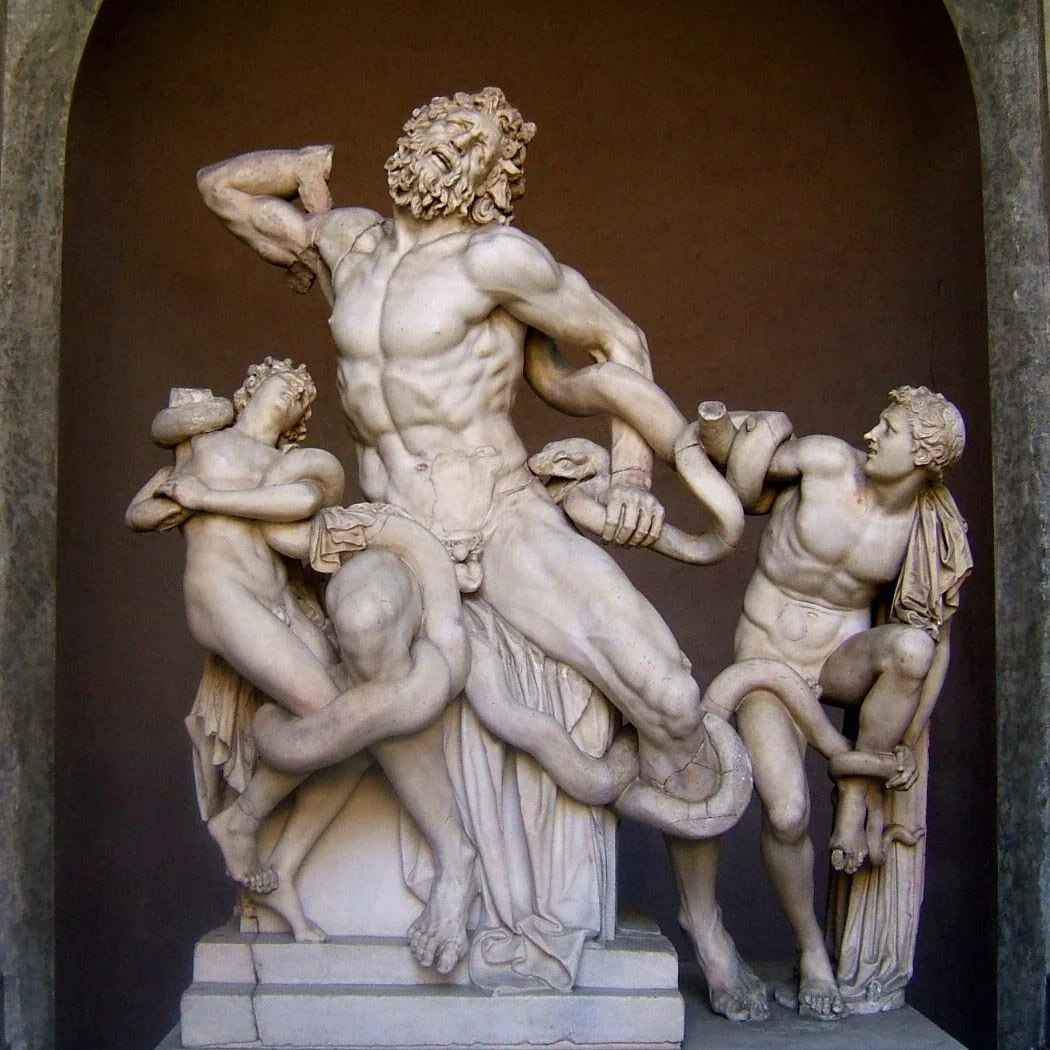
The Laocoön group coils bodies and snakes together, a Hellenistic showpiece of pain, muscle and theatrical composition.
Gods, Humans and Statues: Who Is Being Shown?
Throughout these changes in style, Greek sculptors keep circling around a few recurring subjects: gods, idealised mortals and specific individuals. How they handle each category tells us a lot about what statues were for.
Greek god statues often present deities in human form, but with cues that mark them as more than mortal. Zeus might hold a thunderbolt. Athena carries a spear and wears a helmet. Aphrodite’s pose and nudity are coded to signal a particular blend of beauty and divinity. In our guide to Greek god statues and symbols we look at how attributes, animals and context help viewers tell who is who. The key point is that gods are usually shown in ideal, controlled bodies, even when the composition becomes more complex in the Hellenistic period.
Heroic mortals and athletes occupy a space just below that. Their bodies look almost as perfect as those of the gods, especially in Classical sculpture, where an Olympic victor or a legendary hero might be carved with the same anatomical care as a deity. These works were often set up in sanctuaries, blending human achievement with divine favour. When we talk about ancient Greek sculpture relaxing over time, a lot of that relaxation happens in this category: the athlete who shifts his weight, the hero who turns his head, the warrior who pauses rather than charges.
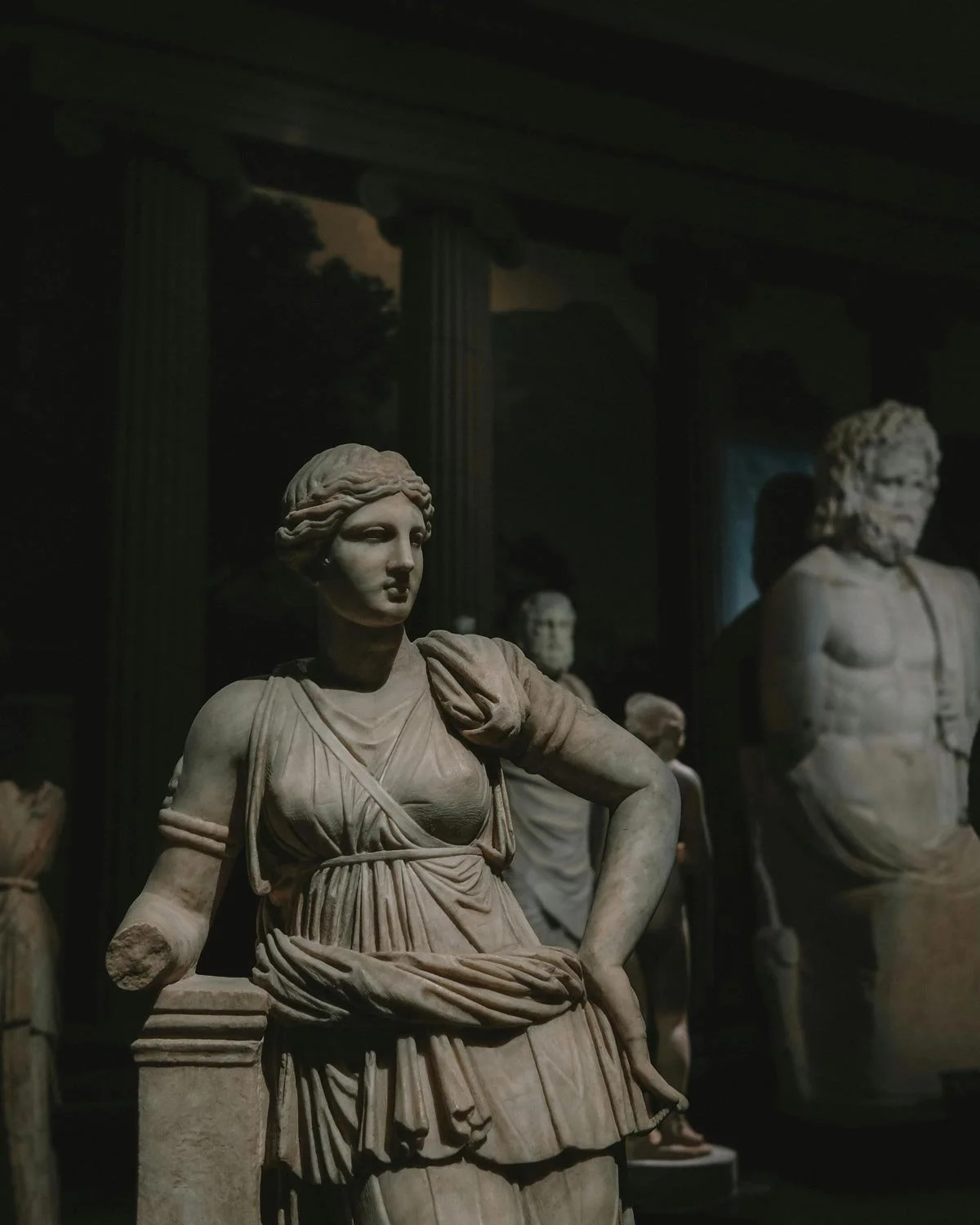
Night-like gallery at the Getty, where a single draped statue steps forward from the shadows of columns and silent companions.
Portraits and more individualised figures become more common in the Hellenistic period. Here we see rulers, philosophers, older people and even children portrayed with more specific features and sometimes less flattering realism. The sculptural toolkit developed for gods and heroes is now applied to a wider set of human experiences. The calm Classical face can wrinkle; the ideal body can sag a little. Yet the same deep understanding of structure and movement underlies these sculptures.
So, when you meet an ancient Greek statue, it is worth asking two questions: who is this meant to be, and how do I know? The answer usually lies in a mix of pose, attributes and the level of idealisation versus realism. And as you practice that reading, you naturally move back and forth between this article and broader overviews of ancient Greek art, seeing how sculpture fits into the wider visual world of pottery, painting and architecture.
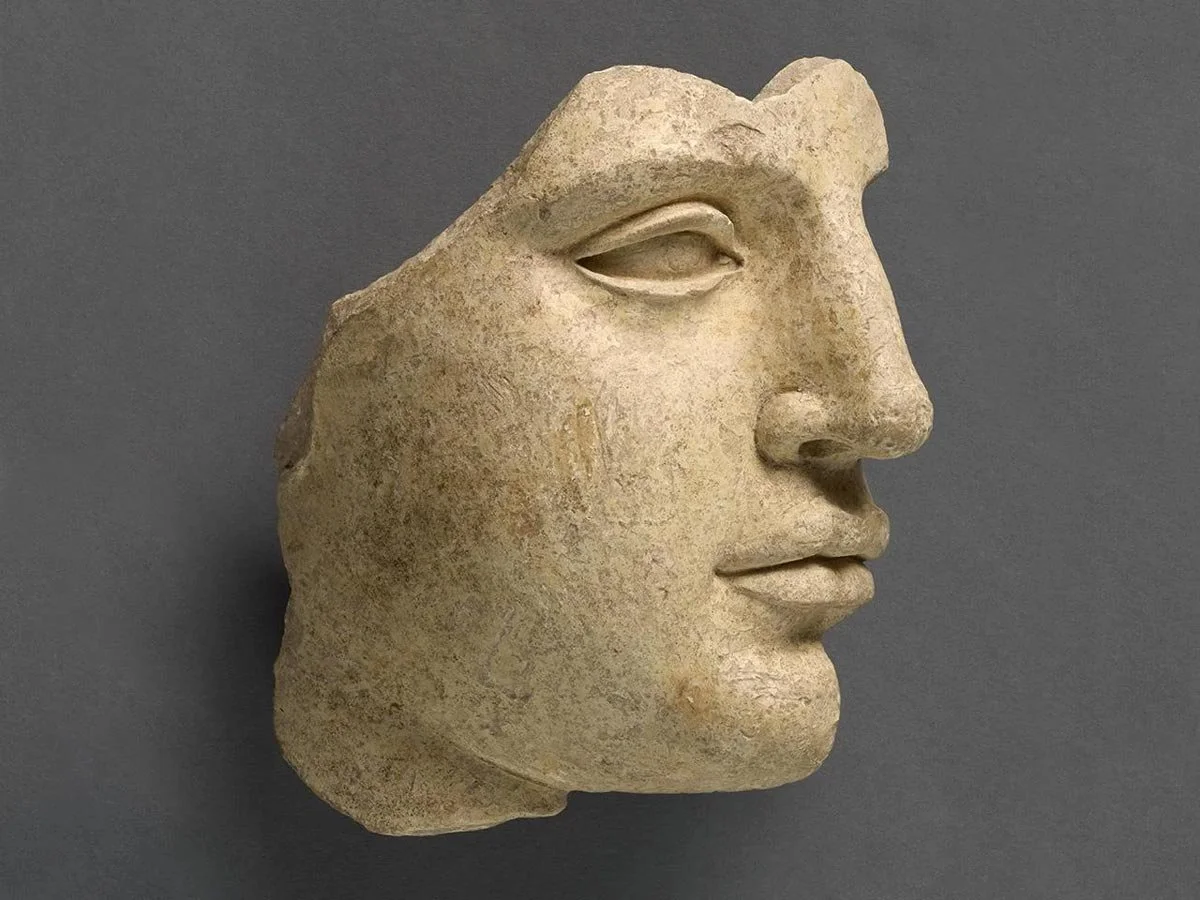
Broken classical face preserved in profile, its serene eye and full lips suggesting a lost colossal statue or relief.
Conclusion
Ancient Greek sculpture is often presented as a set of “greatest hits”: a kouros here, a Classical athlete there, maybe a dramatic Hellenistic group at the end. But when we slow down the timeline, a more interesting story appears. We see sculptors learning, over generations, how to relax the body without losing structure, how to move from archaic smiles to quieter, more complex expressions, and how to show gods and humans in ways that feel both ideal and somehow familiar.
If you hold onto a few anchors, the journey becomes manageable. Early Archaic works like the Anavysos Kouros and Peplos Kore show the first successful attempts at carving full-sized bodies within a strict geometric frame. Classical statues refine that frame into contrapposto and calm faces. Hellenistic pieces then push the same system toward greater drama and diversity, without forgetting the lessons of proportion and anatomy. For a more focused lens on those first experiments, you can always circle back to our article on Archaic Greek sculpture before jumping forward again.
Next time you walk past a Greek statue, try a quick mental test: is the pose straight and frontal, gently shifted, or fully twisted? Is the face smiling in that archaic way, serene and neutral, or visibly emotional? With just those questions, you can often place the work somewhere between archaic stiffness and Classical calm, and feel the long, quiet education of the stone that happened in between.
You may also like