Apollo Sauroktonos: Why This Apollo Statue Feels So Different
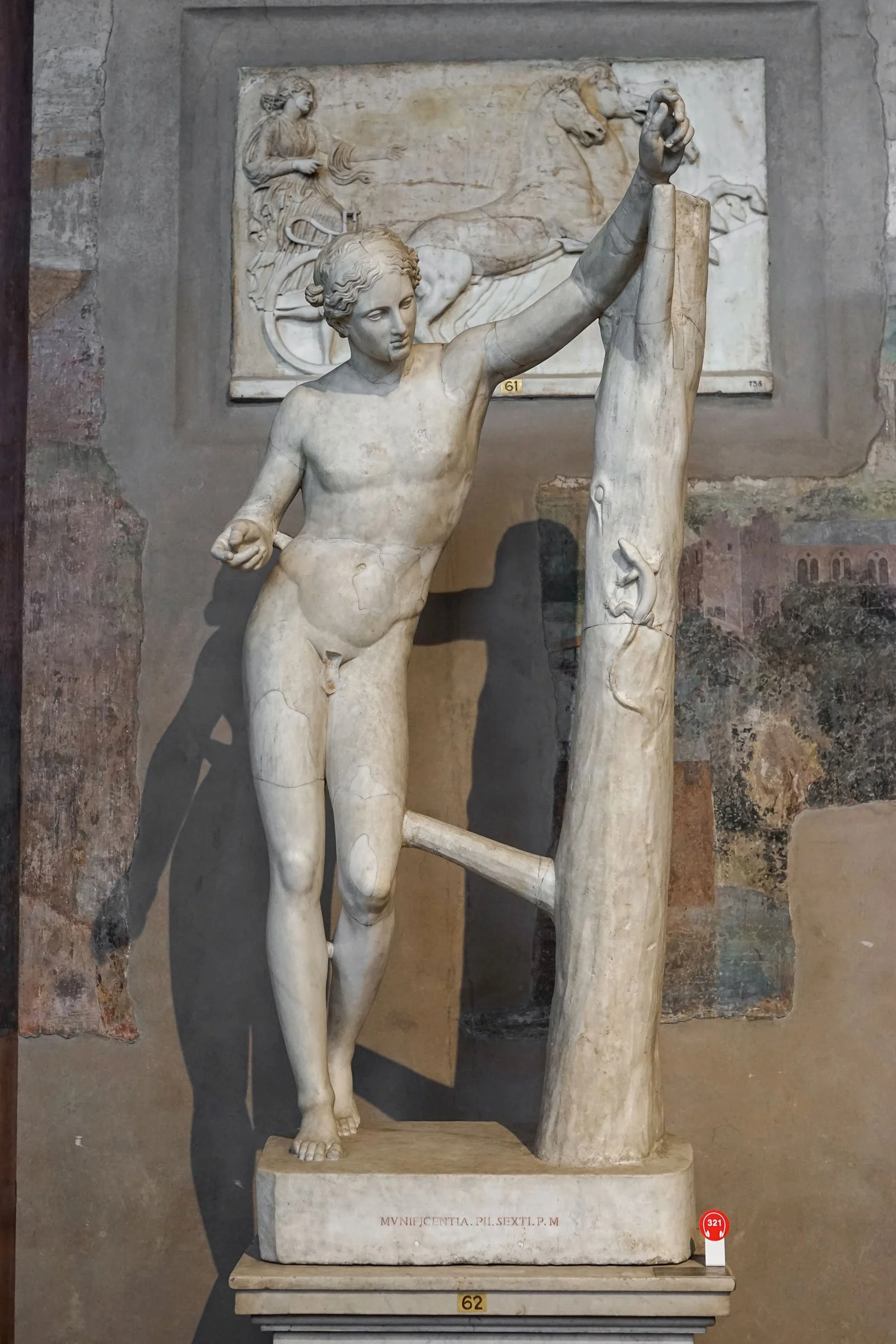
Apollo Sauroktonos feels different because Apollo looks youthful, relaxed, and almost private.
The Apollo Sauroktonos feels different because it gives us an Apollo who is not distant, triumphant, or overwhelmingly divine. Instead, he looks young, slender, relaxed, and almost playful. That is exactly what makes the statue so revealing. It shows a moment in Greek art when gods start feeling softer and more human.
In simple terms, the statue type usually called Apollo Sauroktonos shows the god Apollo leaning against a tree, reaching toward a small creature, usually identified as a lizard. The name Sauroktonos means lizard-slayer. The work is traditionally attributed to Praxiteles and usually dated to the 4th century BCE, though the original is lost and what we know comes through Roman copies and later versions. Even with those complications, its importance is clear: this is one of the best examples of how Greek sculpture begins to move away from hard, public divinity and toward grace, intimacy, and mood.
That is why the statue matters. It does not just show Apollo in a new pose. It changes the emotional language of divine sculpture.
The statue shows Apollo in a strangely light, almost private moment
Most people meeting Apollo for the first time in Greek art expect a very different kind of god. They expect power, distance, and ideal majesty. That expectation makes sense. Apollo is a major Olympian god, tied to music, prophecy, healing, and order in ancient Greek religion. He often appears as a figure of beauty and authority.
The Apollo Sauroktonos shifts that image.
Instead of a god in full command, we get a youth leaning casually toward a tree, apparently preparing to strike a tiny animal. The body is not tense in a heroic way. It is soft, elegant, and slightly languid. Apollo seems absorbed in a minor act, almost as if we have interrupted a private moment rather than a public display of divinity.
That is one reason the statue feels so unusual within the longer history of Greek god statues and ancient Greek statues of gods. The figure is still idealized, of course, but the ideal here is not monumental distance. It is graceful nearness.
What makes it feel so different is the body language
The real shift is in the pose.
Apollo is shown as an adolescent body leaning into space rather than standing in fully stable, frontal confidence. The weight rests gently. The torso stretches and softens. The whole figure seems to drift rather than declare itself. This is one of the clearest signs of a later Classical taste: the god feels more relaxed, more tactile, and more psychologically present.
That matters because Greek sculpture had long been brilliant at building ideal bodies. But here the ideal body no longer acts like a perfect public emblem. It behaves more like a living presence. The limbs are slender, the balance is subtle, and the mood is almost teasing.
This is exactly why the statue matters in the broader history of ancient Greek sculpture. It shows the body becoming less severe and more intimate. Apollo is still beautiful, but he is not frozen into authority. He is youthful in a way that feels almost delicate.
That softness is one of the reasons the type is so often connected to Praxiteles. Whether every surviving version takes us directly back to his original or not, the work fits the Praxitelean world of smooth transitions, relaxed grace, and gods who feel unexpectedly close.
“Sauroktonos” means lizard-slayer, but the meaning is still a little mysterious
The title sounds dramatic, but the action is small.
Sauroktonos comes from Greek words meaning lizard-killer or lizard-slayer. Ancient writers, especially Pliny the Elder, connect the type to a youthful Apollo aiming at a lizard climbing near him. That is the standard identification, and it is the one most scholars still keep.
But the exact meaning of the scene is not completely secure. A god killing a lizard is not an obvious mythological blockbuster. That is part of what makes the statue so interesting. It feels intentionally light and slightly puzzling.
Some scholars have proposed broader symbolic meanings. Because Apollo is associated with order, healing, and the defeat of dangerous forces, even a small creature can take on a larger resonance. More recent debates around the bronze known as the Cleveland Apollo have even raised the possibility that the creature might be more than a simple lizard, though the traditional interpretation remains the most widely accepted.
For beginners, the most useful takeaway is this: the statue’s mystery is part of its effect. It gives Apollo a moment that is neither fully everyday nor fully grand. That in-between quality is one reason it feels so revealing.
The original is lost, and the Cleveland Apollo makes the story more interesting
Like many famous Greek works, the original Apollo Sauroktonos no longer survives. What we know mainly comes through Roman copies in marble and bronze. That is already an important reminder that the history of a Greek statue is often also a history of survival, translation, and reconstruction.
One especially important version is the bronze known as the Cleveland Apollo. It is the only surviving large-scale bronze sculpture of this type, and it has drawn enormous attention because it preserves something closer to the material world of the lost Greek original. At the same time, it also brings debate with it. Scholars differ on whether it should be understood as the original Praxitelean work, a very close ancient version, or the work of a follower.
That uncertainty is not a problem. It actually helps show why the statue type matters so much. Even when the original is gone, the image remains strong enough to keep generating argument, admiration, and comparison. The body, the pose, and the mood all continue to carry the force of a major artistic idea.
Why it matters
The Apollo Sauroktonos matters because it shows a god becoming less remote without becoming ordinary. It makes Apollo youthful, elegant, and intimate in a way that earlier Greek art rarely attempted so fully. Instead of building divinity out of distance, it builds divinity out of poise, softness, and controlled beauty.
That is a major change.
The sculpture helps us see that Greek art was not a single frozen ideal. It kept revising how gods could appear, how bodies could feel, and how beauty could work. In that sense, Apollo Sauroktonos is not only a statue of Apollo. It is a clue to a wider transformation in Greek sculpture.

Conclusion
The Apollo Sauroktonos feels different because it gives us an Apollo who is graceful rather than commanding, intimate rather than remote, and youthful rather than monumentally divine. Whether we know it through Roman copies or through the debated Cleveland bronze, the type still carries the same powerful idea: gods in Greek sculpture could become softer, stranger, and more humanly present.
That is why this statue matters. It does not shout its importance. It changes the tone.
FAQ
What does Apollo Sauroktonos mean?
It means Apollo the Lizard-Slayer.
Who made the Apollo Sauroktonos?
The statue type is traditionally attributed to Praxiteles, though the original is lost and some details remain debated.
Why does the statue feel unusual?
Because Apollo appears as a slender, youthful figure in a quiet, almost playful moment instead of as a distant and powerful god.
Is the original Apollo Sauroktonos still alive?
No. The original is lost, and what survives are Roman copies and later versions.
What is the Cleveland Apollo?
It is a large bronze version of the Apollo Sauroktonos type in the Cleveland Museum of Art and one of the most important surviving examples connected to the work.
Is the creature definitely a lizard?
Usually yes in the standard interpretation, though some scholars have debated the exact identity and meaning of the creature.
Sources and Further Reading
You may also like