Hermes and the Infant Dionysus: What This Statue Means and Why It Matters
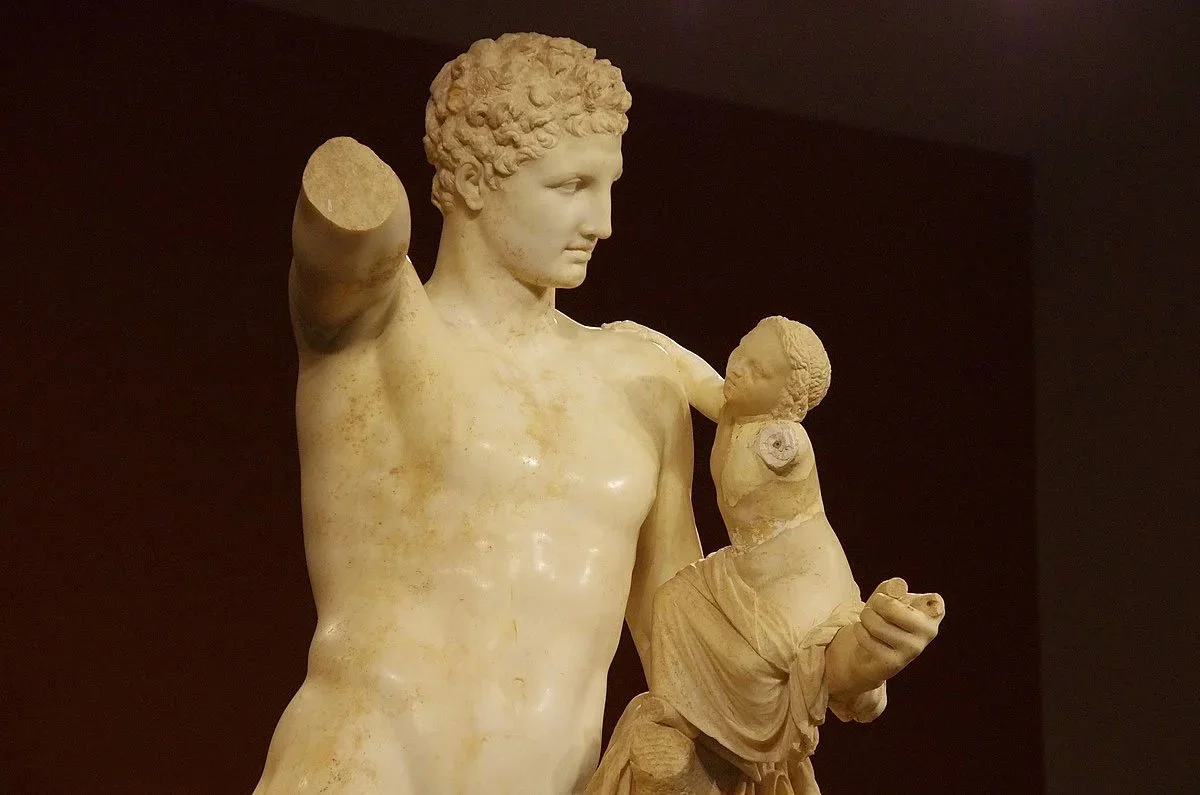
Hermes and the infant Dionysus matter because divine beauty here feels calm, tender, and close.
The statue usually called Hermes and the Infant Dionysus matters because it shows Greek sculpture doing something very difficult, and making it look easy. It is calm but not stiff, graceful but not empty, idealized but still deeply human in feeling. If you want one artwork that helps explain why Late Classical Greek sculpture feels softer, quieter, and more intimate than earlier Greek art, this is one of the best places to look.
In simple terms, the sculpture shows the god Hermes carrying the baby Dionysus to safety. That subject already matters inside ancient Greek religion, because Dionysus is a vulnerable divine child who must be protected after his unusual birth. But the real power of the statue is not only in the myth. It is in the mood. Hermes does not look rushed, heroic, or theatrical. He looks relaxed, almost dreamy. The baby is part of the scene, but the sculpture’s deepest message is really about grace, tenderness, and controlled presence.
That is why the work is so important. It is one of the clearest windows into how Greek sculpture changed when gods stopped feeling only distant and started feeling more physically and emotionally close.
The statue shows Hermes carrying the infant Dionysus, but the story stays unusually quiet
The basic subject is simple. Hermes carries the baby Dionysus away so he can be hidden and raised safely, out of reach of Hera’s anger. In myth, Dionysus is one of the most unusual Olympian gods, and his early life is marked by danger and protection. That gives the sculpture a clear narrative frame.
But what is striking is how little the statue depends on overt action.
This is not a frantic rescue scene. There is no panic in the body, no violent twist, no dramatic gesture. Hermes stands in a relaxed pose, his weight resting into the body with extraordinary ease. Dionysus sits in his arm as a small but important presence. The missing right arm of Hermes probably once reached outward, perhaps holding something for the infant, often imagined as grapes, a subtle reference to Dionysus’s future identity.
That matters because the sculpture treats myth in a very Late Classical way. Instead of turning the story into spectacle, it turns it into atmosphere. The gods become more approachable, more intimate, and more physically real. This is one reason the work matters so much within the history of Greek god statues and ancient Greek statues of gods. It shows divinity without needing distance.
What makes the statue special is its grace, not its drama
If you compare this work to earlier ancient Greek sculpture, the shift is immediately visible. Earlier Classical figures often feel composed and balanced in a firmer, more structural way. Here the balance is softer. Hermes leans. The torso relaxes. The whole body seems to settle rather than declare itself.
That quality is one of the great signatures of Late Classical sculpture. The body does not only stand correctly. It breathes visually.
The surface matters just as much. The figure is famous for its delicate modeling, meaning the forms are shaped through soft transitions rather than sharp breaks. Flesh feels continuous. The face is calm, but not empty. The body seems aware of its own weight. This is why the sculpture is so often connected to Praxiteles or to a sculptor working in a Praxitelean mode. It has that famous combination of smoothness, softness, and quiet sensuality.
That is also why the statue is such an important example of what a Greek statue can do. It is not trying to overwhelm the viewer. It is trying to make marble feel inhabited.
The statue is linked to Praxiteles, but that attribution is still debated
This is the part that needs careful wording.
The sculpture is traditionally called the Hermes of Praxiteles because the ancient writer Pausanias, visiting Olympia in the 2nd century CE, described a Hermes carrying Dionysus there and attributed it to Praxiteles. When the statue was discovered in 1877 in the Temple of Hera at Olympia, many scholars immediately connected the find to that passage.
That traditional attribution remains famous, and many books still present the statue as a work by Praxiteles himself. But the question is not fully settled. Some scholars accept the attribution. Others think it may be a later work, perhaps Hellenistic, made in a Praxitelean style rather than by the master’s own hand.
For beginners, the most useful way to hold this is simple: the statue is traditionally attributed to Praxiteles, but the attribution is debated.
That uncertainty actually makes the work more interesting, not less. Whether by Praxiteles or by someone deeply shaped by his style, the sculpture still tells us something crucial about Late Classical taste: Greek artists were becoming more interested in grace, tenderness, and bodily softness than in older forms of majestic distance.
It matters because it helps define the softer side of Greek art
Hermes and the Infant Dionysus is important not because it is the loudest Greek sculpture, but because it is one of the most persuasive. It shows how a mythological subject can be turned into a study of elegance, poise, and emotional quiet. It shows how gods can look beautiful without seeming remote. And it shows how marble can be worked so subtly that it almost feels like skin.
It also reminds us that ancient sculpture was never only about shape. Traces of finish and color once played a role too, which is why it helps to remember the broader story of painted Greek statues. The modern white surface is not the whole ancient experience.
So the statue matters on several levels at once. It is a key image of Late Classical style. It is an important work in the history of divine representation. And it is one of the clearest examples of how Greek sculpture could make ideal beauty feel unexpectedly tender.

Conclusion
Hermes and the Infant Dionysus matters because it turns a mythological subject into a lesson in grace. The sculpture shows Hermes carrying the infant god to safety, but its real achievement lies in its mood: calm, elegant, intimate, and quietly alive. Whether or not it is truly by Praxiteles, it remains one of the clearest expressions of the Late Classical shift toward softness, delicate modeling, and more human gods.
That is why the statue still matters today. It does not shout. It convinces.
FAQ
What does Hermes and the Infant Dionysus show?
It shows Hermes carrying the baby Dionysus to safety so he can be hidden and raised away from Hera’s anger.
Why is Hermes and the Infant Dionysus important?
It is important because it is one of the clearest examples of Late Classical Greek sculpture becoming softer, more graceful, and more intimate.
Was Hermes and the Infant Dionysus really made by Praxiteles?
It is traditionally attributed to Praxiteles based on Pausanias, but many scholars still debate whether the surviving statue is truly by his hand.
Where was the statue found?
It was discovered in 1877 in the Temple of Hera at Olympia.
Why does the statue feel so calm?
Because its pose, surface, and expression are designed around relaxed balance and delicate modeling rather than dramatic action.
Was the statue originally painted?
Like many ancient Greek sculptures, it likely had added color or surface details that are mostly lost today.
You may also like