Greek Bronze Statues: Why So Few Survive Today
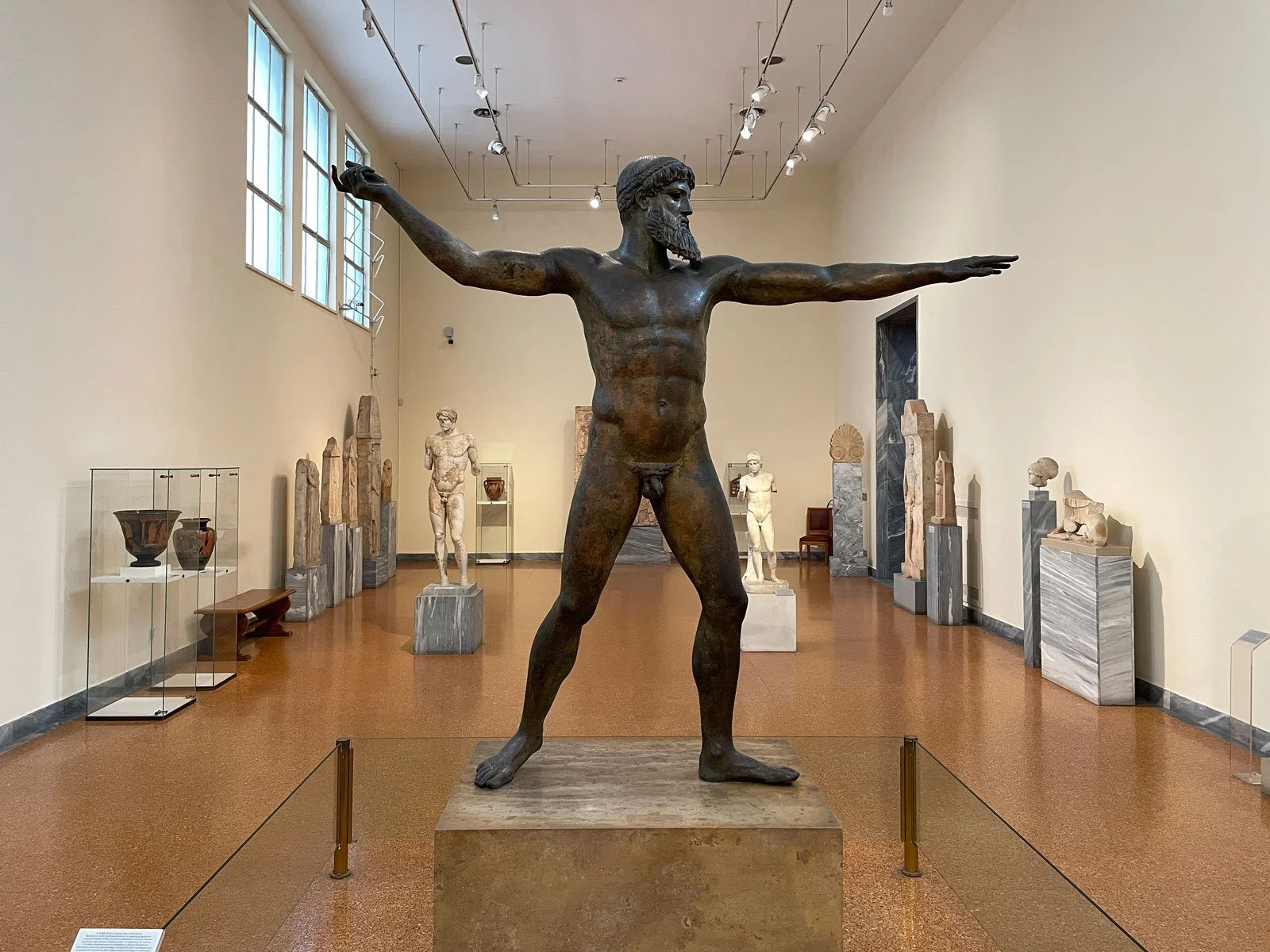
Seeing the statue in a full gallery shot reminds us that art lives in space, not just on a page. The outstretched arms basically “draw” an invisible line through the room—your eyes can’t help but follow it.
If Greek sculptors loved bronze so much, why do we mostly see Greek bodies in marble?
That question is basically the key to the whole museum experience. Bronze was often the prestige material. Bronze could hold daring poses, sharp details, even lifelike inlaid eyes. Bronze was also valuable enough to get melted down the moment a city needed metal for something else. So what survives is not a neutral sample. It’s a survival story.
In this guide we’ll look at what Greek bronze statues were, how they were made, and the very practical reasons most originals disappeared. Then we’ll talk about the lucky accidents that let a few masterpieces slip through time’s recycling machine.
Bronze statues disappeared because bronze was too useful to keep
This sounds almost rude, but it’s the honest explanation. Bronze is portable wealth.
A bronze statue is not just art. It’s a pile of reusable material in a form that can be reprocessed. If a community needs metal for weapons, tools, building fittings, or later coinage and industrial-scale projects, a bronze statue becomes a tempting “storage unit.” You don’t need a quarry. You don’t need a new supply chain. You already have the metal.
That doesn’t mean people casually melted down everything immediately. Many statues were valued, displayed, repaired, moved, and admired for centuries. But across long timelines, the economic gravity is hard to beat: valuable metal gets recycled.
This is where it helps to zoom out and think like an archaeologist, not just an art lover. What survives is often what is:
hard to reuse,
easy to bury and forget,
or accidentally protected.
If you like this “survival bias” perspective, it’s the same logic we use in what survives vs what disappears. Different materials have different fates. A stone wall can become rubble and still leave traces. A bronze statue can vanish completely and leave almost nothing but a written mention.
Myth vs Fact
Myth: Few Greek bronzes survive because bronze corrodes too easily.
Fact: Many vanished because bronze was valuable and recyclable.
So the missing bronzes are not a mystery in the spooky sense. They’re a consequence of material value doing what it always does.
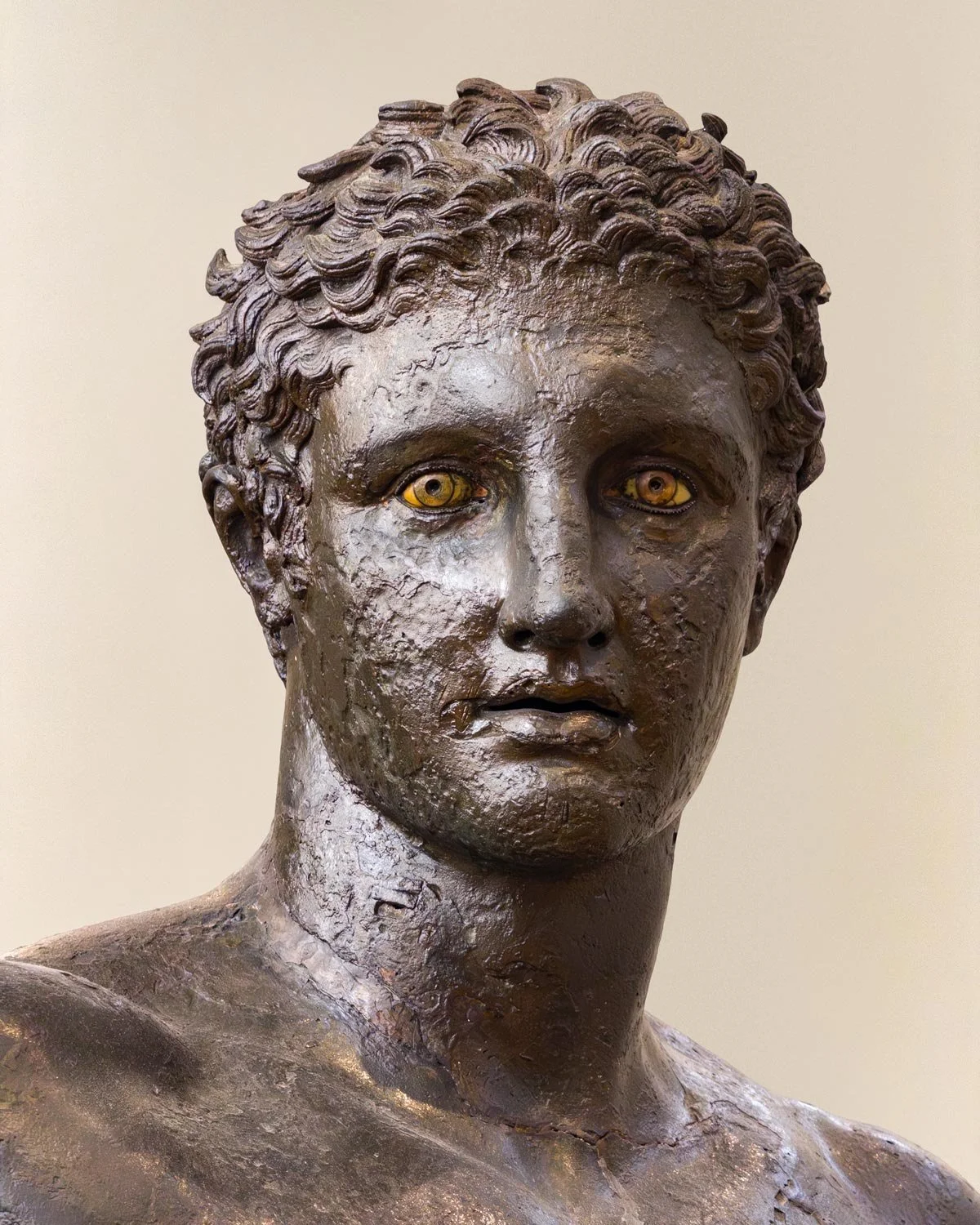
Inlaid eyes are a cheat code for presence—suddenly the figure feels like it’s looking back. Bronze portraits can be shockingly lifelike because the material holds crisp detail and subtle surface modeling.
Lost-wax casting made bronzes spectacular, but also made them “recyclable”
Greek bronze statues weren’t usually solid lumps of metal. They were typically hollow, engineered objects made through lost-wax casting (wax model replaced by molten bronze). That process let artists do things marble struggles with: extended arms, thin edges, delicate details, and surfaces that catch light like skin.
Here’s the basic chain, simplified:
The sculptor makes a model (often in wax).
A mold is built around it.
The wax is melted out, leaving a cavity.
Molten bronze is poured in.
The surface is finished, polished, and sometimes enhanced.
“Enhanced” matters. Bronze statues could include inlays and attachments, which is part of why they looked so alive. Eyes might be set with stone or glass. Lips and nipples could be a warmer metal. Details could be added separately and joined. If you’ve ever wondered how a statue could feel more “real” than marble, a lot of the answer is materials and finishing choices, the kind we unpack inmaterials in Classical sculpture.
And this is where the irony bites: the same properties that made bronze the best medium also made it the easiest to repurpose. A hollow statue contains a lot of metal, but it’s still manageable to break up and melt. It’s an artistic marvel and an economic resource in one object.
If you want the beginner-friendly way to connect technique back to how statues look, how statues were made helps you read surface, pose, and material as one system rather than isolated trivia.
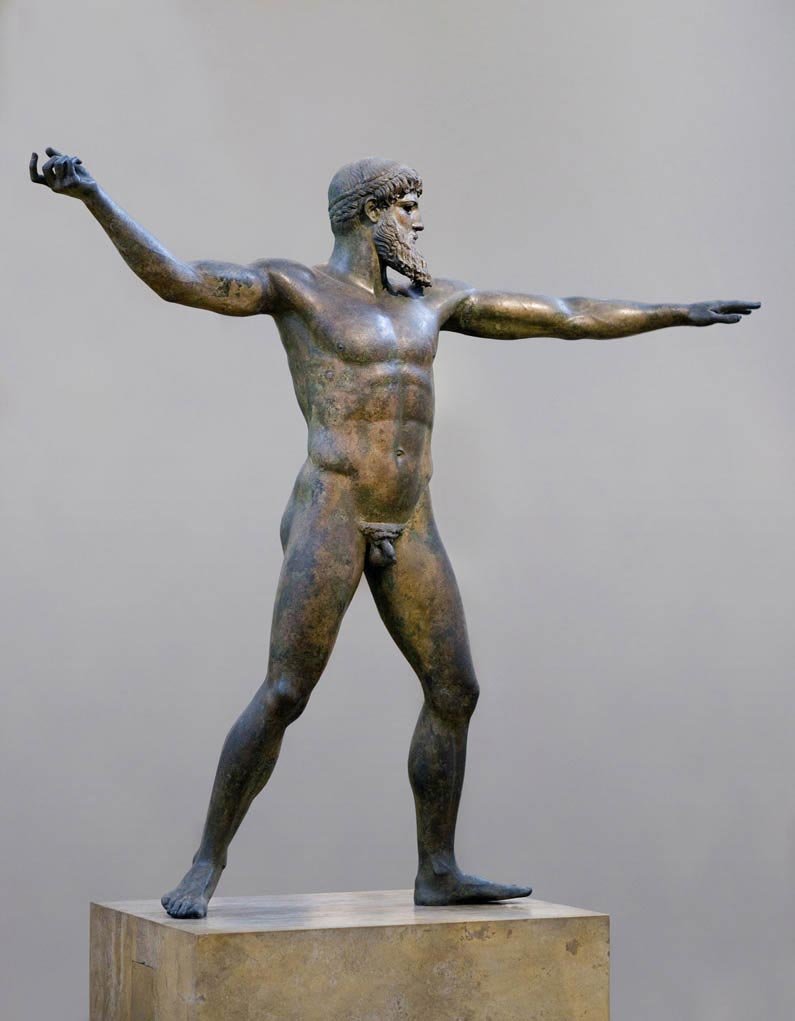
The mystery (Zeus or Poseidon?) is part of the fun: swap the missing object (the weapon) and the whole identity shifts. What doesn’t change is the design—wide stance, torsion in the torso, and a “ready-to-release” tension.
Marble survived more often because it was less tempting, not because it was “more important”
We tend to learn Greek sculpture as marble first, because that’s what fills museums. But that doesn’t automatically mean marble was always the first choice. Often, marble is what remains because it’s harder to recycle into something obviously useful.
Stone can be reused, yes. It can be re-carved, built into walls, even burned into lime. But it’s heavy and not universally valuable in the same way metal is. Bronze is “money-like” across contexts. Marble is “location-like.”
So the survival picture skews. Over centuries, Greek bronzes are melted down, while marble copies, fragments, and repurposed pieces hang on long enough to end up in collections. That’s one reason Roman marble copies matter so much: they preserve the look of bronze compositions that were once everywhere, even if the original medium is gone.
This is where our sense of Classical sculpture can quietly distort. We associate “Greek statue” with white surfaces and a certain calm. But many original bronzes would have looked darker, shinier, more vivid in detail, sometimes with mixed materials. Bronze also holds motion differently. A pose that feels risky in marble can feel effortless in metal.
You can see the “motion problem” in famous athletic types. Think about how much energy is stored in a twisted torso, a flung arm, a balanced spin. Those are exactly the kinds of compositions that bronze handles beautifully. When we read movement in Greek art, we’re often reading marble evidence for bronze ideas, which is why it’s useful to keep motion in sculpture in mind as a case study of how Greek artists engineered believable action.
So if you’ve ever felt like Greek sculpture is “mostly marble,” it’s worth gently rewriting that sentence: Greek sculpture is mostly marble now, but it wasn’t necessarily mostly marble then.
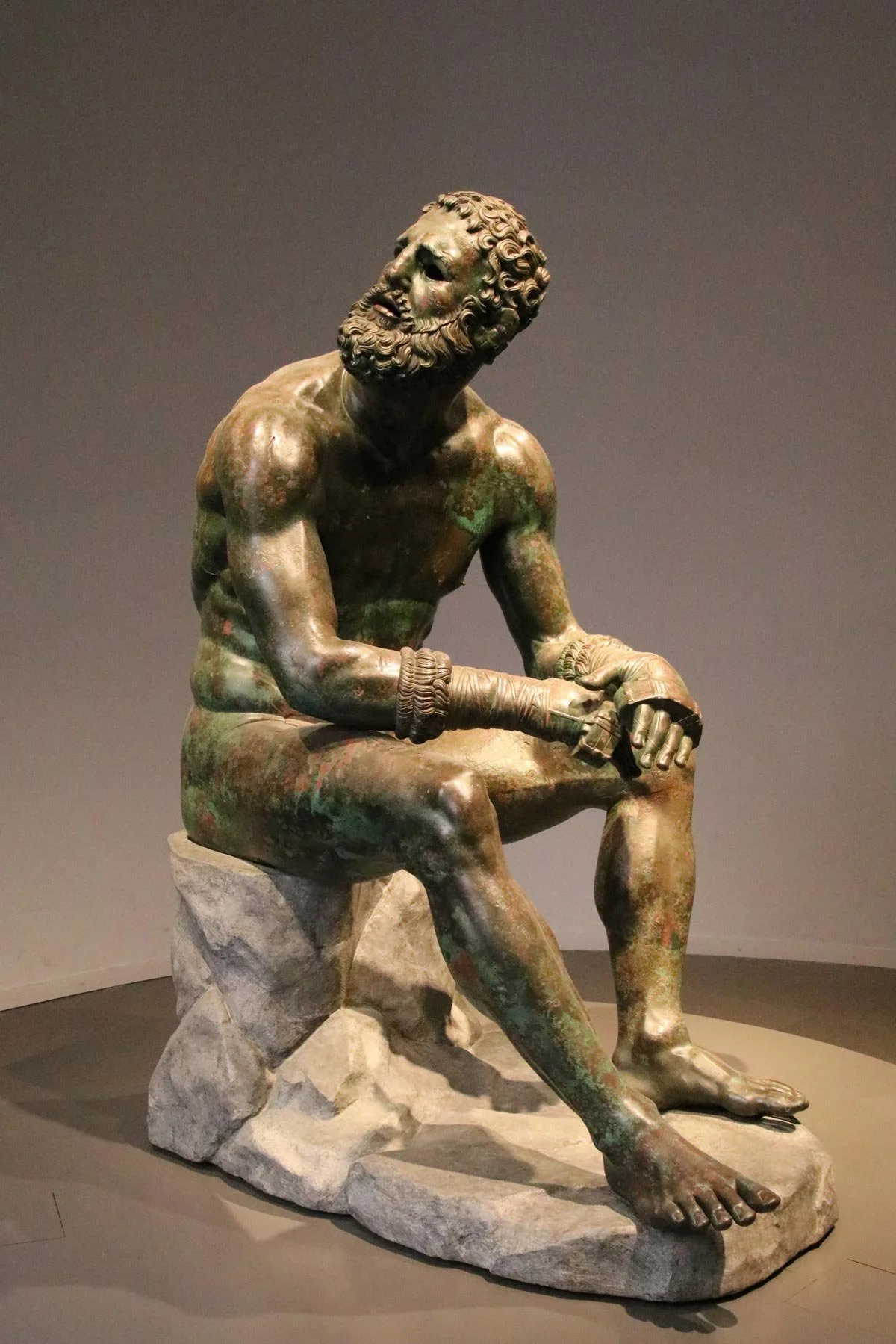
This statue doesn’t idealize—it tells a story. The swollen ears, broken nose, and exhausted posture make the athlete feel painfully real, like we’ve walked in during the quiet moment after the crowd leaves.
The bronzes that survived usually did so by accident, not by protection
How does a bronze statue survive a world that keeps melting bronze?
Usually through bad luck that turns into good luck: loss, burial, shipwreck, collapse, and forgetting.
Underwater finds are the headline story because the sea can hide objects from recycling economies. A statue that falls into the ocean is suddenly outside normal reuse systems. That doesn’t mean it’s safe. Water corrodes metal, and human salvage can strip a wreck quickly. But the sea can still preserve what land would erase.
Burial can do something similar. If a sanctuary is destroyed, if a statue is toppled and covered, if a city is abandoned in layers, the bronze can slip under the radar long enough to become archaeology instead of scrap.
This is also where it helps to remember that “survival” is rarely clean. Surviving bronzes are often missing the very parts that would have been easiest to detach: weapons, crowns, staffs, and attachments. What we see in museums is the body after centuries of loss and repair.
To keep your head straight, it can be helpful to compare bronze survival to other crafts. Pottery survives in huge quantities not because it was more “important,” but because clay is cheap and fragments are almost impossible to recycle back into raw clay. That difference is one reason how Greeks worked with materials is a great mental contrast: ceramic abundance versus metal scarcity is not about taste. It’s about material economics.
So “few bronzes survive” is not a statement about Greek talent or Greek production rates. It’s a statement about what happens to valuable matter over two thousand years.
Bronze scarcity changes the story we tell about Greek art
This is the part that feels like a quiet plot twist: we don’t just lose objects. We lose evidence.
When bronzes disappear, we lose:
the original surface effects (shine, inlays, mixed metals),
the engineering of daring poses in the intended medium,
workshop evidence embedded in joins and repairs,
and a huge portion of what “Greek sculpture” looked like in daily life.
And that absence shapes our imagination. The modern “Greek statue” stereotype is clean white marble, calm face, controlled body. Some of that is genuinely Classical taste. But some of it is simply what survives well.
Once you notice this, a lot of museum labels become more interesting. “Roman copy after a Greek bronze original” stops being an academic footnote. It becomes a reminder that we’re looking at a second-hand version of a lost world.
If you want one anchor sentence to carry with you: bronzes are missing not because the Greeks didn’t make them, but because later centuries kept finding them useful.

Conclusion
Greek bronze statues are rare today because bronze is a material with a long afterlife. It’s prized, portable, and endlessly reusable, which means it was constantly pulled back into circulation whenever societies needed metal. The bronzes that survive are the exceptions: buried, shipwrecked, forgotten, or simply lucky.
And once we see that, the museum experience shifts. We stop treating marble as the default and bronze as the “special case.” We start seeing the Classical world as it probably was: brighter, more metallic, more engineered, and more vulnerable to disappearance.
FAQ
Why did ancient Greeks make so many bronze statues?
Because bronze could hold lifelike detail and daring poses better than stone.
Why do so few Greek bronze statues survive today?
Mostly because bronze was valuable and frequently melted down for reuse.
How were Greek bronze statues made?
Many were made with lost-wax casting, creating hollow forms that were then finished and detailed.
Are most “Greek” marble statues actually Roman?
Many famous examples are Roman copies of earlier Greek bronze compositions.
Why do shipwrecks matter for bronze survival?
Underwater loss can remove bronzes from normal recycling systems long enough for them to be rediscovered.
Sources and Further Reading
The Metropolitan Museum of Art — “The Technique of Bronze Statuary in Ancient Greece” (2003).
Getty Publications — “Bronzes from the Aegean Sea” (2017).
National Archaeological Museum (Athens) — “Classic Period” (n.d.).
National Archaeological Museum (Athens) — “Sculpture Collection” (n.d.).
Bray, Peter — “Is a focus on ‘recycling’ useful? A wider look at metal mutability and the chemical character of copper alloys” (2022).
Castrizio, Daniele — “The Riace Bronzes. Recent Research and New Scientific Knowledge” (2019).
You may also like