Painted Greek Statues: The Originals Were Not All White
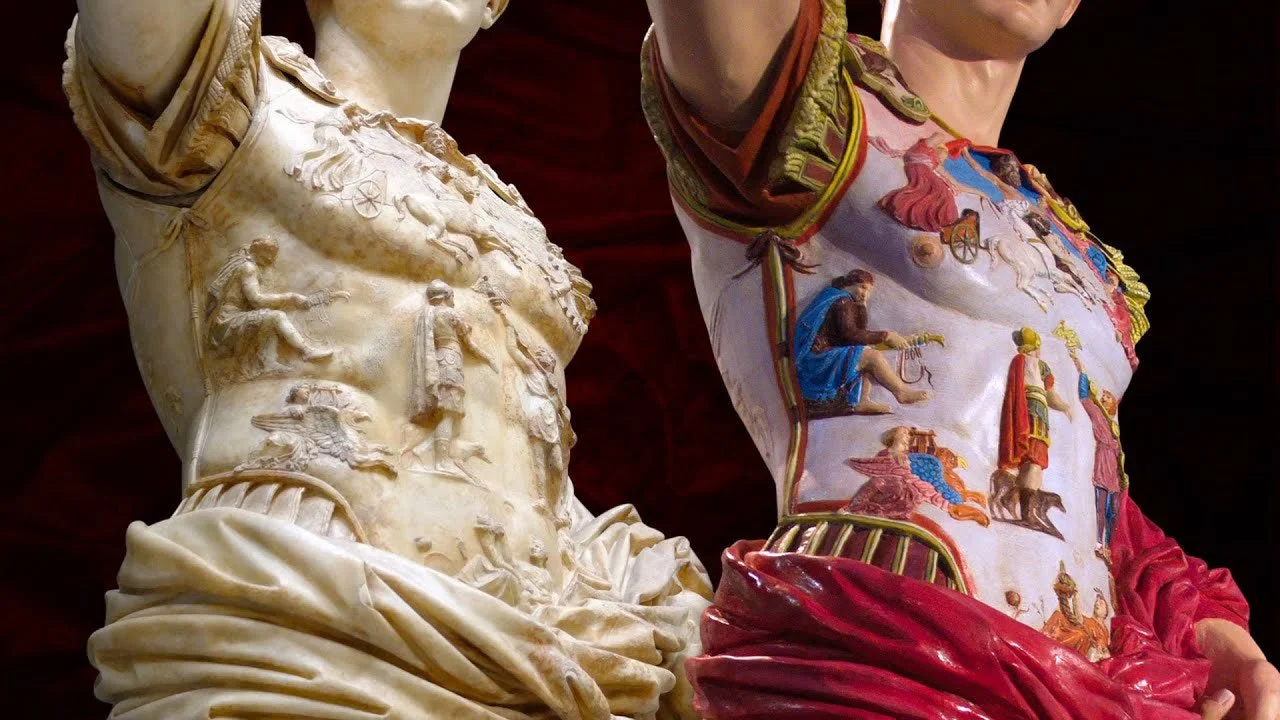
Side-by-side comparisons make it clear that ancient Greek sculpture originally looked very different from the white marble we see today.
There’s a moment almost every art newbie has. You’re in a museum, you see a row of “Classical” marble statues, and your brain quietly files them under: white, pure, minimal, timeless. It feels like that’s the whole point.
And then you learn the truth, and it feels like someone turned the lights on.
A lot of ancient Greek statues were painted. Not “a faint blush.” Real color. Patterns. Borders. Hair details. Sometimes gilding. Sometimes mixed materials. The white-marble look we associate with “classical beauty” is, in many cases, a modern afterimage of what survived.
This guide is our reset. We’ll define polychromy, talk about what was actually painted, and explain how modern science finds pigments that the naked eye often can’t see. We’ll also ground it with a few anchor examples like color on the Peplos Kore and the luxury world of gold-and-ivory gods.
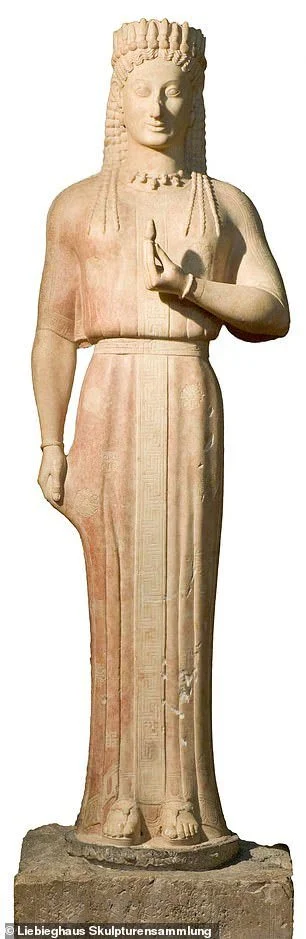
The Peplos Kore in its unpainted state shows why the “white statue” myth became so common.
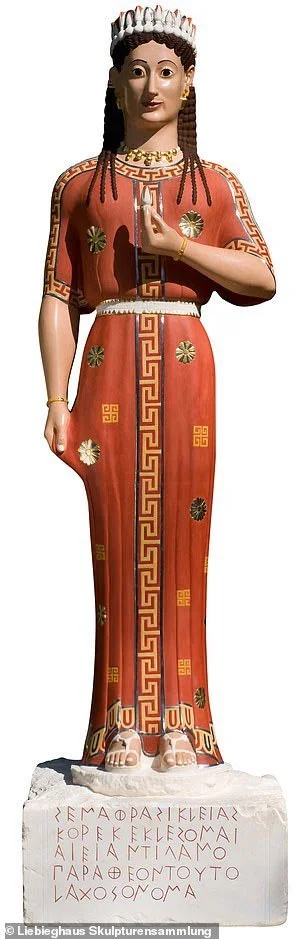
This reconstruction shows how strongly color shaped the look of Greek sculpture.
The “white marble statue” is a modern filter, not the ancient default
This is the big mindset shift, so let’s say it plainly: the whiteness is not the point. It’s the absence.
Many pigments fade, flake, or get scrubbed away over centuries. Paint sits on the surface, which is exactly the part that suffers weather, burial conditions, restoration, and cleaning. So the statue we see today often represents the most durable layer, not the finished appearance.
And there’s a second layer to the myth: taste. Later periods, especially from Renaissance collecting to Neoclassical aesthetics, loved the idea of white marble as pure form. White became “noble,” “rational,” “timeless.” Color started to look like noise.
Myth vs Fact
Myth: Greek statues were meant to be white marble masterpieces.
Fact: Many were colored; most paint simply didn’t survive.
This changes how we read Greek sculpture. If you’ve been using Greek statue basics as your visual checklist, consider this a missing chapter: pose and proportion matter, yes, but surface finish and color were part of the design from the start. And if you’ve been thinking of Classical art as “calm, clean, marble,” it helps to remember that Classical sculpture surfaces were engineered to catch light, and color would have worked with that engineering, not against it.
Polychromy means “many colors,” and it wasn’t limited to one detail
Let’s define the term before we use it.
Definition: Polychromy is sculpture painted in multiple colors.
Now the important clarification: Greek polychromy wasn’t always “paint the whole body like skin.” Often, the most intense color work sits where it clarifies identity and status.
Think of what paint can do that carving can’t do easily:
make eyebrows and eyes readable from a distance
separate hair from skin
create patterned textile borders
distinguish materials like armor, jewelry, or divine garments
add symbolic cues (like a goddess’s costume) without adding bulk
So yes, statues could have painted skin tones, but they also had painted hair, lips, garments, and ornaments. Sometimes the color is concentrated where the story is. Cloth edges, embroidered patterns, sandals, weapon straps, jewelry details. In other words: areas that signal who the figure is and what role they play.
This is where reading statues starts to overlap with reading fashion. Greek clothing (peplos, chiton, himation) had a real-world logic, and sculpture often made it legible through both carved folds and painted pattern. If you’ve ever looked at drapery and thought “it’s all the same,” color is the missing clue that makes layers, borders, and status pop.
And then we get the high-end version: gold, ivory, gemstones, metal attachments. Those weren’t “painted marble statues” exactly, but they belong to the same mindset: the statue is a designed presence, not an abstract form. The most famous example is the missing colossal Athena inside the Parthenon, which is why gold-and-ivory gods matters here. Ancient viewers did not experience divinity as monochrome.

Ancient Greek statues were often brightly painted, not left plain white marble.
We know Greek statues were painted because the evidence is still there
So how do we know this isn’t just a modern fantasy?
Because the statue surfaces still carry traces. Sometimes you can see it with your own eyes in protected recesses: tiny reds in hair grooves, dark pigment in eyelids, blue lodged deep inside folds. But often, the pigments are too thin or too degraded to read under normal lighting.
That’s where modern imaging and analysis come in. Conservators and scientists use non-invasive techniques to detect pigments that fluoresce or reflect in distinctive ways, even when the visible color is gone. The goal is not to “repaint” ancient objects casually. It’s to document what survives and reconstruct plausible schemes with evidence.
If you want a mental model, think like a detective:
the original paint layer is the “crime scene”
time erases most of it
science reveals the residue that the eye misses
This is also why cleaning and conservation are so sensitive. Dirt can hide pigment. Over-cleaning can remove it. Different stones age differently. Different environments preserve differently. So polychromy research often moves slowly, working case-by-case, and building stronger claims from repeated patterns across many objects.
A practical museum habit: if you see carved drapery with deep undercuts, check the protected channels. If you see hair carved in tight grooves, look at the recesses. If you see decorative borders on garments, imagine that the border may have been painted pattern rather than carved detail. The surface is often telling you where the color used to live.
Peplos Kore is the “before,” and she teaches us how color behaved
If you want one statue that makes the color story feel undeniable, it’s a kore from the Athenian Acropolis.
The Peplos Kore is often discussed because she preserves traces of paint and because her clothing is exactly the kind of area where ancient color could do huge work: patterned fabric, jewelry, borders, and symbolic costume. That’s whycolor on the Peplos Kore is such a strong anchor for beginners. She helps us imagine a world where sculpture was not “white form,” but dressed, styled, and visually loud in intentional ways.
And once we accept that, something else clicks: Greek sculpture is part of a bigger image culture. Greeks painted pottery. Greeks painted architecture. Greeks painted panels, even if fewer survive. So polychromy is not a weird exception. It’s consistent with how Greeks used color across media.
That’s wherewhat survived of Greek painting becomes a helpful companion. If we keep expecting Greek art to look like modern minimalist marble, we’re not just misreading sculpture. We’re misreading the wider Greek visual world.
Color also changes how we read “Classical calm.” A composed face in marble can look emotionally blank to us. Add painted eyes, brows, lips, and suddenly that calm has life. Not drama, but presence.
The real takeaway isn’t “statues were colorful,” it’s “color carried meaning”
Here’s what I love about this topic: it doesn’t just correct a fact. It changes how we look.
Once we allow color back into Greek sculpture, we start noticing that surface was never a neutral finish. Surface was part of communication.
Color could:
mark divinity versus mortality
make garments look expensive and patterned
emphasize authority (think formal costume cues)
clarify storytelling details in crowded sculptural programs
help figures read clearly from below and at a distance
It also helps explain why polychromy reconstructions can feel jarring today. We’re not used to seeing “Classical” as vivid. Our taste has been trained by centuries of whiteness, museum lighting, and fragments.
But ancient viewers weren’t trying to create modern minimalism. They were trying to make images that worked in sanctuaries, sunlight, festivals, and civic life. The statue was a public actor. Color was part of the costume.
So the goal isn’t to replace one stereotype with another. It’s to keep the full picture open: Greek statues could be marble or bronze, restrained in pose but rich in surface, calm in expression but visually detailed in ways we’ve mostly lost.

Conclusion
The myth of white marble is powerful because it looks clean, timeless, and “Classical.” But the ancient reality was more alive. Greek statues were often painted, patterned, and materially complex, and modern science keeps finding evidence in places we used to ignore.
Once we see that, Greek sculpture stops being a monochrome ideal and starts being what it really was: a designed presence in a colorful world. And that makes the art feel less like a cold standard and more like a human decision.
FAQ
Were ancient Greek statues really painted?Often, yes. Many show pigment traces, and scientific imaging confirms surviving color on a wide range of works.
What does “polychromy” mean?Polychromy means “many colors,” referring to painted decoration on sculpture.
Why did the paint disappear?Because paint sits on the surface and is vulnerable to weathering, burial conditions, cleaning, and time.
Did Greeks paint only the clothes, or also skin and hair?All of the above, depending on the statue. Hair, eyes, lips, garments, and patterned borders were especially common.
Why do museums still show statues as white?Because most pigment is lost or hard to see, and reconstructions are often displayed separately from the originals.
Sources and Further Reading
The Metropolitan Museum of Art —“Chroma: Ancient Sculpture in Color” (2022).
The Metropolitan Museum of Art —“Ancient Greek Sculpture in Color” (2022).
Acropolis Museum —“Archaic Colours” (2012).
British Museum —“Paint and the Parthenon: conservation of ancient Greek sculpture” (2018).
Liebieghaus Skulpturensammlung —“Gods in Color: Painted Sculpture of Classical Antiquity” (2008).
Basso, Elena; Carò, Federico; Abramitis, Dorothy H. —“Polychromy in Ancient Greek Sculpture: New Scientific Research on an Attic Funerary Stele at the Metropolitan Museum of Art” (2023).
Verri, Giovanni, et al. —“The goddess’ new clothes: the carving and polychromy of the Parthenon Sculptures” (2023).
You may also like