Female Greek Statues: Drapery, Modesty, Status, Power
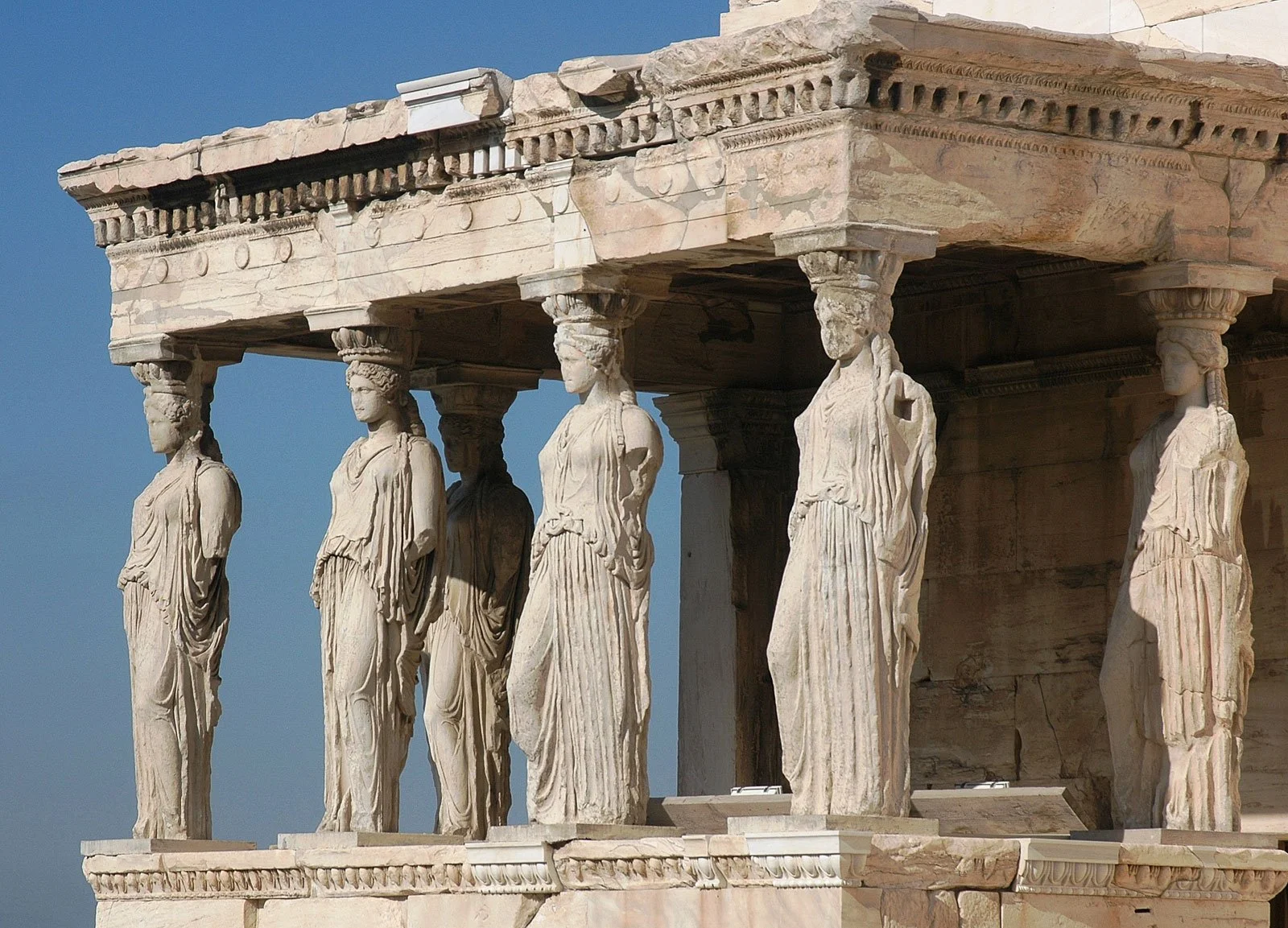
Caryatids are architecture and sculpture fused into one idea: bodies literally carrying the roof. Once you notice the stacked drapery and the stable stance, you see how “human columns” are engineered to look graceful and structural.
If male Greek statues often hit us with the shock of nudity, female statues do something sneakier. They make fabric feel like ideology. You walk past a row of marble women and at first it’s all folds and hems. Then you realize the folds are doing the talking: who she is, what kind of authority she’s allowed to have, how visible she can be in public, and what “power” is supposed to look like when it’s coded as respectable.
So yes, Greek women in sculpture were usually clothed. But “clothed” does not mean “passive.” In Classical art, drapery becomes a technology: it can conceal, reveal, elevate, and control how the body is read.
In this guide we’ll unpack how drapery (carved cloth folds that shape meaning) communicates modesty, status, and power. We’ll use a few familiar anchors: what Greek clothing actually looked like, the Archaic baseline of Peplos Kore and drapery (the Archaic ‘before’), and the divine side of the story through goddesses and their attributes.
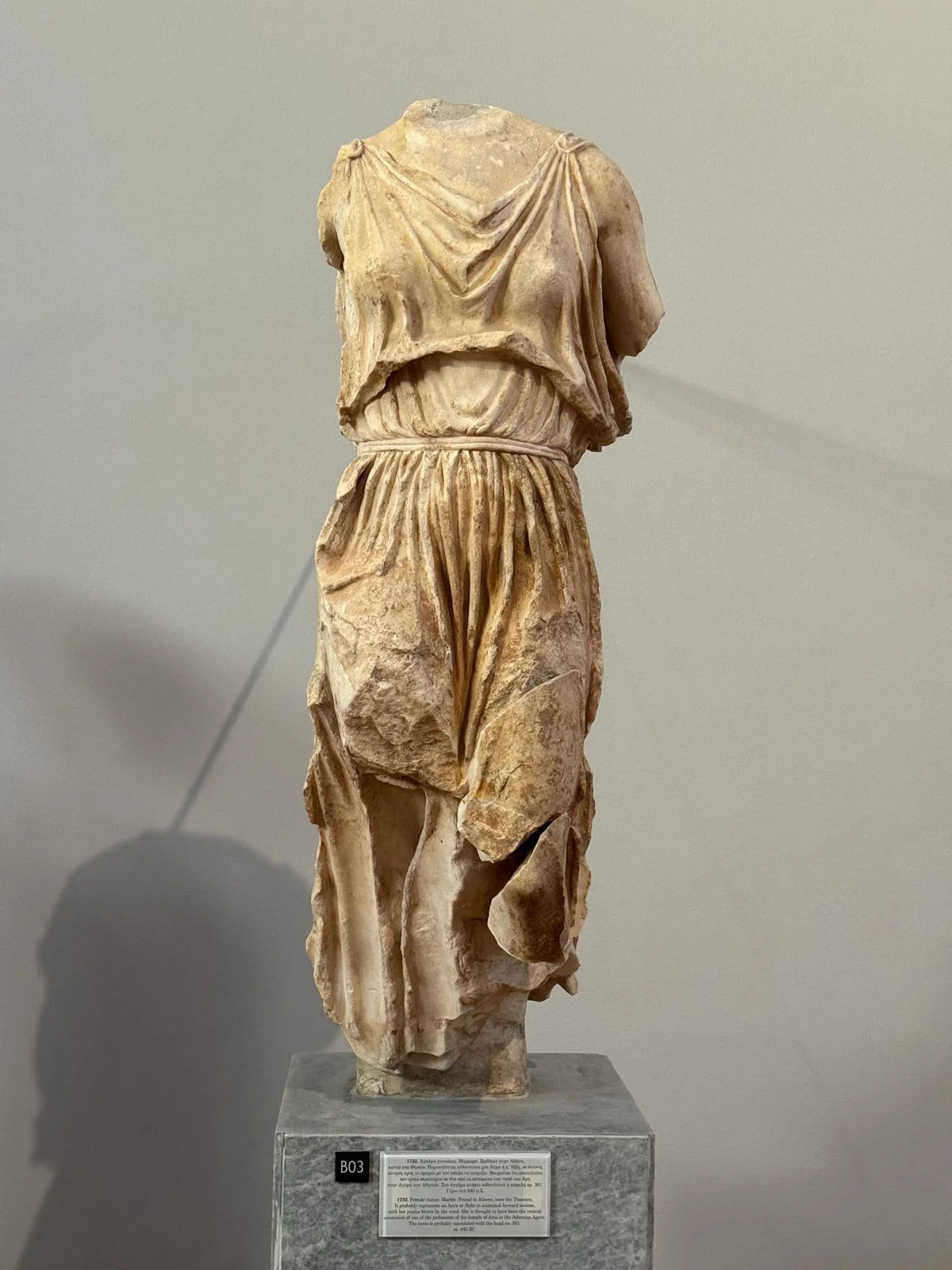
Drapery is one of the best “style detectors” in sculpture: sharp ridges feel crisp and controlled, while softer folds feel heavier and more natural. Even a fragment like this can teach you how sculptors made stone behave like cloth.
Female statues are clothed because clothing was part of public identity
This is the simplest claim, and it’s true. In Greek visual culture, a clothed female figure often signals respectability.
That doesn’t mean Greek women were never represented nude. But compared to male statues, female nudity is rarer and tends to appear in more specific contexts, often tied to goddesses like Aphrodite or later artistic trends. For the Classical period especially, the “default” female image in sculpture is dressed.
Why? Because clothing is not just practical. It’s a social language. What a woman wears, and how it’s worn, tells the viewer what kind of woman she is supposed to be.
A few key terms help us read this.
A peplos (wool garment pinned at the shoulders) creates a different silhouette from a chiton (light tunic, often linen), and both behave differently from a himation (large cloak draped over the body). If you want the real-world forms before we talk about the sculptural symbolism, it helps to picture what Greek clothing actually looked like. Sculptors were not inventing fabric out of nowhere. They were transforming familiar garments into meaning-machines.
And that “public identity” logic becomes even clearer when we compare time periods. The Archaic korai are a perfect baseline. A kore (standing maiden statue, often offering figure) can be lavishly dressed, richly patterned, and still feel formal and emblem-like. That’s why Peplos Kore and drapery (the Archaic ‘before’) works so well as a reference point: it shows clothing as an early sign of role and respectability, before Classical sculptors start pushing fabric into new emotional and physical effects.
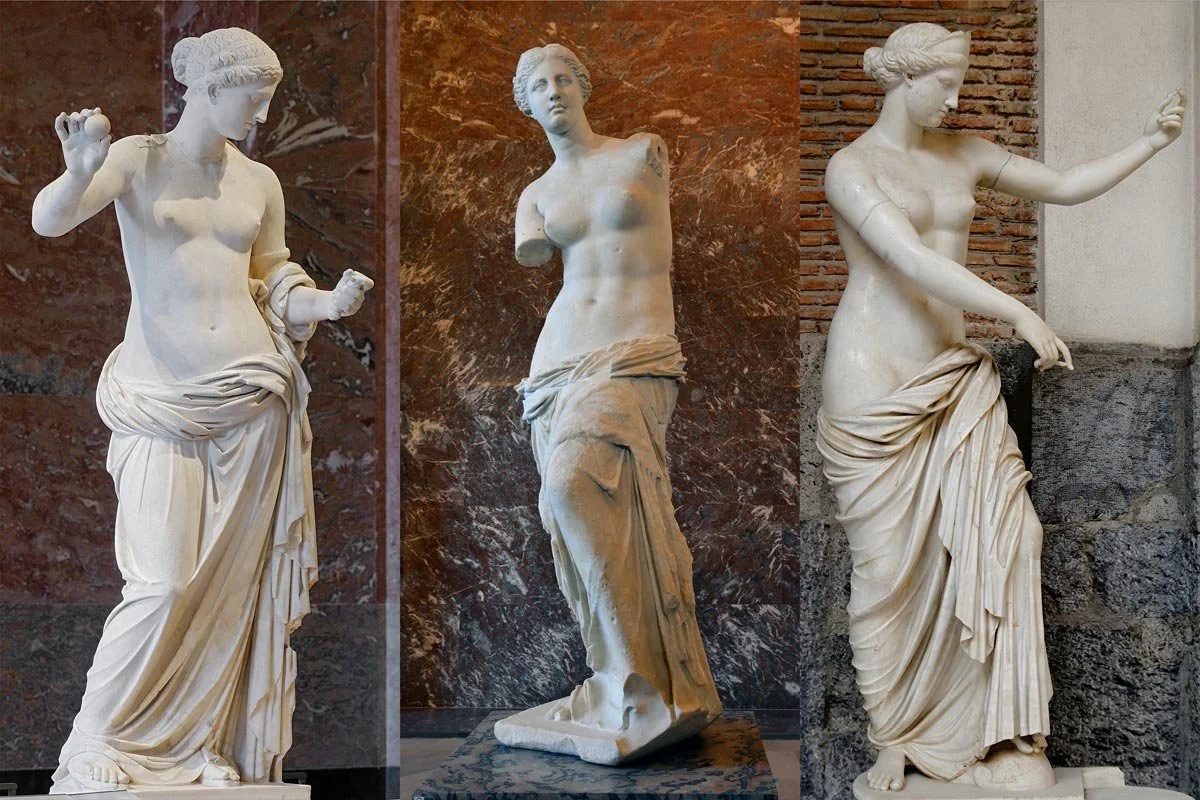
Putting versions side-by-side helps us see what changes and what stays consistent: the gentle hip-shift, the strategic drapery, the calm expression. It’s basically the “remix culture” of the ancient world—copying, adapting, and updating icons.
Drapery is never “just decoration”; it’s a way to control the body
Here’s the real trick: drapery is how Greek sculptors show the body without showing the body.
Fabric gives you plausible modesty while still letting you communicate shape, youth, movement, and even sensuality. In many Classical works, the cloth is carved in a way that makes the figure feel present underneath it, like the body is the structure and the fabric is the music.
This is why drapery in sculpture can carry multiple messages at once:
Modesty and decorum: covered skin signals social respectability.
Status and wealth: heavy folds, layered garments, and complex draping imply expensive cloth and skilled handling.
Movement and life: fabric reacts to the body, so it implies motion even when the statue stands still.
Character: the way cloth hangs can suggest restraint, confidence, or ritual formality.
Classical drapery often becomes a kind of choreography. It leads the eye. It frames important zones (the torso, the hips, the gesture of an arm). It creates rhythm across the surface so the statue feels designed, not accidental.
And we should be honest: this is also where gender ideals are being manufactured. When the female body is consistently mediated through cloth, the “ideal woman” becomes associated with controlled visibility. She can be admired, but in a way that is socially contained.
Myth vs Fact
Myth: Drapery exists mainly to make women look modest.
Fact: Drapery also signals status, motion, and authority.
Once you take that seriously, drapery stops reading as a repetitive museum pattern and starts reading as a sophisticated visual language. You begin to notice how artists vary it depending on whether the figure is mortal or divine, youthful or mature, calm or in action.
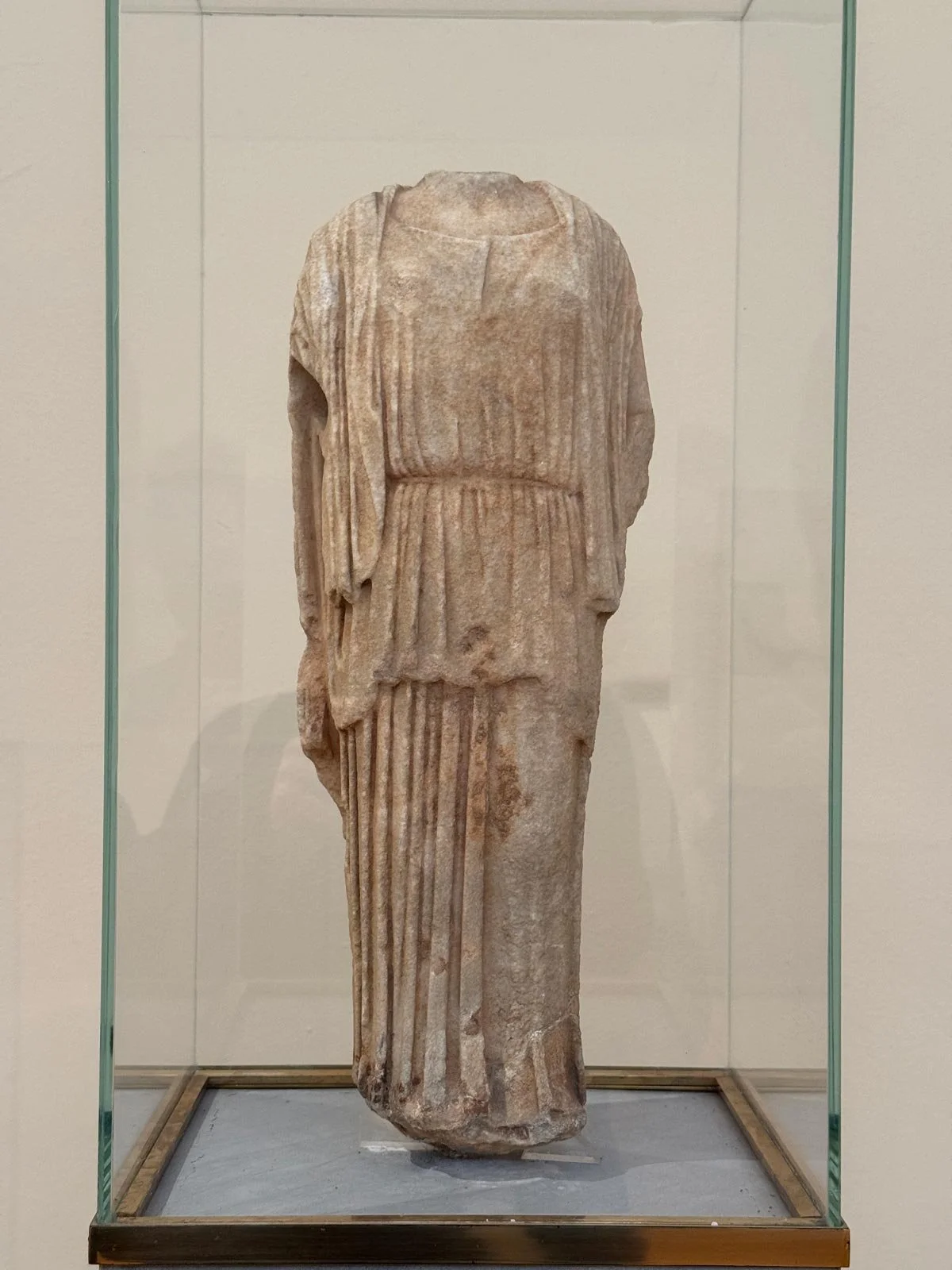
Museum lighting makes it easy to read carving choices: deep shadow cuts show where the sculptor wanted crisp edges, and smooth planes show where they wanted the cloth to feel heavy. Try tracing the fold lines with your eyes—they guide the whole composition.
Goddesses use drapery to project authority, not to hide
When a statue represents a goddess, clothing becomes even more strategic. A goddess is not merely “a woman.” She is a concept with a portfolio.
That’s why it helps to read divine statues through goddesses and their attributes. Attribute (object or symbol identifying a deity) is the easiest first clue. But drapery often does the deeper work: it tells us how that divinity operates in the world.
Take Athena. She’s a goddess of wisdom and war, and her imagery often merges restraint and power. She doesn’t need nudity to show strength. She can be armored, draped, and still dominate the space through posture, scale, and iconography. That’s why Athena as a case study matters here: Athena shows how “covered” can still mean “commanding.”
Even without naming specific statues, we can see the general pattern.
A goddess’s clothing tends to communicate:
Control: the body is not exposed as vulnerable.
Hierarchy: the figure’s presence is elevated through formal drapery and often grand scale.
Timelessness: heavy, orderly folds can make the figure feel beyond everyday life.
And paradoxically, drapery can also intensify presence. When cloth clings or ripples around the torso, the body becomes more noticeable, not less. The fabric frames it like stage lighting.
So female drapery isn’t simply the “opposite” of male nudity. It’s a different route to power. Male statues often signal virtue through the ideal nude body. Female divine statues often signal power through controlled visibility, sacred styling, and symbolic authority.
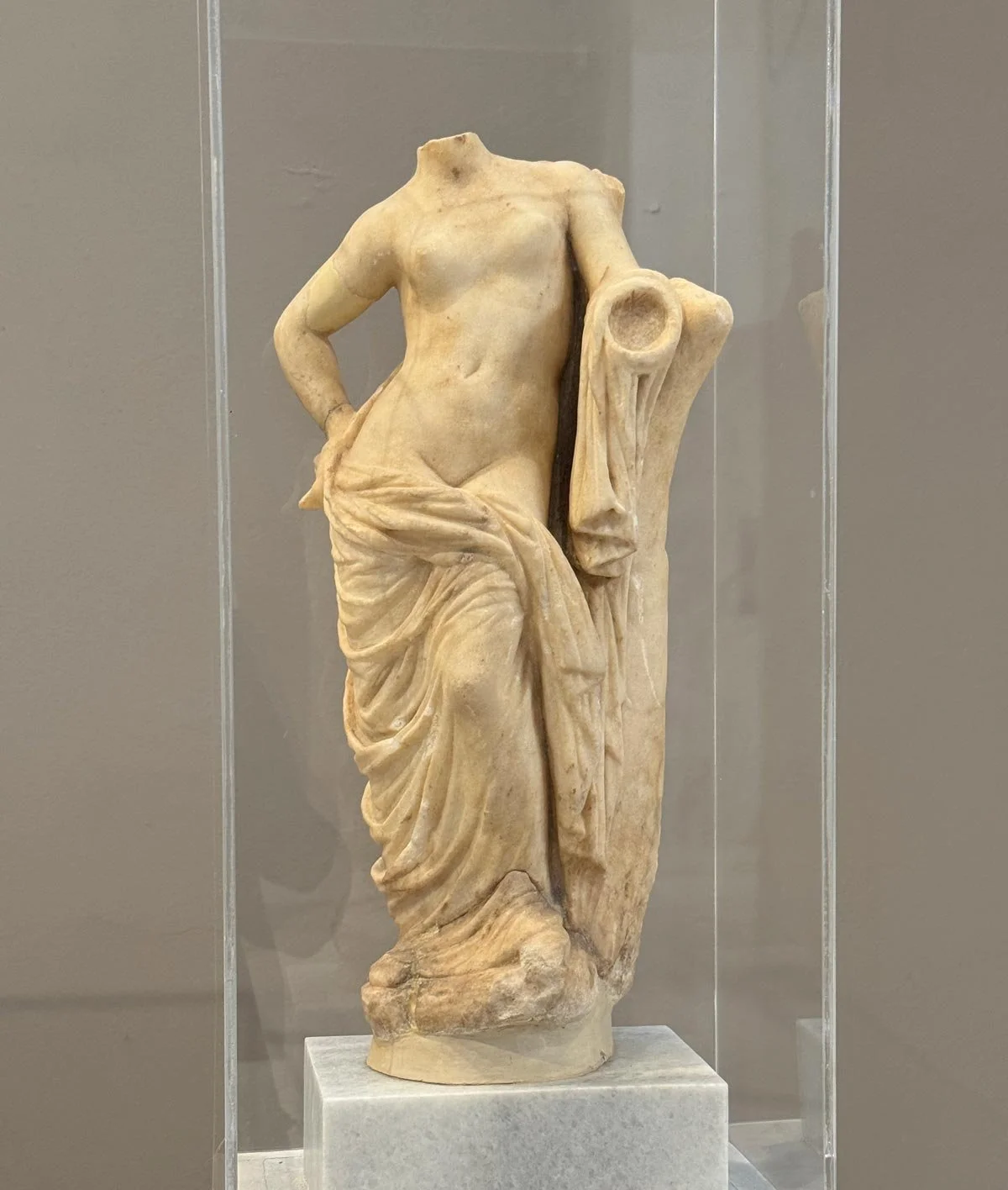
Small-scale figures like this are perfect for studying pose and silhouette without getting overwhelmed by size. The drapery at the hips isn’t just “clothing”—it’s a compositional tool that frames the body and stabilizes the stance.
Greek statues were not white, and drapery was part of the color story
If we keep imagining marble as pure white, we miss half the point.
Greek sculpture was often polychrome (painted in multiple colors). That matters for drapery because patterned borders, colored cloth, and painted details can change how we read the figure’s status and presence. Fabric in real life is not just folds. It’s dye, pattern, trim, and texture. Sculpture tried to approximate that through surface treatment.
That’s why it helps to remember color on statues. Once you allow for color, the drapery becomes less “abstract marble waves” and more “a garment with visual richness.”
Color can do several things at once:
separate garment layers so the body reads more clearly
highlight borders and patterned zones, which often signal refinement
intensify the figure’s visibility in a sanctuary or civic space
Even when pigment is mostly gone today, we’re not wrong to treat drapery as part of a larger sensory design. Greek viewers did not encounter these statues as silent white forms. They encountered them as crafted presences, often in bright light, with paint, metal attachments, and context doing a lot of meaning-work.

Conclusion
Female Greek statues are usually clothed, but the clothing is not a mute compromise. It’s a powerful visual system. Drapery can signal modesty, yes, but also status, motion, sacred authority, and a culturally specific idea of what “proper” power looks like in a female body.
When we learn to read cloth as language, we stop seeing “a thousand similar folds” and start seeing decisions: where the artist reveals the body, where they restrain it, how they elevate the figure, and what kind of social world that elevation assumes.
FAQ
Why are most female Greek statues clothed while male statues are nude?
Because clothing was strongly tied to female respectability in public imagery, while male nudity often signaled athletic or heroic virtue.
What is drapery in sculpture?
Drapery is carved cloth folds used to shape meaning, motion, and status.
Did Greek sculptors use drapery only to show modesty?
No. Drapery also communicates wealth, rank, movement, and sometimes divine authority.
Were female statues originally painted?
Often, yes. Greek sculpture commonly had polychromy, and color affected how garments and layers were read.
What’s a good “before” example for understanding later Classical drapery?
Archaic korai are a strong baseline because their clothing is formal and emblem-like compared to later, more dynamic drapery.
Sources and Further Reading
The Metropolitan Museum of Art — “The Chiton, Peplos, and Himation in Modern Dress” (2003)
Acropolis Museum — “Statue of a Kore: The ‘Peplos Kore’” (n.d.)
Cambridge University Press (Mireille M. Lee) — “The Body as Dress” (2015)
Cambridge University Press (DOI) — “The Body as Dress” (2015)
MDPI Applied Sciences — “Polychromy in Ancient Greek Sculpture: New Scientific Research on an Attic Funerary Stele at the Metropolitan Museum of Art” (2023)
The British Museum — “Figure of a seated woman wearing chiton and himation (museum object record)” (n.d.)
You may also like