Greek Architecture: Columns, Temples and Theatres Explained
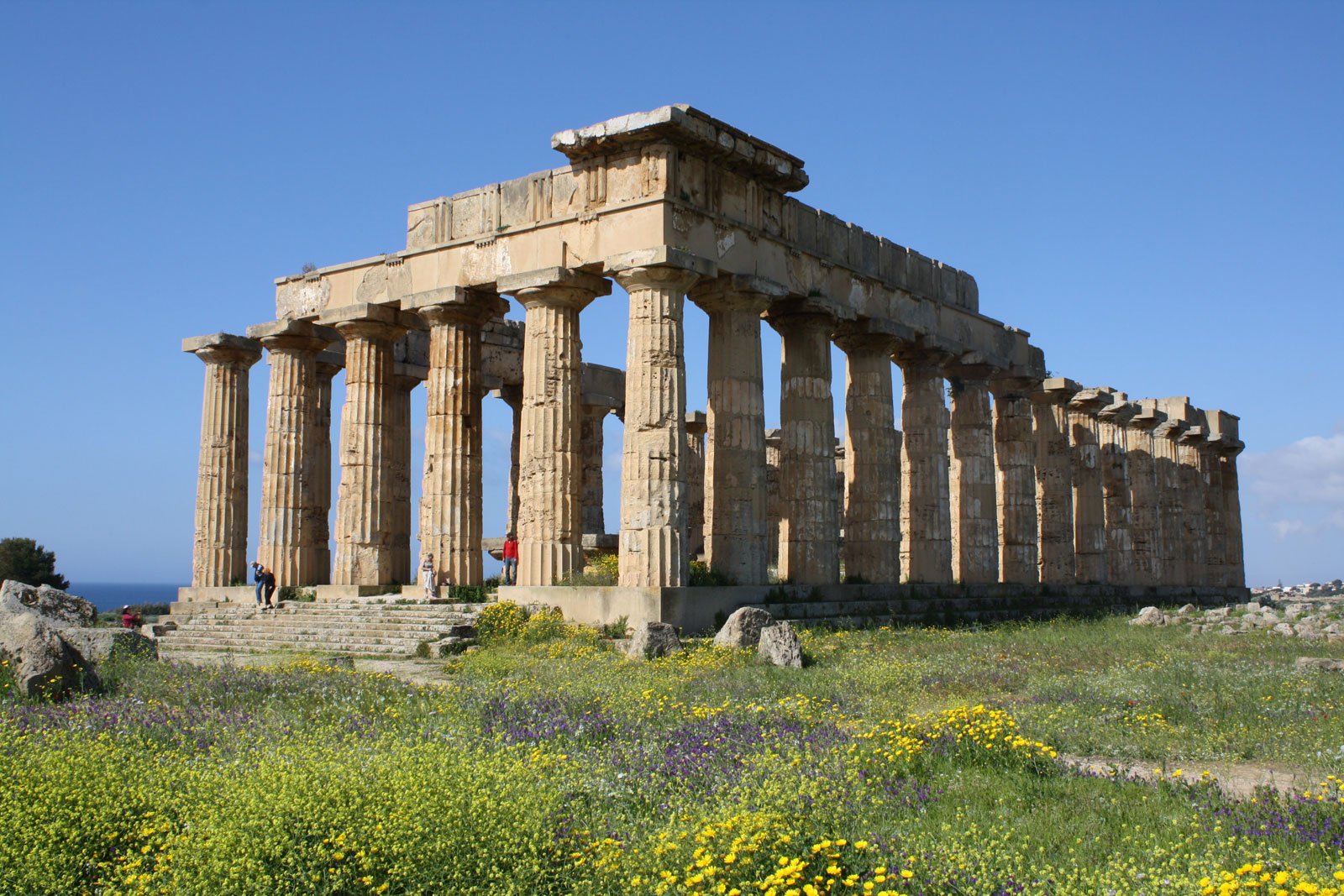
At Selinunte in Sicily, this massive Doric temple shows how Greek architecture travelled and adapted in the western Mediterranean.
Think of all the “important” buildings you know: museums with porticoes, courthouses with steps and columns, universities trying to look serious and classical. Most of them are quietly cosplaying Greek architecture. But if we only see the columns, we miss the real story. Greek buildings are not just pretty fronts. They are carefully tuned systems that organise how people move, gather and look at each other.
In this guide we slow things down. We will look at temples, theatres, stoas and houses to see how Greek builders used space to frame religion, politics and everyday life. Along the way, we will keep an eye on the core Greek architectural features that keep popping up: column types, stepped platforms, open courtyards. If you want to zoom in on any one building type later, you can jump to our walkthrough of the Greek temple layout or our overview of ancient Greek structures as a whole.
Greek architecture is the set of building types and design rules developed by Greek-speaking communities from roughly 800 to 30 BCE, including temples, theatres, stoas, houses and city plans.

Greek Architecture Is a System, Not Just a Row of Columns
We often meet Greek architecture as an image: a front with columns and a triangle on top. Behind that image is a structural system that repeats across many building types.
A typical Greek stone building starts with a krepidoma, a stack of low steps that raises the whole structure above the ground. The top step, the stylobate, is the platform where columns stand. This base is more than a pedestal. It corrects uneven ground, marks a threshold and forces you to climb, which already changes how you feel as you approach. On famous temples, the stylobate is not perfectly flat but slightly curved, a tiny adjustment that keeps the building from looking saggy at the edges.
Above the columns sits the entablature, the horizontal beam zone. In the Doric order, this includes a plain architrave and a frieze of triglyphs (vertical grooves) and metopes (square panels, sometimes carved). In the Ionic order, the frieze becomes a continuous band that can carry long sculpted scenes. We unpack how these elements work together, and how the three main orders differ, in our explainer on types of Greek columns and orders, with separate deep dives into the Doric column and Ionic columns.
Inside this frame, walls and roofs are fairly simple: stone or mudbrick walls, timber roofs with terracotta tiles. What makes Greek architecture distinctive is how consistent the system is. The same column and beam logic appears in temples, stoas and some civic buildings. That consistency lets Greek architects play fine visual games with proportion. By changing the height and spacing of columns, the thickness of capitals or the weight of the entablature, they can make a building feel heavy and solemn or light and agile.
So when you look at a ruin and see “just columns”, you are actually seeing the visible part of a complete sentence in architectural language. Once you start recognising the base, the column, the entablature and the crowning pediment as a coordinated set, Greek architecture stops being a style to copy and starts reading like a system you can analyse.
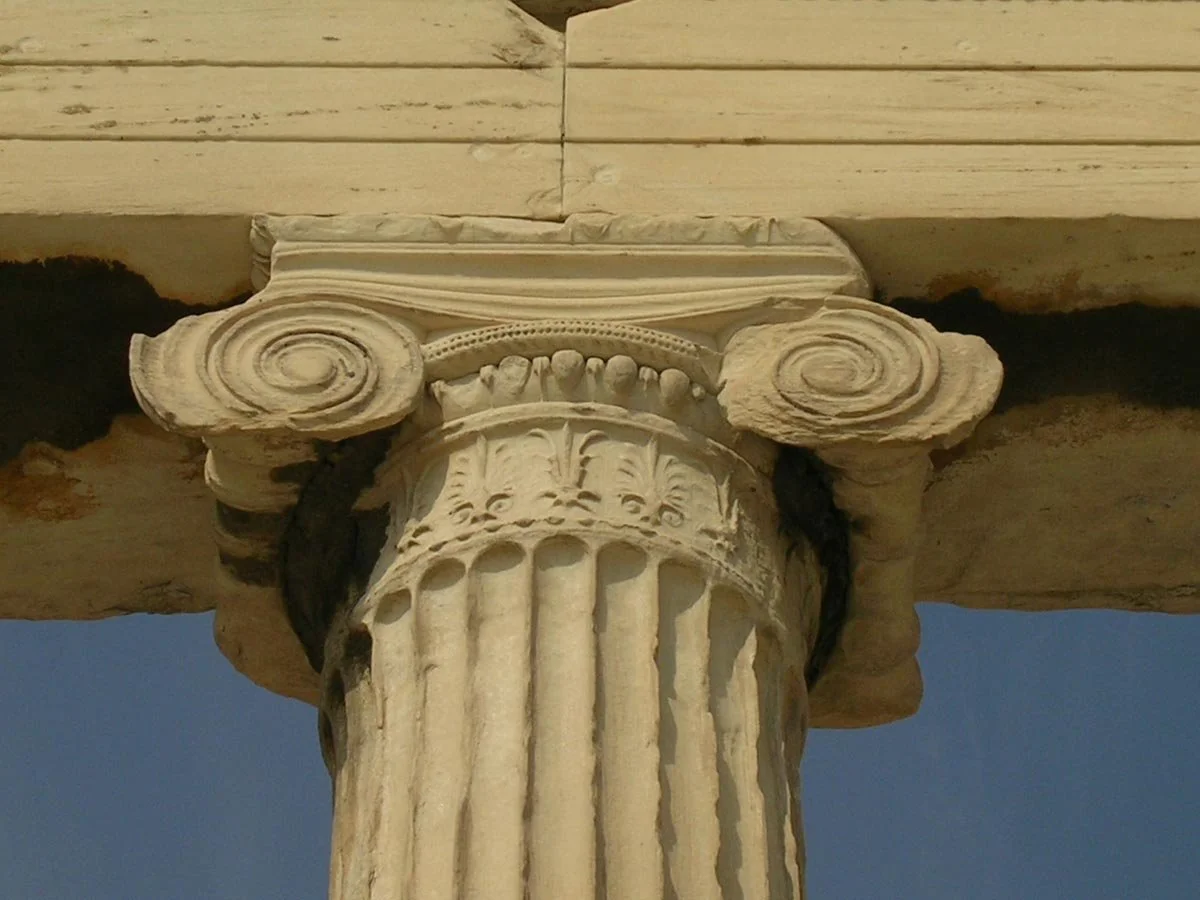
Ionic capital seen in detail, its spiraling volutes and carved molding showing how Greek architects turned stone into ornament.
Temples Turn Structure into Sacred Space
If there is one building type that sums up ancient Greek architecture, it is the temple. Not because Greeks spent all their time there, but because temples are where the architectural system is pushed hardest and refined most carefully.
A Greek temple is built around the naos or cella, the main room that houses the cult statue. Most visitors never go inside. The real ritual action happens outside at an altar, yet the temple shapes that outdoor zone. Our full tour in Greek Temples: How the Ancient Greeks Built for Their Gods follows that route step by step, from first stair to inner room.
From the outside, the key move is to wrap the naos in a peristyle, a ring of columns. These columns create a deep porch on one or more sides and a continuous shaded walkway around the building. Walking this perimeter lets worshippers circle the god’s house, pause to leave offerings and view sculpted details up close. At the same time, the peristyle makes the temple legible from far away. Even if you cannot see the statue, you see its “shell” and know where power is focused.
Temples do not come out of nowhere. Earlier Aegean buildings, especially the megaron, already use a long hall with a front porch and a central focus. The Archaic period translates those mostly wooden forms into stone, regularizes proportions and adds full colonnades. This is where the Doric and Ionic systems begin to stabilise. By the Classical era, temples like those on the Athenian Acropolis represent a mature language, where tiny tweaks to curvature, column spacing and corner details create big differences in how the whole composition feels.
What makes the temple so central is that it aligns ritual, structure and image. The steps choreograph your approach, the façade frames the altar, and the sculpted pediments and friezes tell stories that echo the cult inside. Understanding this type earns you a lot of transferable insight when you later look at other ancient Greek structures, because many of them borrow pieces of temple vocabulary for more secular purposes.
Mini-FAQ. Did Greeks worship inside the temple building? Most major sacrifices and festivals took place outside at an altar, with the temple acting as the god’s house and the visual focus of the sanctuary.
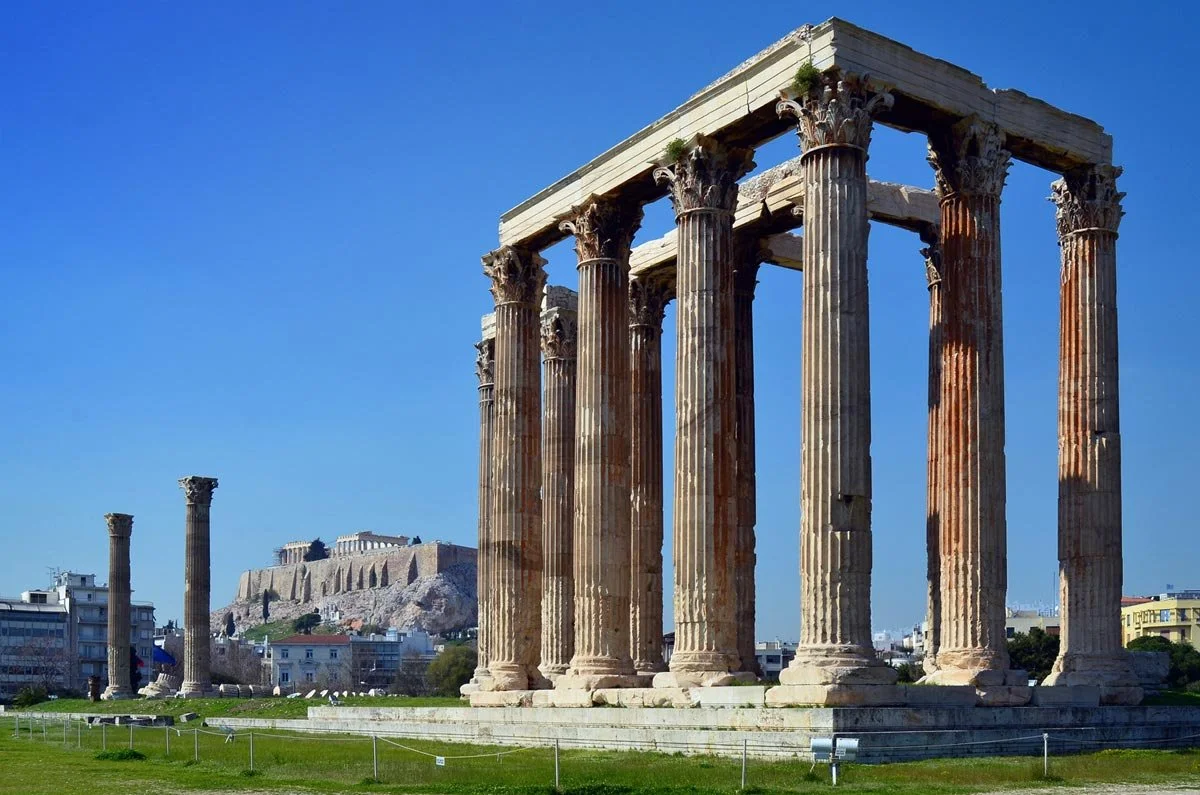
The towering Corinthian columns of Olympieion stand alone in Athens, framing a view back toward the Acropolis and the city.
Theatres and Stoas Shape Politics and Performance
If temples are about gods, theatres and stoas are about people looking at each other. They show how Greek architecture organises public life as carefully as it frames sacred space.
A Greek theatre is usually carved into a hillside. The sloped seating area, the cavea, wraps around a circular or semi-circular orchestra, the performance space. Behind the orchestra stands the skene, a stage building that provides a backdrop and space for costume changes. This arrangement uses the natural terrain to create excellent acoustics and sightlines without heavy construction. When you sit in the upper rows of a theatre like Epidaurus, you realise how precisely the steps, curves and angles are tuned to carry a human voice.
Theatre is not only entertainment. It is closely tied to civic and religious life. Plays are performed during festivals to Dionysus, often dealing with political and ethical questions relevant to the city. So the architecture is doing two jobs at once: hosting ritual drama and acting as a kind of open-air thought space where citizens see their world examined on stage. In that sense, “Greek temple and theatre” together form a complete picture of how built space supports both worship and debate.
Stoas, by contrast, are long, roofed colonnades that frame public spaces like agoras. A stoa might have one or two aisles of columns, with shops or offices at the back. Architecturally, it is a simple type. Socially, it is huge. Stoas provide shade, shelter from rain, and flexible zones for talking, trading and teaching. Philosophical schools are named after them. When we map ancient Greek structures, stoas are the connective tissue that holds markets, law courts, temples and council buildings together.
What both theatres and stoas show is that Greek architecture is very good at shaping how groups assemble. Stepped seating focuses attention on a central point. Parallel colonnades encourage drifting, stopping, small conversations. Neither type is primarily about façade image. Both are about use, movement and the everyday choreography of a city’s population.
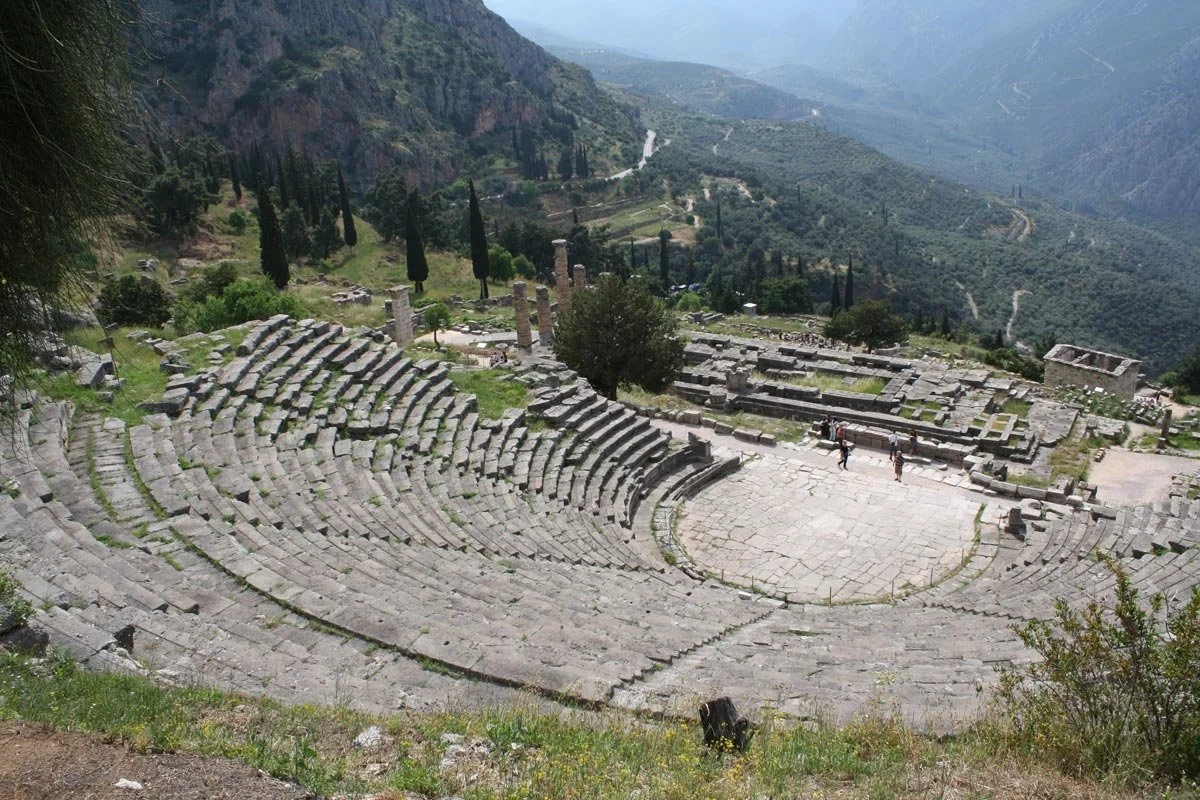
Delphi’s theater curves along the slope, stone seats opening onto the sanctuary below and the hazy mountain landscape beyond.
Houses and City Plans Reveal the Everyday Side of Greek Architecture
It is easy to forget that most Greeks never built a temple or a theatre. They lived in houses along streets, in neighbourhoods that often feel invisible compared to the big monuments. Looking at domestic architecture and city planning fills in that missing half.
A typical classical Greek house is organised around an internal courtyard, an open-air space that brings light and air into the surrounding rooms. Family life happens around this void: cooking, weaving, storage, sometimes small rituals. Rooms are arranged pragmatically rather than symmetrically. Some houses have a special dining room, the andron, used for male drinking parties. Our explainer on ancient Greek houses looks at how these plans vary between regions and over time, but the courtyard principle is a recurring thread.
On a larger scale, some Greek cities adopt more deliberate planning. The so-called Hippodamian plan uses a grid of streets, with residential blocks, public zones and harbour areas laid out in advance. Not every city follows this model, but where it appears, you can see a conscious attempt to link urban form and social order. The agora, temples and theatres occupy key nodes; houses fill in the rest with more modest materials but similar attention to orientation and access.
If we go back to the earlier Aegean world, buildings like the megaron show that this concern with circulation and focus is not new. What changes in the Greek city is how many people are involved and how many different building types have to work together. Temples anchor sanctuaries, theatres shape civic festivals, stoas frame markets, and houses knit everything together into lived districts.
When you put all this side by side, ancient Greek architecture stops being just a catalogue of column types. It becomes a set of tools for organising experience, from the most intimate domestic rituals to the largest public gatherings. The same care we admire in a temple façade also appears in how a doorway frames a courtyard, or how a street lines up with a distant sanctuary on a hill.
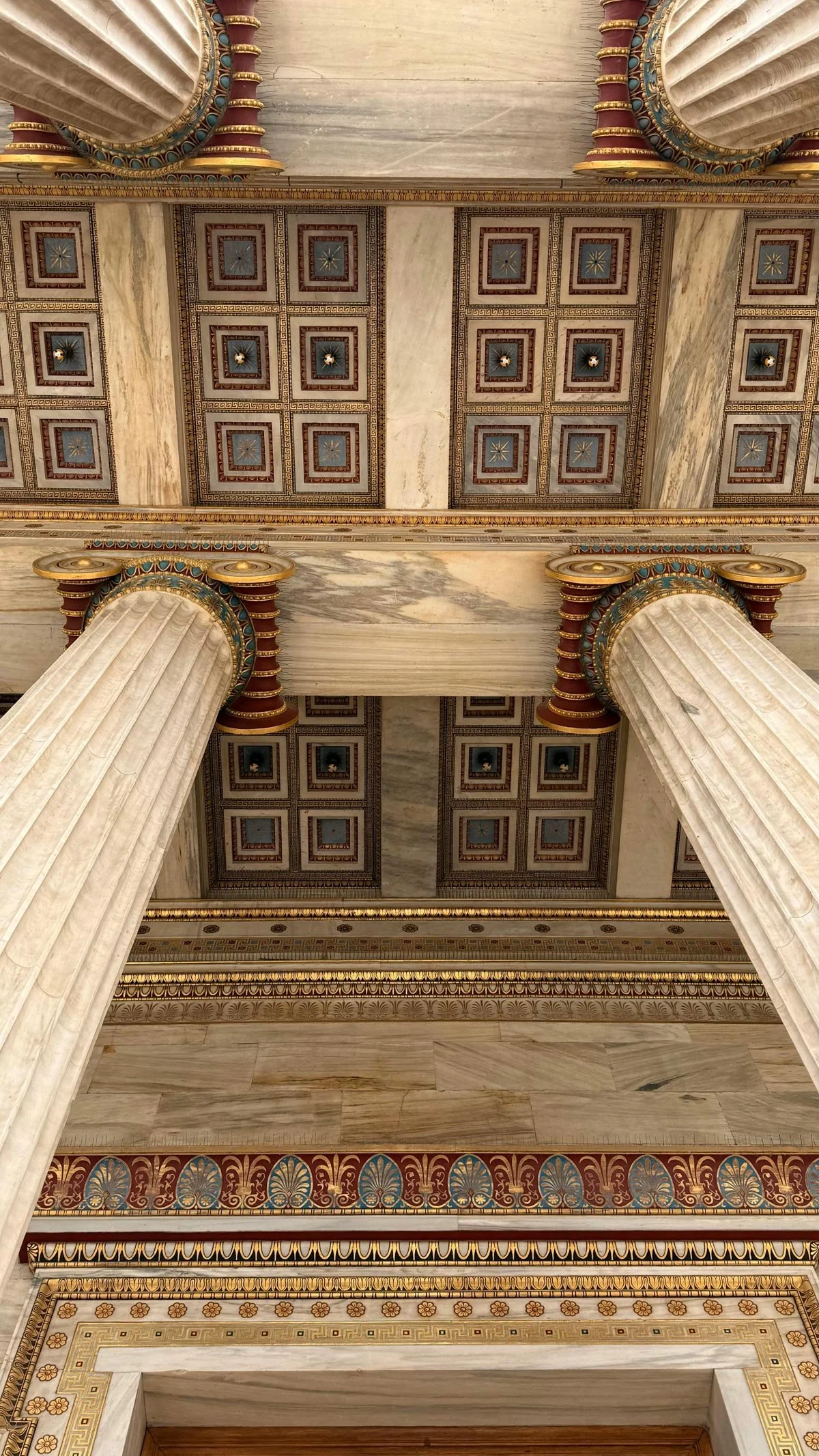
Looking up at a modern reconstruction of Greek polychromy, painted coffers and Ionic capitals restore color to white marble.
Conclusion
Greek architecture is easier to understand when we stop treating columns as isolated symbols and start seeing buildings as structured situations. Temples align stair, column and sculpture to focus worship on a god’s image. Theatres carve the landscape into a giant listening device for drama and debate. Stoas stretch along agoras, turning empty squares into usable, social interiors. Houses and city plans apply the same instincts at a smaller scale, shaping how families move, work and rest.
Once you know this, later architecture becomes easier to read too. Neoclassical banks and museums borrow the temple shell to project stability and authority. Modern university campuses echo the stoa when they arrange long porticoes around central lawns. Even simple courtyard houses today still replay Greek experiments with light, air and privacy. If you want to keep building your map, you can branch off into our guides to the Greek temple, our list of major ancient Greek structures, or our breakdown of Greek column types to see how each piece works in more detail.
Next time you visit a ruin or even a neoclassical building in your own city, try this quick exercise: trace the steps, count the columns, notice where the main view is directed, and ask what kind of gathering this space invites. In that moment, you are doing exactly what Greek architects wanted their users to do: reading space as something meaningful, not just as shelter.
You may also like