Greek Key Pattern: Why the Meander Border Is Everywhere
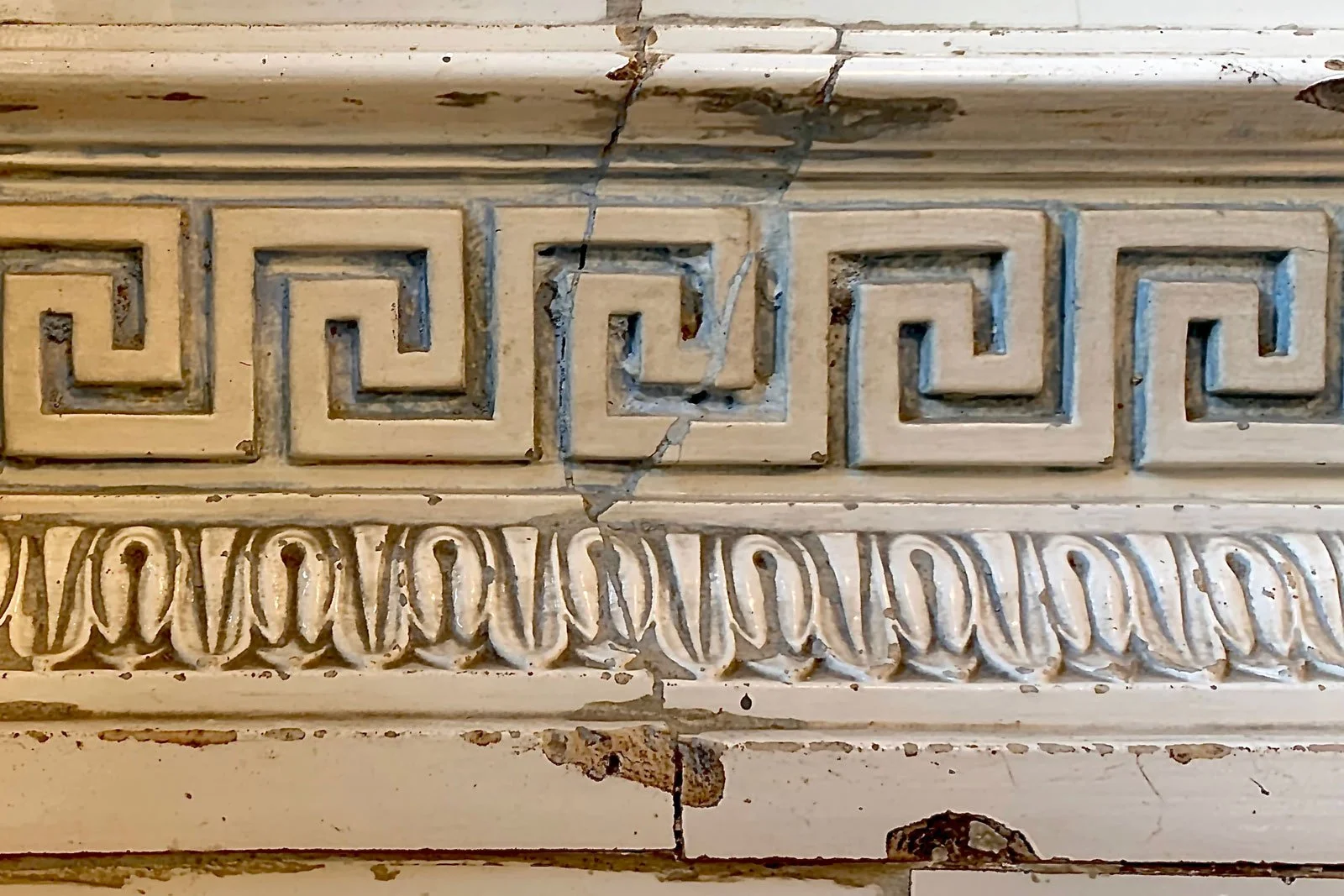
The Greek key and leaf border shows how a simple meander line became a signature motif, marching around walls, vases, floors and modern designs.
Once you start noticing it, you cannot stop. The Greek key pattern – that stepped, right angle line that turns back on itself – runs around temple friezes, vase rims, Roman mosaics and then quietly shows up again on hotel towels and brand logos. It is just a line, yet it feels weirdly satisfying, like a maze that never traps you.
In this guide we slow down and follow that line. We see what the Greek meander pattern actually is, how artists built it on Greek pottery, Greek vases and architecture, and what people have thought it meant, from river journeys to infinity. By the end, you should be able to spot it in museums and streetwear and understand why this one border became so addictive.
Myth vs Fact
Myth: The Greek key always meant “eternal love” in antiquity.
Fact: The pattern likely had multiple associations, and many strong symbolic meanings are later interpretations layered over a simple, flexible border motif.

The Greek key is a continuous line that became a Greek signature
Art historians use “meander” as the technical term for the Greek key pattern. At its simplest, it is a decorative border built from one continuous line that runs, turns at right angles, doubles back on itself, then repeats. Oxford’s Grove Art and reference entries describe it as a linear fretwork border that became especially prominent in Greek art during the Geometric period, around the 8th century BCE.
The name “meander” does not come from geometry but from geography. It refers to the Maeander River in Asia Minor, famous in antiquity for its twisting, looping course. Educator material from the Met and other institutions often explains the classroom version like this: the maze like border on a Geometric vase is called a meander because it recalls that winding river.
What makes the pattern feel so Greek is partly where it shows up. From the 8th century onwards, meander borders run around the necks and bellies of vases, mark the edges of metopes on temples, frame scenes on reliefs and appear in mosaic floors. A Met bowl from the 2nd century BCE, for example, frames a Dionysiac scene with a crisp meander band in relief, and cup fragments from Attic workshops preserve tondo scenes encircled by interior meanders.
At the same time, archaeologists remind us that linear key patterns are not uniquely Greek. Continuous line borders with right angle turns appear in Near Eastern, Etruscan and later Roman art, and in many other cultures. What Greek artists do is turn this simple device into a consistent “house style” and then keep evolving it, so it feels emblematic of ancient Greek art even if its family tree is wider.
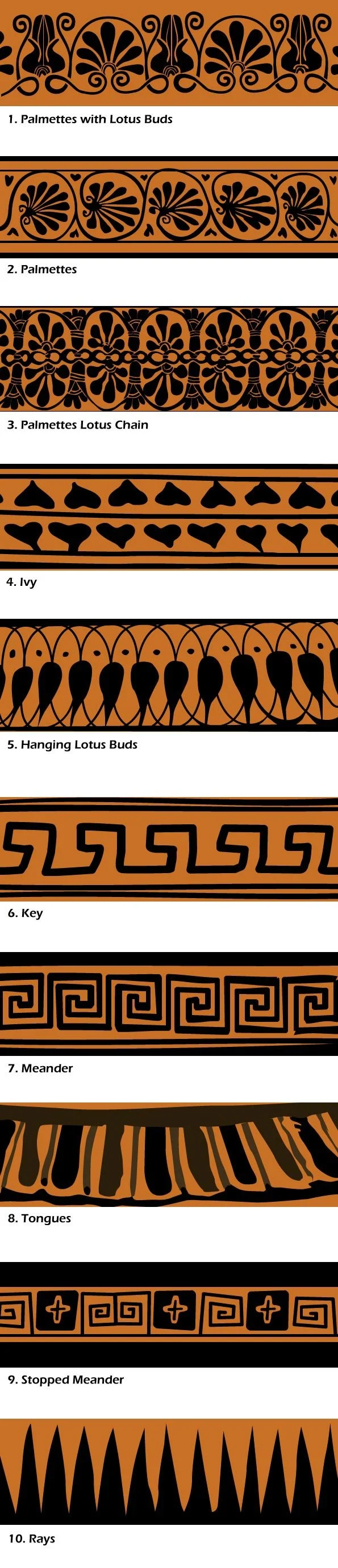
Infographic of typical Greek vase ornament, listing palmettes, ivy, lotus chains, meanders and rays used as repeating painted borders.
How the meander is built: from vase rims to temple friezes
If you strip away all the symbolic talk, the Greek key pattern is also just good design. It is easy to construct, works at many scales and adapts to different materials, which is why it spreads across pottery, stone and mosaic so smoothly.
On Greek pottery, the meander usually runs as a band near the lip or shoulder. In the Geometric period, painters use thick, even lines in black slip, turning corners at ninety degrees to build little squared spirals in a row. Educational guides note how this is almost like a graph paper exercise: you set a grid in your head, decide your unit length and then let the line walk, turn, walk, turn.
Later, in black figure and red figure, the pattern becomes a neat way to frame a narrative scene without pulling attention away from the figures. Fragments of Attic cups show meanders circling an interior tondo, with the pictorial action contained inside. The Princeton Corpus of Attic Vase Paintings describes warriors’ spears and limbs slipping under or against the meander band, which reveals how painters thought about the border as a hard edge that their figures could interact with.
Architects and sculptors pick up the same logic in stone. On temples, the meander often appears as a shallow relief band on geison blocks and friezes, sometimes combined with rosettes or palmettes. A Met corner block with a meander and rosettes in relief shows how the pattern can turn a literal corner while keeping the line continuous, which is a small geometrical challenge in itself. In mosaics, especially Roman ones influenced by Greek designs, meanders can become quite complex, twisting into swastika variants or multi strand “complex meanders” that art historians and mathematicians have analysed like visual algorithms.
Once you see the underlying rule – one unbroken line stepping around a grid – the pattern stops feeling mysterious and starts feeling like a toolkit. You realise why artists decorating everything from a krater to a Greek temple would reach for it. It is quick to lay out, it reads clearly from a distance, and it makes a clean boundary between image and plain surface in both pottery and Greek architecture.
What did the Greek key pattern actually mean?
So what about Greek key meaning. Did ancient viewers see this border as more than a neat frame. The honest answer is: we cannot pin down one official interpretation, but we can map some likely associations.
The most widely cited link is the Meander River itself. Because the word “meander” already meant a winding, twisting path in Greek, it makes sense that a long, wandering line would pick up that name. From there, many writers argue that the pattern evokes ideas of journeying, the flow of water or the passage of time. Design historians and classicists have also pointed out that an unbroken, interlocking pattern is an easy visual metaphor for continuity or eternity.
Modern blogs, jewellery houses and heritage sites often push this further, reading the Greek key pattern as a symbol of eternal life, unity, protective power or the bonds of love. Some of these meanings are grounded in older traditions, others are clearly later romantic layers. A useful way to handle them is to see them as accretions. Ancient artisans may well have liked the pattern for both practical and symbolic reasons, then later cultures added fresh readings as they reused it in new contexts.
We can also look at where the pattern appears. On grave markers, it sits above scenes of mourning or battle, where a continuous border can suggest an enclosing frame for the story of a life. On domestic objects, it might simply signal Greekness or classical taste, especially in later periods. In Etruscan tombs like the François Tomb, a small meander frieze runs above hunting scenes, acting as a neat divider rather than clearly preaching a message.
So when someone tells you “the Greek key means X”, it is fine to be gently sceptical. It is safer to say that the meander pattern carries a cluster of possible meanings – flow, continuity, order, maybe protection – that change slightly depending on whether it runs around a sanctuary, a symposium cup or a modern ring.
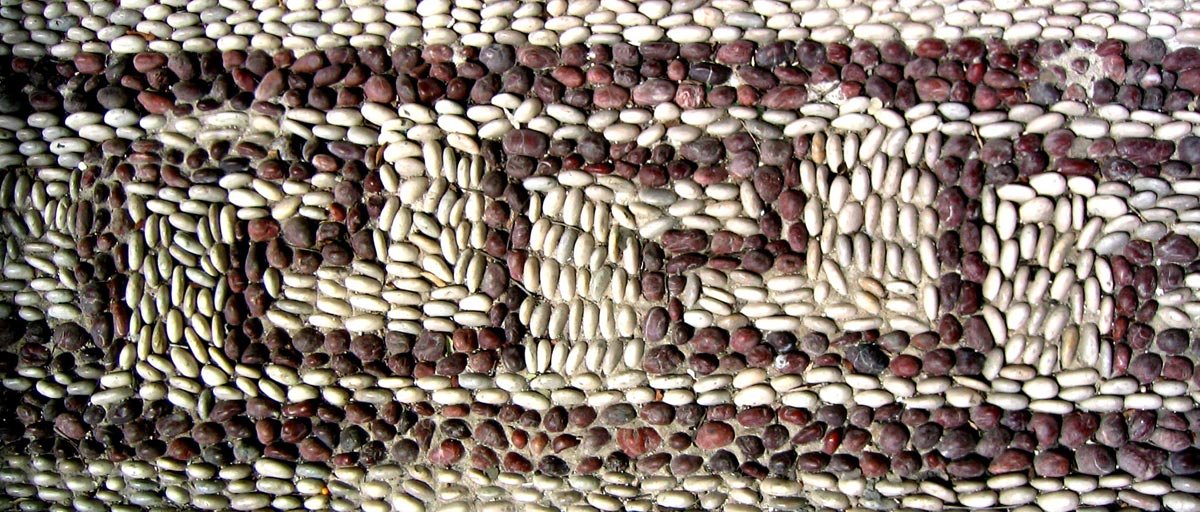
This Rhodes pebble mosaic turns the Greek key into texture, each small stone catching light so the meander seems to ripple softly.
Why the meander feels timeless in modern design
The last piece of the puzzle is us. Why does this very old border still feel so fresh in brand logos, textiles and jewellery.
One answer lies in that blend of geometry and flexibility. The meander has a clear rule, so it reads as orderly and rational, but it can be stretched, mirrored, doubled or rotated without losing its identity. Designers today can compress it into a tight frame around a logo, expand it into a big graphic band on a dress or quilt, or stylise it into a minimal icon. A Met exhibition on goddess imagery and fashion noted that Greek key borders are among the most common ancient motifs revived in modern garments, precisely because they sit so well on hems, belts and trims.
Another answer is cultural. Since the eighteenth century, Neoclassical architecture and decorative arts have used the Greek meander pattern as shorthand for “classical” style. Once that association is in place, any time we see the pattern on a hotel carpet or brand packaging our brain quietly reads: order, heritage, tradition, maybe a bit of luxury. That layering continues a process that already began in antiquity, when Romans adopted Greek motifs into their own mosaics and frescoes.
If you compare the meander to other Greek patterns – wave bands, palmette chains, lotus scrolls – you start to see why this one travelled so far. Waves and scrolls are more organic, which makes them beautiful but slightly harder to reduce. The meander is almost pixel like. It can be drawn with a ruler and used in black and white without losing impact, so it survives easily in print, digital graphics and even simple embroidery. That makes it an ideal bridge between ancient friezes, the painted borders on Minoan bull-leaping scenes and the graphic language of contemporary design.
Once you see it that way, the Greek key stops being just a “Greek souvenir” pattern and becomes a case study in how a tiny design decision can echo for millennia.
Conclusion
The Greek key pattern is one of those motifs that quietly does a lot of work. We watched a single continuous line turn into borders on Greek pottery and Greek vases, step onto temple friezes in Greek architecture, wind through mosaics and then resurface in Neoclassical and modern design. We saw that its “meaning” is not a fixed code but a bundle of associations – river, journey, infinity, order – that different cultures emphasised in different ways.
For me, the most helpful shift is to put the meander back into the bigger ecosystem of ancient Greek art and Greek patterns. When you stand in front of a vase or a frieze, you can now read that border as more than decoration. It is a smart design solution, a visual rhythm maker and a tiny carrier of Greek identity that kept travelling long after the original artisans were gone. Next time you spot the Greek key on a scarf or a logo, try mentally tracing the line back to a Geometric pot or an Aegean wall painting like Minoan bull-leaping. It is the same simple path, just walking through a very long history.
Sources and Further Reading
The Metropolitan Museum of Art — “The Greek Key and Divine Attributes in Modern Dress” (2003)
The Metropolitan Museum of Art — “Terracotta Megarian bowl” (2nd century BCE object page)
Oxford Art Online / Grove Art — “Meander” (encyclopedia entry)
Institute of Classical Architecture & Art — “The Complex Greek Meander” (2016)
Invaluable — “The History and Meaning Behind the Greek Key Pattern” (2021)
You may also like