Greek Vases: Shapes, Names and How the Greeks Used Them
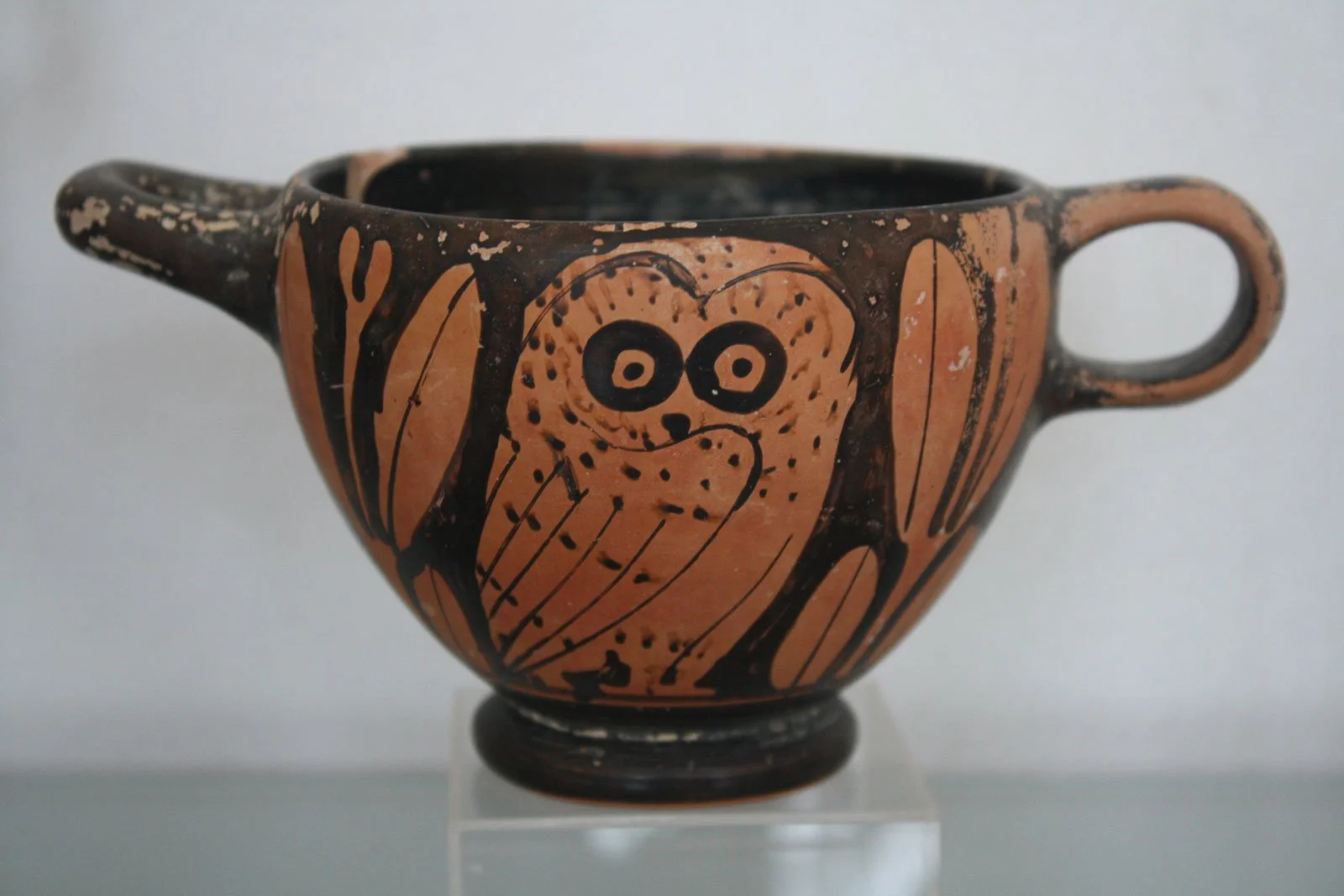
This owl cup, probably used for wine, bears Athena’s bird and the emblem of Athens, turning a small vessel into a witty tribute to city and goddess.
If Greek galleries feel like endless shelves of anonymous pots, you are exactly the reader this guide is for. Once we attach names and jobs to those silhouettes – amphora, krater, kylix and friends – the whole room changes. Suddenly you are not just looking at “vases”, you are looking at storage jars, mixing bowls and drinking cups doing specific work in Greek homes and rituals.
In this article, we stay very practical. We will match the main types of Greek vases to their shapes and functions, and keep tying them back to everyday life in ancient Greek houses and the painted scenes you see in ancient Greek art. If you want more on decoration and techniques, you can pair this with our broader guide to Greek pottery.
Definition
Greek vases are wheel-made ceramic vessels whose shapes, sizes and handles reflect specific storage, serving and ritual functions in ancient Greek life.

Greek vases link shape, handles and function
The simplest way to approach Greek vases is to remember that almost every shape solves a practical problem. Potters and users cared about how to store, pour, mix and drink, and vessel forms evolved to make those tasks easier.
Scholars usually group vases into a few broad categories: storage and transport, mixing, drinking, pouring, and oils and perfumes. Storage and transport shapes, like amphorae and pithoi, are tall with sturdy walls and handles that can take weight. Mixing vessels, like kraters, have wide mouths and broad bodies so wine and water can be combined and served. Cups and drinking shapes, such as kylikes and kantharoi, fit comfortably in the hand and balance well when raised.
The key is that function and form are not abstract. In Greek pottery we already talked about how iron rich Athenian clay, careful throwing on the wheel and controlled firing practices supported this variety. Here, we push further into what those forms actually did in daily life. In the pantry of a city house you might see big storage jars; at a symposium, a cluster of kraters, jugs and cups; at a grave, special lekythoi with white ground decoration. British Museum teaching materials and Smarthistory’s introductions both stress that shape is one of the most reliable clues for understanding context when you meet a vase in a museum today.
Once you accept that Greek vases are tools first, the names stop feeling like vocabulary to memorise and start feeling like shorthand for very specific actions: carry water, mix wine, pour oil, drink, store grain, mark a grave.
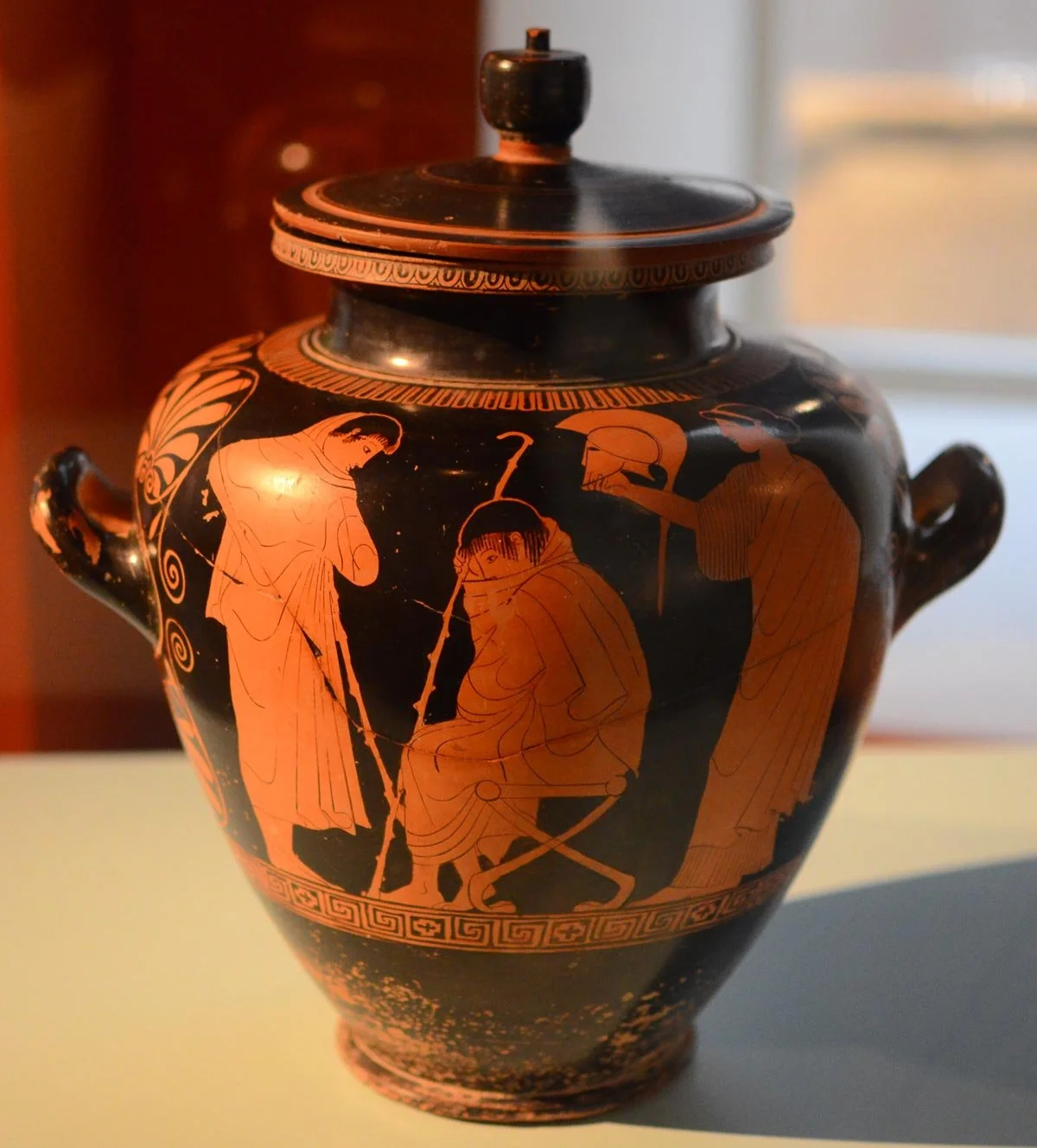
On this amphora by the Hephaisteion Painter, heroes gather at an altar, turning myth and ritual into a scene you can hold.
Main Greek vase shapes: amphora, krater, hydria, kylix and more
Let us give some of the most common Greek vase shapes a face and a job. There are many more, but if you learn this core group, most museum shelves will already feel much clearer.
The amphora is the all round storage and transport jar. It has two vertical handles, a relatively narrow neck and a pointed or flat base. Traders used amphorae to ship oil, wine and other goods; households reused them in storage. Special versions, like Panathenaic prize amphorae, were large, decorated and filled with olive oil as awards. Typology guides and museum catalogues treat the amphora as the backbone of Greek ceramic production. We zoom in on this form and its variants in our separate article on the amphora vase.
The krater is a mixing bowl for wine and water. Its wide mouth and deep body make it ideal for diluting wine at symposia, the all male drinking parties we know from texts and painted scenes. There are several subtypes – bell krater, volute krater, calyx krater – but all share that basic function of being a central mixing vessel on the drinking floor. Smarthistory uses kraters repeatedly to illustrate how shape ties into social practice.
A hydria is a water jar with three handles: two horizontal ones for lifting and a vertical one at the back for pouring. Women are often shown carrying hydriai from fountains in vase paintings, and some famous prestige pieces, like the Meidias hydria, show how the shape could move from daily use into the realm of luxury and display.
Drinking shapes include the kylix, a shallow cup with a wide bowl and two horizontal handles, and the kantharos, a deeper cup with high loop handles. Kylikes often carry images inside the bowl that only appear as the drinker empties the cup, turning each sip into a small visual game. Kantharoi have strong associations with Dionysos in myth and art. These forms appear constantly in our sources on symposia and in the painted scenes we explore in ancient Greek paintings and Greek paintings.
For pouring, the standard form is the oinochoe, a jug with one handle and a mouth shaped for controlled flow. Its name literally means “wine pourer”. Variants like the chous are associated with specific festivals. Other specialised shapes include lekythoi and aryballoi for oils and perfumes, pyxides as lidded boxes, and tall loutrophoroi used in wedding and funerary rituals. Yale’s shape lists and the Beazley Archive make clear that these names are modern scholarly conventions, but they do reflect real differences in form and use.
You do not need to memorise every subtype. If you can recognise amphora, krater, hydria, kylix, oinochoe and lekythos, you already have a basic map of the table and the house in ceramic form.
Mini-FAQ
Q: What are the main types of Greek vases?
A: Common types include amphora (storage), krater (mixing), hydria (water), kylix and kantharos (drinking), oinochoe (pouring) and lekythos (oil and perfume).
How Greeks actually used these vases in homes, rituals and burials
Names and shapes are one thing; seeing how Greek vases lived in real spaces is another. Here it helps to picture a few settings and place the vessels inside them.
In a typical citizen house like those we explore in ancient Greek houses, larger amphorae might stand in storage rooms or courtyards, holding grain, oil or wine. Hydriai would be carried to and from the public fountain, a daily task often shown on painted vases themselves. Smaller containers for perfume or cosmetics sat in women’s quarters, while simple cups and bowls circulated during meals. Archaeological reports and syntheses in the Oxford Classical Dictionary point out that many plain wares never enter museum collections, even though they carried much of the real work.
At a symposium, the cast of vessels changes. A large krater anchors the room; slaves bring water and wine, mix them in the bowl, and use oinochoai to refill kylikes and kantharoi. The outside of a krater might show exactly this kind of gathering, creating a loop between image and use. Smarthistory’s essays on vase painting and symposium culture note how tightly the shapes are tied to social roles: who reclines, who pours, who plays music, who serves.
In ritual and funerary contexts, some shapes take on specialised roles. Tall loutrophoroi appear in wedding and funeral ceremonies; white ground lekythoi are placed on graves, carrying scenes of parting and offerings. Hydriai can be reused as ash containers. British Museum and other institutional resources stress that certain forms become almost symbolic within specific ritual scripts, even when they are no longer used in a purely functional way.
All of this means that, when you stand in front of a case of Greek vases, you are also looking at slices of life: people moving through rooms, fetching water, organising dinners, burying their dead. The same objects that now sit behind glass once clinked on stone floors and wooden tables, in the spaces we reconstruct in ancient Greek houses and across the visual world of ancient Greek art.
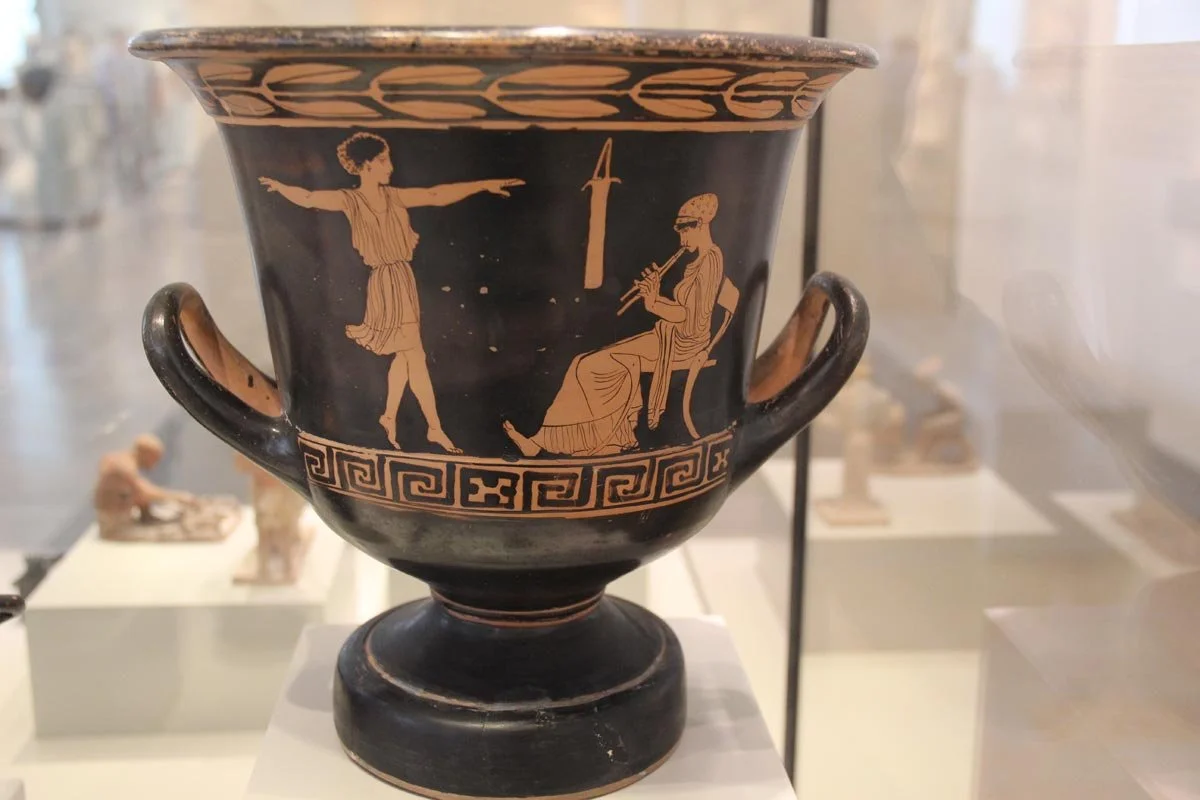
This calyx-krater by the Berlin Dancers Painter freezes a dance lesson mid-step, showing how Athenian pottery staged everyday moments.
How to read a Greek vase quickly without feeling lost
So how do we read Greek vases today without drowning in detail? A few simple steps can make even a short museum visit much more satisfying.
First, identify the shape and probable job. Is the vessel tall with two handles and a narrow neck (amphora)? Wide with big handles and a huge mouth (krater)? Shallow and wide with low handles (kylix)? Use the core set from this article to make your best match. Smarthistory and shape guides like those from Yale and the Beazley Archive confirm that even approximate identifications already help place an object in its social setting.
Second, look at the decoration with that job in mind. A krater used at a symposium often carries symposia or mythological feasts; an oil lekythos used at graves often shows visits to tombs or quiet, reflective scenes. This is where everything you learned in Greek pottery comes back: black figure, red figure and white ground are not just stylistic labels, they also carry period and function clues. Our article on Greek black figure pottery digs into that side more fully.
Third, notice patterns and framing. Meanders, lotus–palmette chains and other borders, which we explore separately in Greek patterns, divide the surface into registers and focus areas. The main story might be in a central band, with more abstract design above and below. Recognising that structure helps you “read” the pot in an organised way rather than scanning randomly.
Finally, remember that each vase is also a piece of evidence in the bigger story of ancient Greek art. Because so little wall painting survives, scholars rely heavily on vases to reconstruct clothing, furniture, architecture and ritual gestures. Academic overviews repeatedly stress how central ceramic evidence is to our understanding of Greek visual culture.
Once you build the habit of matching shape, job and scene, Greek vases stop being anonymous. They become small, portable windows into rooms, streets and sanctuaries that no longer exist.
Conclusion
Greek vases can feel like a technical topic at first: too many names, too many handles. But once we slowed down, a much cleaner picture appeared. We saw how core shapes – amphora, krater, hydria, kylix, oinochoe, lekythos – linked very directly to storing, mixing, pouring, drinking and marking rituals. We placed those vessels back into ancient Greek houses, sanctuaries and graves, and we used their painted surfaces as bridges to the wider world of Greek pottery and ancient Greek art.
For me, the most helpful mindset shift is to treat each vase as a tool with a memory. The shape tells you what it did; the scene tells you what people thought was worth showing on that tool. If you keep this article open when you next scroll through a museum website or walk into a gallery, try choosing one vessel and doing the full exercise: name the shape, guess the job, read the image, then place it mentally in a house, a symposium or a ritual. That one slow look will teach you more than racing past a hundred labels.
You may also like