Bull-Leaping Fresco: Sport, Ritual or Propaganda?
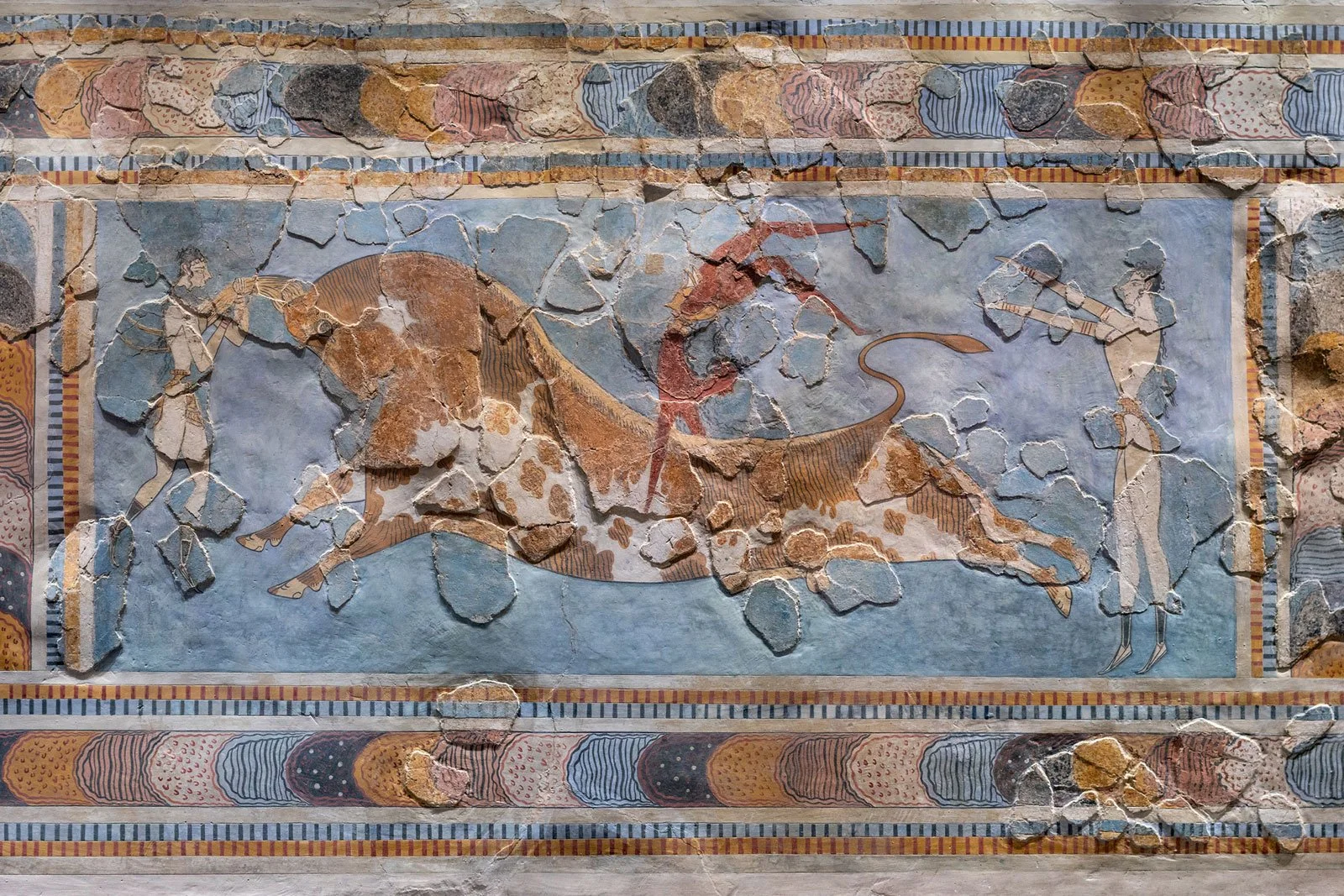
The bull-leaping fresco captures the drama of human bodies confronting a powerful animal, raising questions about sport, ritual, and spectacle in Minoan culture.
Imagine walking into the palace at Knossos. On an upper wall you see a huge bull, frozen mid-charge, its back arched like a spring. Tiny human bodies twist around it: one grabbing the horns, one somersaulting over the spine, one landing behind the tail. The background is a clear, flat blue. Everything feels fast, but also strangely calm.
This is the famous Minoan bull-leaping fresco from Knossos, now in the Heraklion Archaeological Museum. It has become almost a logo for Minoan Crete. But what, exactly, are we looking at here. Is this a real sport, a ritual performance, a symbolic image, or a kind of Bronze Age propaganda poster for the palace itself.
In this analysis, we will slow the scene right down: first the object, then the bodies, then the possible meanings.

A charging bull on a palace wall
The first thing to pin down is that this is not a casual painting. It is a palace fresco, a wall painting made on fresh plaster, probably in the east wing of the Knossos complex, and dated to around 1450 BCE. The panel is about 78 cm high, made of stucco in low relief and then painted. It was reconstructed from fragments, which means that both original and modern work coexist in what we see today.
The composition is simple but intense. A powerful bull runs horizontally across the panel, all four legs off the ground in a long flying gallop. Its body is elongated and curved, exaggerated to underline speed and danger. Around it, three human figures are placed in a sequence: one at the front, apparently grabbing or steadying the horns; one in the middle, upside down over the bull’s back; one at the rear, standing with arms out, as if just landed or about to catch the leaper. Many scholars think we are not seeing three different people in random positions, but three moments of one acrobat’s movement compressed into a single image.
Color works as a code. In many Minoan paintings, men are painted dark reddish-brown, women a paler white. Here, the middle leaper is dark, while the figures at the front and back are pale. That has led to readings where a male athlete executes the leap, assisted or framed by female participants. It is worth remembering that the painting has been heavily restored; some details of the border and even figures may not be exactly as ancient painters left them. The main composition is well grounded in the surviving fragments, but we should be cautious about treating every line as hard evidence.
What we can say safely is that this fresco belongs to the wider world of Minoan frescoes: bright colors, rhythmic lines, and bodies in motion, often set against flat fields of blue or red. Together they turn palace walls into animated surfaces, especially around courts and ceremonial spaces in the heart of Minoan civilization.
How realistic is this leap, and who is doing it?
At first glance, the scene looks like sport. We recognise the logic: human vs animal, risk, skill, the satisfaction of a successful jump. Archaeologists have found small sculptures and sealstones showing similar bull-leaping moves, suggesting that this was not a one-off fantasy. There is even a carved ivory figurine of a bull-leaper in the Heraklion museum that shows a body arched over a bull in a way that matches the fresco.
But when we ask “could this really be done exactly like this,” things get more complicated. Modern experiments with cattle and acrobatics suggest that vaulting over a charging bull by grabbing the horns and flipping is extremely dangerous and physically demanding, even if not impossible. The bull’s movement, weight and unpredictability make the neat rhythm of the fresco unlikely as a repeated, everyday stunt. The painting also compresses action: the three figures probably show phases of a leap, not three people moving at once in a choreographed trio.
Then we have the gender question. If we apply the usual Minoan color code, the two pale figures are female and the central dark figure male. That means the scene is not just “men doing a daredevil thing with a bull.” It is a mixed-gender performance where women are present at the start and end of the sequence, maybe as assistants, maybe as fellow athletes, maybe as ritual participants. This fits with other Minoan images where women appear very actively in processions and ceremonies, not just standing in the background.
So is this an accurate sports photograph in paint. Probably not. It is more likely a stylised diagram of a performance that happened in some form, polished into a smooth sequence and floated against a clear background. That stylisation is typical of Minoan art: the goal is not to record every messy detail, but to capture the energy and pattern of a ritual or event.
Myth vs Fact
Myth: The bull-leaping fresco is a literal snapshot of one athletic jump, performed regularly like a modern sport.
Fact: The fresco is a stylised, compressed image of an event that was likely rare, dangerous and tightly controlled, with its exact form still debated by scholars.
Sport, ritual performance or royal propaganda?
So where does this leave the big question: what was bull-leaping in Minoan culture.
Most researchers agree that bulls were charged symbols in Minoan religion. Horns of consecration, bull-head rhyta (libation vessels) and other images suggest that bulls linked to ideas of strength, fertility and perhaps to specific gods or goddesses. That means any event involving bulls in the central courts of palaces was almost certainly more than just entertainment.
One popular reading sees bull-leaping as ritualised sport: an elite performance that combined athletic display with sacrifice or religious meaning, a bit like dangerous festival sports in later cultures. The location of bull-leaping images near palace courts supports this. These were spaces where public ceremonies, processions and perhaps performances took place, with rulers and high-status viewers watching from balconies and stands.
Another layer is propaganda, even if the word is modern. Decorating palace walls with repeated scenes of controlled danger – humans literally vaulting over a force of nature – sends a message: “Here, within this palace system, we can turn raw animal power into choreographed display.” It shows the court as a place where risk is mastered and transformed into spectacle. For visiting elites or subjects, that must have been an impressive, maybe intimidating visual statement.
Of course, we also have to factor in modern restoration and interpretation. The bull-leaping fresco we see today is the result of early twentieth-century reconstruction. Some framing details and even parts of figures were filled in based on best guesses. Later studies have questioned parts of that restoration, arguing that side borders may not reflect the original fragments. That does not cancel the core image, but it reminds us to be careful about over-reading specific lines or poses.
So the safest answer to “sport, ritual or propaganda” is: some combination of all three. Bull-leaping was probably a real, rare, extremely risky event with religious significance, staged in palace courts and then amplified on palace walls to underline the power and identity of Knossos and other centres of Minoan civilization.
Conclusion
Seen up close, the Minoan bull-leaping fresco is less a simple action scene and more a carefully engineered image about control, danger and display. A single charging bull and three slim human bodies concentrate a whole network of ideas: sacred animals, elite performance, mixed-gender roles, the centrality of palace courts, and the desire of rulers to frame themselves as masters of both nature and risk.
For our wider Aegean journey, this fresco sits at a crossroads. It belongs to the flowing, color-rich world of Minoan frescoes, it plugs into the cult symbols you meet in Minoan religion, and it hangs on the walls of palaces that anchor Minoan civilization. It is also a good example of how we, as modern viewers, have to live with uncertainty: we can reconstruct techniques and spaces in detail, but the exact feel of the performance will always be partly out of reach.
If this close reading helps you look at the bull-leaping panel not just as “that famous Minoan picture” but as a layered object – paint, plaster, reconstruction, ritual, politics – then you are already thinking like an art historian. Next steps could be to compare it with other bull images in Minoan art, or to track how later Greek myths about bulls and labyrinths reuse this visual language in storytelling.
Sources and Further Reading
Heraklion Archaeological Museum — “The Bull-Leaping Fresco” (n.d.) (heraklionmuseum.gr)
Smarthistory — “Bull-leaping fresco from the palace of Knossos” (2020) (Smarthistory)
Smarthistory — “Minoan art, an introduction” (2020) (Smarthistory)
Knossos-Palace.gr — “The Bull-Leaping Fresco” (2024) (Knossos Palace)
Rhodes College — “Minoan Frescoes: Conservation Techniques and Controversies” (n.d.) (sites.rhodes.edu)
UNESCO World Heritage Centre — “Minoan Palatial Centres” (2025) (whc.unesco.org)
You may also like