Ancient Greek Houses: How People Lived Behind the Temples
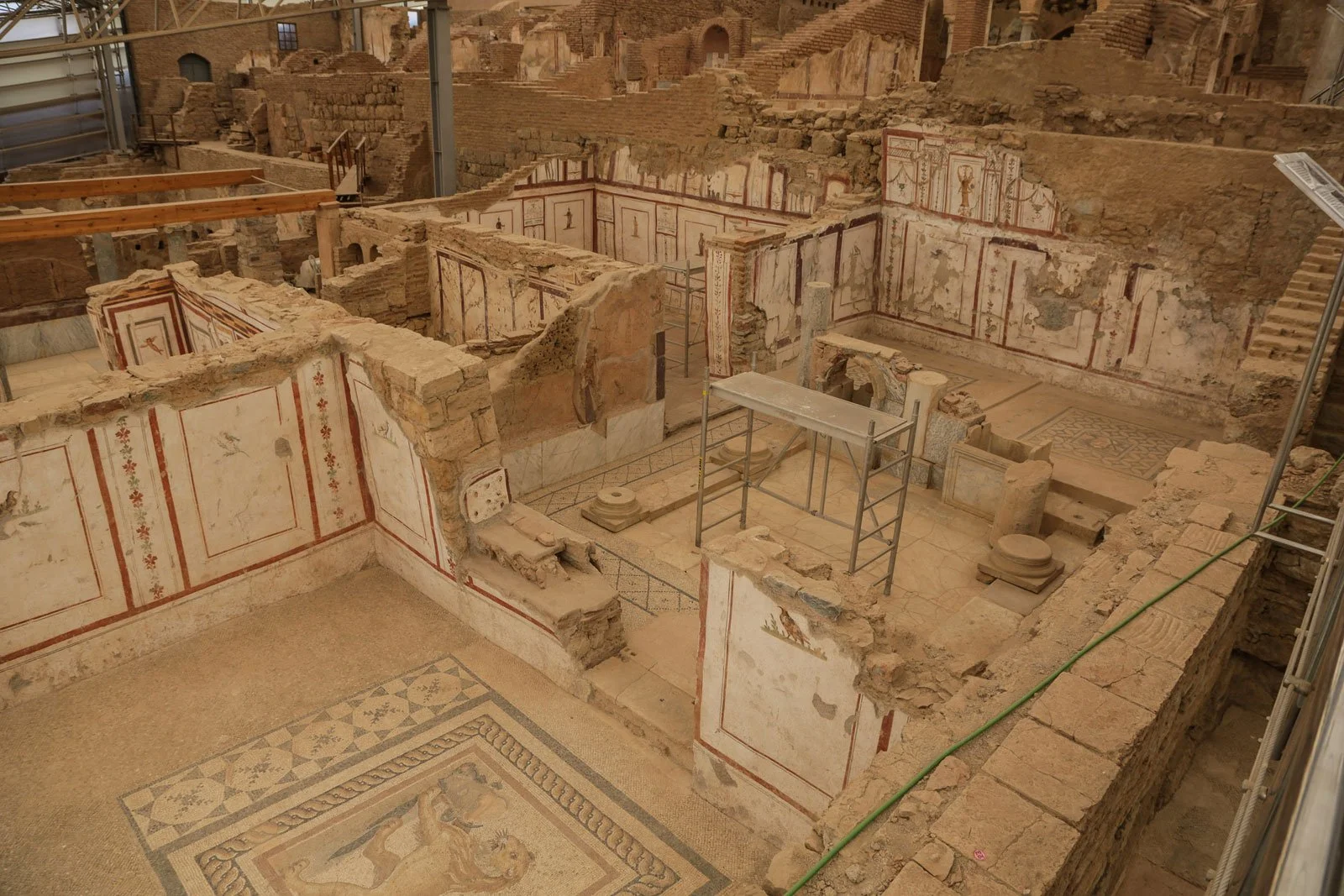
Terraced Roman houses at Ephesus show elite life: painted walls, mosaic floors and stacked rooms climbing the hill in a compact townhouse block.
If you picture ancient Greece, you probably see marble temples on hills, not cramped streets and neighbours arguing over a doorway. Yet most Greek lives unfolded not in front of columns, but inside small, inward-looking houses that rarely make it into textbooks. Once we step past the temple façades and into these domestic spaces, questions pile up: where did people sleep, cook, work, pray, argue, or escape the midday sun?
In this guide, we walk into a typical house in a Greek polis and stay a while. We start at the street door, cross the courtyard, and move through rooms that look plain on a plan but carried heavy social rules: who could enter, who watched whom, who served whom. Along the way, we link domestic layouts to the wider web of ancient Greek structures, city-states and artworks you meet elsewhere on The Art Newbie.

Greek houses turn their backs to the street and open around a courtyard
A striking thing about many Greek houses is what you do not see from the street. Instead of big windows and balconies, you often get a blank wall and a single, modest door opening onto a narrow lane. Step through that door, though, and the house flips open: a central courtyard, sometimes with a small colonnade or portico, becomes the brightest, most public internal space of the home.
Archaeology in places like Olynthus and Classical Athens shows that these courtyard houses are a standard urban solution: rooms cluster around a more or less square open space where light, air and social life concentrate. It is here that cooking fires might be set up on portable braziers, weaving could move into the sun, and children and animals circulate while adults work or talk. Scholars sometimes call this layout an “oikos” or courtyard house type, in contrast with earlier, more linear “megaron” plans that had one big hall rather than many small rooms around a court.
This inward focus is not just an aesthetic choice; it reflects privacy in dense cities. When your walls touch your neighbours’ walls, windows onto the street are not appealing. Instead, you turn your house towards its own micro-world, shielding family life from passers-by and controlling who sees in. The courtyard becomes your internal square, a domestic version of the open spaces that shape life inside Greek city-states. At the same time, that single controlled entrance explains why so many Greek texts and legal speeches obsess about who crosses the threshold and when.
For us, used to façades and “curb appeal”, these houses can feel almost defensive. But once you imagine the noise, heat and dust of a busy polis, the logic becomes clear: the street is where you move through, the courtyard is where you live.

View along a rocky track on a wooded hill near Athens, where worn bedrock and distant city skyline evoke layers of ancient and modern life.
Inside the house, space is flexible but not random
So what actually sits around that courtyard? On a typical plan, you might find a main room for entertaining male guests (the andron), storage spaces, a kitchen area, small sleeping rooms and perhaps a staircase up to an upper floor. Greek authors also mention a gynaikonitis, often glossed as “women’s quarters”, which has encouraged the idea of houses split into strict male and female zones.
Modern archaeology suggests a more flexible picture. In the courtyard houses studied at Olynthus and elsewhere, the same types of tools and objects show up in multiple rooms: loom weights in different corners, cooking equipment in various spots, storage vessels scattered rather than confined to one pantry. That pattern implies multi-purpose spaces, where the same room could host weaving one day and sleeping or storage the next, depending on the needs of the household.
Myth vs Fact
Myth: Ancient Greek houses had rigid “men’s” and “women’s” rooms with locked doors.
Fact: Some texts describe strong separation, but archaeological evidence shows overlapping uses and movement throughout the house.
Gender still matters, but more as a rule about who meets whom, and when, than about fixed architectural labels. The andron, with its couches set up for drinking parties, is clearly coded male and used for symposia. Yet even that space is not as simple as “men only”: visual sources show entertainers and service staff moving in and out, and activity traces suggest that boundaries were negotiated in practice. Meanwhile, rooms associated with women’s work, like weaving or food preparation, also open onto the courtyard, where visitors might pass through.
This mix of literary ideals and messy material evidence is one reason ancient Greek houses are so interesting to study. They remind us that floor plans do not fully capture social rules, and that our own homes, too, sometimes break the way architects imagine we will use them.
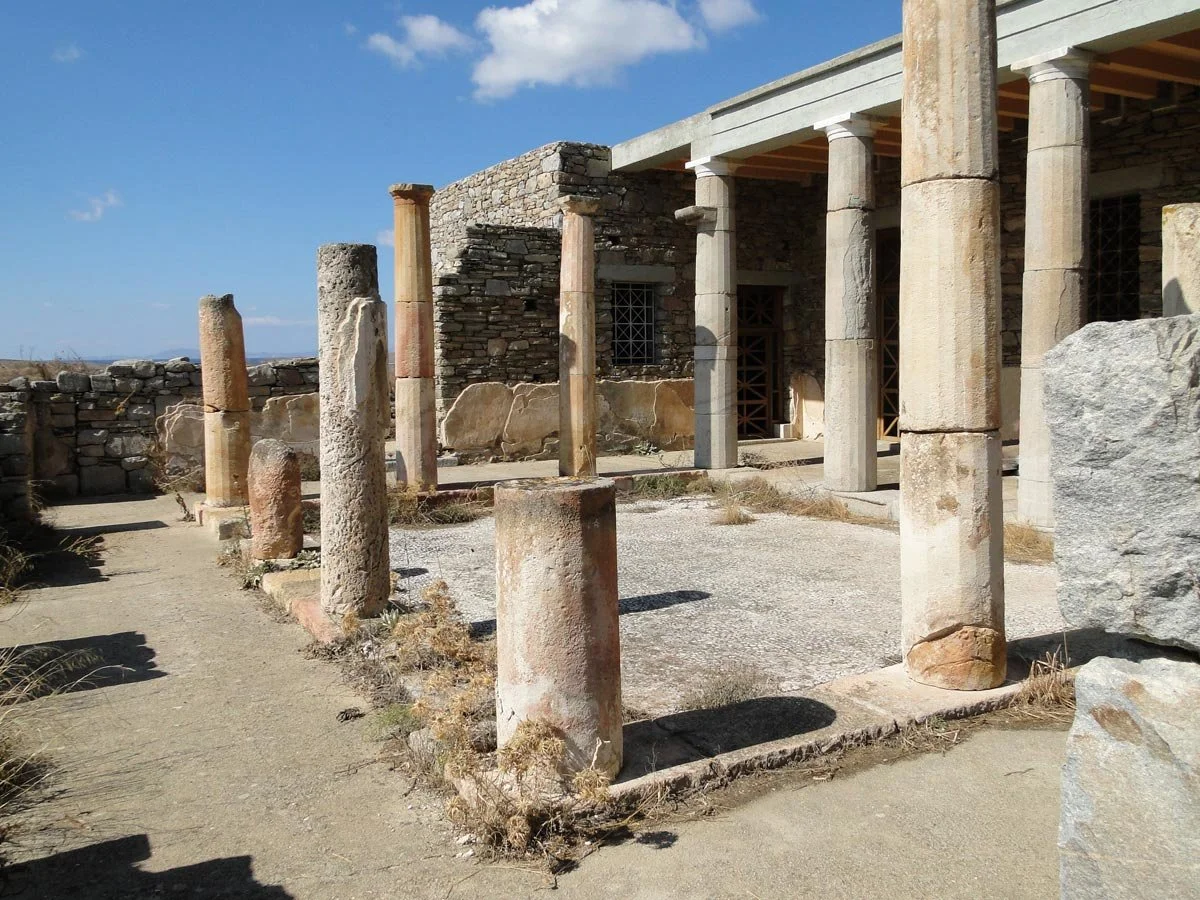
Courtyard of the so-called House of the Masks on Delos, where battered columns reveal how monumental design entered everyday Greek homes.
Daily life turns houses into workshops, pantries and small shrines
If we stay inside a Greek house for a full day in our minds, we quickly see it is not just a place to sleep. It is a workplace, a storeroom, and a religious micro-centre as well. Household production could be surprisingly varied: textile work, food preparation, animal care, small-scale metal or stone work, even aspects of pottery shaping or painting at some sites. Portable stoves, braziers and tools make it easy to shift these activities from dark rooms to the brighter courtyard when the weather cooperates.
Here, the objects you have already met elsewhere on the blog finally feel at home. Big storage jars and amphora vases might line walls or sit half-buried for stability. More refined pieces of Greek pottery appear at meals, or are tucked away until guests arrive. Oil lamps, wooden chests, baskets and simple furniture fill out the picture. Clothes and textiles, which you may have seen in our article on ancient Greek fashion, are not just worn but produced, repaired and stored in these rooms, with loom weights and spindle whorls turning up all over excavation plans.
Religion is woven into this domestic fabric rather than confined to big sanctuaries. Many houses seem to have small household shrines, perhaps near the door, in the courtyard, or beside a hearth, where offerings could be made to protective deities or to ancestors. These quiet rituals connect the oikos to the bigger system of ancient Greek religion: the same gods honoured in grand temples also receive bread, wine or incense in small corners at home. The house is not separate from the sacred landscape; it is a scaled-down, everyday version of it.
Once you see the house as an economic and religious node, it becomes easier to understand why Greek writers treat the oikos as the basic unit of the polis. Managing a household well is, in their eyes, a training ground for managing a city.
Houses plug into the bigger city, even when they hide
It is tempting to picture each house as a self-contained island, but in reality Greek domestic life is deeply entangled with the surrounding urban fabric. Houses pack into insulae (city blocks), share party walls, and open onto streets that lead to the agora, city gates or nearby sanctuaries. Excavations show rows of similar houses built together in some planned quarters, and more irregular clusters in older or poorer districts.
From this angle, an ancient house is one piece in the physical skeleton of the polis, alongside the public buildings you meet in our guide to ancient Greek structures and broader overview of Greek architecture. Temples and stoas frame collective life; houses host the smaller decisions about work, marriage, inheritance and alliances that give those institutions meaning. The same person might spend the day selling in the agora, attend a festival at a sanctuary, and then blow out an oil lamp in a cramped upstairs room, all within a few hundred metres.
At the same time, not all houses are equal. Some have larger courts, fancier mosaics or better access to light and breeze; others are squeezed into awkward corners or built against city walls. These differences reflect status and wealth, but also practical choices: living near busy streets might be good for trade and bad for sleep. Scholarship on households in Athens and other poleis shows that domestic and economic life often blur: workshops and homes overlap, especially in craft or trading families.
If we zoom out, Greek domestic architecture sits in conversation with earlier Aegean layouts, like the megaron-type houses you may have seen in Bronze Age contexts. Over time, as societies grow more complex, houses become more segmented and interdependent. That shift is not just about walls and doors; it is about new ways of organising labour, privacy and neighbourly relations inside the polis.
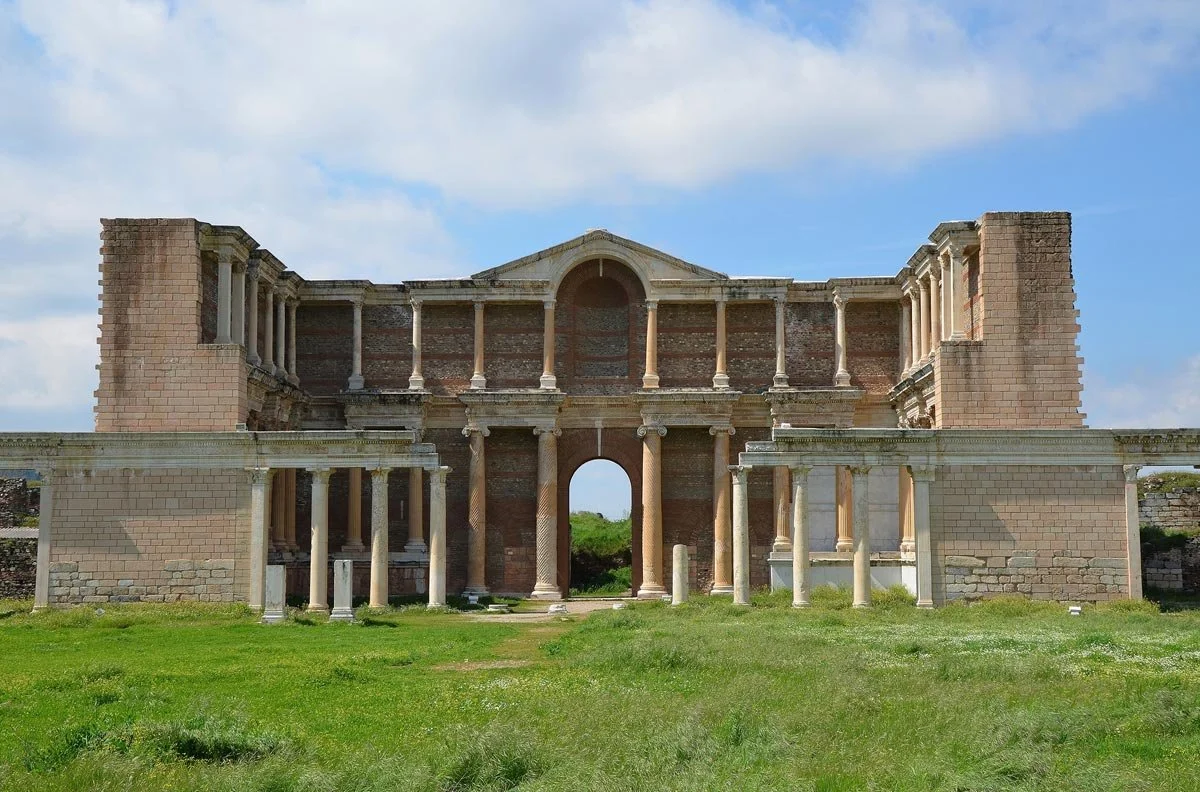
Ruined Roman gymnasium with a broad colonnaded courtyard. Although a public training complex rather than a house, its column-ringed open court echoes the layouts of Greek domestic courtyards on a far grander scale.
Conclusion
Walking through ancient Greek houses is a good reality check. Behind the temples and theatres we usually celebrate, there is a dense world of courtyards, back rooms, stairs and storage jars where people actually lived. We have seen how these houses turn inward for privacy, yet remain plugged into the social, economic and religious networks of their cities. We have also watched modern research soften old clichés about rigid “men’s” and “women’s” quarters, revealing a more flexible, negotiated use of domestic space.
If you keep this domestic lens in mind, other parts of Greek art history start to look different, too. Vase paintings become evidence for household work; floor plans echo ideas about gender and status; the oikos feels less like a background word and more like a lived reality. In the broader journey through ancient Greek art, coming home to these houses gives us a grounded sense of where all those styles and stories were actually unfolding.
You may also like