Ancient Greek Fashion: What People Actually Wore Every Day
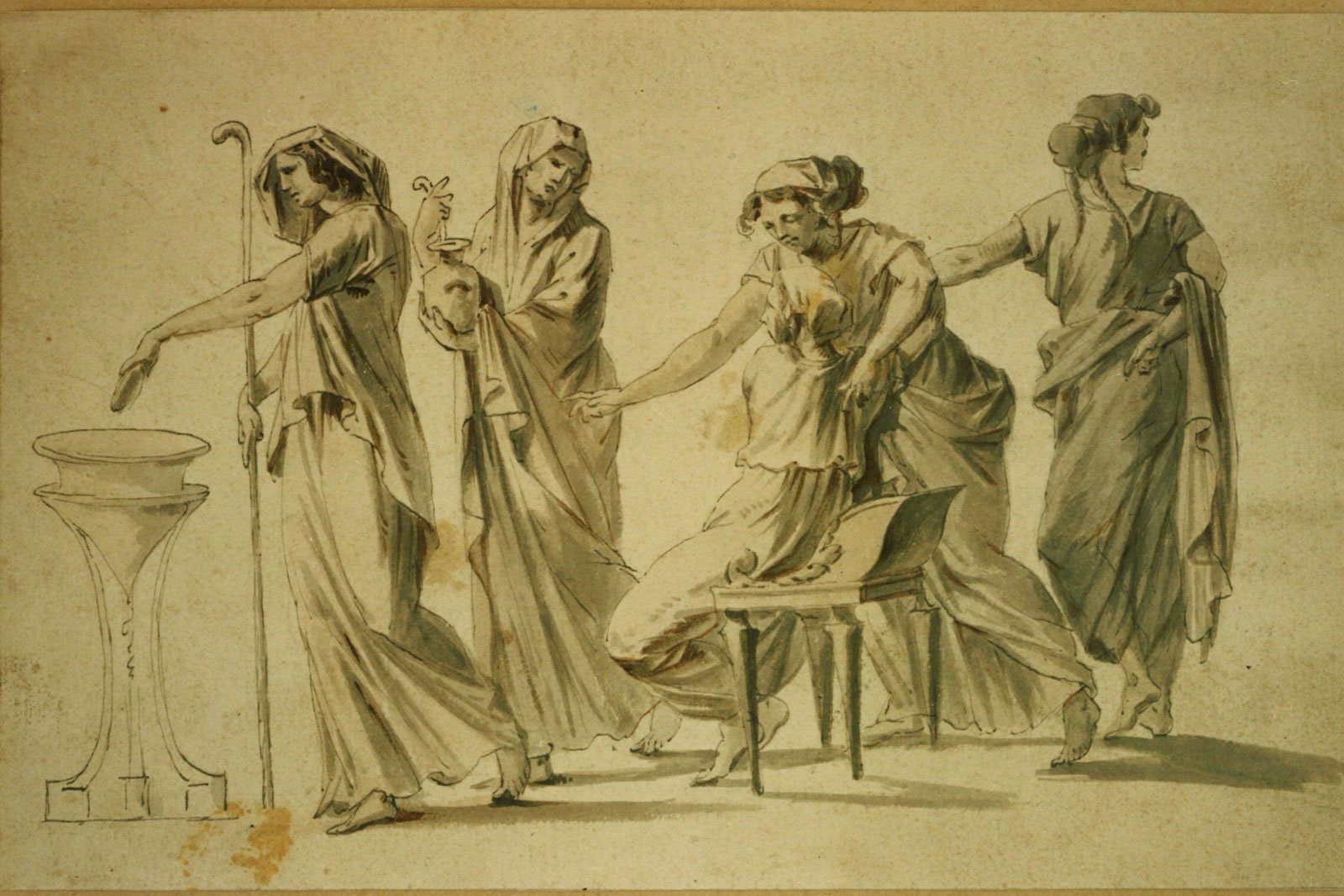
A studio sheet copying reliefs: the artist rehearses how draped women step, turn and pour libations, turning Greek ritual into neoclassical style.
When we think “ancient Greek fashion,” our brain usually goes straight to white marble: smooth, ideal bodies wrapped in perfect folds. The irony is that real Greek clothing was colourful, practical and often quite simple. Most people managed with a few clever rectangles of cloth, pinned and belted in different ways.
In this guide, we strip Greek dress down to its basics: chitons, peploi, himatia, hair and jewellery. The goal is not to memorise every variant, but to give you a toolkit so that next time you look at a statue, relief or vase, you can actually say “that is a chiton” and know what that implies about the person wearing it. We will keep jumping between the clothes themselves, the lives lived in ancient Greek houses, and how artists use dress choices in ancient Greek art.
Definition. Ancient Greek fashion is the clothing, hairstyles and accessories used by Greek-speaking communities from roughly 800 to 300 BCE in daily life, ritual and art.

Greek fashion starts from a rectangle of cloth
The best way to understand what ancient Greeks wore is to forget fitted garments and imagine fabric as architecture. Clothing is mostly made from rectangular pieces of wool or linen, wrapped and pinned rather than cut and sewn to the body. From that simple starting point, three core garments appear again and again.
The chiton is a tunic: a big tube or rectangle of cloth, folded and fastened at the shoulders, usually belted at the waist. It can be sleeveless or have short “sleeves” formed by a line of small fastenings down the upper arm. Men and women both wear chitons, with length and fullness changing according to gender, status and activity. A worker or soldier might wear a shorter, simpler version; a citizen at a festival might wear a longer, more flowing one.
The peplos is slightly different. It is also a rectangle, but it is folded down at the top to create an overfold (the apoptygma) that hangs over the chest and sometimes the hips. The cloth is then wrapped around the body and pinned at the shoulders. On statues like the Peplos Kore, that overfold is what gives the upper body its thick, blocky look. The peplos is strongly associated with women’s dress in the Archaic period, especially in more formal or ritual contexts.
Over these comes the himation, a cloak made from yet another large rectangle of cloth. Worn by both men and women, it can be wrapped around the body in different ways: over one shoulder and under the other arm, across both shoulders, or draped to create a kind of hood. If the chiton or peplos is your base layer, the himation is your coat, blanket, and social signal all at once.
Myth vs Fact
Myth: Ancient Greek clothing was mostly white.
Fact: Texts, sculpture traces and vase paintings show brightly coloured, patterned textiles; the marble whiteness is a modern illusion.
Once you understand that fashion is mostly about how rectangles are folded and fastened, a lot of images become less mysterious. You can see where the weight of cloth is, how the belt changes the silhouette, and how a cloak might be used to cover or reveal parts of the body depending on the situation.
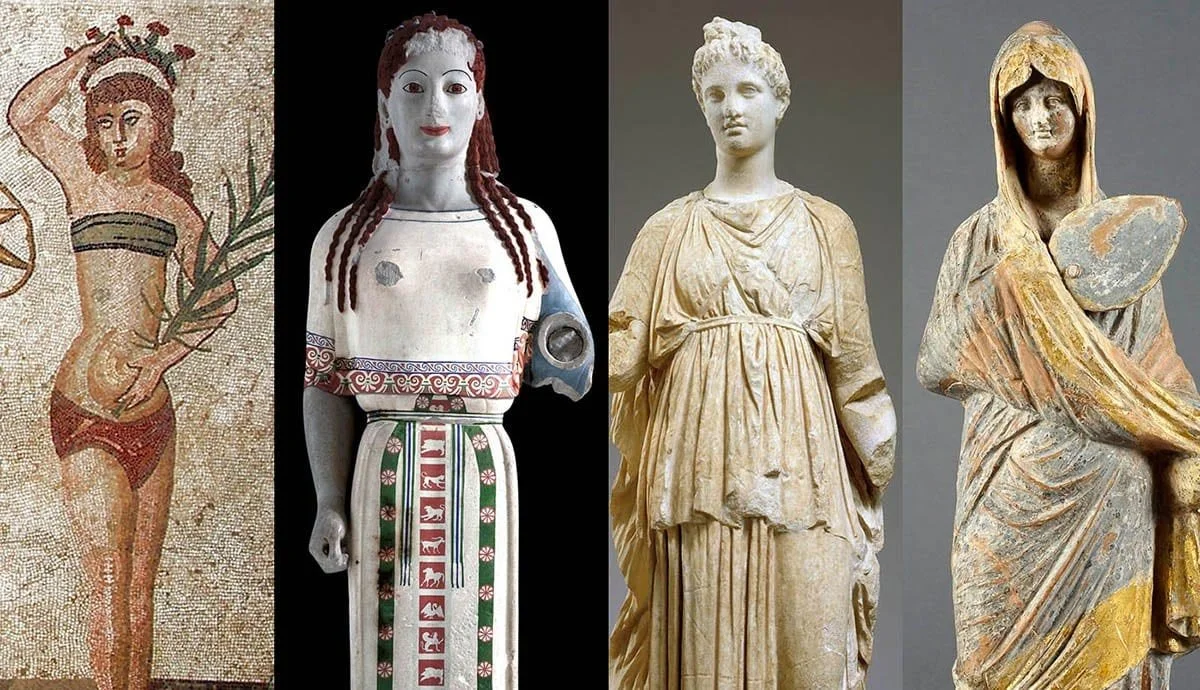
Comparison of ancient figures in paint and bare marble, a reminder that Greek and Roman statues were once alive with bright polychrome color.
Clothing quietly broadcasts status, gender and occasion
Even with this limited toolkit, ancient Greek fashion is not neutral. The way a chiton or himation is worn tells you a lot about who someone is supposed to be, and what they are doing.
Gender is a first layer. In many images, adult male citizens are shown with shorter chitons or even nude, especially in athletic or heroic contexts, while women are almost always depicted clothed, often in multi-layered outfits. On Archaic statues, we see this difference clearly: male kouroi stand nude, while female korai like the Peplos Kore are wrapped in thick garments and detailed jewellery. Gods follow similar patterns. In our guide to Greek god statues, you will notice that goddesses often wear complex layered dress and elaborate hairstyles, while some male gods appear partially or fully nude to signal heroic or ideal bodies.
Status and role show up through fabric quality, decoration and how “neat” the drapery looks. A carefully arranged himation with deep, even folds and perhaps a patterned border suggests someone with the time and help to manage their clothes, often a free citizen or deity. A shorter, hitched-up garment suggests work, travel or lower social rank. Slaves, labourers and some foreigners are often marked by simpler, tighter, or sometimes more revealing outfits. It is not that they had different garment names, but that the same garments are worn in more practical, less controlled ways.
Occasion matters too. Within the privacy of ancient Greek houses, clothing could be lighter, more informal, especially in hot weather. For rituals and festivals, people put on cleaner, better-arranged garments, sometimes with wreaths, special belts or jewellery. Religious rules might require specific dress for certain rites, especially for priestesses and other officiants, which ties fashion directly to ancient Greek religion.
All of this means that when we look at clothing in images, we are not just seeing “what people wore” in a neutral way. We are seeing choices about how to present bodies in relation to gender, rank and context.
Hairstyles and accessories finish the picture
Garments are only part of ancient Greek fashion. Hair, jewellery and small accessories do a lot of extra work, especially in art where colour has faded but outlines remain.
Hairstyles vary by period, gender and age. In Archaic art, women’s hair is often shown as long, patterned masses, sometimes with rows of braids or beads, while men might have longer hair and beards that gradually shorten and tidy up by the Classical period. Later, in Hellenistic works, curls and textures become more varied and individual. In everyday life, hair also responds to practical concerns: tied up for work, loose for certain rituals, covered at times for modesty.
Jewellery adds flashes of metal and colour: earrings, necklaces, bracelets, diadems, hairpins. On statues of goddesses or elite women, carved jewellery might once have been combined with real metal attachments and bright paint. On painted vases, jewellery is signalled with added white or yellow, tiny dots for beads, and patterns that indicate gold or patterned fabric. Inside ancient Greek homes, these pieces would have been stored carefully, brought out for special occasions and woven into family histories.
Footwear is simpler. Many scenes show people barefoot, especially indoors, at symposia or in religious contexts. Sandals and soft shoes appear more in images of travel or outdoor work. Cloaks, belts, pins and small bags complete outfits, but they rarely get named individually in our sources. What matters visually is how these details shift the silhouette and hint at texture, weight and social category.
When you put garments, hair and accessories together, you begin to see why clothing is such a rich resource for reading images in ancient Greek paintings and Greek paintings more broadly. A heavy, patterned peplos, a high, carefully arranged hairstyle and multiple bracelets say something very different from a simple short chiton, cropped hair and bare arms.
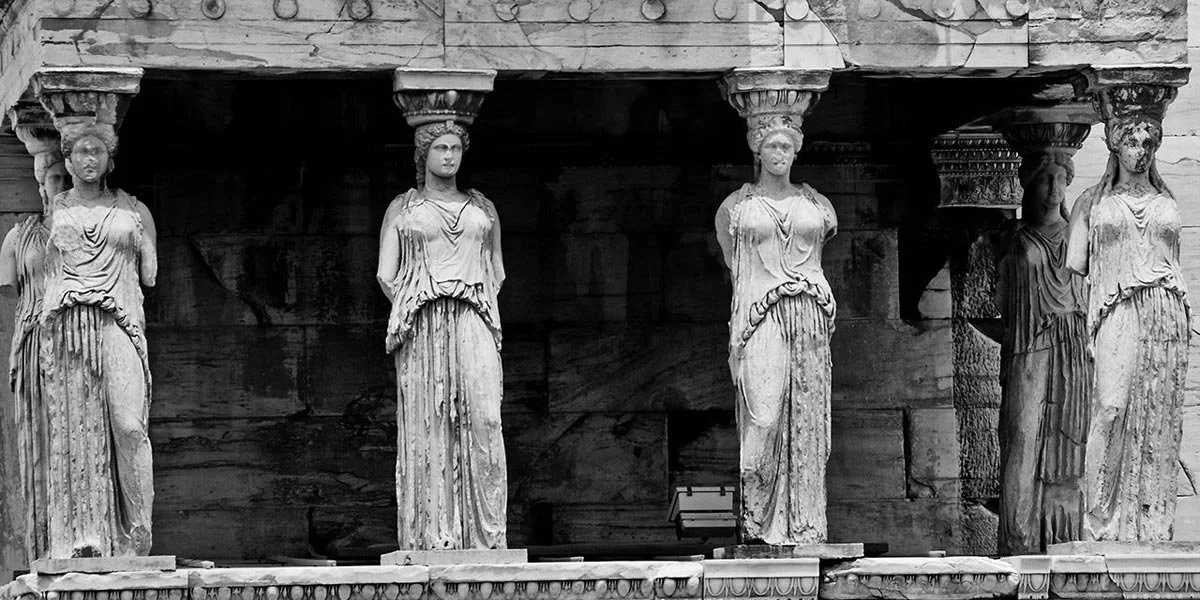
The famous Caryatids of the Erechtheion, where carved maidens stand in place of columns and blur the boundary between statue and structure.
How to read clothing details in Greek art
Most of what we know about Greek clothing history comes not from surviving textiles but from images: sculpture, reliefs and especially painted pottery. So learning to read fashion in art is almost the same as learning to read the art itself.
Sculpture gives us the most dramatic drapery. Marble and bronze goddesses and women often show the weight and fall of cloth in exaggerated folds, with wind-blown cloaks and clinging chitons that almost act like x-rays of the body beneath. Looking closely, you can often spot shoulder pins for peploi, belts cinching chitons, or the edge of a himation wrapped around the torso. Our article on ancient Greek art already follows how styles change from stiff Archaic to relaxed Classical. The clothing changes right along with the bodies, becoming looser, more natural, and sometimes more revealing.
Painted vases add something sculpture has mostly lost: colour and pattern. Black figure and red figure techniques use lines and added colours to show borders, checks, stripes and floral designs on garments. In everyday scenes, you can see workers in shorter, plainer chitons, women at home in longer dress, banqueters reclined with himatia wrapped around their shoulders. Religious scenes show special attire for priests and worshippers, linking fashion again to ancient Greek religion and ritual roles.
A good habit when you look at any Greek image is to ask three quick questions about dress:
How many layers are there? One short chiton, or a longer garment plus cloak?
Where are the fastenings and belts? At the shoulders only, at the waist, or higher under the bust?
What is the overall vibe? Work, ritual, leisure, status display?
Once you start answering those, the images stop looking generic. They turn into specific moments in specific lives lived in ancient Greek houses, streets and sanctuaries.
Conclusion
Ancient Greek fashion can look impossibly elegant from a distance, but close up it is reassuringly simple: a few big rectangles of cloth, well managed. We have seen how chitons, peploi and himatia form a basic toolkit, adjusted by belt height, fabric weight and how carefully they are arranged. Hair, jewellery and small accessories then tune the message further, signalling gender, status and occasion.
For me, the most useful shift is to treat clothing as a translation layer between art and real life. When you look at a statue or vase now, you are not just seeing abstract “drapery”. You are seeing choices made in workshops and homes about how to show bodies that moved through courtyards, climbed temple steps, or stood in front of altars. If you want to keep building that connection, you can pair this article with our deep dive into ancient Greek houses and our broader map of ancient Greek art, and start reading outfits as carefully as you read poses.
Next time you visit a museum, try a small experiment: stop in front of one Greek figure and identify the garments, the layers, the hairstyle, the jewellery. Then imagine the same person stepping off the pedestal and walking home through a noisy street. If you can picture what they are wearing in that moment, you have already unlocked a big part of how the ancient Greeks saw themselves.
Sources and Further Reading
The Metropolitan Museum of Art — “Ancient Greek Dress” (2003)
The Metropolitan Museum of Art — “The Chiton, Peplos, and Himation in Modern Dress” (2003)
Art Institute of Chicago — “Ancient Greek Dress: The Classic Look” (2022)
The Metropolitan Museum of Art — “Scenes of Everyday Life in Ancient Greece” (2002)
You may also like