What Is a Megaron?
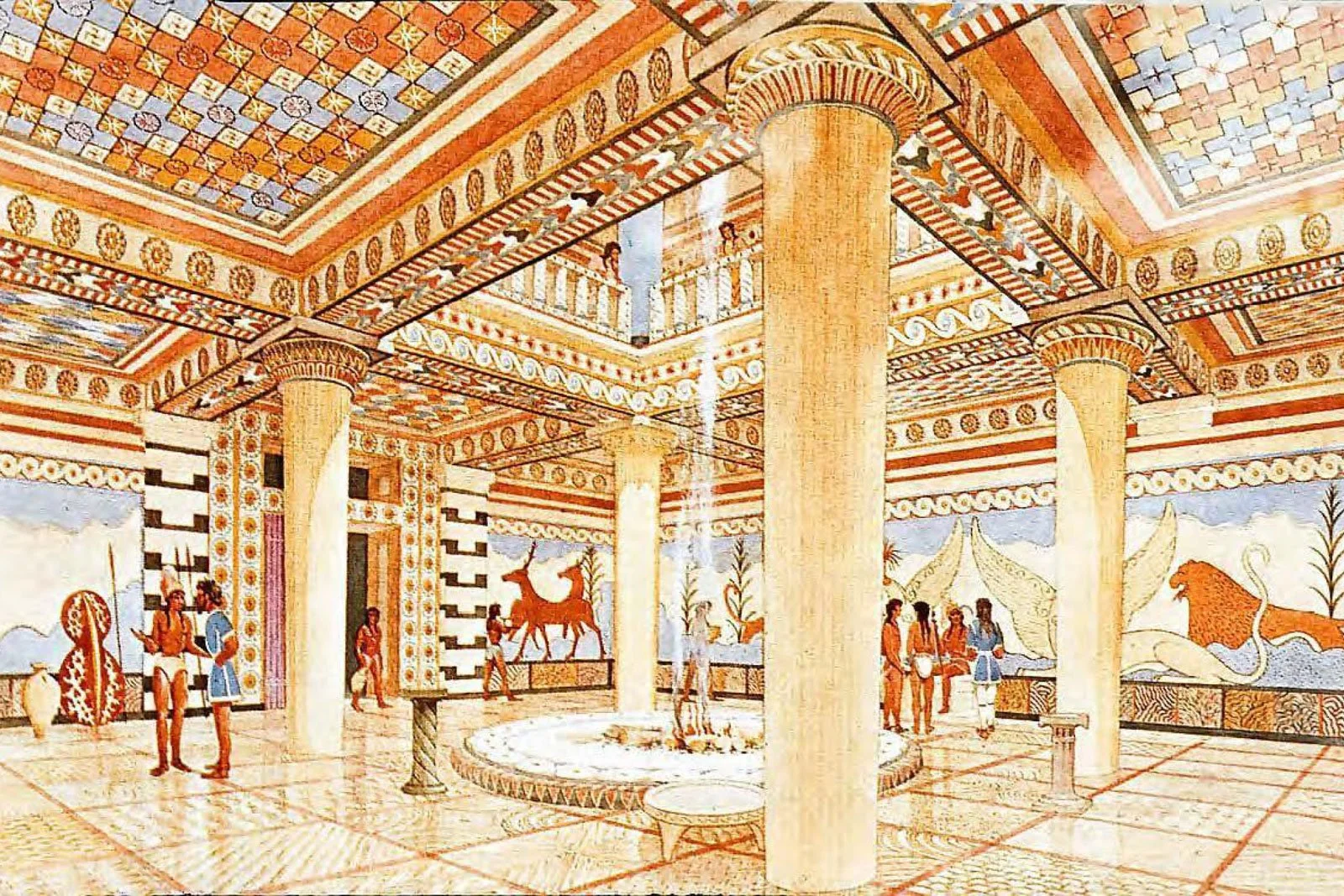
Reconstructions like this help us picture the megaron not as bare stone ruins but as a bright, frescoed hall at the heart of a Mycenaean palace.
If you walk into a Mycenaean palace, sooner or later you end up in one room that feels different from all the others. The air is darker, smoky. A round hearth burns at the centre of the floor. Four columns stand around it. On one side, a throne waits against the wall. You have reached the megaron.
This simple rectangular hall, with its porch, hearth and throne, is one of the most important building blocks of Mycenaean architecture and an ancestor of later Greek temples. Once you can recognise a megaron, Mycenaean palaces suddenly make a lot more sense.
Definition: A megaron is a rectangular great hall with a front porch, central hearth and throne area that forms the core of many Mycenaean and early Greek palaces.

What a Mycenaean megaron consists of
So, what is a megaron in practical terms. In most Mycenaean palaces it follows a similar, almost formula-like plan. You enter from a courtyard into an open porch with two columns between projecting side walls. Behind that is a small vestibule or anteroom. Finally, you reach the main hall: a long rectangular room with a circular hearth in the centre and four columns around it that help support the roof. Along one side wall, usually on the right as you enter, there is a raised platform for the throne of the wanax, the palace ruler.
This sequence porch–anteroom–hall gives the megaron a clear front-to-back axis. You do not step straight from outside into power. You pass a filter of small spaces that narrow the group, then the room opens again around the hearth. The roof probably had an opening above the fire to let smoke escape. Floors were plastered and sometimes painted with patterns. Walls carried frescoes showing processions, animals or mythic creatures, turning the room into a visual stage as well as a functional one.
Not every example is identical. Some early “megaroid” buildings lack one of the usual parts. Some later ones modify the porch or the number of internal columns. The megaron hall at Pylos, for instance, follows the tripartite pattern but has its own details in painting and proportions. Even with variations, though, the basic idea stays recognisable: a rectangular great hall with central hearth, fronted by a porch and approached along a short axis.
If you want to see how this hall sits inside a full palace, our explainer on Mycenaean architecture zooms out to the citadel, gates and surrounding rooms, and our guide to who the Mycenaeans were puts the people back into the plan.
What the megaron was used for and why it matters
Archaeologists see the Mycenaean megaron as a multi-purpose power room. Texts in Linear B from palaces like Pylos suggest that feasting, ceremonies, administrative gatherings and perhaps some cult activity all happened in or around this hall. The throne, central hearth and rich decoration all point to a place where the ruler appeared in a carefully framed way: seated to one side, near the fire and under painted symbols that linked him to wider religious or heroic stories.
At the same time, the megaron connects Mycenaean palaces to a longer architectural story. Rectangular long rooms with front porches already appear in earlier Aegean buildings. Later, in the Early Iron Age and Archaic period, similar hall types evolve into early Greek temples, with a porch in front of a main cella room that houses a cult statue. Many scholars see the megaron as one of the key ancestors of that temple plan: the hall turns from a throne room for a human ruler into a house for a god
In myth and literature, the word megaron survives too. Homer uses megaron to describe the main hall of Odysseus’ house in the Odyssey, where suitors feast and where Odysseus finally reveals himself. The poetry may not be a literal blueprint of a Mycenaean palace, but it remembers a world where social life focuses on a great hall with hearth, benches and a seat of honour. That memory helps link the archaeological remains of Bronze Age palaces to the stories later Greeks told about their heroic past
Conclusion
For a small word, megaron carries a lot of weight. It is at once a specific room type in Late Bronze Age palaces and a bridge toward later Greek houses and temples. Once you know that a Mycenaean megaron consists of a porch, a small fore-room, a main hall with central hearth and throne, you can start spotting it at sites like Mycenae, Tiryns and Pylos, and seeing how the rest of the citadel wraps itself around this core.
For The Art Newbie project, the megaron is a good reminder that “technical” terms are often just labels for lived spaces: places where people warmed their hands, listened to music, watched their ruler, or negotiated their status. Learn this one room, and you get a much clearer feel for how Mycenaean architecture organises power, comfort and spectacle. It is also one of the quiet links that carry Bronze Age building ideas forward into the familiar stone temples that most of us picture when we hear the phrase “ancient Greece.”
Sources and Further Reading
You may also like