What Is an Amphora Vase? A Quick Guide to This Greek Icon
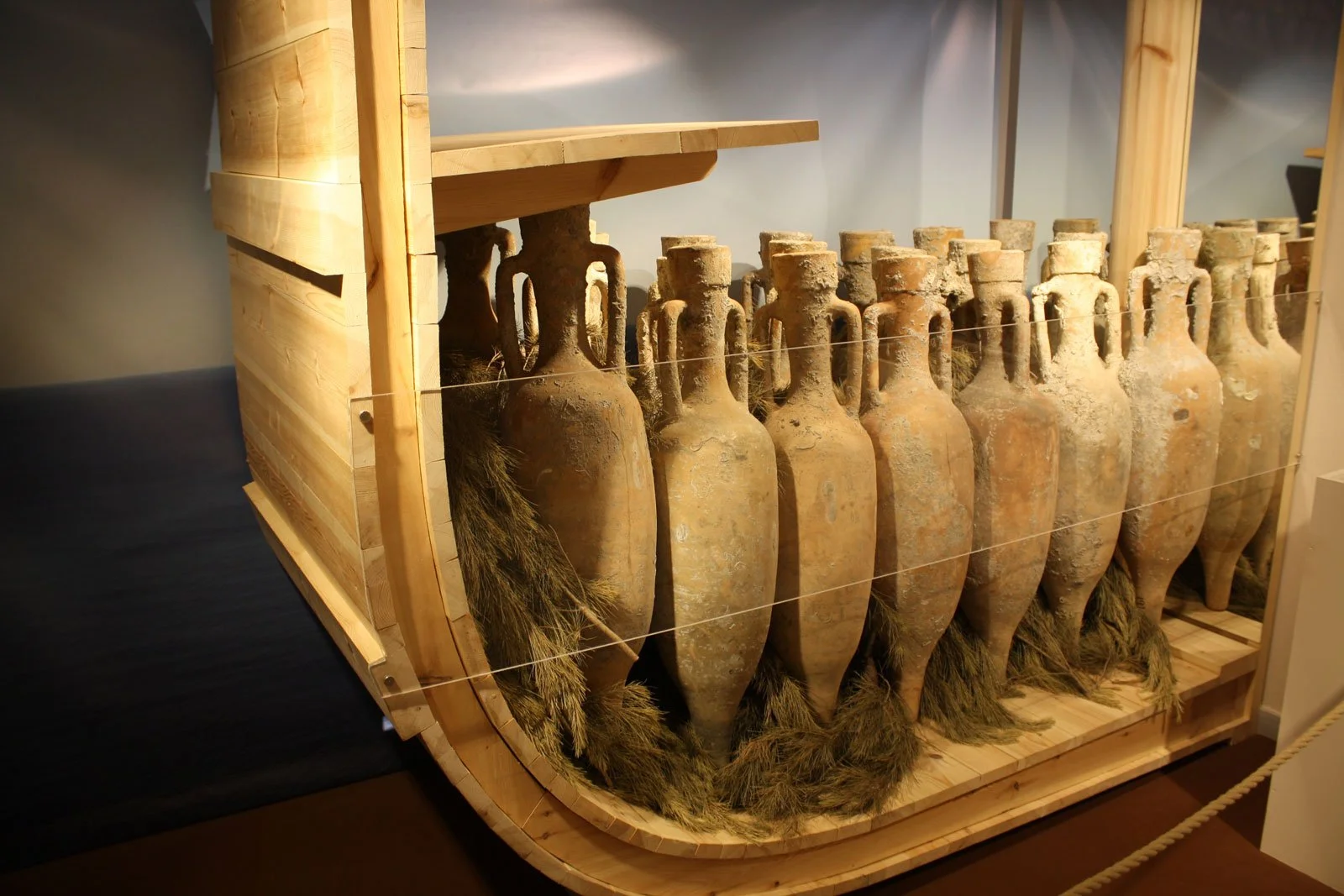
Stacks of amphorae in this reconstructed hull hint at the skill needed to pack a ship, balancing weight, fragile clay and the slow roll of the sea.
If you’ve ever walked through a Greek gallery and thought, “Why are there so many vases with two handles and a pointy bottom?” you’ve already met the amphora. It’s one of those shapes that keeps coming back: in museum cases, textbook diagrams, even modern design objects that quietly quote its silhouette.
In this quick guide, we’ll keep it simple: what an amphora vase is, what its shape tells us about how it was used, and how it fits into the bigger picture of Greek pottery, trade and storytelling. By the end, those “generic” jars will start to look like very specific tools, both for daily life and for painted images.
Definition
An amphora is a two-handled storage and transport jar, usually with a narrow neck and often a pointed base, widely used around the ancient Mediterranean.

What an Amphora Vase Actually Is
A good way to start is to imagine the amphora as the standard container of the ancient Mediterranean. Before bottles, cardboard boxes and shipping containers, you had clay jars, and the amphora was the star of that system.
In plain terms, an amphora is a tall jar with two handles and a narrow neck. Those handles sit on opposite sides of the vessel, rising from the shoulder to the neck, so that one person (or sometimes two) can grip and pour. The neck is slimmer than the body to control the flow of liquid, and the body swells out to hold as much as possible without becoming impossible to lift.
Most Greek amphorae are ceramic, wheel-thrown from terracotta clay, then fired. Some are plain, used purely as packaging for wine, olive oil or grain. Others, especially those from Athens, are part of the painted world of Greek pottery, where the amphora shape becomes a canvas for myth scenes, athletic contests or everyday life.
You’ll also meet different subtypes. A “neck amphora” has a neck that meets the body at a clear angle; in other versions the curve is smoother and the neck flows out of the body in one continuous line. Both still count as amphorae. What matters is the basic kit: tall jar, two handles, relatively narrow mouth.
Shape, Handles and How It Worked
The amphora shape isn’t just aesthetic; it’s engineered for moving goods.
The two vertical handles make sense immediately: someone has to carry this thing. Full of wine or oil, a large amphora can weigh dozens of kilos. Grabbing one handle with one hand and supporting the base with the other gives you some control, especially when pouring. In scenes on Greek vases, you sometimes see servants tipping amphorae while others hold smaller cups or jugs ready to fill.
The pointed base, which looks impractical at first sight, is actually brilliant. On a ship, amphorae could be stacked in rows, their pointed ends sinking into a layer of sand or into special racks so they wouldn’t slide around. On land, the same pointed base could be planted into soft ground or into a stand. Archaeologists often find entire shipwrecks where hundreds of amphorae are still stacked like a honeycomb.
Surface details also talk about function. Trade amphorae can carry painted or stamped inscriptions with information about contents, origin or weight, turning each jar into a label you can read. More luxurious, painted versions, especially in the black-figure technique you’ll meet in Greek black-figure pottery, are meant to be looked at as well as used: they can serve as prizes, grave markers or offerings, not just storage jars.
All of this means that when we look at an amphora in a case today, we’re not just seeing “a vase”; we’re seeing a piece of logistics design, tuned to shipping routes, table rituals and even tax systems.
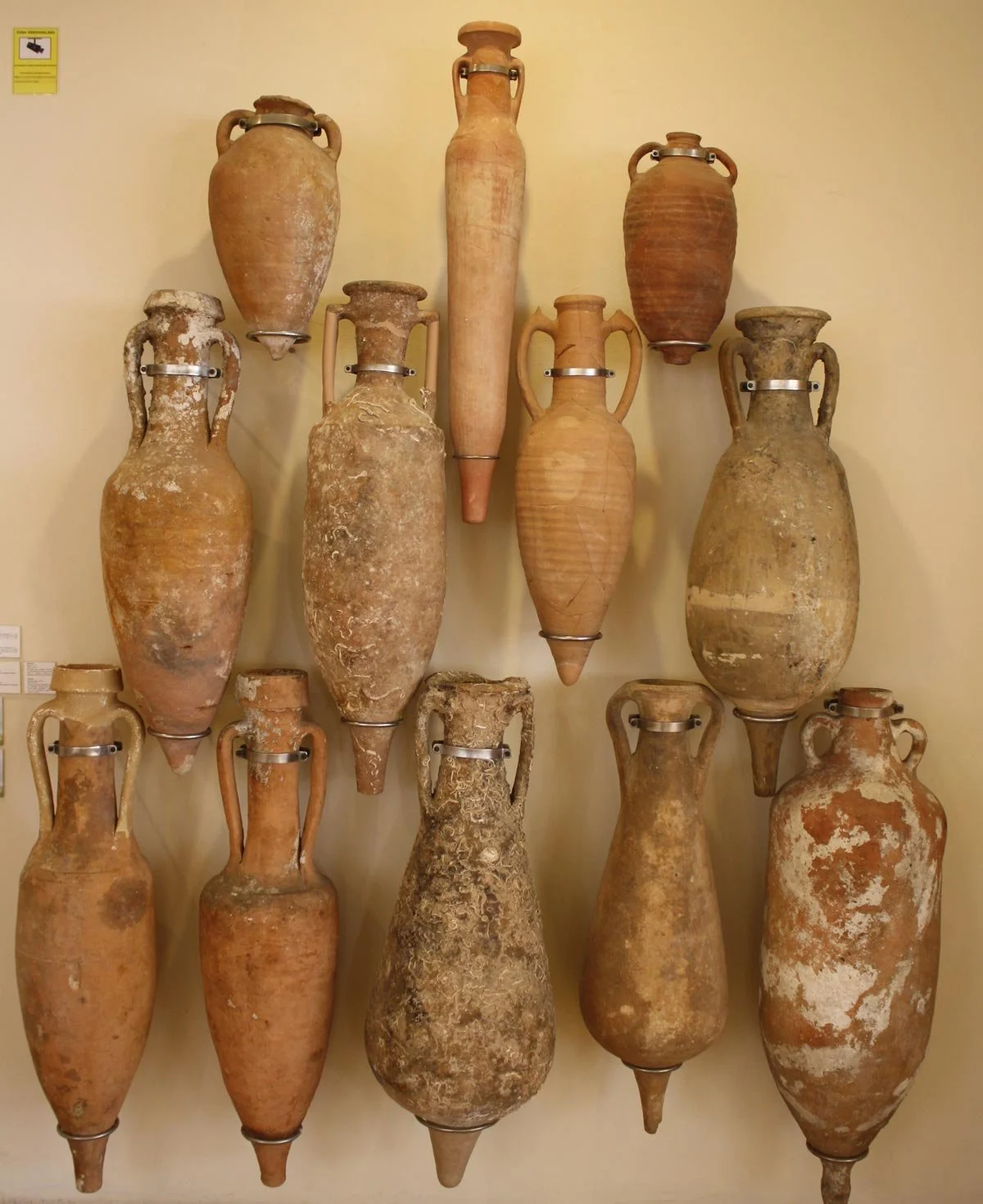
A cluster of slender amphorae forms a sculptural pyramid, reminding us that everyday trade once moved in these clay containers.
From Storage Jar to Greek Art Icon
So why does the amphora feel like such an icon of ancient Greek art?
First, because it sits at the meeting point between everyday life and imagery. The same object that carries olive oil to a household can also carry painted scenes into that household. On some amphorae, myth and reality literally wrap around the same volume: warriors marching around the belly of a vessel that once travelled with soldiers, or banquet scenes painted on jars that stood near actual drinking parties.
Second, the amphora shape becomes a stable frame for experimentation. Artists can play with composition, fitting bands of ornament or narrative scenes around the curved body. If you’ve looked at early Greek pieces like the Geometric Dipylon amphora, you’ll have seen how the whole surface can turn into rings of pattern and tiny figures. Later, in classical Athens, amphorae may show athletic events, gods and heroes, or even very specific prize inscriptions, while still staying recognisably “amphora”.
Finally, amphorae link Greek art to a bigger Mediterranean story. They turn up in shipwrecks, coastal warehouses and domestic spaces across the region. When you see one illustrated in a textbook next to a city plan or a scene of ancient Greek houses, you’re being reminded that images don’t float in a vacuum; they travel on clay, along trade routes, into new contexts.
Next time you meet an amphora, try to read both its shape and its story. What would it have carried? Who handled it? And what did the painted scenes mean to the people who turned this shipping container into a storytelling surface?
Conclusion
An amphora vase is one of those deceptively simple things that pulls a lot of threads together. It is a tool for storage and transport, a carefully engineered form for stacking and pouring, and, in the Greek world, a favourite support for painted narratives that give us a rare window into daily life, myth and identity.
For us, learning to recognise the amphora — its neck, its handles, its pointed base — is like learning a basic word in a new language. Once it clicks, other things start to fall into place: shipping diagrams, excavation photos, and scenes on more elaborate Greek vases suddenly look less random and more connected.
If you want to keep building this “vocabulary” of ancient objects and spaces, we’ll keep unpacking them together, one clear term at a time.
You may also like