Ancient Greek Structures: Temples, Theatres and City Walls
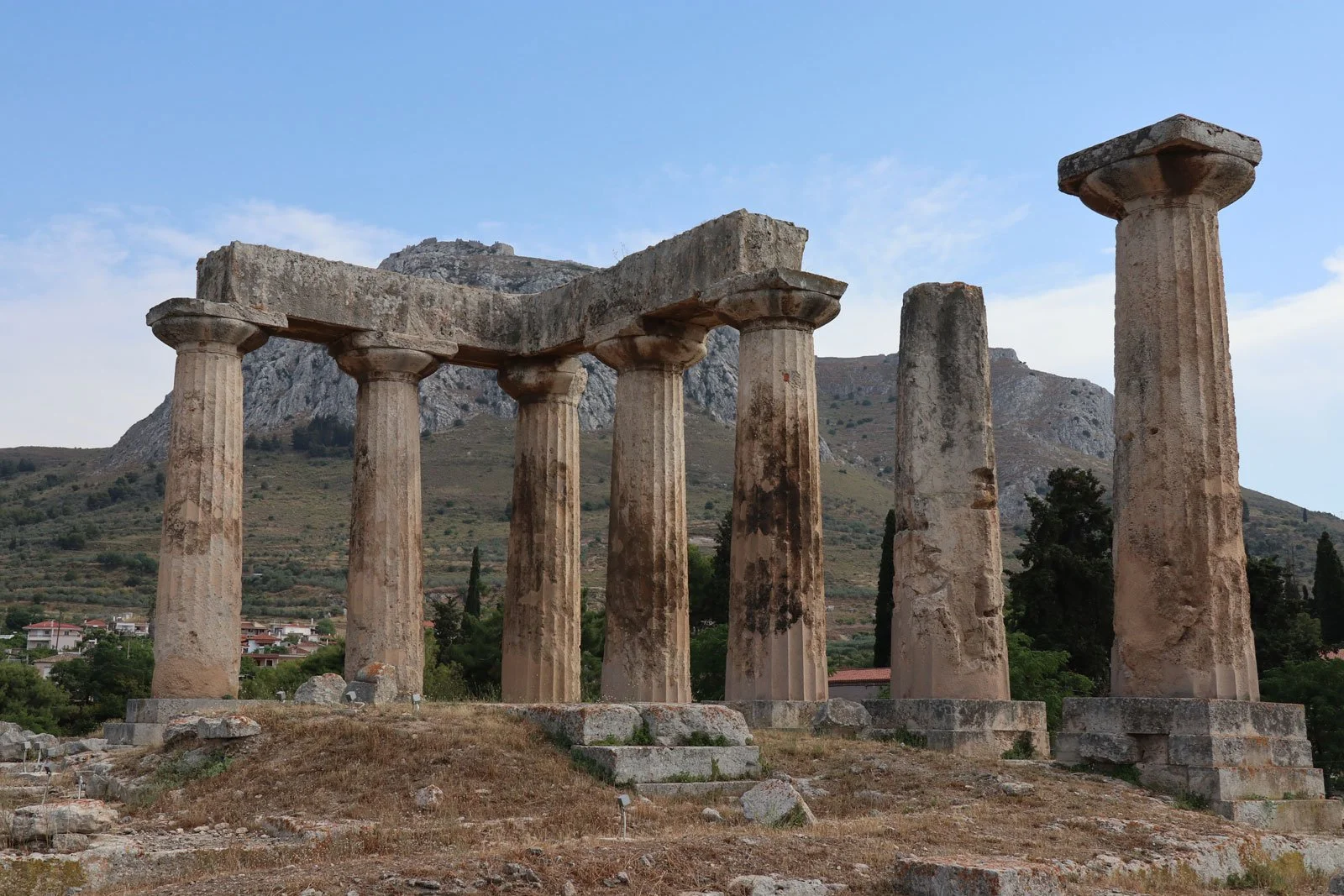
The Archaic Temple of Apollo at Corinth preserves some of the earliest heavy Doric columns in mainland Greece.
If you could fly over a Greek city-state and strip away the trees, you would see a very clear skeleton: a walled hill with temples on top, a crowded centre with stoas and fountains, a hollow for the theatre, a strip for races, houses packed in blocks. Ancient Greek structures are not random ruins; they are a checklist of what a polis needed to worship, argue, train, trade and survive.
In this guide we treat buildings as clues. By walking through temples, theatres, stadiums and city walls, we will piece together how Greek communities organised their lives in stone. If you want a broader style overview in parallel, you can keep our map of Greek architecture as a whole open, or jump later to specific tours like the Greek temple layout or our explainer on ancient Greek houses.
Ancient Greek structures are the main building types used in Greek city-states, such as temples, theatres, stadiums, stoas, houses and fortification walls, built roughly between 800 and 30 BCE.

Ancient Greek Structures Map What a City Needed
A good starting question is simple: if you say “ancient Greek buildings”, what types are you actually thinking of? Usually we picture a temple, maybe a theatre, perhaps some broken columns on a hill. In reality, a functioning polis needs a whole kit of structures.
On most ancient Greek city-states you will find at least:
an acropolis, the fortified high point with key shrines
an agora, the central open space for markets and politics
religious buildings (temples, altars, treasuries)
civic structures (council houses, stoas, law courts)
performance and sports facilities (theatres, stadiums, gymnasia)
defensive works (city walls, gates, sometimes long walls to the harbour)
residential districts with houses and workshops
Each type solves a different problem. Temples focus worship. Theatres create a shared audience. Stadiums host athletic games that double as political theatre. Walls protect people and crops. Houses and streets deal with daily life in between festivals and wars. When we zoom out, ancient Greek structures together draw a map of what a community thought was essential.
This is why your mental ancient Greek map matters. Once you know where the acropolis sits relative to the agora, where the theatre cuts into the hill, how the walls loop around all of it, ruins stop being isolated photo spots. They become parts of a working system.
So, instead of memorising a list of building names, we will move through this system in three big zones: sacred space, performance and sport, and defence plus everyday life. That way, each structure can be read both on its own and as part of a larger urban skeleton.
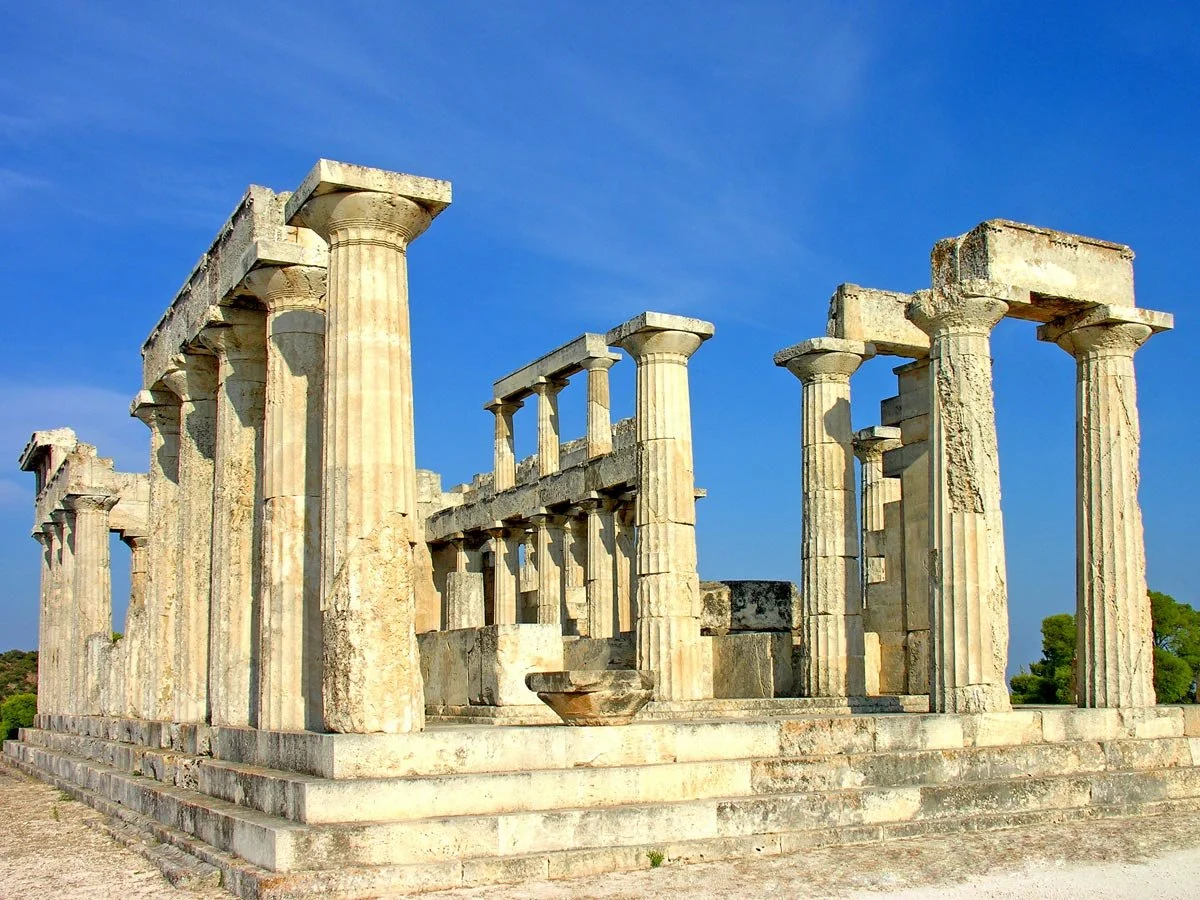
At the sanctuary of Athena Aphaia on Aegina, a fragmentary Doric temple still stages light, sky and stone.
Temples Turn Religious Focus into Stone Landmarks
If you want to understand Greek priorities, start with the temple. It is the most visible of the ancient Greek structures, even though most rituals actually happen outside at an altar. The temple’s main job is to mark where a god “lives” and to frame the space around that point.
Architecturally, the core is the cella (or naos), a rectangular room housing the cult statue. Around it, Greek builders layer structure like clothing: first walls, then a porch, then a full ring of columns on a stepped base. Our dedicated walkthrough in Greek Temples: How the Ancient Greeks Built for Their Gods breaks this sequence down from the first step to the inner room. Here, we focus on what that structure does.
The steps raise the building and slow your approach. Columns create a shaded perimeter that lets people circle the shrine, leave offerings and read sculpted details. The entablature and pediments, sitting above the columns, carry carved scenes that project the city’s chosen myths to anyone approaching the sanctuary. Even if you never enter the cella, you read the god’s presence through this shell.
Temples also inherit and transform older forms. The long hall and porch of the megaron in Bronze Age palaces reappear in temple plans, now translated into stone and multiplied across the Greek world. Column types help signal regional flavours. Doric temples, which we unpack more in our guide to Greek column types, tend to feel heavier and more austere. Ionic temples often look taller, with more slender shafts and scroll-like capitals.
Most importantly, temples work at several scales at once. Up close, they choreograph bodies through steps, porches and side aisles. From far away, they punctuate the skyline, especially when placed on acropoleis. On a full ancient Greek map you can usually spot the main temple complex first and then read the rest of the city around it. Sacred architecture becomes orientation device, political symbol and art gallery in one structure.
Theatres, Stadiums and Stoas Turn Space into Gathering Machines
If temples show how Greeks related to gods, theatres and stadiums show how they related to each other. These ancient Greek buildings turn landscape into a kind of social machine.
A Greek theatre is usually carved into a slope. The seating area, the theatron, wraps around a circular or semi-circular orchestra, with a simple stage building, the skene, behind it. This layout, which we explore in the wider context of Greek architecture, uses natural terrain rather than heavy substructures. The result is excellent acoustics and clear sightlines with relatively modest masonry.
Theatre is not just entertainment. Plays are performed during religious festivals and tackle themes of justice, power and fate. So the theatre is both sacred and civic: it belongs to Dionysus and to the democratic conversation of the city. You can almost read it as a stone diagram of Greek public life: one person speaks or sings, the chorus responds, and a large audience watches and judges.
Stadiums work on a similar principle but for bodies in motion. A stadium is a long, narrow track, often with simple seating cut into the hillside. The best known example is the stadium at Olympia, mirrored later in urban versions like the Panathenaic stadium in Athens. Here, Greek theatres and stadiums together host the festivals that knit a city or a wider Greek world together: athletic competitions, processions, sometimes even political announcements.
Stoas add another layer. A stoa is a long, roofed colonnade, often lining one side of an agora. Architecturally it is simple: a row of columns, a back wall, sometimes a second interior colonnade. Socially it is huge. Stoas create shade in hot summers, cover in winter, and flexible bays for merchants, scribes or philosophers. In our broader overview of Greek architecture we treat stoas as the “indoor streets” of the city centre.
Together, these structures show that Greek architecture is very good at modulating how crowds behave. Theatres concentrate attention on a central point. Stadiums stretch experience into a long corridor. Stoas encourage drifting, browsing and small discussions. When you combine them around an agora and under the gaze of nearby temples, you get a city centre that is constantly teaching people how to gather, watch and talk.
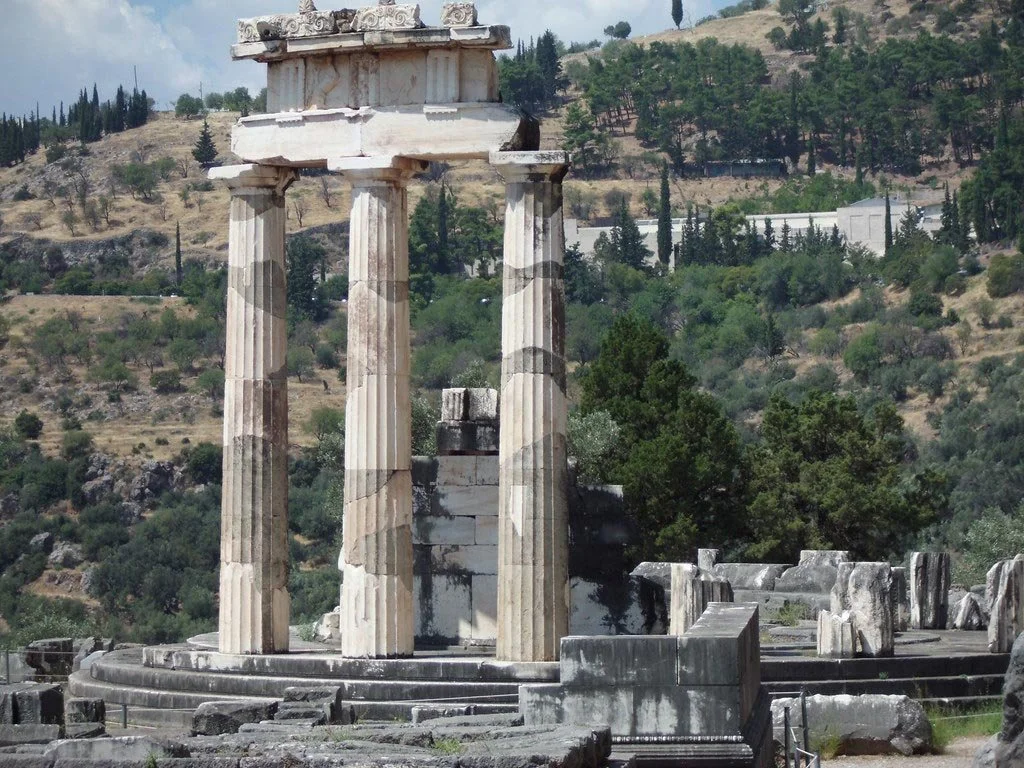
The tholos at Delphi, a mysterious round building whose surviving columns frame views toward the Parnassus landscape.
Walls, Streets and Homes: The Hidden Skeleton of the Polis
It is easy to fall in love with temples and theatres and forget that most Greeks spent their days in more modest spaces: houses, workshops, streets pressed against the inside of defensive walls. These structures are less photogenic, but they tell us how a polis actually lived.
City walls are the hard outer line of many ancient Greek structures. Built in stone, often reforged and patched over centuries, they protect people, wells and farmland from raids. Walls follow the terrain, rising to enclose an acropolis and then looping down to wrap the lower town. Gates concentrate traffic and can be heavily fortified, with towers and dogleg passages. Long walls, like those that once linked Athens to its ports, even extend this defensive skin along narrow corridors. When you trace these lines on an ancient Greek map, you see at a glance what a city considers worth shielding.
Inside the walls, streets and houses fill the gaps between the big monuments. A typical house is organised around an internal courtyard, which we explore more in our guide to ancient Greek houses. Around this open space cluster rooms for storage, sleeping, cooking and sometimes formal dining. The street façades are usually plain. Life happens inward, in the semi-private microclimate of the courtyard. This pattern repeats block after block, giving the city a dense but surprisingly introverted fabric.
This everyday layer matters even for more spectacular structures. Roads from city gates angle toward the agora and key sanctuaries. Processional routes for festivals weave past houses and under gates, linking neighbourhood life to grand rituals. Athletic teams run from gymnasia through city streets to stadiums. In some poleis, especially those that adopt more regular grids, the alignment of streets, walls and major buildings reveals careful planning rather than organic growth.
Seen in this light, Greek defensive walls are not just military hardware. They are the outer frame of a network of streets, houses, shrines and civic buildings that hang together as a single organism. The same culture that painted leaping bodies in Minoan bull-leaping scenes eventually shaped whole cities where movement, risk and spectacle are carefully controlled by stone lines.
Conclusion
Ancient Greek structures are often introduced one by one: a famous temple here, a perfect theatre there, a stretch of wall with a nice view. Once we treat them as a coordinated set, the picture changes. Temples and their peristyles crystallise religious focus on hilltops and in rural sanctuaries. Theatres, stadiums and stoas carve out stages for performance, sport and slow everyday conversation. Walls, streets and houses knit everything together into a defensive, lived fabric.
Having this structural map in mind simplifies everything else you will meet in Greek art and architecture. When you look at a photo or a site plan, you can ask: which part of the kit is this? A religious core, a performance hollow, a market edge, a defensive line, a domestic pocket? Our guides to Greek architecture, the Greek temple, and the world of ancient Greek city-states are there to deepen each piece without losing the whole.
Next time you visit a ruin, try a small exercise. Stand still, turn slowly, and imagine the missing elements: the wall line, the theatre curve, the stoa depth, the house roofs on the slopes. You are, in a way, doing what ancient planners did: projecting a web of structures that lets a community worship, argue, trade, play and sleep behind stone boundaries. That web is the real achievement of ancient Greek structures, and it is still quietly shaping how many of our cities feel today.
You may also like